The reason for writing
"Sharing my writing journey and the reasons for writing. Also, an update on de-Googling my life."
Welcome to my free newsletter. Stay up to date with all my latest writings and ramblings. Wherever curiosity takes me.
I’ve been writing quite a bit lately and it feels great. Best of all, my son has been writing a lot too and it’s been so much fun to read our short stories and poems to each other. It’s been really special to see him blossom as a writer, to see the wealth of ideas that he has, to see him having real fun creating stories and to share each other’s words.
A lot of what I write is personal. So personal that it’s mostly just for me and I only share it with very few people. Then there are some things that I like to put in zines. I usually publish them under a pseudonym and share just a few copies. Hopefully, my words mean something to someone else, hopefully it makes them reflect on something, or moves them. But I like to do that in zines, with anonymity and no pressure.
I’ve always been a writer. From those early short stories railing against know-it-all adults, to my teen poetry, overflowing with emotions as I found my own voice and identity, to scripts that emulated (mostly unsuccessfully) some of my greatest idols, my long rambles trying to make sense of the world and, hopefully, more thoughtful pieces too.
Every person will have a different reason why they feel the need to write or create something. Writing, for me, is the breeze that whisks away the storm clouds. It’s the inquiring mind that explores different ways of living and understanding, finding some answers and, more interestingly, bringing to light new questions and mysteries.
I remember I started making my own stories and shows when I was about five years old. I didn't write them, I'm not even sure I could write at that age (I very stubbornly refused to learn to read and write until very very late, much to my parents' frustration, anger and despair) but I could talk incessantly and my imagination needed an outlet.
We didn't have a video or film camera but we had something equally as exciting for me. My father had a Nagra audio recording device at home. Apparently, he had borrowed it from a friend to record a couple of interviews and a union panel talk. Then, his friend moved away and the Nagra stayed in our cupboard, gathering dust, until I found it and figured out what it was.
The Nagra and I became inseparable. I did some serious interviews with my friends and family pretending to be well known sports people, highly acclaimed actors and rock stars. I remember an interview to a rock star who had sold more records than The Boss. He (played by one of my friends) wanted to talk about music but all I wanted to talk about was how good his drummer was. The beating heart of the band. The conversation went in circles as he became more and more exasperated that I was not interested in him. I remember it being funny. At least at the time.
I also created scenes and radio serials with my friends. We parodied our families and the people we saw on TV. And, sometimes, when none of my friends were around I created comedy gags with myself doing several different voices.
That period, starting from about 5 years old to about 8 years old, I felt free to express whatever I wanted and I became addicted to that feeling.
Then there was the period when I started experimenting with short stories. The story that I always remember was about a group of knights sent by the king to a dragon's lair to save the princess, who had been kidnapped. I don't remember much of how the story went, I know there was some thief who was also attempting to enter the lair to steal the dragon’s treasures. What I do remember, quite clearly, is the princess being angry with the knights for thinking she needed saving. She was not kidnapped, she didn’t need saving, she had befriended the dragon while the knigths were terrified by the creature. Sadly, I lost the story long ago.
During those early years, I created stories simply because it was fun and because it allowed me to enter other worlds but in my teens it was a way to release my anger, my frustration and inner turmoil. Creation became my own therapy, particularly in the form of poems and lyrics for songs that were almost never put to music. A few ended up as songs that I recorded in my bedroom. Demos that never got anywhere. One, The Castle of Lost Souls, was turned into an awesome, epic song by a heavy metal band from my hometown.
In my mid-twenties, my views on the creative process and the creation of art evolved once more. I was reading a book by Alejandro Jodorowsky where he spoke about the purpose of art being to heal. I realised that my creations could not and should not just serve to heal me, but also to heal others. Of course, the word heal, is used loosely. Only Jodorowsky knows exactly what he meant but I take his words to mean that the purpose of creating art should be positive and constructive.
Now, when I write, I totally surrender myself to the process. The process is what I cherish and enjoy the most. Working out what I'm trying to say and why I'm, actually, doing that. Letting myself go down paths, crannies, valleys and peaks that I never thought I could reach. Putting myself in the head, the shoes, the world, the lives, the eyes, of other people, exploring their experiences and seeing what I can learn from them.
Is the finished writing important? Perhaps.
I enjoy printing them and knowing that someone else may read them and I’m helping my son print his story so he can share it with his friends, who are not only interested in reading it but, also, willing to pay a few bucks for a printed version of it. But the best part is that process of exploring ideas, putting words to paper, figuring out how they come together to create a poem, a story or a screenplay and I’m glad that my son feels the same way.
In the current environment, as we see more and more books (and art) generated by people using AI, as we see more people who feel like they want to tell a story but then offload the process of creation to AI, it’s more important than ever to remember that we’ve been telling stories tens of thousands of years.
When we don’t understand something we try to make sense of it with a story.
When we want to reassure or bring comfort to someone we read poetry.
When we cower in fear and long for hope, we tell a story.
When we’re grieving the loss of someone we love, we try to make sense of our emotions with poetry.
It’s in art and storytelling that we explore the unknown, attempt to make sense of what is foreign to us or beyond our grasp. It’s in art that we express who we are and who we would like to be, our identity, our values, our culture.
And, I just can’t fathom, why we would let a piece of code, an algorithm, a set of probabilities, produce stories, poems, songs, comics, art...
AI might be able to string sentences together or to produce some art through a set of probabilities. But AI cannot have new insights, cannot have empathy, cannot be creative. There is no thought behind it and no heart.
DE-GOOGLING MY LIFE
I have been gradually de-Googling my life. It’s taking a while, longer than I hoped for, but I’m getting there. In fact, I’m quite close to totally abandoning Google (except for Google Drive, for a couple of groups that I’m involved with).
Using Google back in the day made sense. It was easy, convenient and reliable. It worked. Those were simpler days when the promise of the internet was still alive, before it all got commercialised and enshitiffied.
Check out these two screenshots from Google’s page back in 1999 explaining the reasons for using Google (courtesy of the Wayback Machine and Annie Rauwerda’s Bluesky thread).
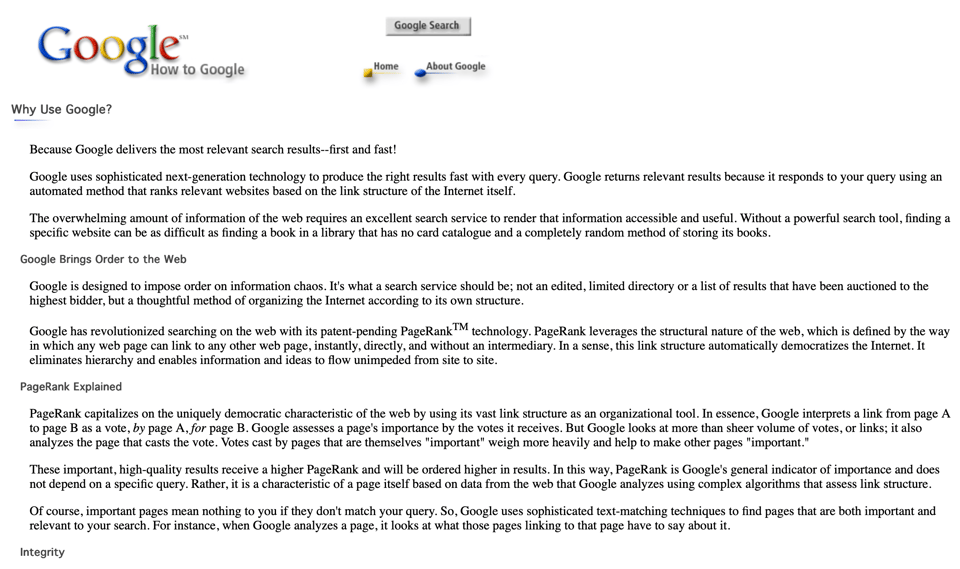
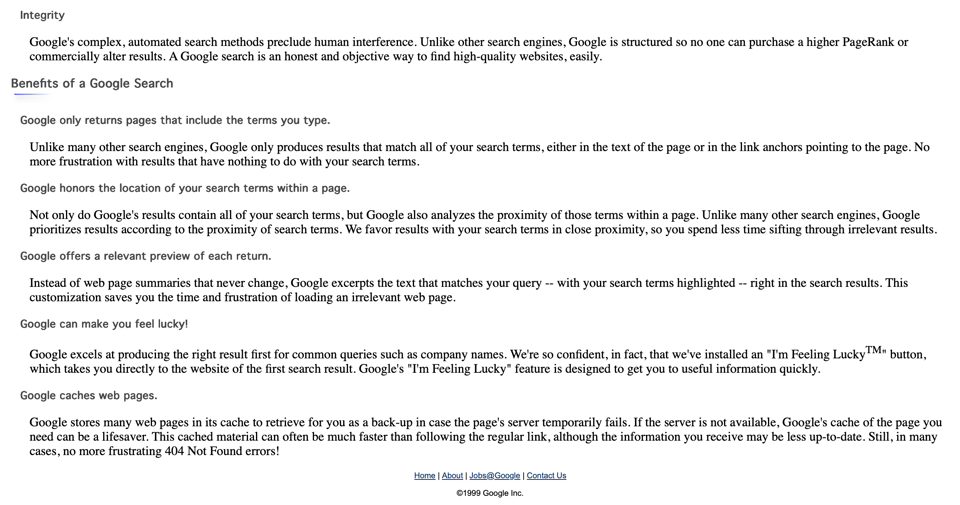
Rauwerda’s thread also includes screenshots of a fascinating interview with the creators of Google that is well worth reading. Among the many quotes, they discuss the difference between portals and Google Search and why Google Search is superior saying:
PAGE: We built a business on the opposite message. We want you to come to Google and quickly find what you want. Then we're happy to send you to other sites. In fact, that's the point. The portal strategy tries to own all the information.
PLAYBOY: Portals attempt to create what they call sticky content to keep a user as long as possible.
PAGE: That's the problem. Most portals show their own content above content elsewhere on the web. We feel that's a conflict of interest, analogous to taking money for search results. Their search engine doesn't necessarily provide the best results; it provides the portal's results. Google conscientiously tries to stay away from that. We want to get you out of Google and to the right place as fast as possible. It's a very different model.
Google today is everything its creators were against. Couldn’t be clearer.
I’m glad I changed my search engine nearly two years ago when it became quite clear to me that Google search engine was getting worse. Then I read about it and, yes, Google was deliberately making their search engine worse so people had to search more often and they could make more money. Then came the AI overviews and now they’re changing Google Search totally embedding Gemini to it. This will further deteriorate people’s ability to do research, to explore information, to critically assess sources, etc. It will also further reduce traffic to websites, blogs, news media etc, the sources that, actually, write articles and produce stories.
In the de-Googling process, I’ve found Paris Marx’s guide to getting of US tech quite useful as a starting point.
I have a MacBook and an iPhone. This may change in the future but those are the devices I have at the moment. With that in mind here’s my workflow at the moment:
Browser: DuckDuck Go but Vivaldi is calling. I like Duck Duck Go. They have a strong focus on privacy, it’s a good browser, the search engine is solid (without all the junk that Google has added to theirs) and you can switch off the AI overviews and chatbot. Having said that, I have been trialling Vivaldi lately and I’m really enjoying it. Vivaldi has a very strong focus on privacy and no AI in sight. I think I’ll still use Safari occasionally (since some websites demand a mainstream browser and it’s always good to have two browsers, just in case) but I believe Vivaldi will become my browser of choice.
Email: This one was easy. I moved to Proton. Emails are very personal and this is a company based in Switzerland that cares about privacy. They will not mine my data, they will not sell it to third parties, they will not use my emails for AI or for targeted ads. They have a free and paid option. I’m on the free account for the moment, but I may subscribe to the paid option. I still use Apple’s iCloud email for some things.
Office: I tend to do most of my creative writing on Scrivener. I’ve been using it for a long time. It’s familiar and it works well. Collaborating with my son, we both use Pages. With the groups I volunteer, the groups have adopted Google Drive. I would prefer not to use Google Drive and Docs, but that’s what the group adopted. That’s the only reason why my Google account will continue to be active for the foreseeable future. Having said all that, I’ve recently discovered Ellipsus and it looks like a great, free, European platform by writers and for writers. It has great features designed for creative writing and for collaborating with other writers. Bonus, they care about privacy and have no AI integration in the platform. I will definitely be trying Ellipsus. I also use Libre Office when I have to. Mostly, when someone sends me a Word document and then I need to send them a Word document back.
News/RSS Reader: I’ve used Feedly for a very long time. I’m used to it and it works fine. But, since I started using Vivaldi as a browser and it has a dedicated RSS reader, I have started testing it out. I feel like I might change to Vivaldi and drop Feedly but it’s still in the to-do-list.
Notes, Passwords and Calendar: I’ve been lazy about this. I share notes and calendar with my wife and son. Changing all of them seems too daunting and Apple’s in-built apps do this really well. Ideally, I would like to change notes, passwords, calendar, office and email all to Proton but the paid subscription for the family to use the whole suite is not something we can afford now. I’ll stay with Apple’s in-built apps for these three functions, at least for now.
Search: I like using more than one search engine. It’s a habit of mine. Sometimes, you discover different sources and links. At the moment I’m using Qwant and DuckDuck Go. When I’m on Vivaldi I tend to use Qwant more. When I’m on Safari or the Duck Duck Go browser, I tend to use Duck Duck Go as my search engine. Old habits are hard to change, so I will probably continue using both but Qwant has definitely grown on me.
Apart from all that, is there a future where I can drop my MacBook?
I’m looking forward to getting hold of an old Intel chip MacBook. A free hand-me-down that I will repurpose as a Linux machine. This will be an interesting experiment and, who knows, maybe my next laptop will definitely be a Linux. I used Ubuntu about 20 years ago and I enjoyed it. I’m keen to see what different Linux distributions have to offer these days and I think I could easily change to a Linux distribution on my laptop for most purposes.
KICKING AROUND THE NET
Various North American public library organisations have published an online statement calling for action in licensing for digital content such as eBooks, eAudioBooks and eComics. The current model is one where publishers have all the power and they are wielding it to impose unrealistic, extortionary pricing. I hope this kind of action grows and spreads globally.
We know that the biggest target for book bans, both in Australia and the U.S., has been LGBTQIA+ books. It’s always good to keep an eye on patterns and trends and PEN America’s new report tracking censorship has seen a sharp increase in attemps to censor non-fiction books in schools. Also, 44% of the cases were works by or about BIPOC people. It’s important to note that this is the U.S. but, as if often happens, trends over there can be imported to Australia.
One of the great things about modern technology and the internet is to see people who are tech savvy creating something they’re passionate about and putting it out there for the benefit of the community. Annie Sexton is a comics creator who’s, also, a software engineer. She’s created Webcomic Studio, a platform that helps creators publish their comics online with a few easy steps. It’s brilliant for creators and brilliant for readers who want to find independent comics. It looks amazing and it looks like a great community of creators and readers is already building up there.
While the Australian government continues to happily sign contracts and memorandums of understading with Palantir, Anthropic, Microsoft, etc., I keep reading more and more about the importance of digital sovereignty. This movement is especially growing in Europe where plans are moving ahead to get rid of the big U.S. tech platforms altogether. I hope to see this movement grow in Australia.
Sweden is the latest shifting from digital to textbooks. I was a secondary school teacher 15 years ago and I remember all the schools moving towards digital platforms, iPads, etc. In fact, I was part of the team driving that change at the school where I worked. I, enthusiastically, supported the introduction of Google Drive and associated apps and iPads into Year 7 and 8. I rewrote the ICT curriculum and introduced students to lots of different apps and platforms but time and experience bring clarity. It’s clear to me now that, while devices and apps have their uses and positives, overall, students are better off working in physical formats, reading from books and relying less on apps. We were sold a croc that has deteriorated learning, not improved it. The rollout of AI in education (which is what the big tech platforms are pushing for) will further deteriorate student learning. I’m not saying remove all screens and apps but schools need to find a better balance and action is needed now.
Here’s a dystopian horror story. An AI app designed to get rid of school librarians. What students and schools need is well funded school libraries with a qualified librarian. Instead, this is an AI powered app designed to replace qualified librarians. We have a fight in our hands.
And I’ll end today with Karen Hao, the author of Empire of AI, a book I highly recommend, talking about AI narratives that reporters and journalists should not uncritically repeat. We need serious reporting about the issue that questions the dominant narrative promoted by the big tech companies. Large language models and Gen AI are not inevitable. The vast consequences of hyper-scale AI and data centres need to be critically examined. There are better paths forward with AI.
PHOTO OF THE DAY
I’ve been fascinated by and attracted to Japan since I was little. Anime and manga, sure, but, also samurai movies have always spoken to me. It’s been a long wait but travelling to Japan in 2024 was a dream come true.
I was most interested in the countryside and my favourite parts of the trip, the ones I really enjoyed the most, were around Lake Kawaguchi (in the Mount Fuji area), Hakone, Kyoto, and Miyajima Island.
Osaka in contrast was a cultural shock. I was overwhelmed by the city and the city life. The colours, the light, the amount of people… I, definitely, could not live there but I really enjoyed the visit and getting lost in a sea of people.

That’s it from me for now. Hopefully you found something interesting. Feel free to share with whoever you like. This newsletter is free and will always be free. It’s shared with a Creative Commons BY ND licence which enables reusers to distribute, remix, adapt, and build upon the material in any medium or format for noncommercial purposes only, and only so long as attribution is given to the creator.

