
The Intertidal Update - January 2026
One of our 2026 resolutions is to craft and adopt an AI policy. When we mentioned we were doing this to some partners they said “where do you start?” So, we’re sharing some of those resources here. If you’re thinking you don’t need an AI policy, I encourage you to at least take some time with your colleagues to talk through your “AI, why?” and articulate when and how you’ll use AI and how you’ll talk about those choices. A policy can be very short, like Buttondown’s policy on generative AI (“no”). But, as AI gets pushed into more and more products, it’s good to be deliberate and intentional about the benefits, risks, impacts, and responsibilities. What’s your purpose for using a "computational system to perform tasks typically associated with human intelligence” and what will you do with the results?
Three organizing principles for our policy
I. The data centers powering AI have real environmental impacts and transparency around those impacts is low. As an organization working on data sharing and ocean/climate sustainability, we recognize that using AI has costs. It’s not magic, free, or endless. We’ll be watching to see if quantum computing reduces AI’s energy and water use, but for now we want to keep ourselves on an AI budget.
- MIT Technology Review has an ongoing reporting series on AI & environmental impacts, including this piece on water; UNEP is also tracking AI impacts
- Hugging Face maintains an AI energy use leaderboard
II. We need to be specific about what we mean by “AI.” Some of the data-intensive topics we work on, like global ocean circulation and weather models, have been the focus of “advanced computer science” for decades and that work crosses into AI territory. We’ve used LLMs to extract data out of PDFs, but not to generate summaries. Our contracts include explicit clauses about how we use and share our partner’s data. Dumping a client’s data, or any PII, into a commercial AI model? No. Using AI to help copy edit a final report? Up for discussion, including how we decide that with partners.
- Elsevier’s generative AI disclosure policies for journals. Are authors actually complying? Should it be optional? Is AI reducing innovation and original scientific thought?
III. What do we want to get better at, and where can AI help by doing things we can’t do? AI can’t set your goals and if you feed AI bad data, it just gives you wrong answers faster. But, AI + expert review could help clean, process, publish data by automating tasks. That means the humans in the loop need to have good critical thinking skills. AI can connect and analyze large, heterogenous ocean data sources, like acoustics and imagery, if people frame the research questions and needed outputs. Our AI policy should help us pick when to invest in our own capacity and human community, and when the benefits of AI outweigh the costs.
- DeepMind and the Stockholm Resilience Centre wrote an in depth analysis on applying AI to planetary sustainability
- WRI’s Evan Tachovsky on responsible AI use
- NTEN, TechSoup, and Fast Forward have general AI policy writing guides. Jake Porway talks about why you should include examples.
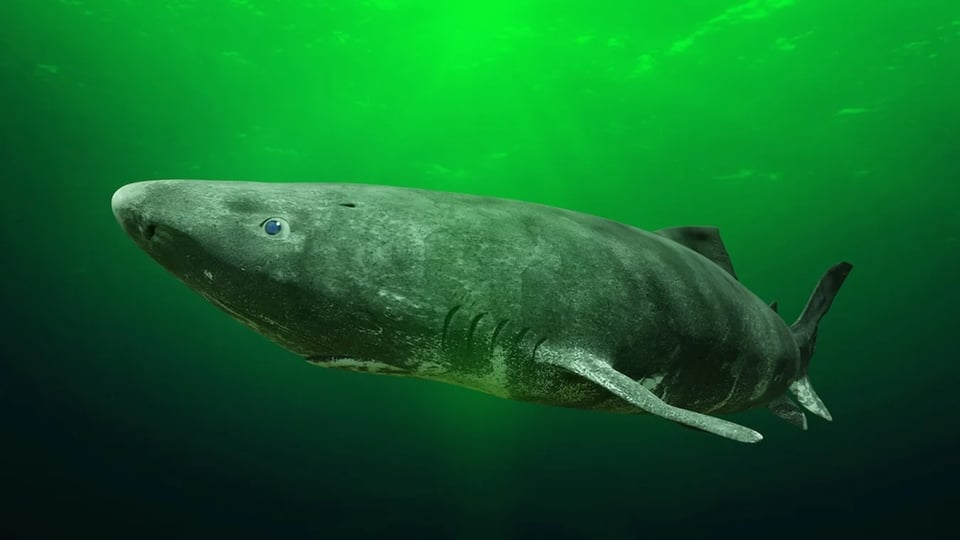
OK, let’s take a break from AI with this gorgeous Greenland shark, which can get to 400 years old and never need glasses. Truly living the dream.
Upcoming events
- The ODI has a free webinar on using AI to design public services on Feb 5th
- International Love Data Week is Feb 9-13 so get your data valentines ready. You could also join a climate and health datathon with Harvard’s Dataverse on Feb 11.
- ESRI’s online GIS for Climate Action course starts Feb 18 and includes talks from Dawn Martin, Jonathan Foley & Katharine Hayhoe
- We’re launching Intertidal’s first Data Stewardship Training March 17th and applications will open in Feb. Contact mollie@intertidal.agency if you want to know when we launch (we’ll remind you in the Feb newsletter too).
We’re also getting our slides, posters, and stickers ready for AGU’s Ocean Sciences Meeting in Glasgow Feb 23 - 27. Drop us a line if you’ll be there too.
Thanks for reading and subscribing. Is there a data topic you’d like us to dive into in a future newsletter? Reply and let us know.
-Kate