
The Intertidal Update - February 31, 2026
We’re extending the envelope of the shortest month because we spent last week in Glasgow with 6,000 other ocean people at the AGU Ocean Sciences Meeting and the days were just packed. The themes of data stewardship were everywhere, not just at our poster session. How do you create repeatable, containerized workflows that carry documentation from sensor to data service? How do you achieve not just technical data interoperability along with organizational, political, and legal alignment?
People are connecting hyperlocal data with regional models in ways that improve both regional forecasts and data products for local coastal communities and industries. And yes, people are using AI, but to borrow Drew Breunig’s framing they’re building Interns and Cogs, not Gods. These are data processes, policies, and programs designed by humans that uplift, showcase, and support human expertise and lived experience and that deliver products designed for human review and interpretation, often with a high degree of transparency and interrogability. The ECOPs are doing amazing things, the SCOPs are stepping back and lifting up, and as an MCOP, I’m here for these collaborations that are more than the sum of their parts.[1]
One of my favorite stories comes from a fellow traveler in the NSF Blue Economy Convergence Accelerator that helped launch Intertidal. She’s working with a community in the Pacific Islands that installed an array of ocean sensors and chose to make some of that data public. At a meeting with ocean-climate scientists, a community leader pointed to one of the modelers and said "I'm giving you our data so you can improve your models for us." The scientist jumped at the chance because that hyperlocal data improves forecasts for other ocean places. This is the virtuous cycle we need more of, where data collectors and holders feel confident in sharing data and can do so in ways that benefit both their own communities and ocean science more broadly.
More food for thought
Design Training
Stanford’s Nadia Roumani & Thomas Both are running their virtual Design for Social Impact training in April. If you’re curious about user research, systems thinking, and how to make data products that matter to people, go learn from them. You could also check out Lou Downe’s book “Good Services” and see if your local Service Design Network has regular meetups.
Game playing
Another factor delaying this newsletter was that I started with a long discourse on Pablo Torre and C. Thi Nguyen’s conversation about the philosophy of games and how focusing on quantitative metrics too tightly can undermine your ultimate purpose. [https://www.youtube.com/watch?v=7AdbePyGS2M] That draft isn’t ready yet, but if you listen to the episode and want to talk about it, email me.
3 quick tidbits
Microsoft scientists figure out how to store data on glass, squeezing 4.84TB of data in a 12 cm2 pane about the size of a postcard.
We’re late to this TNFD news but thrilled to hear about their proposal for an international Nature Data Trust, with all the standards and guidelines to make data connectable to the system.
The fish doorbell is back!
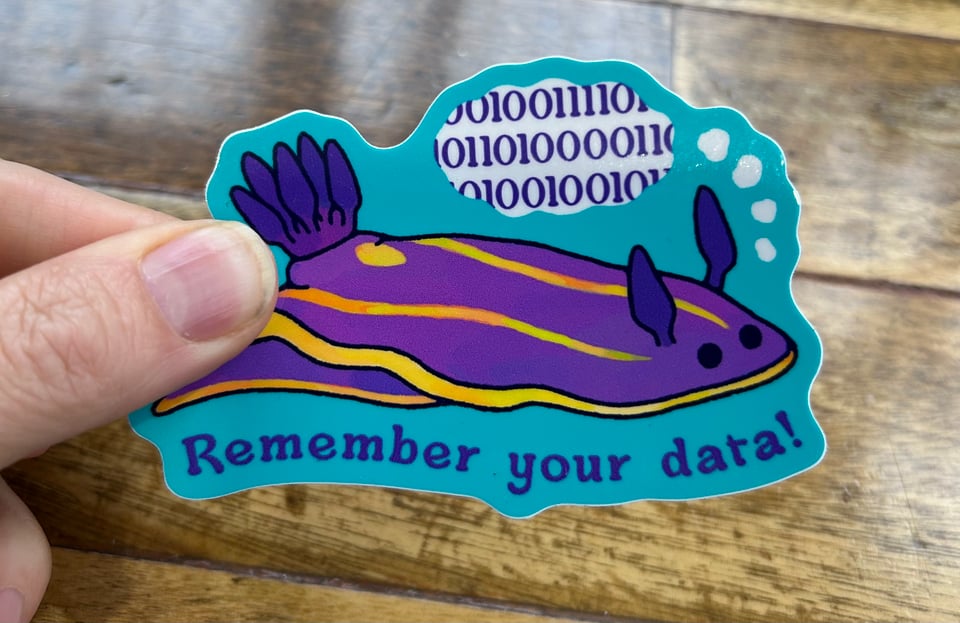
Thanks to everyone who met up with us for tea, trifle, and thoughtful conversations in the UK. We ran out of stickers fast but we’ll make more. Want us to send you one? Tell us how you’re remembering your data.
- Kate
[1] The term Early Career Researcher (ECR) has been around scienceland for a while, often defined as someone <10 years out from their PhD. For the UN Ocean Decade, organizers wanted a more expansive definition covering people who work on ocean issues in all sectors, from MBAs to ship captains. Hence the creation of Early Career Ocean Professionals (ECOPs), now a thriving international community with in-person and virtual gatherings, trainings, and support. AFAIK nobody calls senior people SCOPs, but at the pub one night a bunch of us realized we’re all Mid-career now so we’re embracing the label.