Sapphic books season
2026-06-25
Happy Pride, despite it all. As previously promised, I am back in your inbox to discourse upon some gay-ass poems.
Every experience of realizing one’s own queerness and coming out is unique, some more painful, some sweeter or at least more narratively satisfying. A poetic part of my own queer arrival: years-long waves of recognition as I continue finding, woven through culture, that queer people have always been here. All over the world and all throughout history, we’ve loved each other as best as we can given the circumstances, biases and risks that we face for it. Queer love hides in plain sight. Finding it in all forms of art from before I knew I was queer is invigorating, like hearing the birds every day then gradually picking out which ones make which songs. And like the birds, it makes me wonder with a faint hint of regret what I missed for so long.
I like the term “sapphic” and the mythos of Sappho, the original yearning lesbian. This summer I love the wide-ranging nearly 40-year-old volume by the Greek poet Olga Broumas, Perpetua, which holds all the stuff of life and poems: sorrow, death, desire, sex, and casting about into other consciousnesses to explore and set all those things more fully and vividly on the page.
At the end of the long and appropriately grim three-part poem “Massacre,” this casting-about sensibility speaks itself plainly:
If I were Black,
which I am,
if I were Jew,
which I am,
Irish, Palestinian,
native or half-breed,
which I am, I am
homeless or disappeared,
immigrant or queer —
Resinous weeds
grow taller where the water
fell on the craggy slant.
I pound the mattress.
What I don’t understand
holds us back.
Here is a voice that longs profoundly to understand, to be unbound by the weeds and the slant of the shore where ancestors across generations of historic time escaped the massacre. To know, in its truest form, what it is, which I am. The endnotes credit the acclaimed Appalachian poet Charles Wright for this “if I were… which I am” construction, which also recalls to my Chicago-pilled ear Sandburg’s “I am the People, the Mob.” Poets are always talking to each other and themselves in poems, sticking their magpie scraps together into new verse, learning how to be from each other.
The second section of this book travels further, and one poem in particular travels by bike so you know I had to love that. “The Way a Child Might Believe” also references the phenomenon of the green flash before sunset and sunrise: something I remember chasing on a cruiser bike from my grandparents’ garage on Sanibel Island as a child. I never saw it, but I still feel along with this poem that “A borrowed bike at twenty-one / Was like a Guggenheim.”
The short sentences that follow that simile within the same line (“It rained. We laughed.”) strike me like a sequence from a film, something beautifully framed like the French New Wave.
OK here I’ll just put the whole poem, dang:
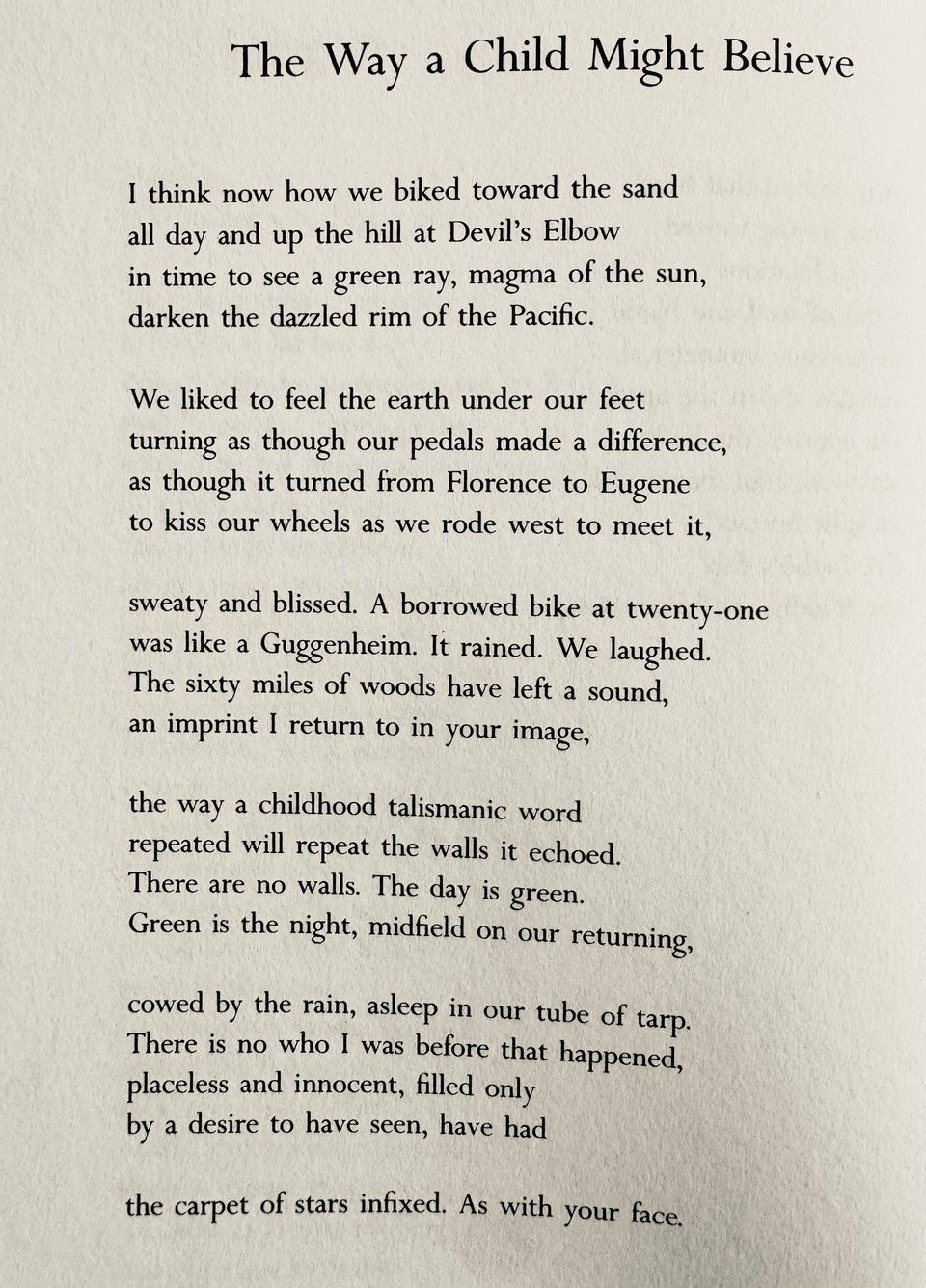
And what an ending! That “desire to have seen” the whole “carpet of stars” is one that fills me still, I think. It’s the roaming desire, the one for love, for travel, for love of the people with whom you travel. A big queer wondrous love.
And then the book’s final section “Lumens” is composed of short and sensual little aphoristic bites of poems, including the spiciest two lines I’ve ever committed to memory for OPP:
It’s not just that you’re wet but that you’re swollen
Ocean where for me you dip
Y’all, I might be a little shy and prudish but this still gets a blush out of me. The rising o’s of “swollen” and “ocean” tumbling into “dip” are what does it: those delicious sounds like a lover’s bitten lips. (Sorry if you are my actual family and you’re reading this email and this is yucky! I love you!)
Anyway, consider getting gayer and/or reading more queer books in these last days of this queer pride month. As a true sapphic doofus, I recommend it.
Yours,
Erin
Don't miss what's next. Subscribe to A Poem Miasma: