Research Reflections
issue #2.
[A market in Lagos, Nigeria, 1940]
“Oh, you don’t know?” Ama said, her eyes wide in her face.
“Well, I hardly know her to begin with.”
“Her poor husband got back from Burma a few weeks ago, blind!” Ama said, covering her eyes for added effect.
“Actually blind?”
“As a bat.
Apparently, he got shrapnel in his face and is lucky to even be alive!” Ama said.- The Parlour Wife, Foluso Agbaje
World War II changed communication technology in a major way, a lot of the foundation for how we communicate today is a result of technology that was optimised during and after the war. The Web would come roughly 50 years later at just the right time, when the foundational technology was in just the right place, and the bellies of the Powers That Be were hungry.
Beat.
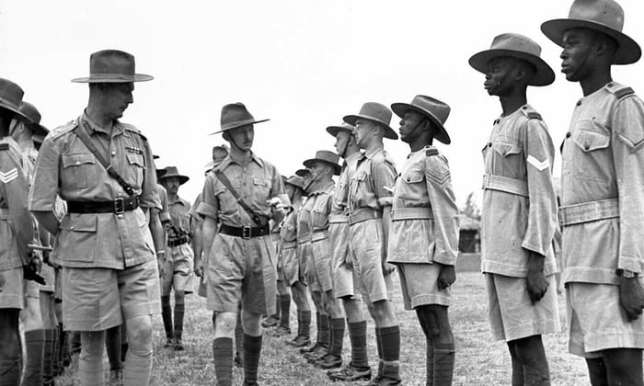
WWII treated technology with more reverence than the people who fought in the war, many soldiers were thrown away, treated like spoiled beans half-eaten by insects. And while it’s called a “world” war, it was definitely the West’s war. Nigeria was still a colony at the time and exported men, food and taxes to support the efforts. Many Nigerian soldiers didn’t return home, or returned home missing parts of themselves. Those that lived fought to prevent Germany's colonial rule in Europe, and went back home to live under Britain’s colonial rule.
Beat.
Without the sacrifices of these soldiers (and the many from other occupied countries) would the British codebreakers have time/energy/capacity to refine computer technology at home, or would they have been forced to fight? What would the computer look like if the West fought the war alone, without Black and Brown people to feed bullets and bombs?
Beat.
Richard Dawkins compares brains to computers (read: software) and in Programmed Visions: Software and Memory, Wendy Hui Kyong Chun challenges this analogy by reminding us that software hasn’t always been in the same way that nature has always been. I agree that software isn’t natural, and while I know it wasn’t Dawkins’ intentions, his analogy highlights the malleability of certain personhoods. Namely Black personhoods. Software can be anything the creator of the software wants it to be, similarly a Black “person” can be anything the White Supremacist structures want them to be. A Black woman can be:
nothing,
livestock,
a man,
a woman
depending on who you speak to and when. What/who a Black person is at any given time depends on what needs to be extracted/exploited.
Beat.
TBL’s parents were prominent mathematicians. During WWII his father was “instructed to stay on to take parts I and II of the mathematical tripos as a compressed two-year course, because the government needed people trained in mathematics and electronics”1, instead of fighting.
Beat.
What does a web created by the daughters of traumatised Yoruba WWII soldiers look like?