Registering Darkness Exposure: the theoretical possibility of scotographic film emulsion
An abstract, image and biography for the Journal of Imaginary Research. My research has become complex, inasmuch as I have started adding an imaginary component to the real one. Never not doing the maths joke.
Another abstract submission to the Journal of Imaginary Research, for their 12th volume, whose theme is 'Exposure'.
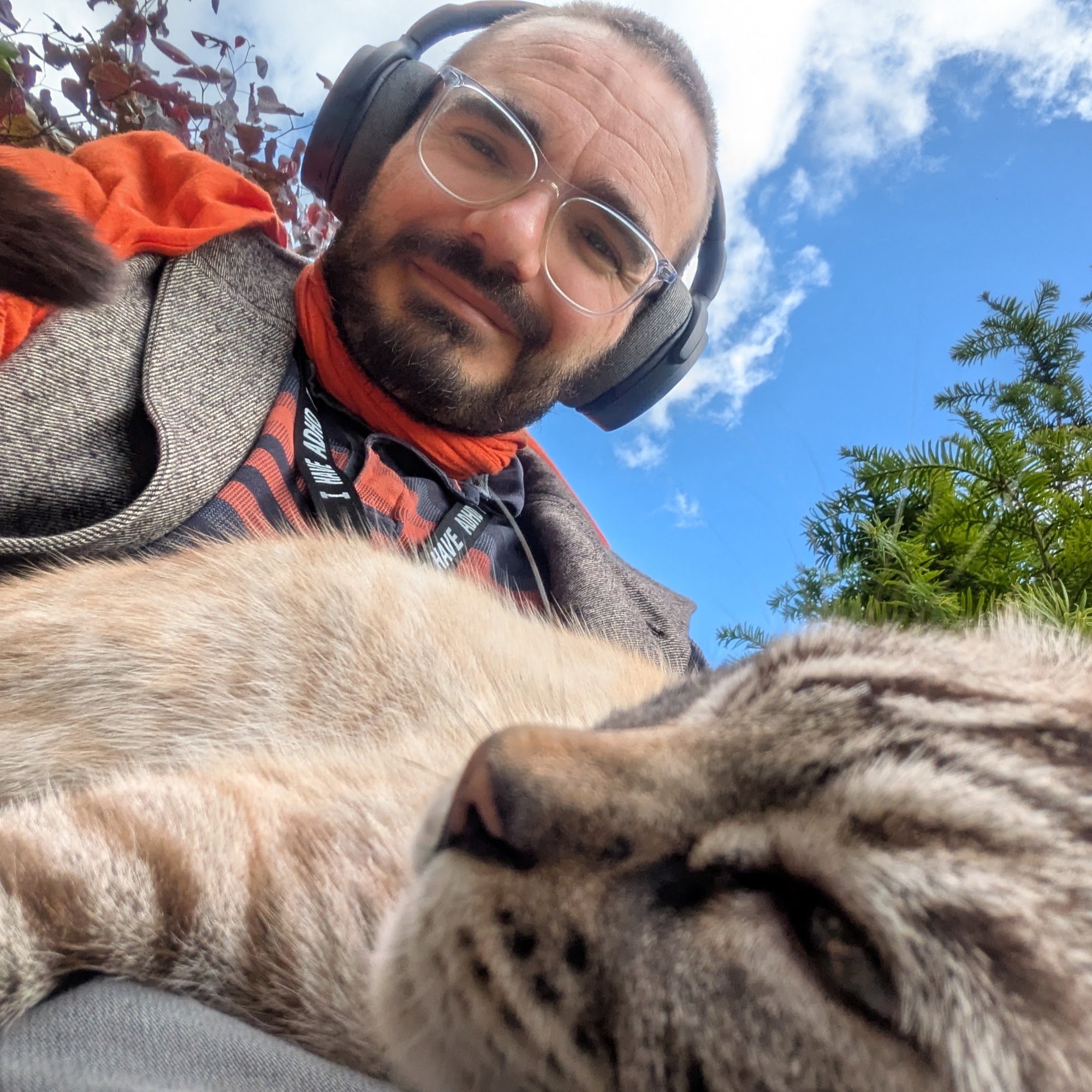
 Le Chat Bâillant¸ digital render © Robert Desnuits, 2026
Abstract
Darkness may be as important as light to the pictorial Arts, yet this importance, to this day, remains vastly under-acknowledged. This systemic mysoscoty is apparent in the very language of Art, Fine and Gross (eg. chiaroscuro, never oscuchiaro), and was made material in the development of photography (literally 'writing the light'). Building on new models of Physics (Schado, 2019; Obskür, 2025), developed to account for discrepancies in the 'standard' one (dark matter, dark energy), positing an antiparticle for the photon (the scoton), we draw from the biochemistry of the biological world (cyanobacteria, Monotropa uniflora), to propose a process for the synthesis and titration of obscurine, a compound sensitive to darkness exposure.
The proposed method uses a CRISPR-spliced strain of e. coli, followed by separation and precipitation, to be conducted under full spectrum illumination (for self-evident reasons). The biochemical nature of the process makes obscurine's precise formula still unknown, although we propose titration tests to establish presence and concentration, and reagent test panels for future research on precise chemical composition and structure. We validate our results in-silico, modelling monoclonal synthesis and the scotosensitive reaction. We further model darkness capture on a 10cm x 10xm glass plate coated with a 0.5mm layer of 100μg/l obscurine emulsion, developed and fixated in a brightroom. It is no overstatement to claim that our work could mark the birth of a new pictorial Art: Scotography.
Biography
Dr Robert Desnuits (b. 1983) is a computational biochemist at the Université de Technologie de Compiègne (UTC) in France, and a hobbyist night photographer. He holds a Diplôme d'Ingénieur in Computing, (2005), and a PhD in Biological Engineering (2009) from UTC. His photographic work has been featured in several exhibitions in Compiègne: Obscurité (2011), Ombres Sombres (2016), and Nuit Noires (2023), to glowing reviews in the Courier Picard and France 3 Régions among other local media. Robert lives with Renfield-Gunther Syndrome (RGS), a rare disease which limites his daytime activities. He works, teaches and lives in Compiègne, the latter (sometimes the others too) with his cat Ténèbre.
 Logo: Eniko

