જ⁀➴
A couple of months ago, my friend Robin, an incredibly talented translator of light and/as warmth, invited me to present work at her end-of-residency show at Confloptus, a gallery located on the outer edge of Oakland’s Chinatown. Her theme for the show was Respond to Tree:

Her suggestion/my immediate line of thought was to incorporate my work with Oakland Gleaners, the all-volunteer food salvage mutual aid org I’ve been co-running for the past 1.5 years. However, because of Confloptus’s proximity to Chinatown and my own two+ years studying Chinese calligraphy at the Oakland Asian Cultural Center, I kept wondering if there was a way to fold in my 书法 studies with my “life’s work”—literary writing, in English, and my organizing with OG.
During one early April class, my calligraphy teacher Mr. Liu gave me the following proverb to copy/practice:
十年樹木
百年樹人
In proverb language, the characters mean:
A skill is not acquired in a matter of days.
But literally translated, they mean:
In ten years, a tree is wood.
In a hundred years, a tree is a person.
Before that class, I’d already been planning on pulling bolted lettuce and chard out of my planter boxes as I turned over the soil for fresh spring starts. After that class, I had the idea, What if I pulled the main stems of the bolts, dried them out, and used them as brushes to affirm my response to “tree time”—methodical practice, long-term learning—by painting the characters of Mr. Liu’s uncanny practice prompt?

Eventually, I arrived at a three-part response to tree:
1) 十年樹木 / 百年樹人 written in strip mall calligraphy ink, using bolted garden chard and lettuce brushes on 宣紙, presented alongside Mr. Liu’s original example and a character practice sheet.1
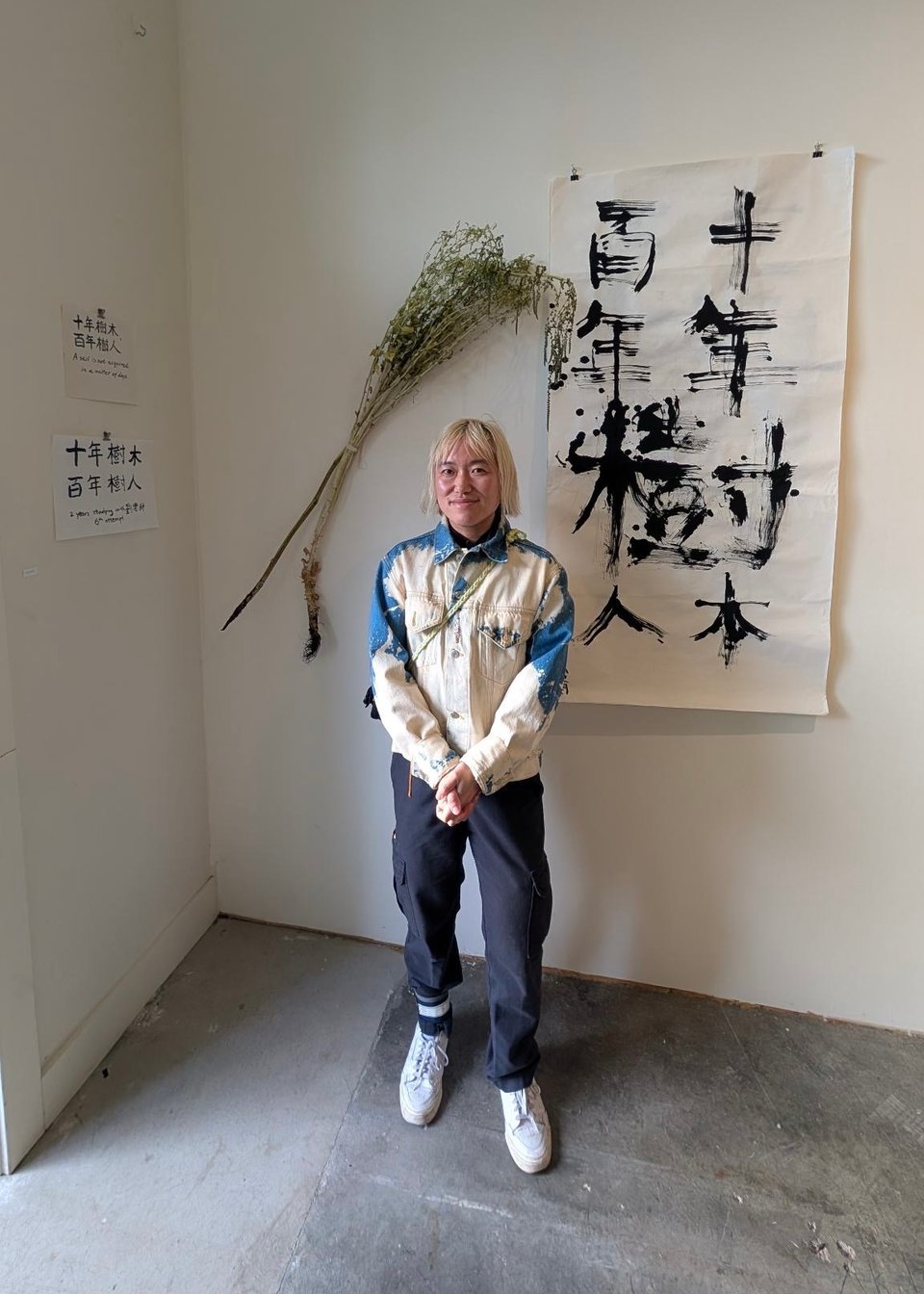
2) A “living sculpture” created out of flower and tree cuttings from my backyard. (I originally wanted to build a bouquet out of branches from a glean, but the pick timing didn’t line up.)

3) The following piece, which I read at Confloptus on the day of the show; I only started building out this newsletter to share this part, but as with all things, I have so/too much to say… Anyway without further ado:
The Root
I began heaving, digesting, writing, whatever, two hours after tabling an event named “West Oakland Has Roots,” which was hosted by the West branch of the Oakland Public Library and the great niece of Bobby Seale. Over the course of three hours, two other volunteers and I 1) poured almost a gallon of ginger lemonade, which I’d made two nights before by pressing about 75 split and/or bruised Meyer lemons into juice that was then mixed into simple syrup I’d made with a soft mountain of sugar that, under the lights of my stove vent, appeared patterned with quartz spears of oil slick, and, 2) fresh-pressed about 60 lbs of slightly tart, very floral seedless oranges into Sunny D-neon liquid sunshine.
Both the lemons and the oranges came from two trees in East Oakland’s Maxwell Park neighborhood, one yard, stewarded by a woman named Paulette. The weekend before, five other people and I picked 300 lbs of fruit off Paulette’s trees. Whatever you’re imagining, think less: Good citrus is dense, and Paulette’s fruit was some of the best I’ve ever picked. This is because she gets her trees professionally pruned by Erik King, whose name tripped a wire in my head when she said it.
Turns out, I’d actually picked at Paulette’s place before, back in 2024. Hers was one of the first yards I’d gleaned at; the founder of Oakland Gleaners, Sonja, used to live down the street from her. We laughed and marveled at the connection, the delayed recognition. We’d known each other but hadn’t known it.
This slow dawn situation is happening to me more often—less cryptically, I am not unregularly getting recognized in unexpected ways. Like when I went to pick up a library hold and before I could ask, someone at the desk said, “We just pulled it off the shelf, I was surprised you hadn’t gotten it already.” Or, when Laura and I tabled at the Ballers park and someone came up to us, peered at me, and exclaimed, “Where do I know you from?”, followed shortly by, “You’re so memorable!” Or, when the woman who organizes the monthly pantry at my local elementary school went in for a hug the last time I dropped off, despite us interacting for maybe ten minutes total across two years.
It’s disorienting to become known. Both in the sense of living a semi-active public life and the ambient act of being perceived. I used to devote serious energy dissecting the notion of a “performative public persona” while interviewing musicians and writers I admired. Their answers could be uneasy, laced with simmering venom or evasive non-resolution or, most often, a combination of both plus resignation to the fate that their creative life, their once sheltered harbor, was now the crossroads of several temperamental trades.
Capital investment, parasocial devotion, real-time historical revisionism which sometimes took form in the work of reporters like myself who’d examine their body language, their tone of voice, their clothes, the natural lashes on their off-duty faces, their dinner order or lack thereof, and note whether they crack their knuckles or twirl their hair or pick at their skin, and drive fine nails through any slip of the shield, chasing the moment when ambiguity about their doubled life surfaces. In the best-worst cases the turn can happen suddenly, a deep shadowed ripple is revealed to be a hunting leviathan engorging on want or shame or rage, and shatters the mask they might not have known they were wearing, though they often do, know.
I digress. Nothing I learned from those conversations prepared me for the messages I started getting from young people, who told me that my books accurately, in negative and violent ways, reflected the things they were going through in their own lives while also, crucially, deliberately on my part, offering blueprints for survival, escape, transformation, or some combination thereof. But the knowledge that my art could act as a life raft, a kite, a mirror, doesn’t change the fact that I can’t control the ocean, the wind, or how light reflects. There is so much left, lost, in the gap between the page and the future, the life you can touch and the life you can only imagine.
Which is why I gravitate toward the glean. The trees don’t have much to share by way of speech but I make enough noises to speak for a grove. Clicks of tongue, reedy whistles of appreciation, undignified yelps when a twist of the picker brings down a hail of mandarins or, more painfully, pears. Something I’ve started saying to donors and volunteers alike: “The fruit wants to be picked.” An offhand remark I made while pulling plums off Vivian’s prodigious tree; during one glean, she noted how much lighter, higher, happier the branches seemed. It’s the case for trees and people alike—when the alleviation of burden becomes mutually pleasurable, passion blooms. Yes, I will run my brush through your foliage until you can feel the darting breeze through the open pockets of your cresting branches. This is how you wish to be treated, to be loved: by being passed onto, and into, the world.
Beyond the arboreal element, to glean for strangers, with strangers, is to bite into a gentler fruit of knowledge. I’m grateful for the people who let me into their homes and the people who show up for the OG project. I’m in awe of the people organizing the distributions we donate to and indebted to the people who bring us deeper into the food salvage ecosystem.
Still, I am only ever reverent toward the bushes, shrubs, and trees we pick from. To create from an elemental, primal urge, to provide something usually adored by those who receive it, crave it, but whose works are often literally gatekept by forces outside their control—Fruit trees are artists are fruit trees. Artists are fruit trees are artists.
A running joke: Those nights when I’m up until 3AM reading bootleg manga scanlations on the same kinds of shifty sites I once prowled two decades ago? I’m fertilizing my mind, that’s it, I just need to read two hundred more chapters, watch thirteen more episodes, loop five hundred more plays of the same song, and then I’ll finally be ready to send out flowers. Metaphors germinate easily. My notes app and voice memos are seed libraries; my physical notebooks are leaf litter and sites of future recycling. Each gruesome revision is a tactical prune. And my work, whether it’s plucked from or falls from my branch, despite my own concerns or caveats about the timing of the season, too early, too late, wants to be picked.
This is as close to a manifesto as I might ever get, the root of my practice not just in art but in life. There are conditions in which nothing can grow. But almost any soil can, through time and care and attention, regenerate into someplace where fruit becomes possible. Environmental improvements, thoughtful shaping, careful grafts and yes, regular picking: All these practices can turn a tree around, bring fragrance at the first blush of spring and gloss to the first flush of tender creeping green. Because all fruit responds to the tree it calls home.
Every tree we glean was once a splinter the size of a robin’s hallux or a pit the size of a robin’s egg or a speck as shiny and dark as a robin’s eye. How much resolve it takes to push out of and into uncertain earth, sprouting as above, so below, leaves twirling in plant time, slow dancing in the light, while taproot filigree embroiders little lightning through the soil. How much chance plays a part in which stems become slender bark become trunks stamped with decades of petrified halos. How much work goes into producing a flurry of petals that fall away as the fruit of so much labor swells and softens.
How bitter are the systemic failures that allow hunger to flourish amidst such ostentatious abundance, especially in the East Bay where, on higher ground, you can see small suns of citrus dot the landscape like a Kusama vision. There are many ways to respond to this reality—I take my cue from the trees and tend to the harvest of my life, our lives, in whatever ways I can touch. In writing, I pour my thoughts, my heart, my dreams. And in the trees, nature’s sweetest offering falls into my picker basket or my open palm, willingly, hopefully. How honored I am to bring this bounty into our shared world. And how much closer the sky looks through the crown of any canopy as I reach, forever and always, toward another day in the sun.
More responses from the other artists in the show:


Robin highlight reel AKA “I Can’t Believe It’s Colored Pencil”:


Parting shot:

Exit music:
Thanks for "listening." Stay tuned...!
♬ xoxo Lio
⋆。゚☁︎。⋆𓂃 ོ☼𓂃


With the exception of Robin’s digital flyer and the “Had to do it to em” portrait shot, all photos were taken on my Konica Minolta DiMage X1. ↩
You just read issue #39 of How I'm Feeling Now. You can also browse the full archives of this newsletter.