Bouquet Day Saturday//Remembering Wendell Berry
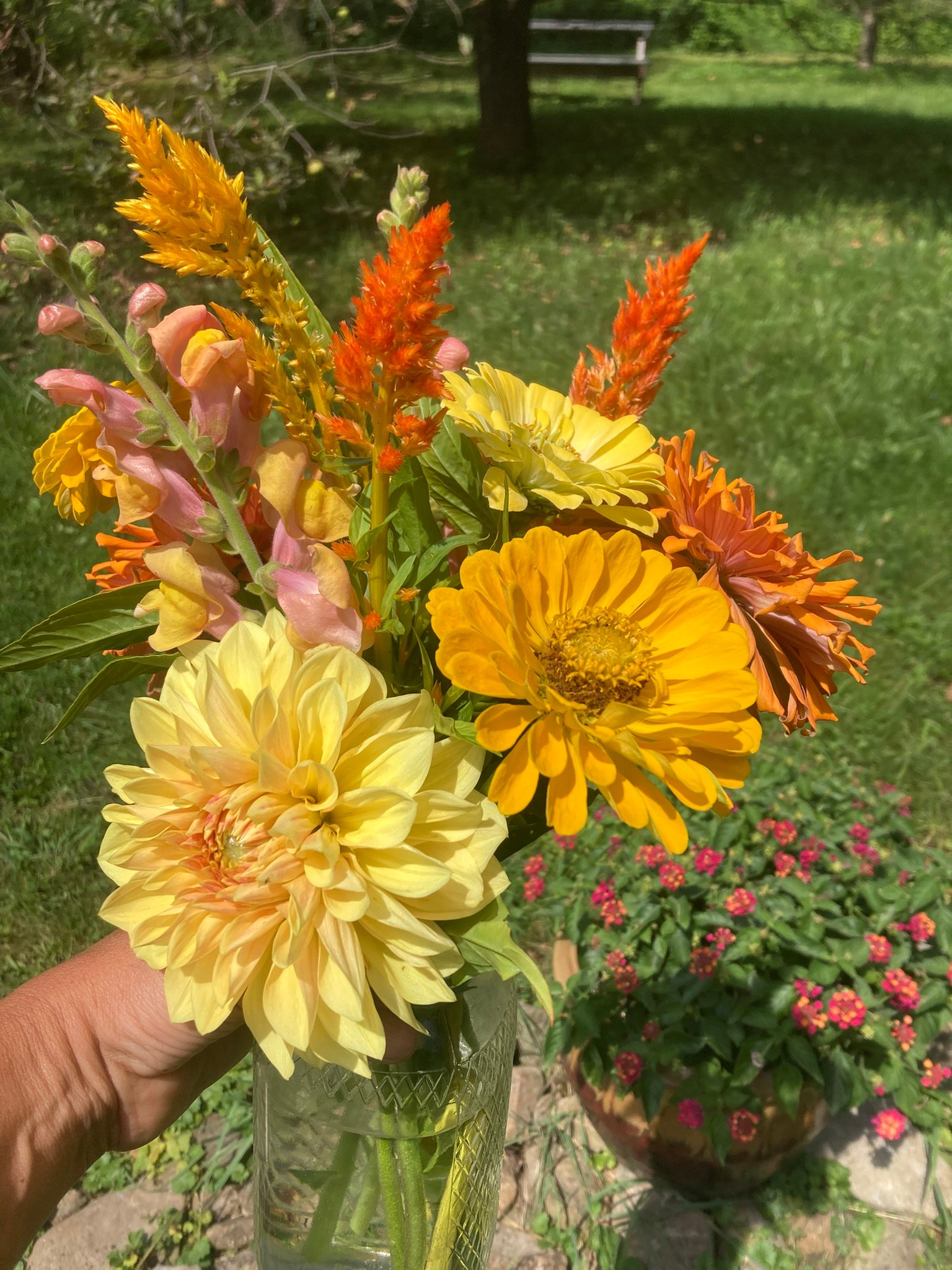
We will be open at the farm this Saturday, September 12, for the third bouquet day of the season! September in Pennsylvania is a dahlia’s favorite month - come cut a few to take home with you or just take a walk and enjoy all the colors and forms.

The gardens will be open from 2 - dusk. Bring a chair or a blanket and stay for a while. Bring a picnic if you’d like. The sheep will be pastured nearby and Todd will lead a guided visit around 4:00, but we can also point you in the right direction to visit the sheep on your own. We’ll also have supplies on hand this week to make a flower crown, a whimsical way to celebrate all of these beautiful blooms. And against all odds, our Magness pear tree is loaded with fruit! Now is the perfect time to pick some of these delicious pears. Our 100% grass-fed ground lamb will be for sale, along with wool fertilizer pellets for your garden, and this year’s cured garlic for purchase. The season of fresh flowers will only last for a few more weeks! The last garden day of the season will be in two weeks, Saturday Sept. 26th, from 2 - dusk.
Tell a friend and bring a friend - we do not advertise except through this newsletter, but these events are open to everyone. When you find our lane, drive up past the barn for parking and the gardens. Wear sensible shoes for walking on flat but uneven ground. We will have cutting shears and jars available, but feel free to bring your own. Bouquets are by donation. Thanks to all who came to the farm in August! The tomato tasting was a lot of fun, and while we never got around to an official vote, two tomato varieties that got a lot of praise were Mountain Spirit and Tappy’s Heritage. Our small initial run of sheepskins was warmly received, and we are honored that our wool will be in other homes this winter. Thank you!

(Getting to the farm from the Donegal turnpike exit is still complicated by the bridge closure on Copper Kettle Road, but folks seem to be finding their way. If you’re traveling from Pittsburgh or points west, I’ve written a few notes at the end of this email.)
Wendell Berry died last Monday. Those of you who have been reading Hi-View Gardens newsletters for a while have no doubt heard us refer to his writings. Those of you who know me well know that this author has influenced my thoughts and actions for all of my adult life. Berry was the author of over eighty books of essays, poetry, and fiction. In all of these genres, he wrote of rural places and from rural places. He wrote of what it is to be human and the ties that bind us to each other and to the world in which we live. Many, many people have written tributes over the past week, many have shared their remembrances. He touched, challenged, inspired, and also angered and frustrated many people over the long years of his writing life. I hesitate to add my own voice to the chorus. Homage can be a way of giving thanks and honor, but sometimes also a way to draw attention to oneself, maybe in the hopes that some of the glory and shine will transfer by proximity. And yet I know myself to be in the debt of Wendell Berry, and perhaps that is worth saying.
I first read his writing the summer after my sophomore year of college, at a little environmental studies school in northern Michigan with a small but excellent library. I do not remember which book caught my attention, but I do know that his words immediately rang true. I was away from home, mildly rebellious, questioning the world in a twenty-year-old kind of way, beginning to be sure of the things that I loved but completely unsure of where I fit into the world of academia and careers. What Wendell Berry gave to me, and I suspect to many others, was permission to come home. His account of leaving and returning to Henry County, Kentucky gave us a lens to see that “marginal” rural places could, in truth, be the center of a life. He tirelessly wrote of the ways that industrialization and mechanization have reduced rural communities and bonds of interdependence. In those essays I began to understand that my family’s story fit into a larger story. When I read his novels I recognized the characters – I knew Old Jack. I knew Hannah Coulter. I had heard these tales, I had inhabited some of the same rhythms and landscape. I had absorbed, if not fully understood, some of the same joys and sorrows. Once I began reading Wendell Berry’s books, I never stopped. My first job after college was surveying birds on the North Dakota prairies. In the evenings I read A Place on Earth and wanted to know more about my grandparents’ lives, and wanted to be back in the barn at milking time, and wanted to know how to grow a garden. I came back to Pennsylvania. I read and reread the Mad Farmer poems and went to work on a farm. There I met a young man who had also been reading Wendell Berry. He had, in fact, interned under Berry’s friend and agrarian counterpart, Wes Jackson. I read Jayber Crow while Todd and I began to build and imagine a life together. We combined our bookshelves, where dual copies of some of Wendell Berry books still remain.
What Wendell Berry does not offer to any of us is a blueprint. He did not necessarily want to be emulated, he did not want all of his readers to buy a farm or raise a hog. He did want us to think long and concretely about our places, our economic lives, and the work of neighborliness. He grew exasperated with the scores of people asking him to give them hope. Hope was not something that he could dole out – hope was a responsibility. In my own life, I know that the work of homecoming will never be complete. We must work out how to live and make a living and understand where we are against the great forces of upheaval and uprooting. Wendell wrote it this way, after a long stay at Stanford University: “What I get from the experience out here is the awareness that the life we want is not merely the one we have chosen and made; it is the one we must be choosing and making. To keep it alive we must be perpetually choosing it and making its differences from among all contrary and alternative possibilities. We must accept the pain and labor of that, or we lose its satisfactions and its joy. Only by risking it, offering it freely to its possibilities, can we keep it.” Thank you, Wendell Berry, for the gift and challenge of your writing. Rest in peace.

Sara (and Todd) Wetzel
302 Lephart Rd, Rockwood, Pa 15557
If you have never read any of Wendell’s books and would like a place to start, I recommend Hannah Coulter or Jayber Crow if you like fiction. Any of the collections of his Sabbath poems are moving and accessible. In recent years some of his most influential essays have been published in collected volumes.
For folks traveling from Pittsburgh or points west, be aware that you will encounter a detour around Copper Kettle Road where a bridge is being replaced. This will likely route you to 281 S at a different point than you are accustomed to and may add a few minutes to your travel time. If not using an app (that may route you a different way) detour onto Indiantown Road off of Trent Road near the Laurel Hill State Park entrance. Detour signs are in place, but not especially obvious. This will take you to Rt. 281, turn right and continue south through New Centerville and New Lexington to Lephart/Duppstadt Rd. The weather forecast for Friday looks like a 50% chance of rain. We will be here rain or shine, but it’s worth checking the forecast for Rockwood if you are traveling any distance. Sometimes the temperature and precipitation vary greatly between here and Pittsburgh!
Add a comment: