Texttools dot py
A small script I find really useful, and you might too!
I make a lot of personal software tools. One of these is "texttools.py", which is easiest to explain with an image:
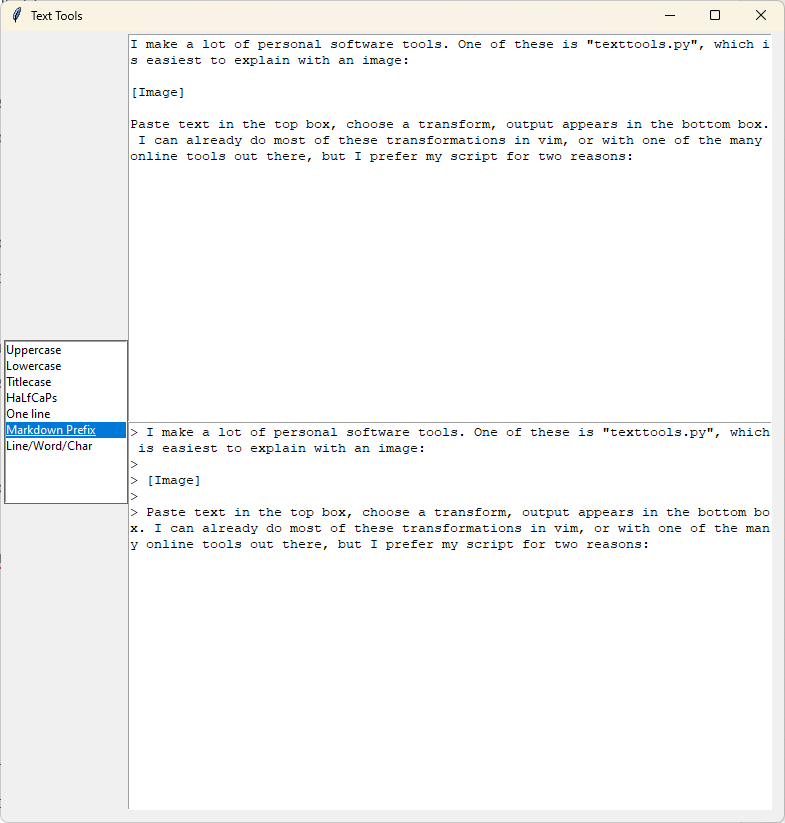
Paste text in the top box, choose a transform, output appears in the bottom box. I can already do most of these transformations in vim, or with one of the many online tools out there, but I prefer my script for two reasons:
- There's no context switching. I don't have to leave my current tab or vim buffer and worry about cleanup later. One hotkey opens the GUI,
<esc>closes it, with no break in my workflow. - It loads in <10 ms.
It took me like an hour to make and I use it all the time. And it's small enough that I just share the whole script here.
How it works
Texttools is a python script running a tkinter GUI. I used tkinter because it's a builtin; I would generally not recommend it if you have any better options. On the plus side, being a builtin means you don't need to install a package to use this yourself.
import tkinter as tk
from tkinter import N, S, E, W, ttk


# Complex transforms go here,
# Simple transforms are just lambdas
def _wordcount(s: str):
    "Returns a tuple of linecount, wordcount, charcount"
    return (len(s.splitlines()), len(s.split()), len(s))

transforms = [
        # Transforms go here, for example
        {"name": "One line", "transform": lambda x: " ".join(x.splitlines())}
        ,{"name": "Line/Word/Char", "transform": _wordcount}
        ]

class GUI():
    def __init__(self) -> None:
        self.root = tk.Tk()
        self.active_transform = lambda x: x # start with no transform
        self.layout_gui()


    def layout_gui(self) -> None:
        self.mainframe = ttk.Frame(self.root, padding="3 3 12 12")

        self.root.title("Text Tools")
        self.mainframe.grid(column=0, row=0, sticky=(N, W, E, S))
        self.root.columnconfigure(0, weight=1)
        self.root.rowconfigure(0, weight=1)
        self.content_box = tk.Text(self.mainframe, undo=True)
        self.content_box.grid(column=2, row=2)

        self.output_box = tk.Text(self.mainframe, undo=True)
        self.output_box.grid(column=2, row=3)

        self.transform_box = tk.Listbox(self.mainframe)
        self.transform_box.grid(column=1, row=2, rowspan=2)
        for t in transforms:
            self.transform_box.insert(tk.END, t["name"])

        # Keyboard bindings
        self.root.bind("<Escape>", lambda _: self.root.quit())
        self.content_box.bind("<Tab>", lambda _: self.transform_box.focus())

        # vvv makes clicking or pressing enter change the transform
        self.transform_box.bind("<Button-1>", self.select_transform)
        self.transform_box.bind("<Return>", self.select_transform)

        # vvv makes anything typed in update the output
        self.content_box.bind("<Key>",
                              lambda _: self.root.after(1, self.update))

        self.content_box.focus()

    def update(self):
        content = self.content_box.get('1.0', tk.END)
        content = self.active_transform(content)
        self.output_box.delete('1.0', tk.END)
        self.output_box.insert('1.0', content)

    def select_transform(self, _):
        try:
            selection = self.transform_box.curselection()[0]
            self.active_transform = transforms[selection]["transform"]
            self.update()
        except (ValueError, IndexError):
            pass

def main(): # Entry point for pyproject.toml
    gui = GUI()
    gui.root.mainloop()

if __name__ == "__main__":
    main()
Man I forget how much I dislike tkinter until I have to look at it again. If you want to add your own text tools, just put a new item in the global transforms array.
To make it easier to run the script, I put it in a "toolkit" repo with this pyproject.toml:
[project]
name="toolkit"
version="0.0.1"
requires-python=">=3.8"

[project.gui-scripts]
toolkit-texttools = "toolkit.texttools:main"
Then running pip install -e . creates a toolkit-texttools binary (or in my case a .exe).
Finally, I wrote an AutoHotKey script so I could load it with a keyboard shortcut:
; & numpagedown + t both pressed at same time
NumpadPgDn & t:: toggle_app("Text Tools", "toolkit-texttools.exe")
I like mapping stuff to the numpad because it's guaranteed to not interfere with any OS or program-specific hotkeys.
Short newsletter this week because I'm still recovering from jetlag. See you all next week!
Add a comment: