
Hi everyone! I write to you from beautiful Burlington, on the shore of Lake Ontario, where I’m partway through my tour for Mercutio. I’m driving a rental car around the southerly parts of Ontario, which I don’t have a chance to visit very often. I’m really enjoying it, and I’m grateful to the excellent publicity team at HarperCollins Canada for setting it up.
This morning I was on a panel for the Stratford Festival, and this evening I did a reading and Q&A in the Lincoln Pelham Public Library in Vineland. I’m off to Toronto next, where I’ll be at Word on the Street on Saturday — it’s free! And next week, I’ll be back in eastern Ontario for Kingston WritersFest on Thursday, and the Ottawa International Writers Festival on Friday (and that one is also free).
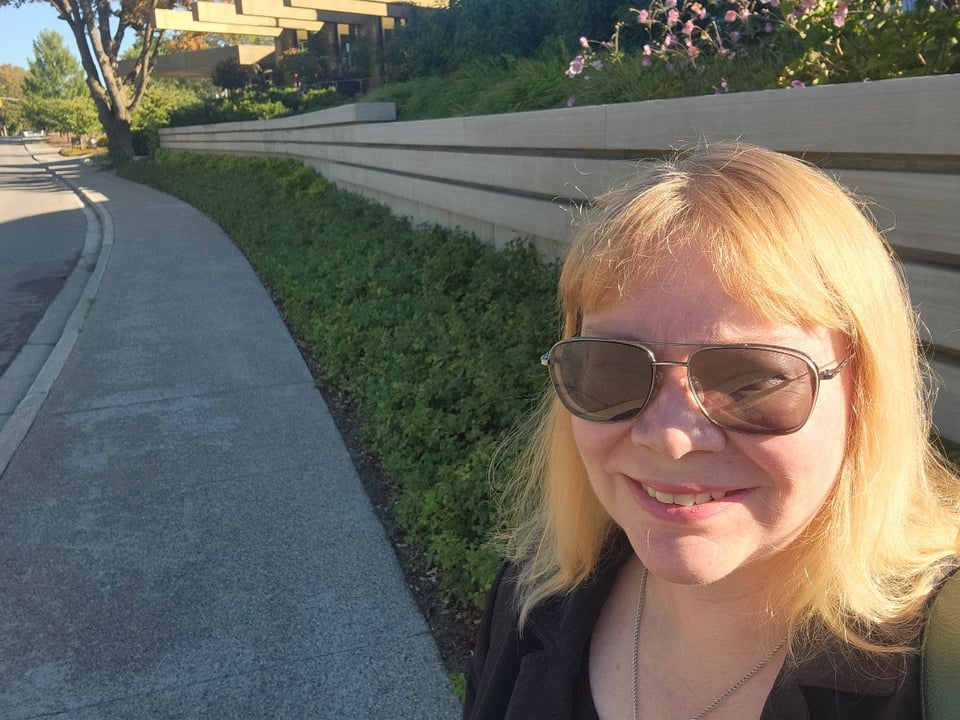
Me outside the Tom Patterson Theatre in Stratford this morning, very happy to be about to spend 2 hours talking about folklore and books:
In my last newsletter, I wrote, “I’m not currently on contract for anything.” I didn’t explain what I meant by this, and I had a few concerned queries — some people thought my agent or editor had washed their hands of me, or something like that. My apologies! It doesn’t mean anything bad at all, and nothing has shifted in my business relationships. A better way to put this might be “I don’t currently have an obligation to a publisher to meet a deadline for a book.” This was only worthy of comment because I have not experienced the feeling of not being on deadline for a piece of fiction since 2016.
Let me back up a second and talk about the cycle of traditional publishing. Authors are independent contractors; we sign agreements with publishers, in which we sign over certain rights to our work and they give us money and publish it. Part of the author’s side of the bargain is delivering the manuscript of the book itself by a certain date, and there are two ways we can fulfill that duty.
Option 1: We can write the book before we even offer it to a publisher. This is called writing “on spec” and it’s pretty much the only option available to a debut novelist. A publisher wants to know you can write a whole book before they sign that first contract.
Option 2: We can sign the agreement and then write the book. (The publisher is agreeing based on the author’s pitch and, usually but not always, an outline and/or sample chapters. I’ve sold books based on a brief paragraph in an email. I’ve signed contracts with nothing more than “second book to be determined.”) Once we’ve signed that contract, we have a deadline to deliver the manuscript, and we refer to this as being “on contract” for a book. This is a typical arrangement for novelists who are mid-career like me, but it’s not mandatory. I have friends who write every book on spec, by choice. It gives you more freedom over what the book is, and how long you take to write it. In other words, there is nothing bad or weird about not being on contract. Contracts beginning and ending is part of the normal cycle of writing and selling books.
Some of my contracts have been for two or three books at once, and occasionally, a publisher will sign a very successful author to a contract for a lot of books in one go, but that’s unusual. When Tor Books signed a 13-book deal with John Scalzi, it made headlines. The important thing to remember is that even in that kind of contract, it’s not the author that’s contracted; it’s the books. We authors work for ourselves, always. We can even write for other publishers while we’re under contract, so long as it doesn’t violate any non-compete or other clauses we’ve agreed to. (Our contracts with our agents, though, typically are not tied to particular books. I’ve had the same wonderful agent, Jennie Goloboy, since 2014.)
So, when I said it was unusual for me not to be on contract, this is what I mean. Here’s a chart showing my contracts for three novellas, two long pieces of interactive fiction, and nine novels (counting Armed in Her Fashion and The Chatelaine as a single novel, although it appears on two contracts under its two titles.)
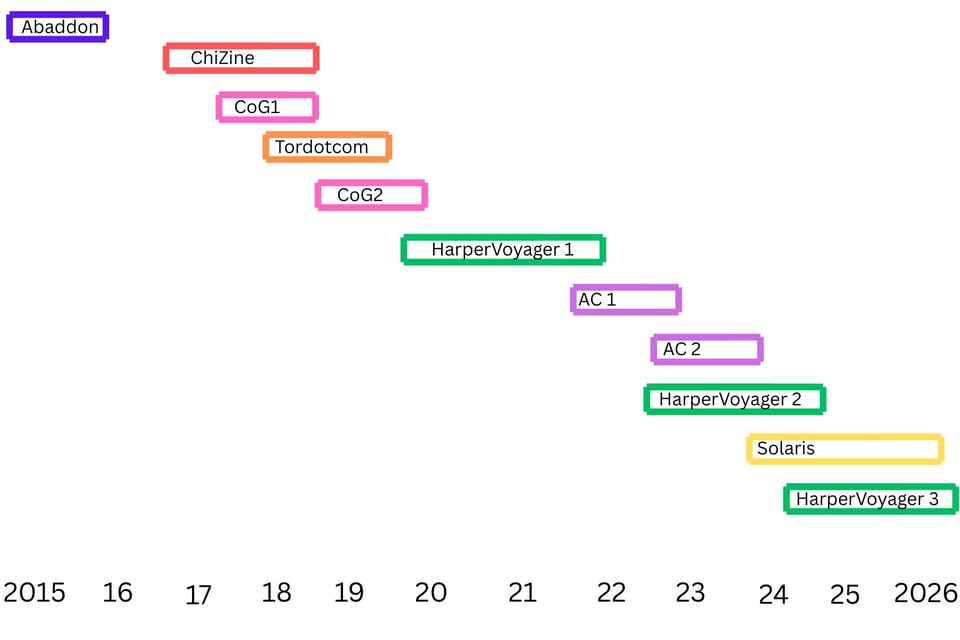
Please marvel at my graphic design wizardry.
I have left shorter things and other game work off for simplicity’s sake (and most of my 40+ published short stories have been sold on spec anyway.)
Each little rectangle begins (very roughly) at the time I signed a contract, and ends (very roughly) around the time I reviewed the copy edits for the final (or only) book on that contract. (The author does continue to have obligations after copy edit review is done, including page proofs, but the copy edits are the last major piece of work.)
As you can see, not only am I usually on contract, but my contracts usually overlap, meaning I am often on contract with more than one publisher (for more than one project) at any given time.
I have opted for selling my novels and novellas on contract wherever possible just because I liked the security, and I work well on deadline. For the last 10 years, I was trying to make my living as a freelancer and to get as close to full-time as possible as an author, so I absolutely needed there to be as few gaps as possible between payments coming in.
Now I have a day job again, in part because I finally accepted that I could never work hard enough to orchestrate the breakout I needed to make novel-writing my full-time income, and the teaching and freelancing I was doing to make up the difference was a lot of work and stress of its own kind. I’m recovering from what I am realizing was a pretty severe case of burnout (for the reason for the burnout, well, see chart above.) So while I am very slowly writing a new book, I’m in no hurry to try to sell it. I want to take my time with it. It’s also a bit of a departure for me, so I’d rather sell it once it’s done, or at least done-ish, so that it’s clear to everyone (including me) what sort of book it is.
So the short version is: I’m not on contract because I have interrupted the cycle, by not submitting any ideas or pitches to a publisher. I didn’t go into this break with any kind of plan; it could have lasted a few days, but it’s turning into months. There was a time when not being on contract for a book would have felt scary, but right now, for me, it feels like a much needed break and a moment to stop and think about what I want from the next phase of my writing career. So all is well, and the writing is still happening.
And I’m working on the copy edit review for The Realm Invisible (so it was premature when I said I was not on contract — but the thing I’m drafting now is not on contract.) And, of course, I’m on tour to promote Mercutio! So author life is still very busy, and my brain is noodling away as I drive around from event to event, not only on the book I’m currently writing, but on two other books that are clamouring for my attention. I honestly don’t know what I want from the next phase of my publishing life, but books don’t seem to be done with me yet.
You just read issue #70 of Kate Heartfield's Newsletter. You can also browse the full archives of this newsletter.