
HDA Housing Starts: Q2 2024

Housing Starts: Q2 2024
News & Updates from HDA
HDAdvisors provides housing and community development consulting services to developers, non-profits, housing authorities, local governments, lenders, and other members of the affordable housing industry.
We’ve been busy this year and are excited for both summer projects and fun!
Helping Alexandria explore a local rental subsidy program to continue its track record of innovative housing solutions
While Congress continues to underfund Housing Choice Vouchers and other major rental assistance programs, the demand for homes affordable to very low-income tenants remains strong. This is especially true in Northern Virginia.
That’s why the City of Alexandria hired HDA and the Virginia Center for Housing Research at Virginia Tech (VCHR) late last year to evaluate how to design a new local rent subsidy program (LRSP).
You can read our full report on LSRP’s for Alexandria here.
Local subsidy programs help fill the gap left by federal assistance, and can be more flexible in meeting community needs. After historic levels of rental assistance during the pandemic clearly demonstrated the benefits of housing stability, more localities began developing and funding LRSPs. Still, on the whole, they remain rare. The National Low Income Housing Coalition could identify only 72 locally-funded LRSPs in the entire country in 2023.
Alexandria’s interest in LRSPs follows a long track record of innovative solutions to uplift its lowest-income residents. Recently, these include a Pilot Rental Subsidy program and the ARISE Guaranteed Income Pilot program.
Alexandria’s Pilot Rental Subsidy program provides funding to further subsidize 10% of the total units in a LIHTC project to be affordable for 30, 40 and 50% AMI households. As of March 2024, The City has allocated just over $1 million to 37 units in 4 projects. The grants provide additional subsidy for a 5-year term.
To provide the City with full insights, HDA and VCHR investigated national best practices on structuring, funding, and implementing LRSPs. We quickly discovered it wouldn’t be easy. Most communities are still experimenting with relatively new LRSPs, creating an incredibly varied landscape across the country.
However, by conducting a census of fifteen different LRSPs, and by interviewing administrators from programs in Chicago, North Miami, and Washington, D.C., we developed high-level takeaways for seven different factors that must be considered when designing a new LRSP. For example, funding sources for the most successful LRSPs were usually connected to a dedicated revenue stream. Just like housing trust funds, ad hoc annual allocations are not sufficient.
Using these findings, combined with guidance from existing City plans and community feedback, HDA recommended a project-based subsidy model to leverage ongoing housing initiatives, keep administrative costs low, and potentially target investments in neighborhoods vulnerable to rapidly rising rents.
Rather than proposing specific subsidy levels, we collaborated with City staff to design three distinct scenarios based on program guidelines and assumptions about the client base. Each took a different approach, varying in target population, subsidy depth, and policy goals.
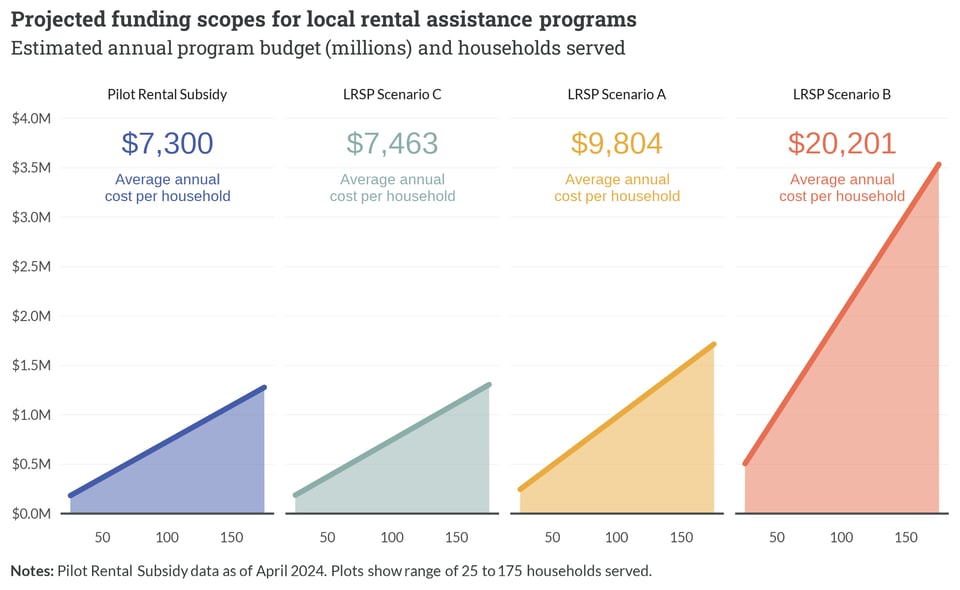
Our analysis revealed the tension between reach and impact. Two scenarios began with the same hypothetical $500,000 annual budget, but tested alternative subsidy approaches and prioritized different types of very-low income households. The third scenario explored what it would take to meaningfully support 150 persons or families in unstable housing situations. Here, the average subsidy per client more than doubled, leading to an estimated annual program budget in excess of $3 million.
Today, City staff are incorporating our analysis to inform ongoing conversations with City Council and other stakeholders about Alexandria’s overall strategy to improve housing outcomes for low income renters. A citywide housing needs assessment is currently underway, which precedes a comprehensive update to Alexandria’ Housing Master Plan later in 2025.
As communities throughout Virginia grapple with housing affordability, Alexandria's thoughtful approach sets a promising example for developing targeted, effective solutions. If you’re interested in exploring similar analyses to inform your own locality’s housing strategies, HDA stands ready to lend our expertise and support.
What we’re up to:
Maria is becoming bird-pilled at her new house! She has identified over 16 different species visiting her dining establishments (aka feeders), but her favorite right now is the tufted titmouse because it’s just so cute. Look at its tuft!

Amelie has been in the garden, building raised beds using the hugelkultur method! She’s hoping her tomatoes don’t get scorched, while the yarrow happily takes over.
Erica had a blow up fight with her sister in the Branch Museum, thankfully very few people seem to visit that museum. But one woman got an earful.
Jonathan reached the halfway point in Robert Caro’s interminable LBJ series a few months ago. After a slight detour to take in The Rise and Fall of the Third Reich (for no particular reasons related to current events, of course), he has Master of the Senate queued up next. Clearly, he knows how to pick light summer reads.
Eric has recently joined the City of Richmond’s Zoning Advisory Council, which is seeking to provide the City’s Planning Commission with feedback about the city’s zoning rewrite. In addition to that, Eric has been going into the back catalog of How Did This Get Made? episodes to detach from reality. Relatedly, he recommends Paul Scheer’s new book, Joyful Recollections of Trauma.
Flora, as promised, found a drummer for her band Flora & The Fauna, and has been rehearsing and playing shows all over Richmond. She even played in D.C. in May!

Local music journalist Marilyn Drew Necci described the band’s music as “sweet anthems of pure lovelorn pop,” and noted, “their upbeat, energetic stage presence makes it impossible to keep from smiling when they’re performing.”

Copyright © 2025 HDAdvisors. All rights reserved.
You are receiving this email because you opted in via our website.
Your affordable housing experts.
Our mailing address is:
HDAdvisors
203 N. Robinson St.
Richmond, VA 23220
