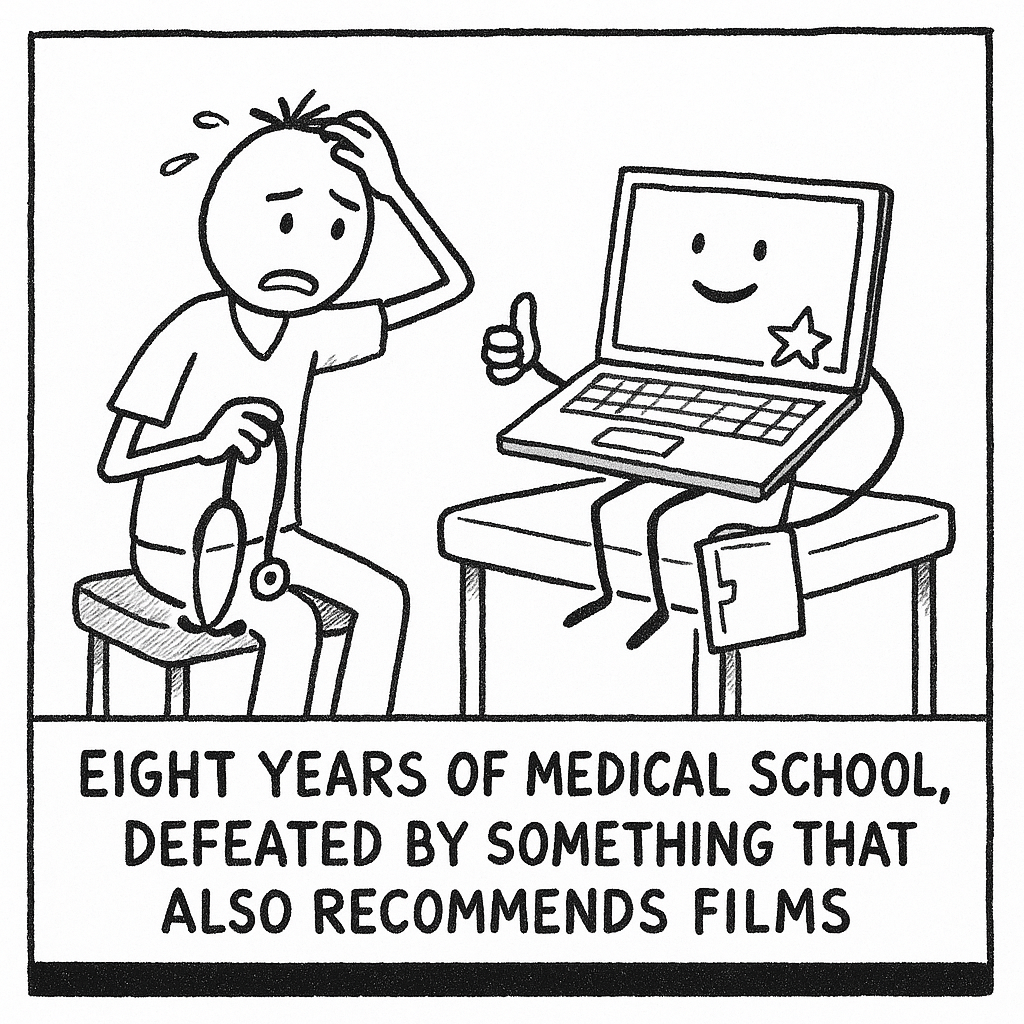
Today's Hallucination HQThe Doctor Will See You Now (And Lose)
A Harvard study pitted large language models against emergency room physicians on real diagnostic cases, and the AI won — or at least, scored more accurately than two human doctors across a range of conditions. This is either a triumph of machine learning or a pointed comment on A&E wait times. The study is careful to note context matters enormously in medicine, but "more accurate than a doctor" is a sentence that will be doing a lot of heavy lifting at hospital board meetings.
Source: TechCrunch
Beijing to Meta: Not Today
China has blocked Meta's $2 billion acquisition of Manus, a Chinese-founded AI startup, on the grounds that handing the technology to an American company would be a national security risk. Which is a fair concern, expressed by a government that has its own rather robust opinions about data. The move reflects a broader pattern: cross-border AI deals are increasingly subject to the kind of scrutiny once reserved for nuclear treaties, only with more lawyers.
Source: CNN
Content Without a Composer
Streaming platforms are filling up with AI-generated music at a rate that would impress even the most prolific human artists — which is to say, none of it has had a difficult breakup or a difficult decade, and it shows. The Verge examines who, exactly, is asking for this. The answer appears to be: algorithms recommending it to people who weren't paying close attention. Whether that counts as an audience is a philosophical question the music industry is not yet ready to have.
Source: The Verge
This Is Fine (It Is Not Fine)
KC Green, creator of the "This Is Fine" meme — the dog calmly sitting in a burning room, in case you've been offline since 2013 — says AI startup Artisan used his artwork without permission in an advertising campaign. Artisan, you may recall, is the company behind billboards encouraging businesses to "stop hiring humans." The combination of stolen art and anti-human sloganeering is quite the brand identity. One hopes the irony is not lost on them. It probably is.
Source: TechCrunch
One Hundred New Worlds, No Planning Permission Required
Astronomers have deployed an AI tool called RAVEN to sift through NASA's TESS mission data — millions of stars worth — and it has confirmed over 100 exoplanets, including 31 previously unknown worlds and several described as "rare and extreme." RAVEN found in months what would have taken human researchers considerably longer, which is either inspiring or slightly deflating depending on how many astronomy PhDs you've accumulated. The planets, for their part, were there the whole time.
Source: Science Daily
As always, the machines are trying their best. So are we.
**
|