[Warning for spoilers for Downton Abbey in general, and Downton Abbey: The Grand Finale in particular.]
Yesterday (amidst what has, so far, been a very chaotic and heavy week), I got to go to the movies with my mom and watch Downton Abbey: The Grand Finale for a second time. I’ve been a Downton Abbey girlie for so long now, and have spent too much time thinking about these characters and imagining them and playing with them. For all of its conservative spirit, Downton Abbey still manages to have a chokehold on me—something I luckily get to share with the dozen other fellow gay leftists obsessed with Thomas Barrow on tumblr.
But this newsletter isn’t about any of it. It’s about how, I first watched The Grand Finale, the ending seemed to be profoundly bittersweet: nobody was unhappy, but- everything was shifting and changing, and it turns out, just like any of the DA characters, I too can get quite resistant to all of it.
Mary’s ending, in particular, had a lingering tragedy I could not shake: yes, she got what she wanted, but she was also standing all alone in that big house, surrounded by all the happy memories she once got to have, with only the ghosts of her dead husband and her dead sister to keep her company. Sure, that (beautiful, heart-wrenching) flashback sequence had been more about bringing the movie to a satisfying, emotional ending than about Mary, but the feeling remained. I came out of the movie feeling satisfied, but also a bit empty.
Cut back to last night. Like I said, it’s been a hard week, and I think some of that caught up to me as I was watching the movie. In particular, watching the scene right at the end with Anna and Mary (who are finally standing as equals! I don’t imagine that was the intention behind the choice to have Baxter and Anna trade places, but it’s something I deeply appreciate nonetheless), where Anna asks Mary to be her baby’s godmother and remarks about how we all depend on each other and that’s how it should be, I had one of those full-body shivers that leaves me a bit teary eyed. I’m not someone who cries easily, so this kind of reaction is as close as full-on sobbing I usually get1. I did not expect that scene to get me, but I’m not mad that it did.
And then the last scene arrived and, this time, I knew what was coming. I thought I knew what I was going to feel as I watched the ghosts of all these characters I love (or love to hate lol) dance around on the screen, but instead of the bittersweet melancholy, the spark of resignation, the emptiness, I felt a profound tranquility. Yes, Mary Crawley stands alone. But that’s not, by far, the whole story.
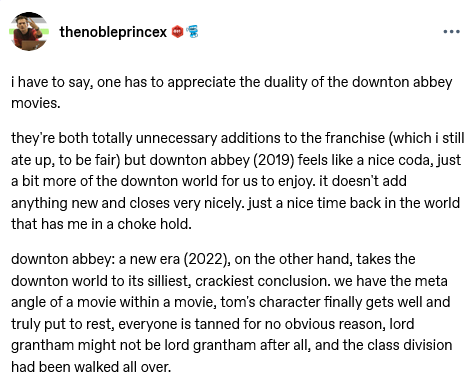
The plot of The Grand Finale is deceptively simple (and so mundane, when compared to the grandiose storylines we got in the previous movies): Mary has gotten a divorce (which, even with my very slim knowledge of 1930s England, I still know is quite a capital-letter Big Deal) and has to now deal with the backlash of that. There are a few more shenanigans going on (including the gays literally coming to save the day, Robert having a meltdown or, a particular favorite of mine, Isobel being a badass bitch and working so hard to honor Violet’s memory, and doing so in her own way); like my sister, who is only now watching Downton Abbey, pointed out, it feels the most like the show that the movies have ever felt.
But the movie is also, in a way, an ode to Mary herself. Mary (who, as one of the characters points out, has chosen to make herself a castout, which is such a delicious thread I’d love for someone to unravel!) is put through some trials and tribulations, but the movie spends its whole length telling her that it’s okay. That she’s okay. It is there in Cora’s fierce defensiveness of her, in Tom coming over just to stand up to her, in Anna’s quiet support, in Edith’s literal every move2. By the end of the movie, she’s been accepted and forgiven by nearly everyone of importance, including her father and Downton’s neighbors.
When watching this storyline, one has to remember where we came from. In the days leading up to the movie, I decided to do a little rewatch marathon, which obviously included some episodes from Season 1. The Mary Crawley we meet in season 1 is nowhere near The Grand Finale’s Mary: she’s someone who had been engaged to a person she didn’t love and that she didn’t want to marry; she’s unable to inherit what should be righteously her by virtue of her sex; she’s young and still a bit naive; she’s misunderstood by nearly everyone around her, who find it easier to simply disregard her as cold and unfeeling instead of trying to understand her (which, ugh, just as I wrote this, it made me feel some kind of way about how this is the way autistic people also often get treated. I don’t really headcanon Mary as autistic, but it definitely struck a chord in me!)
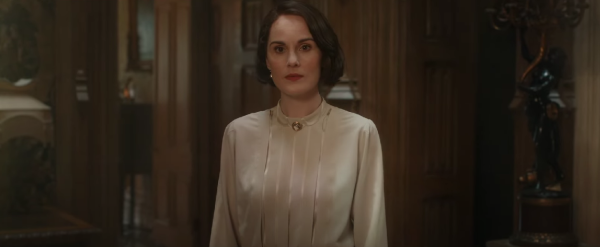
As she stands in the great hall of Downton, reminiscing on all the people she loved who once stood there too, the Mary we see is none of those things. She’s the master of her fate now. She’s not saddled up with a man she doesn’t want, or that doesn’t want her. She doesn’t have to stand behind the throne of Downton’s heir; she now gets to sit on it and rule it. Better yet, she actually knows how to do it, and to do it well—and everyone around her is capable of recognizing it. She’s no longer young and naive; no, she’s someone who slept with a man just because she felt like it, and, when he attempted to blackmail her for it, she not only did not feel shame, but had people to turn to for help. She is settled into who she is rather than afraid of it, capable of showing love and apologizing, of owning all that she has and that she is. She stands alone—but she’s held up by her family and her friends and her confidence.
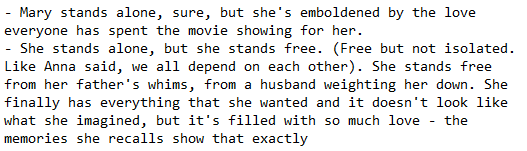
The Grand Finale is a film made specifically for the lovers and watchers of Downton Abbey. It’s a sentimental, emotional movie, with all its goodbyes and its musings about change, its necessity as well as our resistance to it. It’s a happy movie: all the characters get their happy endings in one way or another3. At first, Mary’s ending might not seem like a happy one, but I guess that’s a very Mary thing to have too. She’s not like other girls, after all (/j).
On a personal note, I am someone who is alone a lot—and who is often lonely, too. Maybe that’s part of the reason why I love this ending so much, the quiet contentedness of being on your own and being okay with it. I mean, as a queer polyamorous autistic, I love alternative happy endings in general4, but this one in particular, once I finally understood it, felt so dear to me. And in the conservative world of Downton Abbey, as well as in a time of trad-wifery and a general return to outspoken sexist and misoginistic values, it’s kind of cool that it’s lead female character’s happy ending is not to be happily married with a baby on the way, happy to submit to her husband’s rule, but standing on her own, in her house, on her terms. Very cool indeed.
All this to say, Mary Crawley stands alone; she does not stand lonely. And long live Mary’s slut era—she for sure deserves it.
Some notable exceptions: the finale of season 2 of Torchwood, when I was probably too young to be watching Torchwood in the first place; the West End production of Next to Normal; or, more recently, the ending of Fellow Travelers, which left me full-on sobbing for fifteen minutes. (Jonathan Bailey & Matt Bomer, I fucking love you guys. ♥) ↩
And boy oh boy, does it make me feel some sort of way that in the season 6 finale Edith says, “You're such a paradox. You make me miserable for years, and then you give me my life back.” and this movie is literally the tables turning and Edith giving Mary her life back. Delicious, delicious. ↩
For the purposes of this piece (and of my own sanity), we are not talking about Tom Branson. (I also do frown at the need to marry off Mrs Pattmore (even though I don’t have anything against Mr Mason) but we’ll also leave it for now.) ↩
If you love romance books and like to see other people discussing them and their politics and ponder about all the things a ‘happily ever after’ can be, do yourself a favor and check out the podcast Rebel Ever After. (Episodes are stand-alone, so go for whichever one you fancy or, if you like a rec, I’d say to go with TJ Alexander’s interview.) ↩
You just read issue #1 of TELL ABOUT IT. You can also browse the full archives of this newsletter.