
Miracles of God Today 2026: Miracles Still Happening Today
An honest article for the doubtful, the curious, and the ones who stopped believing.
Start Here: I'm Not Asking You to Believe Anything Yet
If you're a skeptic, you've probably been handed religious articles before. They usually begin by assuming you already agree, then spend a thousand words shouting at you.
This one won't do that.
Instead, I want to ask you to do something much smaller and much harder: suspend the automatic "no" for about fifteen minutes.
Not "believe." Just pause the reflex.
Because here's something worth noticing about your own mind. When you hear a story about a blind man who suddenly sees, your brain does not evaluate it. It rejects it — instantly, before any evidence is examined. That's not reasoning. That's a filter that was installed in you long before you had a chance to inspect it.
Most people in the modern world carry an unexamined rule in their heads that goes roughly like this: the universe is a closed machine, and nothing from outside it ever reaches in. That rule sounds scientific. But it isn't a scientific finding. No experiment ever produced it. It's a philosophical assumption — a starting posture — and it quietly decides the verdict on every miracle claim before the first piece of evidence is even read.
So let's be fair to both sides. If you demand that believers examine their assumptions, you should be willing to examine yours.
Here's the honest question, stripped of religion for a moment:
Is the universe a sealed room — or is there a door?
Everything else follows from that.
The Thing Skeptics Rarely Sit With

Let me paint you a picture.
Fourteen billion years ago, there was nothing. No space. No time. No matter. Not even emptiness, because emptiness is still something — it's a place. There was no place.
And then there was everything.
An entire universe of matter and energy came into existence from a state where no matter, no energy, and no physical laws existed. Something came from nothing. And it came in with a level of precision that even atheist physicists describe as unsettling. Adjust the strength of gravity by a fraction of a percent and no stars form. Adjust the ratio of the strong nuclear force slightly and no carbon exists — which means no chemistry, no biology, no you. The margins are so narrow that scientists invented an entire theory of infinite unobservable parallel universes largely to avoid the alternative explanation.
Pause on that. To avoid the word God, some of the smartest people alive proposed an infinite number of invisible universes, none of which can ever be tested or observed.
And then those same voices turn to a Nigerian woman who says her tumor disappeared after prayer and say: "Where's your evidence?"
Look, I'm not saying that proves Christianity. It doesn't. It proves something much more modest but much more important for this conversation:
If the universe itself began by an act that violates everything we know about how nature behaves, then the door is not sealed. It was opened at least once. The only remaining question is whether it has ever opened since.
The miracle isn't the strange exception to reality. Existence is the miracle. Everything after it is a smaller thing.
What a Miracle Actually Is (You Probably Have the Wrong Definition)

Skeptics usually imagine a miracle as "nature breaking." A rule being violated. Physics glitching.
That's not what Scripture describes at all.
Here's a better picture. Imagine a ball rolling across a table. Newton's laws describe its path perfectly. Now reach out your hand and lift the ball. Have you broken the laws of physics? No. Gravity still worked. The laws still held. An agent simply acted within the system.
That's the biblical model of a miracle. Not the suspension of natural law, but the intervention of a Person into a world He built and still holds together.
And this matters for the whole conversation, because it means miracles aren't chaos. They have a signature. In Scripture, they are almost never random. They are:
Purposeful — they point to something, never just spectacle
Merciful — they overwhelmingly fall on the suffering, not the powerful
Personal — they come through relationship, not technique
Revelatory — they reveal the character of the One doing them
You'll notice Jesus refused to perform a miracle for Herod, who wanted a show (Luke 23:8–9). But He healed a beggar shouting on a roadside. That's not inconsistency. That's a pattern — and it's the exact opposite of what a con artist's pattern would look like. A fraud performs for the powerful. Jesus performed for the desperate.
The Central Claim, Stated Plainly
Christianity does not merely claim that miracles happen. It makes a far more specific claim:
A carpenter from Nazareth was executed under Roman authority, was buried, and three days later walked out of his own grave — and that same Person is alive right now and still acts in the world.
That's it. That's the whole thing.
And notice: if that claim is false, nothing else in this article matters. But if it's true, then the burden shifts entirely. If a man really did defeat death two thousand years ago, then a healed spine in Johannesburg in 2026 is not extraordinary. It's ordinary. It's what you'd expect.
The New Testament says exactly this: "Jesus Christ is the same yesterday, today, and forever" (Hebrews 13:8).
Which brings us to the objection you're probably already forming.
"But Miracles Stopped After the Apostles"

This is the most common intellectual off-ramp, and it deserves a straight answer.
It's called cessationism — the belief that miraculous gifts ended when the last apostle died. Here's the problem: there is no verse that says it.
The passage usually cited is 1 Corinthians 13:8–10, which says prophecy and tongues will cease "when that which is perfect is come." But read the very next line, which defines what "perfect" means: "For now we see through a glass, darkly; but then face to face." That's not describing the completion of a book. That's describing seeing God directly. That hasn't happened yet.
Meanwhile, look at what Peter announced on the very first day of the Church, quoting the prophet Joel:
"And it shall come to pass in the last days, saith God, I will pour out of my Spirit upon all flesh: and your sons and your daughters shall prophesy... and on my servants and on my handmaidens I will pour out in those days of my Spirit; and they shall prophesy." (Acts 2:17–18)
"The last days" is the entire period between Christ's ascension and His return. We are inside that window right now. The promise was never dated to expire in AD 100.
And Jesus Himself said something that should stop any honest reader cold:
"He that believeth on me, the works that I do shall he do also; and greater works than these shall he do; because I go unto my Father." (John 14:12)
He did not say "for forty years." He said "he that believeth on me."
Four Men, Four Continents Watching
What follows are four African prophets whose ministries have become, for millions of people, the visible answer to the question "does God still do this?" I'm including the footage so you can look with your own eyes rather than take my word for anything.
I'd suggest watching at least one before you finish reading.
Prophet Shepherd Bushiri — Malawi & South Africa

The man. Born in 1983 in Malawi, Shepherd Bushiri came from ordinary beginnings and built the Enlightened Christian Gathering (ECG) into one of the largest church movements on the continent. What began as small gatherings became stadium crusades drawing tens of thousands across Southern Africa. Alongside preaching, he is known as an entrepreneur and author, and his services are defined by mass prayer, prophetic declaration, and healing.
What people see. Attendees describe an atmosphere they call "thick" — the sense of a Presence entering a room. Testimonies include the sick rising from wheelchairs, deaf ears opening, and worshippers overwhelmed by what they identify as the Holy Spirit.
One recurring feature of his ministry is unusual enough that skeptics should note it, because it has a direct biblical ancestor. In Acts 5:15, the sick were carried into the streets "that at the least the shadow of Peter passing by might overshadow some of them." Believers report the same phenomenon today.
Watch:
▶ The God of Wonders Who Does Miracles — Prophet Shepherd Bushiri
▶ Extraordinary Miracles During the 2015–2016 Crossover Night
Why the "fire and wind" detail matters. A skeptic hears that and thinks theatrics. But this is not a modern invention. The Church was born with exactly these two signs: "Suddenly there came a sound from heaven as of a rushing mighty wind... and there appeared unto them cloven tongues like as of fire" (Acts 2:2–3). If God announced Himself with wind and fire once, the claim that He might do it again is at least internally consistent with the source document.
Prophet T.B. Joshua — Nigeria

The man. Temitope Balogun Joshua (1963–2021) was born into poverty in Arigidi Akoko, Ondo State. He had little formal education. He founded The Synagogue, Church Of All Nations (SCOAN) in Lagos, and it became one of the most visited religious sites in West Africa — pilgrims flying in from Europe, Asia, the Americas, and across the continent in numbers large enough to measurably affect religious tourism into Nigeria. He built Emmanuel TV into a global Christian broadcast network watched by millions.
He was also, by any measure, extraordinarily generous. Scholarships. Rehabilitation programs for former militants. Support for widows. Large-scale distribution of aid to the poor.
Sit with the shape of that life for a second, because it's the part skeptics skip. A village boy with no education, no connections, and no money ended up being consulted by heads of state and mobbed by desperate people from four continents. Whatever else you conclude, that trajectory demands an explanation.
What people see. His services were unusually public. Prayer for the sick happened on camera, in front of enormous crowds, broadcast live and worldwide. Blind eyes opening. The crippled walking. Deliverance from long-standing affliction. His ministry travelled — Korea, Israel, Latin America — and drew crowds everywhere it went.
Watch:
The pattern worth noticing. Blind eyes are the single most repeated sign in the Gospels — Bartimaeus (Mark 10), the man born blind (John 9), the two blind men (Matthew 9). And when John the Baptist, sitting in prison and full of doubt, sent messengers to ask Jesus whether He was really the Messiah, Jesus did not send back a theological argument. He sent back a list of observable events:
"Go and shew John again those things which ye do hear and see: The blind receive their sight, and the lame walk, the lepers are cleansed, and the deaf hear, the dead are raised up, and the poor have the gospel preached to them." (Matthew 11:4–5)
Notice the method. Heaven answers doubt with evidence, not with a lecture. That's not an anti-intellectual religion. That's a religion staking its claim in the observable world — which is exactly what a skeptic should want.
Prophet Uebert Angel — Zimbabwe & UK

The man. Born in 1979 in Zimbabwe, Uebert Angel founded the Spirit Embassy / Good News Church, with congregations and influence spanning Zimbabwe, the United Kingdom, and the wider African diaspora. He's an author and businessman as well as a preacher, and teaches extensively on faith, provision, and how the prophetic gift operates. His crusades regularly fill venues across Africa, including Nigeria.
What people see. Two things dominate. First, instantaneous healings under the laying on of hands. Second — and this is the one that makes skeptics sit up — what believers call "miracle money": the sudden, unexplained appearance of finances during services.
Let's be honest about that one. It's the claim most likely to trigger your alarm. So let's think it through rather than react.
Watch:
▶ Instant Miracles: God's Healing Power Through the Hands of Prophet Angel
▶ Miracle Money Rains in Millions in Auchi at the Command of Prophet Uebert Angel
The theological logic. Here's the thing: if you accept a God who created matter from nothing, then multiplying existing matter is a smaller act, not a larger one. And supernatural provision is one of the oldest patterns in Scripture:
Bread appeared on the ground every morning for forty years (Exodus 16)
Ravens delivered food to a starving prophet (1 Kings 17:6)
A widow's jar of oil refused to run empty (1 Kings 17:16)
Another widow's vessels overflowed until she ran out of containers (2 Kings 4:1–7)
Five thousand people ate from a boy's packed lunch (Matthew 14)
Jesus told Peter to pay the temple tax with a coin found in a fish's mouth (Matthew 17:27)
That last one is remarkable and almost never quoted. Jesus performed a currency miracle to pay a tax bill. A God who does that is not embarrassed by money appearing in a meeting.
The right question is never "could God do this?" It's "what is this for?" Provision in Scripture always lands on need — the widow, the hungry, the stranded. That's the test to apply.
Prophet Jeremiah Omoto Fufeyin — Nigeria

The man. Jeremiah Omoto Fufeyin is based in Warri, Delta State, and founded Christ Mercyland Deliverance Ministry. He is known across Nigeria for two things running side by side: a deliverance-focused ministry, and unusually extensive philanthropy. Food distribution. Cash gifts. Scholarships. Sustained support for widows, students, and the vulnerable across the Niger Delta and beyond. His weekly services reach a large online audience, and people travel from across Nigeria and West Africa for prayer.
What people see. Loud, physical, joyful worship. Deliverance from what participants describe as demonic oppression. Healing. Prophetic words spoken over individuals in crowds. Testimonies of breakthrough after years of stagnation, restored health, restored families.
Watch:
On the subject of demons. I know. This is where the modern mind fully disengages.
But be consistent. If you reject the demonic because it's invisible and immaterial, then you have a problem, because you already believe in dozens of invisible immaterial things — consciousness, mathematics, moral obligation, the number seven. None of those can be weighed. You accept them because of their effects.
And deliverance was not peripheral to Jesus. It was central. "They brought unto him all sick people... and those which were possessed with devils... and he healed them" (Matthew 4:24). He then handed that authority on: "Behold, I give unto you power to tread on serpents and scorpions, and over all the power of the enemy" (Luke 10:19).
As for the dancing — David "danced before the Lord with all his might" until his wife was embarrassed by him (2 Samuel 6:14–16). Restraint has never been the biblical standard for worship. Sincerity has.
Popular Miracles In History That History Could Not Explain Away
Everything above happened recently enough that a skeptic can reasonably say, "Give it time. Someone will explain it."
Fair enough. So let's do something harder.
Let's look at cases that have already had the time — decades, in some cases more than a century. Cases that were investigated by hostile journalists, examined by secular doctors, tested by committees specifically assembled to debunk them, and published in medical literature. If time and scrutiny dissolve miracles, these should have dissolved long ago.
They haven't.
1. The Day the Sun Danced — Fátima, Portugal, 13 October 1917

What was claimed in advance. This is the detail that makes Fátima different from almost every other miracle claim in history: it was announced beforehand.
Three shepherd children — Lúcia dos Santos (10) and her cousins Francisco (9) and Jacinta Marto (7) — said that a heavenly figure had told them a public sign would occur at a specific place, on a specific date, at roughly noon, "so that all may believe."
The prediction was printed in newspapers. That's a stunning risk. It gave the entire nation months of advance notice to gather and watch a specific patch of ground at a specific hour — with every opportunity for total public humiliation.
Who was watching. Estimates of the crowd range between 50,000 and 70,000 people, standing in heavy rain. Crucially, the crowd was not a self-selected group of the devout. Portugal in 1917 was under an aggressively secular First Republic; churches and schools had been seized, and public religious festivals banned. Journalists came specifically to mock.
What was reported. Witnesses described the rain stopping, the clouds parting, and the sun appearing as a dull, silver disc that could be looked at directly without pain. It then appeared to spin, throw off multicolored light across the landscape and the crowd, and plunge toward the earth before returning. Many reported that their soaked clothing and the muddy ground were suddenly dry.
Why this one is hard to dismiss. The most detailed contemporary account was written not by a priest but by Avelino de Almeida, star reporter for O Século — an openly anticlerical, Republican newspaper in Lisbon. He arrived a skeptic, wrote in a mocking tone about the pilgrims, and then filed this:
"To the amazed eyes of those people... the sun trembled, the sun had never-before-seen brusque movements beyond all cosmic laws — the sun 'danced'... It still remains for the competent ones to apply judgment to the macabre dance of the sun."
The full translated 1917 dispatch is available here: Avelino de Almeida's original O Século report, translated
An anti-religious newspaper putting a reported miracle on its front page is not what fabrication looks like. It's what a reporter looks like when he cannot explain what he just watched.
Notably, Father John De Marchi, who spent seven years (1943–1950) in Fátima interviewing witnesses, recorded that among the hundreds who gave formal testimony — believers and scoffers alike — "none to our knowledge has directly denied the visible prodigy of the sun."
Be honest about the counter-arguments. Not everyone saw the same thing. Some saw only colors. Some saw nothing at all. Skeptics propose retinal effects from staring at the sun, or an unusual atmospheric phenomenon. These are serious proposals and shouldn't be waved off.
But note what they don't explain: the appointment. Optical illusions and cloud phenomena do not RSVP three months in advance to a location chosen by children.
Sources:
2. The Shrine That Employs Doctors to Debunk Itself — Lourdes, France, 1858–present

If you built an institution specifically designed to reject miracle claims, you would end up with something close to the Lourdes Medical Bureau.
The setup. After a 14-year-old peasant girl named Bernadette Soubirous reported visions at a grotto in 1858, cure claims began pouring in. Rather than celebrate them, the Church did something almost no religious movement does: in 1883 it established a permanent medical office to investigate and, in most cases, disprove them.
The numbers should give a skeptic pause — in the right direction. Over 7,000 cures have been formally claimed at Lourdes since 1858.
Seventy-two have been recognized.
That's a rejection rate above 99%. As one commentator put it, you'd have better odds at the lottery.
Think about what that rate signals. A fraud machine approves. A filter rejects. This institution rejects almost everything that walks through its door.
The seven criteria. For a cure to pass, a panel must agree that:
The disease was serious with an unfavourable prognosis
The disease is known and documented in medicine
The disease is organic and lesional — with objective biological or radiological evidence. Purely psychological, functional, or nervous conditions are excluded by rule, precisely because they're susceptible to suggestion
No treatment can plausibly account for the recovery
The cure was sudden, instantaneous, and without convalescence
It restored full vital function, not merely reduced symptoms
It was permanent, not a remission
Criterion 3 deserves your attention. The Bureau has pre-emptively conceded the placebo objection. It refuses to consider exactly the category of illness where placebo works.
A case that survived it. Sister Bernadette Moriau suffered from cauda equina syndrome — a spinal nerve disorder. By 2008 she had endured four failed surgeries, a spinal neurostimulator, permanent braces, a splinted, twisted left foot, and heavy morphine doses. She travelled to Lourdes that year, by her own account not seeking healing.
Days after returning home, during a period of prayer, she says she felt heat spread through her body and an inner voice telling her to remove her braces. She did. Her foot was straight. She stopped the morphine and the neurostimulator at once.
Then came eight years of investigation. Multiple neurologists. Multiple rheumatologists. Repeated imaging and electrophysiology. Two psychiatrists in Paris tasked with determining whether she was lying or hallucinating. Dr. Alessandro de Franciscis, the Bureau's president, estimates her file was reviewed by at least 300 physicians.
Dr. Kieran Moriarty, one of the reviewing specialists, was asked whether any treatment could have produced her recovery. His answer: "No treatment would be that effective that quickly."
Her case was declared the 70th miracle of Lourdes in 2018. The 71st was recognized in December 2024, and the 72nd in April 2025.
Sources:
CBS 60 Minutes — full investigative report and transcript, "Where 72 medical miracles have been recognized" (this segment includes video)
The Sanctuary of Lourdes — official statement of the seven criteria and full statistics
Aleteia — "Why are there only 72 approved miracles at Lourdes?"
One of the reviewing doctors, Jacek Mostwin, a professor of urology at Johns Hopkins, described the panel's posture this way: "We're just as technical as a forensic pathologist when it comes to looking at the technical details of the case."
And the local bishop, asked directly what he would say to skeptics, gave an answer that could serve as the thesis of this entire article:
"Come and see. Be open. Don't be narrow-minded. Be open to believe that the real world is wider than the visible one."
3. When Researchers Brought Instruments Into the Field — Mozambique, 2009
Here's the objection you've been waiting to raise: "Fine, but nobody ever measures these things properly with equipment, in the moment."
Someone did.
In 2009, a research team led by Dr. Candy Gunther Brown of Indiana University, with a physician (Dr. Stephen Mory), a Cambridge-trained doctor in tropical medicine (Dr. Rebecca Williams), and a professor from Saint Louis University (Dr. Michael McClymond), travelled to rural Mozambique carrying an audiometer and standardized "Illiterate E" vision charts.
They tested 24 consecutive subjects reporting hearing (14) or vision (11) impairment, immediately before and after they received hands-on prayer at Christian meetings in the villages of Impiri, Namuno, Chiúre, and the city of Pemba.
The results were published in the peer-reviewed Southern Medical Journal, September 2010.
Significant improvement in auditory function: p < 0.003
Significant improvement in visual function: p < 0.02
Two subjects showed hearing thresholds reduced by over 50 decibels
The researchers' own conclusion: "The magnitude of measured effects exceeds that reported in previous suggestion and hypnosis studies."
Read the design carefully, because it anticipated your objections.
They deliberately chose hearing and vision specifically because those functions are less susceptible to psychosomatic influence than conditions like pain or arthritis — and they say so explicitly, criticizing earlier prayer studies for choosing rheumatoid arthritis, which is vulnerable to perceptual improvement.
Three subjects were excluded from the analysis for giving false-positive responses during testing. Two subjects who couldn't be retested were counted as unimproved. The study had IRB approval from Indiana University and was funded in part by the John Templeton Foundation and the Lilly Endowment.
Be fair about its limits. It's a small sample. There was no control group. Ambient noise in the field was high. The authors themselves call for further study rather than claiming proof. Published commentaries in the same journal pushed back.
But that's precisely the point worth making to a skeptic: this is not a testimony video. This is a documented, instrumented, peer-reviewed, methodologically self-critical study, sitting in the medical literature, that anyone can pull up right now.
Sources:
What These Three Cases Have in Common
Fátima, Portugal — 1917
Announced in advance? Yes — predicted months ahead, with the date, time, and location printed in newspapers
Hostile witnesses present? Yes — anticlerical Republican journalists came specifically to mock
Documented by non-believers? Yes — the fullest contemporary account was filed by O Século, an anti-clerical Lisbon paper
Best skeptical counter: An optical or atmospheric effect from staring at the sun
Lourdes, France — 1858 to present
Announced in advance? No — cures are claimed after the fact and investigated retrospectively
Hostile witnesses present? Yes — review panels are built to reject, and do so in over 99% of cases
Documented by non-believers? Yes — reviewing physicians may be of any faith or none; one case passed roughly 300 doctors
Best skeptical counter: Rare spontaneous remission that happens to satisfy all seven exclusion criteria
Mozambique — 2009
Announced in advance? Yes — the testing protocol was fixed before subjects were prayed for
Hostile witnesses present? Yes — submitted to peer review and publicly criticized in the same journal
Documented by non-believers? Yes — published in the Southern Medical Journal, with IRB approval
Best skeptical counter: Small sample size and no control group
Notice that each case carries a genuine counter-argument. I won't pretend otherwise, and you shouldn't trust anyone who does.
But notice something else: the counter-arguments are all different. One needs an optical illusion. One needs an improbable run of spontaneous remissions. One needs measurement error in calibrated audiometry.
To dismiss the whole body of evidence, you need a separate ad-hoc explanation for every case. That isn't one theory — it's a series of individual rescues, each invented to protect a conclusion you brought with you.
At some point a simpler explanation becomes available. And the reason it still feels unavailable isn't that the evidence is weak. It's that the conclusion is costly.
The Honest Bottom Line
None of this forces belief, and it isn't supposed to. God has never operated by compulsion — He gives enough light for the willing and enough shadow for the unwilling, because He is after love, and love cannot be extracted at gunpoint.
But the claim that miracles are undocumented, unexamined, and unavailable to scrutiny is simply not true. They have been reported by anticlerical journalists, filtered by panels that reject 99% of what they see, and measured with instruments in African villages by researchers publishing in medical journals.
The evidence is on the table. It always was.
The question was never whether there is enough of it. The question is what you'll do with it.
A note on the video links above: the Fátima section links to a BBC feature containing 1992 archive interview footage with an eyewitness, and the Lourdes section links to the full CBS 60 Minutes segment. Both can be watched directly at those sources.
Now, The Serious Objections
You deserve real answers, not slogans. Here are the strongest arguments against everything above, taken seriously.
"Hume proved miracles are always irrational to believe"
David Hume argued that since a miracle violates uniform human experience, the evidence against it will always outweigh any testimony for it.
It sounds airtight. It isn't. It's circular, and the circle is easy to see once pointed out.
Hume claims human experience is uniformly against miracles. But how would he know that? Only by first dismissing every single report of a miracle as false. He assumes his conclusion in order to build his premise. He's essentially saying: "miracles never happen, therefore reports of miracles are false, therefore miracles never happen."
By that same logic, no genuinely unprecedented event could ever be rationally believed — which would have made meteorites, germ theory, and continental drift permanently irrational to accept. Every one of those was dismissed by experts because it contradicted "uniform experience."
Evidence is supposed to shape our expectations. Hume's rule uses expectations to forbid evidence. That's backwards.
"It's the placebo effect"
Sometimes it is, and honest believers should say so plainly. Emotional environments produce real physiological effects. Pain perception shifts. Adrenaline masks symptoms. That's well documented and Christians shouldn't pretend otherwise.
But placebo has known boundaries. Placebo does not regrow tissue. It does not restore an optic nerve. It does not close a hole in a heart or make a tumor disappear from a scan. Placebo affects subjective symptoms — pain, fatigue, mood. It does not reverse objective structural pathology.
So the placebo objection covers part of the ground, honestly. It does not cover the strongest cases. And in intellectual honesty, an explanation that covers 60% of the data is not a refutation of the other 40%.
"It's emotional manipulation and crowd psychology"
Again — sometimes, yes. Crowds are suggestible. Music, expectation, and social pressure are powerful. Any honest believer has to concede this.
But run the objection in reverse. Crowd psychology explains why someone might feel healed. It does not explain why a man who has been blind for thirty years walks home reading. It explains excitement. It doesn't explain outcomes.
And note: this objection proves too much. If emotional crowds automatically produced healings, football stadiums and concert arenas would be the world's most effective hospitals. They aren't.
"Show me a peer-reviewed, double-blind study"
This is a fair demand in spirit, but it contains a category error.
A double-blind trial tests a repeatable mechanism — a drug that behaves the same way in every subject. Miracles, by definition, are not a mechanism. They are the acts of a Person. You cannot run a controlled trial on a free agent, any more than you could design a double-blind study to prove your mother loves you.
Personal agency is not tested by repetition. It's tested by evidence and testimony — which, incidentally, is exactly how courts of law establish the most serious facts in human society, including guilt, innocence, and death.
That said, medical documentation of unexplained recoveries does exist, and individual cases with before-and-after imaging have been reviewed by physicians. The evidence base is not empty. It's simply not the shape of evidence a pharmaceutical trial produces — because it isn't that kind of thing.
"Some of these preachers have been accused of fraud"
Yes. And this objection deserves the most direct answer of all.
Fraud exists. Scripture said it would, repeatedly and bluntly. Jesus warned: "Beware of false prophets, which come to you in sheep's clothing" (Matthew 7:15). Paul warned of men who suppose "that gain is godliness" (1 Timothy 6:5).
But apply the logic evenly. Counterfeit currency exists only because real currency exists. Nobody forges a banknote for a currency that was never issued. The very existence of religious fraud is indirect evidence that there is something genuine worth imitating.
And Jesus gave a usable test — not a feeling, but an observable one: "By their fruits ye shall know them" (Matthew 7:16). So look at fruit. Scholarships funded. Widows fed. Addicts sober. Marriages rebuilt. Communities changed. Millions who encountered Christ.
More to the point for a skeptic: your ultimate question isn't about any of these four men. It's about God. Whether a particular preacher is flawed, saintly, or somewhere in between, the real question underneath is whether the God they point to is real. Men are always the weak link. That's true in every field — medicine, science, journalism, government. Corrupt doctors exist. Medicine still works.
The Question Nobody Asks a Skeptic
Here's something I'd genuinely like you to consider.
Suppose God did prove Himself to you tomorrow, beyond all possible doubt. A verified, undeniable, video-documented, medically-confirmed miracle performed at your personal request.
What would change in your life?
Because if the honest answer is "nothing much" — then evidence was never really the obstacle. Something else was.
This isn't an accusation. It's an observation from the text itself. Jesus performed signs so undeniable that His enemies never once disputed that they happened. Read the Gospels closely: the Pharisees never say "that healing was faked." They say "He casts out devils by Beelzebub" (Matthew 12:24). They accepted the event and reinterpreted the source — because accepting the obvious source would have cost them everything.
Jesus put it precisely: "If they hear not Moses and the prophets, neither will they be persuaded, though one rose from the dead" (Luke 16:31).
That is a shockingly bold claim. And history tested it. One did rise from the dead — and many still weren't persuaded.
Belief has never been purely an evidence problem. It's a willingness problem wearing an evidence costume.
"Why Africa?"

It's a fair question and it deserves a real answer, not a defensive one.
Part of the answer is sociological. Much of the Western world has spent three centuries training itself out of a supernatural worldview. That training is thorough. Where the possibility of divine action has been culturally erased, people don't ask for it — and don't recognize it when it comes.
But there's a deeper answer, and it's in the text. Of Jesus in His own hometown, Scripture says something startling: "He did not many mighty works there because of their unbelief" (Matthew 13:58).
Read that again. The power wasn't reduced. The reception was.
Faith isn't the payment for a miracle. It's the posture that receives one. Miracles are not distributed by geography. They're distributed by hunger. Much of Africa has retained something the modern West traded away: a worldview in which God is near, the unseen is real, and prayer is the first response to crisis rather than the last.
That's not superstition. It might be the older and more accurate map.
What Miracles Are Actually For
Here's the part that surprises people, and it's the most important section in this article.
Miracles are not the point. They never were.
A healed body will still eventually die. Lazarus walked out of a tomb — and then died again later. An emptied wheelchair is a beautiful thing, but it's temporary. Every person Jesus healed in the first century is dead today.
So what were they for?
Signs. That's the actual biblical word — semeion, a sign. And a sign is not a destination. A road sign that says "London 40 miles" isn't London. Its entire purpose is to make you look somewhere else.
John states it outright:
"Many other signs truly did Jesus in the presence of his disciples, which are not written in this book: But these are written, that ye might believe that Jesus is the Christ, the Son of God; and that believing ye might have life through his name." (John 20:30–31)
The miracle is the sign. Jesus is the destination.
Which means the greatest miracle available to you today isn't the healing of a body. It's the forgiveness of a life — a person who was closed, cynical, guilty, and afraid becoming genuinely new. That transformation happens every single day, in millions of people, and it's the one miracle that lasts past the grave.
And here's what should genuinely arrest a skeptic: that particular miracle requires your permission. God heals bodies unilaterally. He does not save souls without consent. Everything Christianity offers, at its center, is a door that opens from the inside.
The Invitation
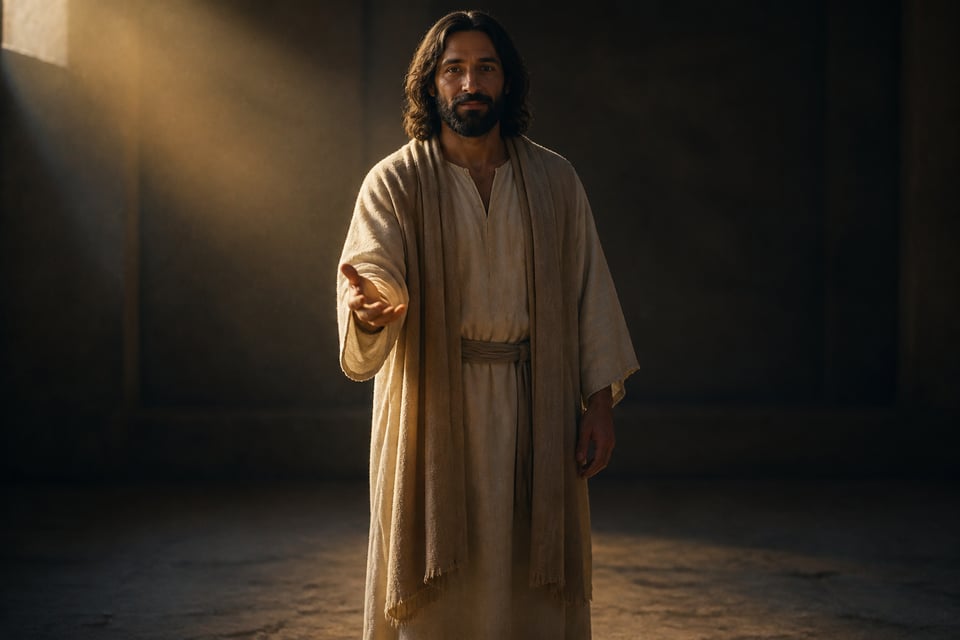
The best answer ever given to a skeptic was three words long.
When Nathanael heard about Jesus, he sneered: "Can there any good thing come out of Nazareth?" (John 1:46). It was a cynical, dismissive, superior remark — exactly the kind you'd make.
Philip didn't argue. He didn't produce evidence. He said:
"Come and see."
That's all this article is.
Watch the recordings above. Look at the faces of ordinary people the moment something they'd given up on happens to them. You don't have to conclude anything yet.
Then do the harder thing. Pray — even if it feels absurd. Even if you're not sure anyone's listening. Say something honest, like:
"God, if You are real, and if Jesus is who He claimed to be, show me. I'm willing to know the truth, whatever it costs me."
That's not a religious formula. It's just honesty, and honesty is the only thing God has ever required as a starting point. The promise attached to it is old and specific: "Ye shall seek me, and find me, when ye shall search for me with all your heart" (Jeremiah 29:13).
The miracles of God did not end at Calvary, or at Pentecost, or when the last apostle died. They continue in Lagos and Warri, in Johannesburg and Harare, in hospital corridors and living rooms, in packed stadiums and half-empty village churches. They happen wherever someone is desperate enough, or humble enough, to take God at His word.
The door in the sealed room was opened once, at the beginning of everything.
It has never been shut.
Jesus sacrificed himself to give us access to miracles through him.

He's ever waiting to receive you.
All you ever need to do is pray.
"Behold, I am the LORD, the God of all flesh: is there any thing too hard for me?" — Jeremiah 32:27
Watch the footages linked in this article. Then judge for yourself. The evidence is on the table.
The question is… Will you believe?
The impossible is possible with God.
A miracle can still happen today.
Today might be yours 😊.

If you made it to the end, congrats.
And if you're ever in doubt of the existence of Jesus.
Read it here: 10 Historical Evidences of Jesus Outside The Bible.