The glaciers at the end of the melt
Why the park's naturalists measured Lyell and Maclure in the first week of October.
At the head of the Tuolumne River, beneath Mount Lyell, the melt season is running out. Mount Lyell is 13,114 feet, the highest peak in the park, and below the high peaks lie the last two ice bodies in Yosemite, the Lyell and Maclure glaciers. Both formed in the Little Ice Age, and the Park Service counts them as a year-round supply of cold water to the Lyell Fork of the Tuolumne, most of all in late summer and fall, after the winter snowpack has melted.
A glacier keeps an account: winter snow added, summer melt taken away, and the balance is the climate written in ice. The ice moves only while it is thick enough to flow under its own weight, or while water underneath lets it slide. In 2012 scientists repeated John Muir's 1872 stake experiment on the Maclure and found it moving about an inch a day, Muir's rate, at less than half its old size, because its own meltwater helps it slide. In 2022 it had slowed to three quarters of an inch. The Lyell had not moved at all, probably because it is too thin, and the park now writes that "the term 'glacier' may no longer properly apply to the Lyell ice body." The site's account of how Lyell has lost 60 percent of its area since 1900 has the thinning too: roughly 120 vertical feet.
Early October is when the park's naturalists went up to read that account, every year from 1931. In December 1939 Assistant Park Naturalist M. E. Beatty explained the timing: snow from the previous winter "often covers the glacier surface and shaded fronts until early October," and until the ice edge is bare it cannot be measured. "Ordinarily, studies are made during the first week of October but the light winter of 1938-39 made earlier measurements possible," he wrote that December. That year the first measurements were taken on September 18.
This year the melt season is not closing yet. The Tuolumne Meadows sensor, at 8,500 feet, read 34°F at 7 am Saturday, with no snow on the ground. The National Weather Service forecast for Yosemite Valley calls for sun every day through Friday, with highs from 84 to 92. Every warm afternoon is another day of melt on the Lyell, which by the park's own projection could disappear within a decade or so.
 The Lyell Glacier above its moraine. Photo: NPS Natural Resources / Wikimedia Commons (public domain)
From the naturalists' notebooks
In the week of October 9 to 16, 1932, Junior Park Naturalist C. C. Presnall measured glaciers with Bert Harwell and noted what lived at the ice. "Rosy finches were by far the most common form of life, appearing in large flocks at every glacier and snow field we visited," he wrote. On Kuna Glacier, at 12,400 feet, over a hundred circled "close by to feed on insects frozen in the ice." (November 1932)
Three years later Beatty reported the fifth survey finished on October 5, with a slight advance after a heavy winter, and judged that "there is no immediate danger of our Sierra glaciers disappearing entirely." (December 1935) The Park Service's projection for the Lyell today is the measure of what ninety years did to that sentence.
Also in season
The nutcracker's harvest. Fall is when the Clark's nutcracker buries pine seed, near treeline along Tioga Road. Whitebark pine (Pinus albicaulis) cones do not open when the seed is ripe, and the seed ripens from mid-August to mid-September, so the nutcracker (Nucifraga columbiana), which breaks the scales and buries the seed, is the tree's only important means of dispersal. A nutcracker carries up to 90 seeds at once in a throat pouch and may store 30,000 or more in a season. The seeds it never retrieves, the site's guide to the high-country animals notes, become the next generation of trees.
 A Clark's nutcracker at Lassen Volcanic National Park. Photo: LassenNPS / Wikimedia Commons (Public domain)
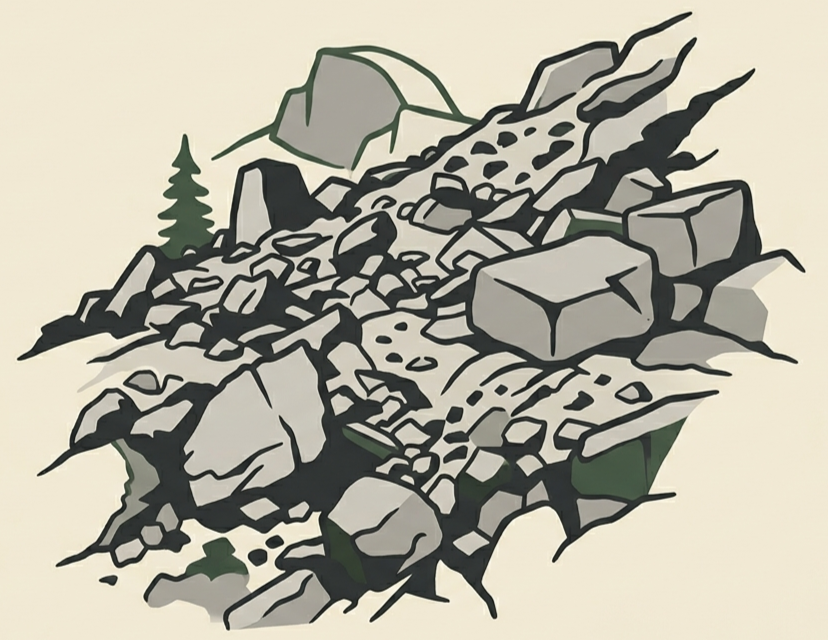
The cony's hay. The pika, which the 1932 naturalists called the cony, does not hibernate. It spends the short summer curing cut grasses and wildflowers on the rocks into haypiles, its food through the winter. It lives in the cold air spaces between the rocks of the talus slopes above 8,000 feet along Tioga Road, and it announces itself with a squeak-toy "eep" from somewhere inside the rubble.
Before you go: there is no overnight parking on Tioga Road from October 15, and the Tuolumne Meadows Wilderness Center closes after October 14, when permits for Tioga Road trailheads move to self-registration on its porch. Road and trail status for the rest of the park is on the Park Bulletin.
Forwarded this? The letter is free at thetalusfieldjournal.com/newsletter.
The ice keeps its own account. Back next Sunday, when there is something to say.