Gnamma

Archives
Subscribe

Gnamma

Archive

Gnamma #21 - Loose Space & Tight Friendships

I organized a little meet-up of Brown and RISD grads I knew in Oakland, recently, and was reminded that many of them I knew through working at the Brown Design Workshop. 

Since moving to the West coast, I haven't had access to a "workshop"-style space. A messy, communal space. I love spaces like this because of the relationships they help build—where, without forcing it, you can spend a lot of time with people of similar interests—and because they act similarly to a home "junk drawer." Stuff can accumulate until it finds utility by someone, for something, at some point. A natural pressure-release valve in the circulation of material in the world (but you need to make the time to sift through it...). 

Now that I'm doing field work, I've gained access to some of the instrument prep & testing spaces on university campus. The spaces are fairly locked-up, due to how expensive the tools are, but finally, I have a beat-up workbench that I can commandeer for a few days at a time. Whew! 

I appreciate working on physical objects (in contrast to conceptual or analytical work) because problems tend not to hide themselves: every aspect of the entity is present, whether you thought about it or not. (Whereas, with conceptual objects, they have the possibility of bringing along baggage you didn't prepare for.) My boss at the BDW, Chris Bull, once said that "there is an indelible truth in the construction of physical objects." 

Physical objects, too, rarely have a sense of starting "from scratch." You're always starting within a material, within a budget, within a spatial constraint. When doing open-ended analytical work, I can tie myself into a knot fretting about how early decisions will dictate my end results. When I'm working in a messier material reality, I find it easier to just start putting stuff together. (Maybe it's a childhood of LEGO...)

It's a dream of mine to (help) run a community space. I love thinking about the physical and social conditions that make for effective working and sharing space, be it a woodshop, library, co-working space, or dance studio. There is so much value in bringing some zones of action out of the home and into public or shared spaces; it prompts forming communities and sharing costs. 
 
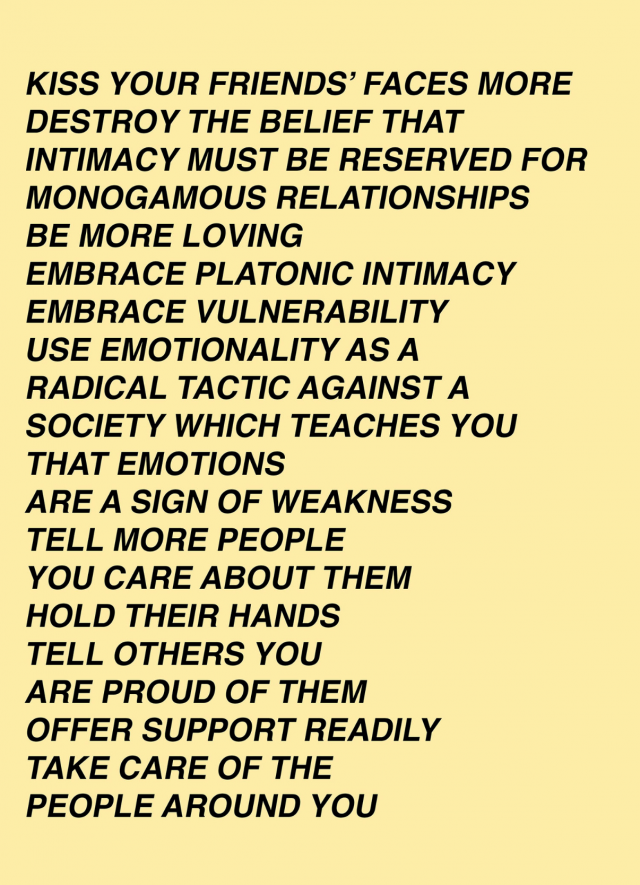
Lora Mathis
Free post
#22
May 26, 2019
Read more

Gnamma #20 - A Metaphor to Cradle The World

First, a shameless plug for something I'm running a week from now: 
 
waterbodies is a workshop to connect with the water around you. waterbodies wants you to get wet! waterbodies wants you to remember what water tastes like! waterbodies wants you to know where the water comes from, and where it goes! waterbodies wants you to feel that complexity is natural! waterbodies wants you to feel like you belong here! waterbodies wants you to melt into the world and find yourself anyway.

Saturday, May 25th at 1pm at magic & pasta in Berkeley, CA, Ohlone land. 1135 Page St, then turn the corner to the garage. Please wear shoes that can get wet. Bring a towel, water bottle, and memories of childhood if you can. MORE INFORMATION HERE. 
 
~

I've been writing poetry off-and-on for a few years, but in April (National Poetry Month), I wrote some poetry every day. The timing was perfect, as April ended up being a bit of a rollercoaster. A daily reflective practice helps me get in touch with how I'm feeling and gives me a place to pour my energy. 

In writing, I've been reflecting on the metaphors I use and find important in my navigation of the world. In language, what isn't a metaphor? A word is a word, but it projects some array of connotations and denotations into the minds-eye of the reader. My first interest in poetry came through reading Aram Saroyan's Complete Minimal Poems (beautiful edition), which helped me recognize that poetry doesn't have to be long-winded and densely wrought to have emotional weight; it can be playful, brief, and still knock the wind out of you. Saroyan's work also plays with  words both as metaphors (i.e. linguistic objects) and objects in themselves (as typographic objects). 

Earlier this year I noted how Learning Gardens developed a sense of importance around the metaphor of gardening. I find "gardening" deep in connotations, connections, and values that I appreciate. I've also written about water, how water in the landscape has served me well as a metaphor for an entity that exists as both solute and substrate, or for things where boundaries are both necessary but often difficult-to-define. 

If you've ever worked with a group on a complex project, you know how much time can go into making sure everyone is on the same page—a state that can be more easily reached through an easy-to-grok metaphor. Call this a "conceptual model," call it "shared language"—it boils down to having similar metaphors for understanding the object of your focus. 

In this sense, a metaphor is a tool for grasping something. A glove, a handle, a mode of holding. ("Grasp" feels a bit strong here—alternatively, "hold" or "cradle" may make more sense.) We approach abstract, intangible, and complex things through metaphors as a way to build an understanding. Douglas Hofstadter has a great lecture about this and more, "Analogy as the Core of Cognition." 

Some metaphors stick, and some are useful only once. As one's relationship with a metaphor deepens (either by spending a lot of time with it, or seeing it ubiquitously), the metaphor can expand, and our understandings along with it. We can start to "jump" between metaphors, where two adjacent metaphors may connect their two otherwise-distant signified entities.

I've thought about mathematical notation as metaphor, too. Einstein Index Notation is one of my favorite mechanisms by which, in trusting the expressive power of the notation system, I've found myself able to make conceptual leaps. For instance: within a train of logic, I might be at a moment where the physics of the problem make sense and are well-expressed by the mathematical symbols, but I need to make a jump to another point. With this notation system, sometimes the in-between steps have no physical reality. But, once on the other end, the connections between the notation and the physical entities I'm seeking to capture re-emerge. The notation—a metaphor itself—acts as a bridge between two other coherent metaphorical states. 

My poetry practice has been a way for me to engage with some metaphors I hold dear—water, gardens, the moon, the skull, bedrooms. Sometimes writing poetry feels navel-gazing to me, but I'm trying to believe in the act of creating and publishing a metaphor as valuable and lovely. Sharing metaphors is sharing your set of keys to concepts and feelings, which gives others the opportunity to find some new understandings, too. 

Nic has a great channel on Are.na for more thoughts on this: Theorizing Metaphor. 

Seeking a foothold,
Lukas
 
Free post
#21
May 18, 2019
Read more

Gnamma #19 - Manifesting One's Values

Listless Lukas this week. I don't want to write much. 

In Summer 2015 I had a block of time with few external expectations. I did a lot of work on myself that summer, including writing a small manifesto of values and things I felt I had learned in life thus far. Advice for myself, by myself. That link goes to the current version, which has been updated and tweaked over the years, as it should be until I die or otherwise give up. 

I've returned to this document at times when I need to remind myself how little control there can be in life, and how to keep building towards one's values regardless. It reminds me how to center myself through what I seek to manifest in the world. This helps me think about self-care outside of self-indulgence. 

Recalibrating,
Lukas
Free post
#20
May 10, 2019
Read more

Gnamma #17 - Short & Wet

In late May (25th, likely) I'll run a workshop at Magic and Pasta. We're figuring out the exact nature of the event, but largely it will focus on how people relate to and conceptualize bodies of water, especially those we live around. I thank Helen, Kendal, and John for the opportunity! I can also credit many others with this idea: Hydrosocial studies, this lecture, messages with Pierie. 

My interest revolves around water as an intractable hyperobject—but also one that is terrifically mundane. We connect to water reservoirs whenever we turn on the tap; we create our own bodies of water whenever we take a bath; you are also probably just a short walk from your closest creek, river, or reservoir. We exist as bodies of water and in bodies of water (the atmosphere), which is especially apparent in the Bay Area. 

Talk to any surfer and they'll probably say they feel "connected" to the ocean, inasmuch as they regularly spend time there, paying attention to it. Despite the fact that a complete view of the physics of water flow escape us, plenty of people are extremely adept at "reading" water towards mechanistic understanding and emotional connection. What happens when we give this kind of attention to a nearby creek? To the reservoir that gives us drinking water? To our own bathtubs? 

In the face of climate change's disruption of typical hydrologies, perhaps "using water should be like drawing blood" (ref by Éd). I'm also hoping that by physically interacting with Berkeley's bodies of water (creeks and the Bay), we can build a more emotional connection to their dynamism and sensitivity to coming changes. 
 
The other thing that is interesting about water is that you’re never looking at water alone. You’re looking at water in relation to something. Whether a lake, or a river, or environment. Water is a very dependent material in terms of its neighbors, and you do have to wonder where its transparency comes from. The transparency of water is also the most opaque thing about it. (ref)

Stay tuned, I'll share as details come into full-view. 

Bubbling,
Lukas
Free post
#19
April 28, 2019
Read more

Gnamma #18 - Geologic Objects

I've been thinking and conversing a lot, recently, on geology. In alternate universes, I imagine studying architecture or geology in college. In going into engineering, excitingly, I get to touch on both of these. 

When I think about geologic timescales I return to thinking about scaling: from a lived-experience day-to-day, geology appears inert. And to objects and processes operating on geologic timescales, culture and biology are negligible perturbations at the surface. The scales do not match at all. Stewart Brand's famous diagram captures this: 
 
 
Free post
#18
April 28, 2019
Read more

Gnamma #16 - The Next Big Change

There's a looming big decision in my life, and I'm writing this week partly to start conversation. The decision is, "what next?" I'll finish my master's program in December of this year, which feels soon enough to start figuring things out. I have some specific work I'm interested in doing: coastal adaptation to sea level rise, sediment management, fluvial habitat restoration, flood risk mitigation. I also miss teaching. Still, as always, I am pretty open to whatever comes my way. 

(I remember going to a talk by Ann Pendleton-Jullian where she discussed her pathway through life, and she introduced the metaphor that one's vehicle through life is more akin to a sailboat than something with an outboard motor.)

I have a history of being sloppy at making large life decisions: I pulled teeth out over changes as a teen, I lost some friends due to flip-flopping on my decision to transfer colleges, my move to Los Angeles was sudden and stupid, and the decision to come to the Bay Area for grad school was almost flippant. I regret none of it, of course, and have a supportive family (thanks!!). Now, with the next chapter of life on the horizon, I'm curious if I can structure the next transition more intentionally. 

After 8 months I finally feel something of a social and emotional network in the Bay Area, but I still ache for the social spheres I left behind in New York and Los Angeles. Leaving this academic program can ostensibly set me up into the first truly professional job of my life, and most of the connections are in San Francisco or Southern California. That said, I'm lucky that there is environmental engineering work to be done anywhere: I will not be tied to metropolitan areas to find work, but my expertise (and desire to surf) will keep me on the coasts. I've always dreamed of having a chapter of my life outside of the United States. 

I'm not someone particularly motivated professionally, but I would like to find meaningful work; I care deeply about my friends and community-building, but I believe I could do this in many places; geographic location is important to me, but I believe any new places can force me to change and develop. Basically, my scaffolding for the decision feels very mutable. This is all just a bit of context to ask: how shall I establish a set of priorities to inform what I will do next?

(and for me, "what I will do" and "where I will go" feel very intertwined...)

Have you made a structural change in your life recently? Change in place, change in work, change in personal life, some combo of any or all of those, something else? To the extent that you had control, how did you assess your priorities to guide the decision-making? Were there any cognitive tools (ways of thinking) that helped? I'd love to hear. 

Waffling,
Lukas
Free post
#17
April 20, 2019
Read more

Gnamma #15 - Why the newsletter?

Short and early Gnamma this week; I'm in an all-weekend Wilderness First Aid workshop and won't have time to write much. 

I want to touch on why the newsletter format feels right to me. 

My first social online experiences were in 2005, and I started blogging right away (on a Blogspot account), as a place to share LEGO creations that I thought were cool. I was 12 years old. I then co-ran a blog with a guy named Dez who I think lived in North Carolina. Or maybe Oklahoma. I joined another LEGO blog as one of a handful of writers. They all fizzled, and I can hardly remember their names. 

In 2008 I got a tumblr and loved it. Tumblr helped cement some of the friendships I had made through the LEGO community which, at the end of the aughts, was crumbling. But then tumblr got ads and lost the small-scale feel of the blogging circles I was accustomed to. (In the context of today's platform landscape, it started to feel more like Instagram than a blog: short posts mostly seeking to position myself within a web of meta-aware subcultures on the platform, and less sharing what was actually on my mind.)

My tumblr use waned as I started using Are.na, twitter, and instagram. Now it's down to just Are.na and instagram, the rest fading into the internet ether. There have been fits-and-starts of a blog on my website, out of a desire for a place to put longer-form thoughts, but I always hate figuring out how to keep links alive while my stylistic preferences and web technology change. I like my instagram private, as a way to reduce noise and focus on people I already know. 

Much of the joy in my relationship with online media has come through sharing things with people I don't already know. I can hardly imagine removing a public face from the internet: it is part of who I am. It's been 14 years of sharing myself and meeting people on the internet. (That's over half of my life.)

A newsletter makes sense because I want to have a public-facing place where my ideas are accessible, but I hate the necessary upkeep of my personal webpage. A newsletter using the tinyurl service for now, allows me to have a point of public access but, even if tinyurl folds, the material is decentralized into everyone's email inbox space. Those who want to hold on to the words will be able to. It takes the locus of control, in terms of maintenance, out of my hands. In terms of internet infrastructure, I think email servers are one of the most stable, so for now I'll trust in that. 

Knowing that this goes straight into inboxes removes some of the ambient internet performativity that I felt came with an always-accessible blog. (Yes, I know, these are publicly archived too, but it feels like the ephemeral aspect of the publishing is more embraced.)

Some newsletters I enjoy:
Night Heron
Dream Machine
Potato Is A Mass Noun
Metafoundry
The Internet Is A City
News from Alexandra Lange
Kneeling Bus
Subpixel Space

Hitting Send,
Lukas
 
Free post
#16
April 12, 2019
Read more

Gnamma #14 - Neogeographia

As with many of my Are.na channels, Neogeographia started as a private channel with an invented phrase, to start collecting something for which I didn't yet have a solid name. 

But now the name has stuck, and what I'm seeking to capture are "new geographies" or ways we relate to and study the land. In my eyes, this comes intertwined with greater public awareness that "nature," inasmuch as we linguistically separate "natural" and otherwise, is constructed from an anthropocentric point of view. Humans are natural, too, and "wilderness"—well, I'll let Bill Cronon take the wheel: 
Far from being the one place on earth that stands apart from humanity, [wilderness] is quite profoundly a human creation-indeed, the creation of very particular human cultures at very particular moments in human history. It is not a pristine sanctuary where the last remnant of an untouched, endangered, but still transcendent nature can for at least a little while longer be encountered without the contaminating taint of civilization. Instead, it is a product of that civilization, and could hardly be contaminated by the very stuff of which it is made. 

21st-century environmentalism needs to abandon its romantic upholding of "natural / wilderness" and develop a more holistic view of how humans both fit into and create the world. Inference's review on Peter Sloterdijk's Spheres gets into this: 
We are vitally dependent on the earth’s biosphere, yet “the containers and atmospheres that we must allow to surround us can no longer be taken for granted.” We have entered an age in which our “surroundings themselves became, or were recognized as [becoming], constructs.” [...] Sloterdijk has diagnosed the Anthropocene as marking the irrevocable end of what he calls the “backdrop ontology,” the state in which nature is nothing other than “the inoperative scenery behind human operations.” The backdrop is now becoming the foreground, and rapidly becoming a matter of life and death. Immune systems have become central concerns. Making the immune systems explicit means, Sloterdijk writes, in the most important and tragic messages of the book, that human intelligence must break its ancestral habit of trusting to the “backdrop ontology”
Free post
#15
April 7, 2019
Read more

Gnamma #13 - Inherent Scales

Hi Everyone, firstly, some quick bullets: 
  • The Learning Gardens Slack has ended. Big thanks to Soft Surplus & friends for hosting a farewell party last Friday. I'm excited to see where diffusion will lead, and am thankful for the people I've met along the way. 
  • If you are in the Bay Area, let's do something together! I'm going to see Kim Ip dance on Friday, and Theo Parrish et al. in April. 
  • If you're in Detroit area, check out the Cranbrook MFA show. Some of my first serious conversations about art were as a docent in this museum back in high school; it is unbelievably cool to know that Sam is showing there.
Now on to the regular stuff. 

One of the reasons I chose to be an applied math major in college was that I felt mathematics could provide powerful metaphors for making sense of the world. 

My focus area was in partial differential equations. I'm still doing this: when we do analytical fluid mechanics, we're dealing with partial differential equations (PDEs). PDEs can be tricky because there aren't well-structured techniques for finding solutions to them. As such, a lot of what mathematicians do is try to simplify them into known forms, or at least get ballpark estimates of what is going on. 

One of the tools for doing such is nondimensionalization, a process of scaling. For equations derived from physical situations, primarily, this means taking parts of the equation that have units attached (i.e. the acceleration in Navier-Stokes Equations could have units of meters per second^2) and pulling the units out as separate coefficients. Essentially, one can "clump" all of the elements with units into a single term, which yields a nondimensional quantity. 
 
Free post
#14
March 31, 2019
Read more

Gnamma #12 -Dance, Word, and Question

This past week, I went to a workshop at 2727 California Street run by Audrey Johnson, a Detroit-based dancer I met via a friend. 

Audrey's guidance in the workshop was poetic, and I know that she is thinking and working around how language and movement can blend. Mostly, she asked questions and implored us to respond through movement. I was reminded of Padgett Powell's The Interrogative Mood—150 pages of pure, rapid-fire questions. Reading the Interrogative Mood is a bit difficult: if you start to skim and read the questions just as words, you lose the nuanced patterns throughout; if you endure each question, each page can take a half hour. I didn't think of it at the time, but I may have been channeling such when I made my list of questions on pedagogy (see Gnamma #7). 

It's hard to find meaningful questions for anything, and I find some appeal in this "brute force" approach as a place to begin. (Audrey's queries weren't a deluge: they were nuanced and fairly structured sequentially.) Remember your teachers saying, I hope, that "there's no such thing as a stupid question?" I believe in the adage because any question is a starting point, to build momentum and comfort in exploring answers. 

Reframing thoughts as questions can help suspend logical thinking, too, if you're seeking a divergent mode. My former coworker Lindsey once posed the question, "[can you] walk without sharp edges?"

If I read the words "a walk without sharp edges," my gut response would to think about what in the world that could mean, or if it makes sense. Posed as a question, however, I felt the idea entered the room more softly, with a suspension of disbelief. 
 
(src)


The imagined action presses into reality. (This mode of thinking could be framed through Fluxus.) I left the workshop with my body warm and mind reeling from the scope of what felt possible as I followed the questions posed and responses I explored. 
 
The semester is starting to wind down, forcing me into a convergent mode of working, which feels against-the-grain for my brain these days. As such, I'm feeling thankful for the spaces around me that are promoting expansion, questioning, movement. 

Asking the stupid question,
Lukas
Free post
#13
March 24, 2019
Read more

Gnamma #11 - Practicing Geography

My love for surfing has done (at least) two things to my experience of California: brought me back to the same specific locations with some regularity, and made me crucially interested in some conditions of the place. (Where are the winds coming from? How sharp is that big rock on the left? How deep is the break at low tide?) Surfing has become a way for me to "practice geography."

"Practicing Geography"—this phrase has been ringing in my head for the past half-year, colliding with thoughts on bridging digital and physical space, back-to-the-land millennials, and the experience of topographic surveying. For me, it connotes an attention to site-specific conditions: a desire to engage with place as it is. The practice may deepen with a commitment to return, especially at a timescale on which you start to see geographic change (cc, Terra Fluxus). 

My mother's a geographer. This fact, naturally, rubbed off on me. I grew up with ever-present maps and discussion of the nature of place, space, and how people intertwine with landscape. She also loves art museums. Largely because of her, the first thing I wanted to be growing up was a scientist, the second thing a sculptor. 
 
Richard Long
Free post
#12
March 17, 2019
Read more

Gnamma #10 - Home Depot Furniture

I find a distinct joy in furniture that is really simple. Stupid simple. Mostly in the sense of materials and construction. 

To bring this back to last week, I like furniture that is "legible" in as much as it is honest about its materials and demonstrates some of its manufacturing. This both makes me feel closer to the raw materials (celebrating some primitivism) and more willing to modify it to fit my needs. (i.e. if I can see how it was made, I'm more willing to take it apart and to modify confidently.) I also just appreciate budget, ingenuity, and creative recycling. 

(Aside: some of the side effects of machine learning-driven design will be increasing illegibility in form and manufacturing process to humans. I think Morgan gave me this thought. But a consumer-side illegibility is already happening through complexity and proprietary maintenance. The black-boxing of car functionality, for instance—or really anything that works agains the right to repair.)

At the fun and low-brow end of simple furniture, there's a genre I call "home depot furniture"—that which you can make with a single trip to your local church of the 2x4, Home Depot. 
 
 
Free post
#11
March 9, 2019
Read more

Gnamma #9 - Reading the Street

While differentiating "human-made" and "natural" landscapes is pretty fruitless, we can effectively make the distinction between objects designed for human legibility or not. Sedimentary layers in rock? Readable if you have some geology background, but not designed with legibility in mind. Some plants have co-evolved with animals towards legibility (appetizing and approachable fruit, say), but many require scrutiny. For the majority of humans on earth, the objects we deal with day-in day-out are designed by humans, for human use. Still, some tools are built to be legible at a mass scale (think: signage in a public transit terminal) while others are "expert interfaces" with steeper learning curves. 
 
 
It's a normal fault, duh (if you know what to look for).
Free post
#10
March 3, 2019
Read more

Gnamma #8 - What I'm Studying

What am I studying? I've been asking myself this question as I develop an independent study this semester, with little pressure from my advisors. And to answer it, I've been trying to return to why I'm in graduate school in the first place: to develop some skills at the intersection of what I find interesting and what what I see as necessary for the world. 

Well, I've always found fluid mechanics fascinating. This interest started with a love for the descriptive power of partial differential equations, grew with recognition of their epistemological difficulty, and, now that I'm a bit of a surf bum, blends with a love for splashing in the ocean. 

And what's necessary? Finding ways to exist under climate change, of course. Hydrology will be critically important as meteorology becomes more volatile and glaciers melt. Between extreme precipitation and sea level rise, our landforms are going to start shifting around faster than we anticipate. 

Tectonics take the lead, but sediment accumulation by fluid transport is the second major way that landforms are made (whether anthropogenic or natural). How do we account for the sediment necessary to make and maintain landforms under a changing climate? How do we manage infrastructure towards healthy sediment dynamics? 

These are question I'm hoping to dive into. There are long-term (geologic) and short-term (flood insurance) implications of the morphology afforded by sediment budgets. Additionally, much to the joy of an applied mathematician, the opportunity to bring statistical records, observational insights, and analytical models together for mutual cross-validation. 

Short newsletter this week, but something I wanted to share. 

Saltating,
Lukas
Free post
#9
February 24, 2019
Read more

Gnamma #7 - The Teacher's Imposition

The world is full of bad teaching. And somehow we all get on with it, of course.

Still, I have found it typical that people perk up when they think of their favorite, electrifying teachers. These are people we think about for the rest of our lives, largely because they inform our interests and ways of looking at the world (ontology, value systems, networked ideas, etc) at early ages. Let's talk about teachers, and I want to be clear: everyone directs teachable moments in life (especially guardians and managers). I'm referring to people in explicitly assigned roles to teach. (This thus puts these thoughts largely outside of the realm of unschooling, I think, but I do not know enough to say—would love to understand more in this realm.)

"Why Education is so Difficult And Contentious": TL;DR because when we say education we mean indoctrination, and everybody—teacher, parent, politician, etc—has different opinions on how people should be. It's touchy to talk about forced indoctrination because it both engenders fascism and is the founding idea behind of public education. There are obviously gradients of imposition on the student. Illich supports the need for the pedagogue to connect student to resources, but not much more—a fairly "hands-off" view of the teacher by today's standards. Still, the connective moments are going to reflect the ideology of the pedagogue. 

Are teachers necessary for learning? No. Learning is between the student and the world. A quippish phrase I heard a couple times working at RenArts was "you can lead a horse to water but you can't make it think." But education (structured learning with others) requires teachers, basically by definition. Teachers "lead to water" and apply social pressure to encourage partaking. 

What makes for a good teacher? Well, I maintain the chief goals of structured learning are to build agency and cultivate awareness in the student (and maybe share specific skillsets). So, what kind of teacher builds agency in the student and cultivates awareness to the extent possible? Some modes of teaching quickly follow: I believe the teacher needs to support open-ended, coherent, and honest activities. 

Without open-ended-ness, we lose exploratory and self-actualizing potential. Without coherence, students can get mired in lack of knowing where to start or end (but a little ambiguity isn't bad). Without honesty we lose touch with the world and how to work with our lived realities. By "honesty" here, I mean to be honest about application of material, about history of thought, and about context of the activity itself; as such, the best teaching acknowledges and works with its own context (/media) and the needs of the people in the room. 

I am trying to recall where I heard the phrase that "teaching is making space." The teachers frames the room, the activities, the needs, the expectations, the discussions. In doing so, they embed indoctrination into the teaching. In the effort of honesty in the classroom, these framing decisions needs to be made explicit for the students. The effective teacher must constantly wrestle with their internalized epistemologies and ego in seeking to constantly be aware of and share their own framings of the world. (When I ran a workshop for the Free School of Architecture in Summer 2018 on alternative learning communities, I mostly brought with me a long list of questions to answer in seeking to understand how one is framing a learning space.)

This need for constant "pariefracture" (a breaking of the frame, expanding the conceptual realm, or meta-level "zooming out"—my friend D.V.'s term) in teaching gave me quite a bit of anxiety, as a teacher, until reading Parker J. Palmer's book "The Courage to Teach," in which he outlines six paradoxes of teaching. I like these paradoxes in themselves, but the larger concept that resonated with me was the ability to treat a paradox not as a dead end (as one does in mathematics, generally) but rather as a challenge that can be pulled out and embraced as the dynamo of an ongoing practice. Teaching never resolves: you just wake up tomorrow and give it another shot. 

I think what I'm circling around, here, is how much of learning from a teacher involves inheriting their ways of looking, concurrent with the teacher's ways of looking being in constant, self-aware flux. We inherit snapshots of our teachers' worldviews, blend them together over our own substrate of grokking the world, and call it education.

Riding the dynamo,
Lukas
Free post
#8
February 17, 2019
Read more

Gnamma #6 - (A Breather) // Tokyo and the Mini-Map

Hi Everyone—

Unfortunately, the time I had allocated to writing Gnamma this week got eaten up by scattered plans. I knew this would happen at some point, and I think generally when it does I'll share a little bit of otherwise unpublished things I've written.

So, this newsletter will be a short essay called "Tokyo and the Mini-Map," which I actually did publish on my website for a couple months on 3 August 2018, but I am not sure if more than 10 people ever read it. I've spruced it up just a nudge, and the writing intended for this weekend will be published next week. 

​I'm really happy about my commitment to share a newsletter a week in 2019, but when I read my letters thus far, the writing is less organized than I'd like. I'll be working on this going forward. 

Also, the LG Slack diffusion has increased my readership a lot. Please respond to these emails if you want to talk about anything therein or anything thereout. I'm all ears. 

~

I went to Japan for the first time recently with my friend Nathan, after a decade of mounting interest credit to a boyhood of manga, Miyazaki, and Nintendo. Much of what we enjoyed was just walking around. 

Tokyo in particular was dazzling in its balance of vastness and minute detail. Its differences from LA, the large city that I know best, are acute. I had been warned by friends that finding things in Japan, no less Tokyo, required patience, as there is no over-arching city structure, streets are rarely named, Google Maps spotty, and directions given completely relative. (Google Maps did prove immensely useful for getting within a ballpark, though.)

Meanwhile, Los Angeles, while not completely a modernist's dream, is mostly grids scaffolded by well-labeled arteries. I regularly wish Google Maps could give me directions in the just-precise-enough way that Angelinos do: "take the 105 to the 110 North and get off at Figueroa... go up a bit, past the school, then it'll be on your right." In LA, these major roads provide a fairly immutable reference grid for the city. Tokyo residents must have their own techniques for finding things to the necessary fidelity of their city. 

I picked up Fumihiko Maki's City with a Hidden Past at Tsutaya Books in Daikanyama and ate it up as Tokyo revealed itself. The book has some history on land use and the growth patterns that shaped Edo-Tokyo. Knowing just a bit about land use, expansion, and topography make a city richer and more legible. 

Modern Tokyo addressing can get you within a block of what you're looking for; sub-block specificity, including which door on which floor of which unmarked apartment building, still requires tenacity. (Kudos to the Japanese Post.) In chapter 5, the author notes that the denser the neighborhood, the more the street gets used as personal space, and more "neighborliness" is often exhibited through sharing in public. (Note this was written before super-dense high-rises existed.) The denser the neighborhood, too, the harder to locate things tucked away. We found that, when seeking something nearby, people were excited to help and occasionally went to lengths to help us locate it.
 
Ground-figure comparison of Shibuya blocks from "A Typology of Street Patterns" (2014)
Free post
#7
February 9, 2019
Read more

Gnamma #5 - Some Lessons from Learning Gardens

The Learning Gardens Slack, which has been, emergently, the "home" of the initiative, is shutting down in two months. This is a decision by me, Éd, and Morgane to encourage decentralization and distributed ownership of the idea. You could see whiffs of this coming in my earlier newsletter. 

The goal returns to the kernel of the initiative in the first place: encouraging people to make spaces to take on [learning] initiatives they believe in. A Slack may re-emerge, things may decentralize, circle around tools like Are.na and Twitter and Discord, one-off forums, group texts, email newsletters, IRL groups and meeting spaces. Or perhaps the whole thing will fizzle for a while until some future moment. We, the janitors, generally tried to keep our moderation and assertiveness minimal, but this represents a strong-armed push to catalyze something new. 

With this change forthcoming, I'm asking myself, what have we learned over 2.5 years of Learning Gardens as a public concept? 

If someone came to me today saying, "I want to start a group of people to study X together!" some of my first questions would be: Is X well-defined enough to rally a group behind it? If X is vague, is the group well-defined enough to organize? Do you have the bandwidth to deal with not only organizing "content" for the group, but also managing a social landscape or making the conditions such that it can self-manage? 

Let me clarify: X here doesn't need to be a "topic." It can also be a "mode of organizing." The medium can be the message, here, and a lot of the value in Learning Gardens has been in bearing witness to a variety of organizational schemes. (But I do recommend either a well-defined topic, well-defined group of people, or well-defined structure!) 

This comes as NO surprise to anyone who has run groups or shared spaces: good management takes a lot of energy. It takes either a lot of active management & conversation, or a lot of lead time to build a substrate of mutual trust such that self-management works. To keep people aligned in logistics, to keep momentum, to upkeep a value set that people connect with, to generate ideas of where to go next. If your group is one organized around discrete "events" (in-person meet-ups, skype-in conversations, workshops, publications, etc), it's important to remember that the bulk of the work happens around these things, too: in the preparation and post-facto follow-up. You, organizing, should prepare for this and think of it as a way to invite others to participate (rather than feeling like you need to take on the "extra-curricular" work by yourself). 

Redundancy in information-sharing is necessary. I've learned this lesson repeatedly, given a general desire to be a bit terse in what I put up online. Oversharing is necessary to get the point across, to get people to see it twice, to get them to come back. 

Online, even in a semi-closed gardens of the sort that Slack groups emerged to be, the line between "being there" and "not" is thin. We have a term for riding this line: "lurking." Lurking in its internet-native form can be quite positive. (If you "lurk" in real life spaces, you're creepy.) It allows for exploratory observations of new interests, for following along without the commitment of joining the room, for feeling a connection even when formal participation might be difficult or contentious. 

Learning Gardens is about learning, however, and one thing I strongly believe is that you do not learn passively. I don't want LG to be a loose social space: there is enough of that already. I want LG to be about communities formed through action. Latent in my thoughts around the decision to retire the Slack is the desire to see people turn a lurking tendency into an organizing (or participating) one. Trust is necessary for the vulnerability and confidence that breeds effective learning experiences, and trust is easiest to build when you know who else is in the room. 

Thanks to everyone who has made the Slack interesting and dynamic over these years. I am looking forward to what is next! Please drop me a line if you are in the Bay Area.

Joining the room,
Lukas
Free post
#6
February 3, 2019
Read more

Gnamma #4 - Intractable Water

Hydrology is the study of water and its movement on and around the earth. It involves the study of resources management, rainfall, rivers, erosion, and more. UC Berkeley, my institution at present, has a handful of classes representing sub-fields including Forest, Vadose Zone, Groundwater, and Urban hydrology. 

As the semester begins, I've been sampling these classes and comparing them to the hydrology course I took last Fall. None have been well-structured in the prototypical sense, by which I mean, none have had clearly delineated landscapes of ideas or more than stunted branches of progression through concepts. And while I'm sure there are some options out there, none of the textbooks I've seen are clearly organized either. Studying hydrology seems to start in the middle of the content and spiral around itself, or touch on some ideas and neglect necessary components of intertwined processes. (Maybe the water is discussed but not the soil; maybe the soil is discussed but not the ecology.) What is going on? 

Well, how can we structure an understanding water in the first place? The only way to keep track of water and turn it into an entity—an identifiable stock—is to contain it. When we do this we can start talking about fluid mechanics and all the lovely physics we've developed around tangible, identifiable objects. But water  has a fickle relationship with its container: it escapes through the air, leaks out the bottom, erodes walls, drowns its territory, and invites rot. 

One might instead plan to keep water in motion, as a flux (fluid dynamics). This requires a containing body and adds ontological complexity. What is a river? The first half of Heraclitus' most famous quote is that "no man ever steps in the same river twice;" a river is an entity of flux, a "control volume" that engineers worldwide are accustomed to thinking with. This methodology requires imposing a static frame around a dynamic entity, and losing the full view of where the water came from, and where it's going. 

Basically, water doesn't stay put, but keeping it moving makes management difficult. Water resource management is a calculated keeping-track of reservoirs (quantity and various qualia) and flows which depend on hydrologic phenomena like rain, snow, and fog to maintain desired quantities. Whether in-motion or not, we can only start keeping track once the water is in our designated containers—an enormous technological imposition on an entity that loves to destroy the walls around it. These buckets are generally distinct locations we have designed to collect and command surface water (tanks, pipes, oceans, rivers): what about the other parts of the water cycle? 

Conversations with my friend Pierie have introduced me to the work of Mathur and da Cunha, and some of their work around "rain" as a metaphor for water, in its connecting atmospheric to surface water. Rivers, reservoirs, oceans—a focus on these keep us locked in a "stock" and "flux" view of the forms water takes and how we can commodify it. "Occult" forms of water (mist, fog, clouds) comprise a very small percent of volume of water at any given moment, but represent enormous amounts of water movement around the globe. Occult forms may serve as a better metaphor for how to think about water—more ephemeral, more amorphous, harder to avoid. We're in hyperobject territory, now, which feels like a more appropriate ontology than the dualistic and deterministic framing ever-present in typical engineering. 

The approach to hydrology that we're working against is one of water being *here* moving *there* as a contained entity to be extracted and put to use. Our little blue dot really has water everywhere, and it is only at the global scale that we can even think of the hydrosphere as a closed system. A lake, a river, and our human bodies just happen to be a high concentrations of water, with low concentrations of water in-between (as air, land, and drywall). All of it is being shuffled around by biotics and gradients in density, temperature, and energy. 

The nature of water is canonically chaotic and self-determined despite our best engineering. Water as an omnipresent flux hyperobject is the best ontology, for now, but this designation does little to help the contemporary hydrologist. Perhaps this is why everyone teaching the subject just says "fuck it, let's start with Darcy's Law."

Sopping wet,
Lukas
 
Free post
#5
January 27, 2019
Read more

Gnamma #3: Terra Fluxus

My favorite class last semester was Bill Dietrich's Geomorphology. Geomorphology is the study of earth (geo-) forms (morphology). Geomorphologists are, in essence, trying to answer the question: why are landforms shaped the way they are? And what makes them change? 

Why are hills generally convex? Why are some beaches rocky and some sandy? Why do some rivers meander, and others are ramrod straight? What forces make landscapes change over time? 
 

Some landform-shaping processes are quick, and some are slow. I did research on the process by which the Russian River, in Sonoma County, breaks through a berm of sand  that separates the river from the ocean ("breaching"). The berm takes weeks or months to get built by waves; high river flows cause the breach to happen over a few minutes, we think. Months and minutes are both tractable timescales of lived human experience, despite orders of magnitude difference. What about years, or decades? 

Morphodynamics on geologic timescales (e.g. tectonics) require data sets not based on observation but rather record interpretation. This has historically been the case, too, for decadal-scale processes and change. But satellite imaging now has around four decades of history under its belt, allowing us to now see, watch, and replay landscape change that may be too slow to personally photograph but too rapid to meaningfully interpret via proxy variables. This is why Google Earth Engine's Timelapse is so cool, and good multi-decade data sets by passionate people can make major contributions to understanding. This is a timescale over which rivers avulse, beaches erode, landslides complicate property rights, and the weirding starts takes place. 

Geomorphology (and, more broadly, Geology) is a young discipline within the Western canon of sciences. Given the outlook of the Anthropocene, the field little backing for much work to be done in anticipating how landforms will respond to increasingly tangled senses of "human-made" and "natural" environmental effects, whether local or global. But physical shifts alone are of course not the main source of worry. 

Decadal dynamics also happen to work on a timescale with large effects on lived experiences for humans. Decades are the timelines we think of when making homes, families, and bodies of meaningful work. Typically, landform elements have served as static reference points in cultural production—elevation markers, mythic hilltops, and property boundaries alike.

The earth is dynamic. Climate change will likely increase the rate of surface morphology change, bringing it closer to this timescale of lived experience. Land cannot, in the 21st century, be thought of as a fixed good. Our spatial reference points will shift anew and old memories will press a newfound urgency on to the landscapes we have. 

Eroding into the sunset,
Lukas

(p.s. One of the most amazing examples of this, to me, is the prevalence of rivers serving as international borders, despite a river being by definition a body of water that moves through space... and rivers love to move around)
Free post
#4
January 20, 2019
Read more

Gnamma #2 - To Grow A Garden, edit

I neglected to include that Morgane is also on the LG janitorial team as of now, which feels important; she's helped make decisions with me and Ed over the past year and has been a key garden leader over LG's history. 

Lukas

Free post
#3
January 13, 2019
Read more
  Newer archives Older archives  
Powered by Buttondown, the easiest way to start and grow your newsletter.