In my last newsletter, I implored you readers to consider the "freakology" of wetlands, particularly those heavily impacted by development and human activity.
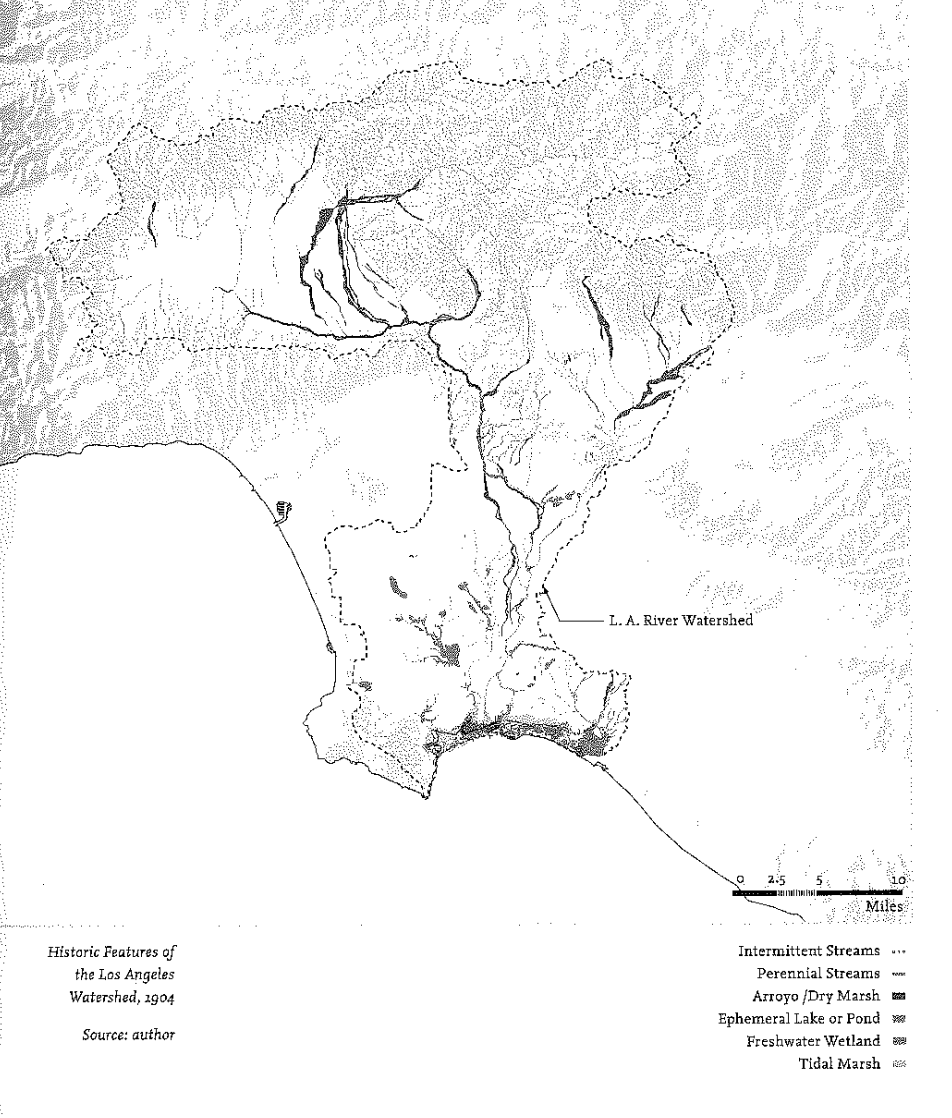
I'm borrowing here from David Fletcher's "Flood Control Freakology" (2008), an essay and book on the Los Angeles River, which you may know better as a big concrete channel featured as a place to drive your car in the movies. It no longer looks like the prototype of a wetland. Despite the pavement, the pollution, and the infrastructure, ecology remains: there are birds, plants, even fish making homes in the place. He encourages embracing "freakology" over "bucology," removing any expectation that this place would be "natural" in the same way that some unpopulated mountain valley might be; he also extends "ecology" beyond the biotic and into the social and political. Chris Reed writes:
Fletcher’s “freakologies” are compelling examples of the general phenomena and arguments of the book. Freakologies — Fletcher’s term — are the offspring of dynamic environmental flows (of water, minerals, plant communities and animals) and the manifestations of artificial infrastructural systems (concrete channels, steel bridges, vertical walls and stormwater and sewage discharge pipes) that sustain LA’s economy. These “freak ecologies” include: emergent vegetation nurtured by the scarce organic nutrients and silts caught up in the inorganic debris dumped into the channel (junk cars, shopping carts, old clothing, plastic bags); squatter camps under bridges and in storm drains, their occupants cashing in cans and bottles carried by floodwaters at recycling centers, washing clothes and bodies in the low-flow channels, lighting combustible waste and logs at night to make communal bonfires; new stands of mixed native and exotic, ornamental and agricultural plants swept downstream from yards and nurseries and nature reserves, feeding off effluent from treatment plants and car washes; bat colonies and swallow nests, tucked beneath overpasses, that help control disease outbreaks by consuming vast quantities of the mosquitoes that breed in the river’s standing water; and the largest concentration of black-necked stilts in the United States, which feed off the invertebrates that thrive in the river’s algae fields — fields that themselves result (accidentally) from the channel’s shallow configuration and the high volume of nutrient-rich sewage discharged into it. This is the stuff of the networked, infrastructural city — not an idealized, romanticized, riparian past that could no longer thrive here — and this, according to Fletcher, forms the basis for a rich discussion of its future.
These ideas are near to my heart because it was the chapter of my life living along the LA River that convinced me to change my career and pursue a career related to habitat restoration. I wanted to get into the work of helping plants and animals thrive, especially in the urban areas of society. I felt like I wanted to pursue the "one crazy trick" to combat the climate and biodiversity crisis at the same time: give space for the natural world to do its thing. Plant the plants (to sequester carbon and help beehives live), tear up concrete (to replenish aquifers and reduce flood risk), connect kids with nature (so the next generation will step up).
 from the Cactus Store
I still believe in these things deeply. But as I've spent more time with these ideas, of course, the nuance begins to emerge. Maybe removing an invasive plant will actually throw an ecosystem out of its new state of balance. Maybe "balance" isn't even important. Maybe aquifer recharge will lead to more flooding where we don't want it. Maybe the language we use around conservation still acts as though humans being involved is a bad thing, or unnatural (it ain't). Or maybe the language makes it seem as if we're completely in charge (we aren't).
In restoration work, a fundamental question is: what do we restore to? What do we want it to look like? "Clean?"—denying the relative messiness of true ecology. "Like that wetland over there?"—but that can't happen because that's there and this is here. "Like it did 10 years ago?"—sure, but why not what it looked like 50 years ago? 100 years ago? We need more specific goals because we need to make more specific decisions, and we will inevitably be caught off-guard by something unanticipated in these messy space-time assemblages we call "ecology." There's no perfect thing to recreate, although we might all have the western-civilization Arcadian myth in our heads: imagining some previous state of humankind in utopic balance with the non-human, "pristine" world. But this just never happened. Humans and nonhumans alike have just been scrounging around to cohabitate on this planet for as long as we have managed it, and everything gets remixed constantly by time and the travel of tectonic plates, bird migrations, or boats to go inner-tubing.
These thoughts in mind, I was really excited to read two recent entries in Willa Köerner's wonderful newsletter, Dark Properties. She began with a question: "What if we let the lanternflies live?" and followed-up with an interview covering the salvation qualities of invasive species. Sure, some things are genuinely invasive in negative ways, throwing off longstanding and diverse webs of other species, but I deeply appreciated two sensibilities that challenge this: a reminder that we're not really in charge of it all, and that we might just be witnessing ecological changes-in-progress, where we (humans) are just one of the things in the mix. The systems around us are changing and "invasive" species are responding to these conditions all the same.
My training is as an environmental engineer, so I'll be the first to tell you that we can and do mess around with environmental and ecological processes all the time. Sometimes the impacts are huge, and sometimes they end up vanishing before our eyes. And most of the time, it's somewhere in-between. So many of the interesting things in environmental work happen at the mesoscale. This just means the messy middle: the macro is kinda vague and difficult to affect (e.g. atmospheric chemistry), the micro can be difficult to scale up and generalize (e.g. soil microbial respiration). It's this mesoscale where all the fun stuff happens, where the macro- and the micro- collide, and where humans get to play our hands as well. Anyone who really looks closely and touches the world is involved, as engineers or ecologists or farmers or geologists or shepherds or stewards or just as friends of the nonhuman worlds. Let your freak flag fly as you step into involvement in this dazzling globalized, rapidly-changing future ahead of us.
Lastly: I have suspended paid subscriptions to this newsletter for now. Thanks to everyone who has supported me writing—I am so grateful!—but I am going to take a little break for a couple months as I focus on some other big changes in life. I might still write, but I don't want the pressure to do so on any timeline.
Unnaturally,
Lukas
P.S., I highly recommend this entry from Crime Pays But Botany Doesn't:
You just read issue #106 of Gnamma. You can also browse the full archives of this newsletter.