"Cybernetics" is a word that misleads us in today's world due to what "cyber" has come to connote. Cyber does not necessarily mean anything about the electronic or the digital or the online, but rather evolved from a Greek word for "steersman"—someone operating a boat. I often think of a sailboat, making subtle changes with the lines and the rudder to stay on-course while responding to changing currents and winds. This etymology invokes feedback systems between an operator and their machine, and perhaps their environment:
The word “Cybernetics” was first defined by Norbert Wiener, in his book from 1948 of that title, as the study of control and communication in the animal and the machine. The term cybernetics stems from the Greek κυβερνήτης (kybernētēs, steersman, governor, pilot, or rudder) [source]
Now, Wiener's term cybernetics has come to represent a broad swath of research about causal and feedback systems (see wikipedia) across many disciplines and cross-disciplinary spaces, from ecology to organizational theory and beyond. The study typically focuses on the organizational structure of the focus system(s), and the feedbacks between their components.
One of my favorite aspects of wetlands is that they are complex systems, with various interaction parts and processes and thus lots of opportunities for feedback loops. Wetland landforms or communities often exhibit what we might call "self-organization:" that is, their "elements interact to produce a global function or behavior." Take a look at a satellite image of this reedy wetland portion of the Cameia in Angola and tell me there isn't some kind of patterning algorithm at work, making small-scale dynamics evolve into this large-scale pattern:

By definition, a wetland is a system that is periodically inundated by water. This means the system is perturbed, regularly, by this major regulator—the presence of water. But how the wetland gets wet, and the dynamics that follow, depend on the wetland's shape and the vegetation growing in it, and thus invoke sediment transport and soil chemistry and many other things—maybe a bit of geology. In the image above, microtopography and water routing likely drive feedback with vegetation growth patterns and maybe chemical calcification processes, thus creating small islands with somewhat even spacing and maybe a smooth distribution of island sizes. All of these factors are a perfect recipe for cybernetics: the wetland and all of its constituent parts, responding to the regular forcing function of water's arrival (whether by tides or a river or rain).
In coastal wetlands, a major feedback-based process is that of accommodating for sea level rise. Being inundated for longer periods of time means there is more time for sediment in the water to sink and accumulate on the ground in thin little layers. Over time, these layers build up, making the wetland shallower and shallower. But if it becomes too shallow, then there is no longer sufficient time for sediment to layer on top—a natural negative feedback loop. On the flip side, if the water gets too deep, it can incur faster currents that prevent sediment from settling. Natural subsidence and compaction also mean that the layers sink over time. These dynamics typically allow tidal wetlands to stay in alignment with sea level as it goes up and down on long (glacial) timescales. But really, there are other forces at play, including lateral effects, including everything in this causal diagram below and more (i.e. it neglects subsidence!):
 Figure from Fagherazzi et al. 2020, "Salt Marsh Dynamics in a Period of Accelerated Sea Level Rise"
We haven't even added the biogeochemical components yet:
 Kadlec & Wallace 2009, Treatment Wetlands
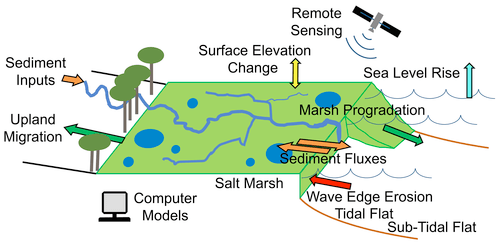
I hope the cybernetic essence of wetlands starts to become clear. The figure below is from the Fagherazzi paper again, and starts to invoke how we keep track this stuff, too—often with computer models and remote sensing. This is crucial because it begins to invoke the control part of cybernetics in wetlands! As has been the case for beaches, sometimes the same interventions aimed to protect them (e.g. install a jetty) ends up driving destruction (e.g. down-current erosion) due to unpredicted feedback loops. I think the same might be happening in some habitat restoration projects, where attempts to restore certain processes (e.g. connection to tides) may also put them more at risk of some future damages (e.g. introducing pollutants). A cybernetics-oriented approach can help try to predict what we can, to move these projects forward and acknowledge the nonlinear and "unnatural" responses we might see in the future.
So many wetlands, globally, have been modified, either into oblivion or into sewage treatment or more subtly, with a levee here and a ditch there. Human relationships with wetlands are as old as our species is, and we've been modifying them for our ends for nearly as long. Tentatively embracing life in Scandinavia, I'm learning how many viking rituals seemed to include throwing stuff into the bogs around here.
 From an awesome project by nonhuman nonsense.
And one of the key things wetlands do is they accumulate. They build up layers, often absorbing and storing whatever it is that reaches their muddy shores, remembering their histories. And memory—or delays in information transfer—can critically impact the evolution of dynamic and cybernetic systems. Exactly how this shows up and gets modeled is at the fringe of my thinking, and brings me back to some of the dynamic systems work I did back in my undergraduate degree. I've recently been exploring modeling wetland trajectories through their phase space of sedimentation using tools like Convergent Cross-Mapping, whereby the multi-dimensional structure of the system is effectively encoded into a series of time lags of a single dimension of the system. This thinking brings me back to some of the ideas in Liquid Computer—what are the information encodings and functions that allow a wetland to compute? And, compute what?

I'm starting to mix metaphors a little aggressively here, and I move between an interest in formalizing these ideas and rendering them academic versus just letting the wetland freakology be its freaky, nonlinear, simultaneous, emergent, historiographic, and cybernetic self. Regardless, I've begun to compile schematic diagrams, resources on wetland dynamics, and related ideas in an Are.na channel to fantasize about a Center for Cybernetics and Cultures of Wetlands (CCCW), which I'll start some day after becoming fabulously wealthy writing poems.
 Again from nonhuman nonsense.
Looping back,
Lukas
P.S.: Some links:
- A brief history of cybernetics.
- Following up on Gnamma 104, and intriguing new book on salt lakes and their queer ecologies.
- The Cybernetics Library.
You just read issue #105 of Gnamma. You can also browse the full archives of this newsletter.