Leaning into the Light
Recapping my attendance of Lumenaura and GLEAM, plus my exciting project for an artist residency at Lakewood Cemetery!

In this month’s newsletter, I’ll be breaking down the pros and cons of attending two light festivals last month—Lumenaura in Aurora, Illinois and GLEAM in Madison, Wisconsin—as well as sharing photos and videos of some of the installations. After that, I’ll be going into detail about what I’m currently working on!
Lumenaura is a fairly new festival, I believe in its 2nd or 3rd year, and this year the GLEAM exhibition celebrated 10 years. Both events are longer than most light art exhibitions/festivals, with Lumenaura running for 16 days in October and Gleam running from late August to late October.
**Note: Unfortunately the redesign of my newsletter editor removed the play button from videos, making them somewhat indistiguishable from photos. If you see a title underneath an image along with “Positively Disintegrating,” that’s a YouTube video. Click on the image to watch.
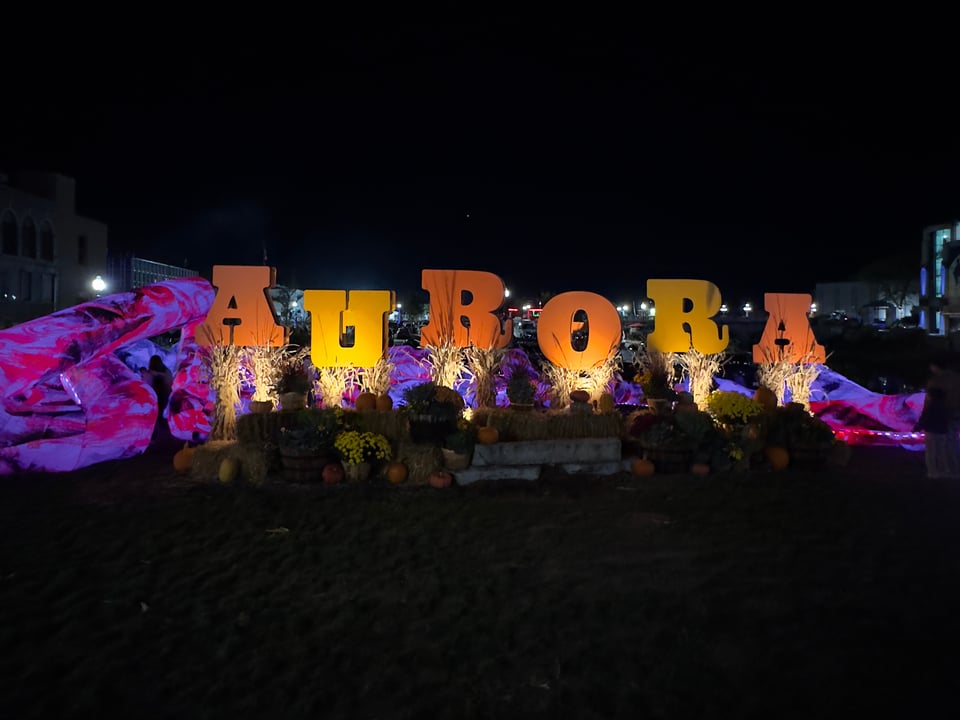
— LUMENAURA —
Pros:
Charming, walkable town with a lot of independent businesses and a Holiday Inn within walking distance (though I didn’t stay there).
Easily accessible by Metra train if you’d prefer to stay in Chicago and go out to visit the festival. (It’s about an hour train ride.)
Lots of free parking.
No ticket required, totally free to attend.
A good mix of local artists and installations that have been at larger festivals around the country (including Blink).
Cons:
The festival spread out over several blocks and while there were maps on sandwich boards scattered throughout, the only portable map was digital. (May not be a con for everyone, but I find a printed map is easier to repeatedly refer back to, especially in an unfamiliar city, and allows me to check off what I’ve already seen so I don’t miss anything.)
The installation description signs were black with small white text and close to the ground, making them difficult to find and read in certain areas.
It seemed like the bulk of the advertising and budget went into the first weekend. There was music, food trucks, and an information booth for assistance. When I attended the second weekend, there were none of those things and a significantly smaller crowd, likely due to the absence of a festival atmosphere.
The event website is poorly designed and there is no social media account for the event itself. Information and updates are spread out between the Instagram accounts of the city of Aurora, the event production company Monochronicle, and the artists themselves.
Some of the installations aren’t present for the entire length of the festival, however that wasn’t mentioned anywhere on the website or social media. There was one installation (seen in the video below) that was on the map but wasn’t installed until the second weekend (which I found out on Instagram a few days before it was installed).
While it had quite a few missteps, Lumenaura was still worth attending. I made a few connections and was able to gain some perspective on smaller light festivals.
— GLEAM —
Pros:
Gorgeous location (located in Olbrich Botanical Gardens).
Tickets were really reasonable at $18 for a weekday ticket (weekend was slightly more). GLEAM is a fundraising event for the botanical gardens as they are otherwise free to visit.
Wayfinding was easy and well-organized.
Really diverse installations with a mix of national and international artists.
Plenty of volunteers placed around the grounds for assistance.
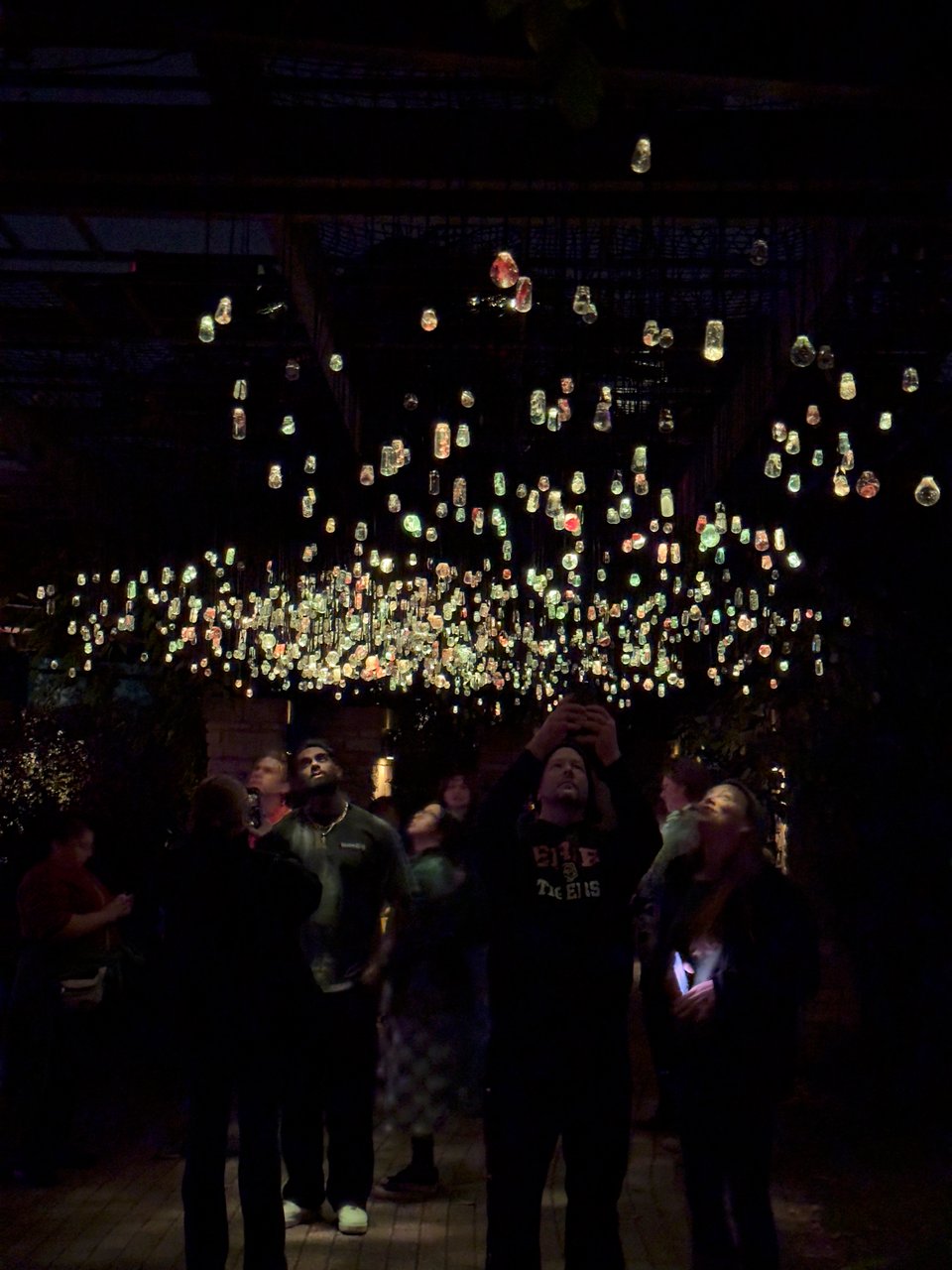
The Beholder by James Tapscott. Natural items preserved in resin, illuminated with LEDs.
Cons:
Tickets are timed, which isn’t an issue, but the first installation was inside the conservatory so there was a big crowd in a small space right away. If people stopped to take pictures, it was hard to move around them. However, people moved through it quickly so it was possible to walk through a second time with less of a crowd before the next ticketed entry group came in. After that, everything was outside so people spread out considerably.
Close to a regional airport so there were many low flying planes overhead.
To keep the crowd flowing you can only go through one way which means once you leave an installation you can’t go back to it. (This is likely only a con for me.)
Parking lot fills up quickly—I got there about an hour before my ticket time and there were only a few open spaces at the back of the lot. There are adjacent parking lots but it’s a much further walk to the entrance.
I’m honestly disappointed that I hadn’t heard of GLEAM before this year as it was very well done. The installations were incredibly inspiring and I’m glad Instagram showed me ad for it in time to attend just before it ended.
Overall, though I put more miles on my van than I would have liked to, I’m excited to have discovered two potential opportunities within a reasonable driving distance. I’m planning to apply for a spot at both in the future!
WHAT I’M CURRENTLY WORKING ON
Next month is the application deadline for the artist in residence program at Lakewood Cemetery in Minneapolis. This year was the inaugural year of the program and after attending the info session for next year, I’m very excited to apply.
The aim of the program is to reimagine the role of a modern cemetery and invite the community into the space. The cemetery is nondenominational so art projects do not have to include faith in their themes. This year’s artists created projects around grief, repurpose, and the cycles of life.
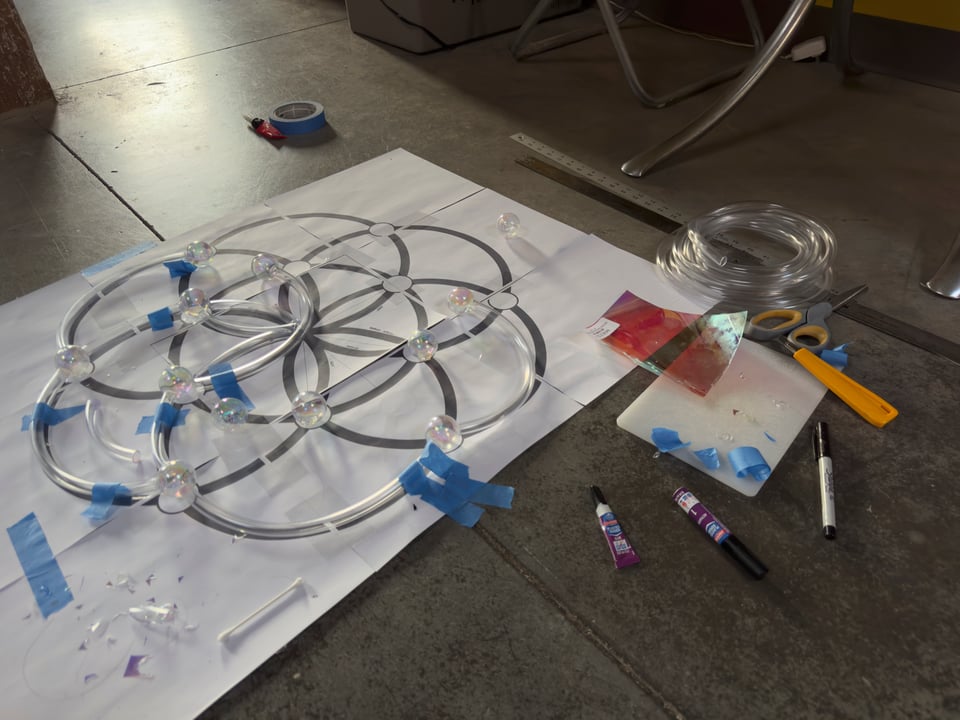
When I walked through the grounds after the info session, I noticed a shape very similar to the seed of life repeatedly being used on buildings and other structures. This lead me to consider multiple projects: standard surface projection around the grounds, and a seed of life sculpture that could be potentially placed on a shallow reflecting pool (located outside of two mausoleums) and projected onto.
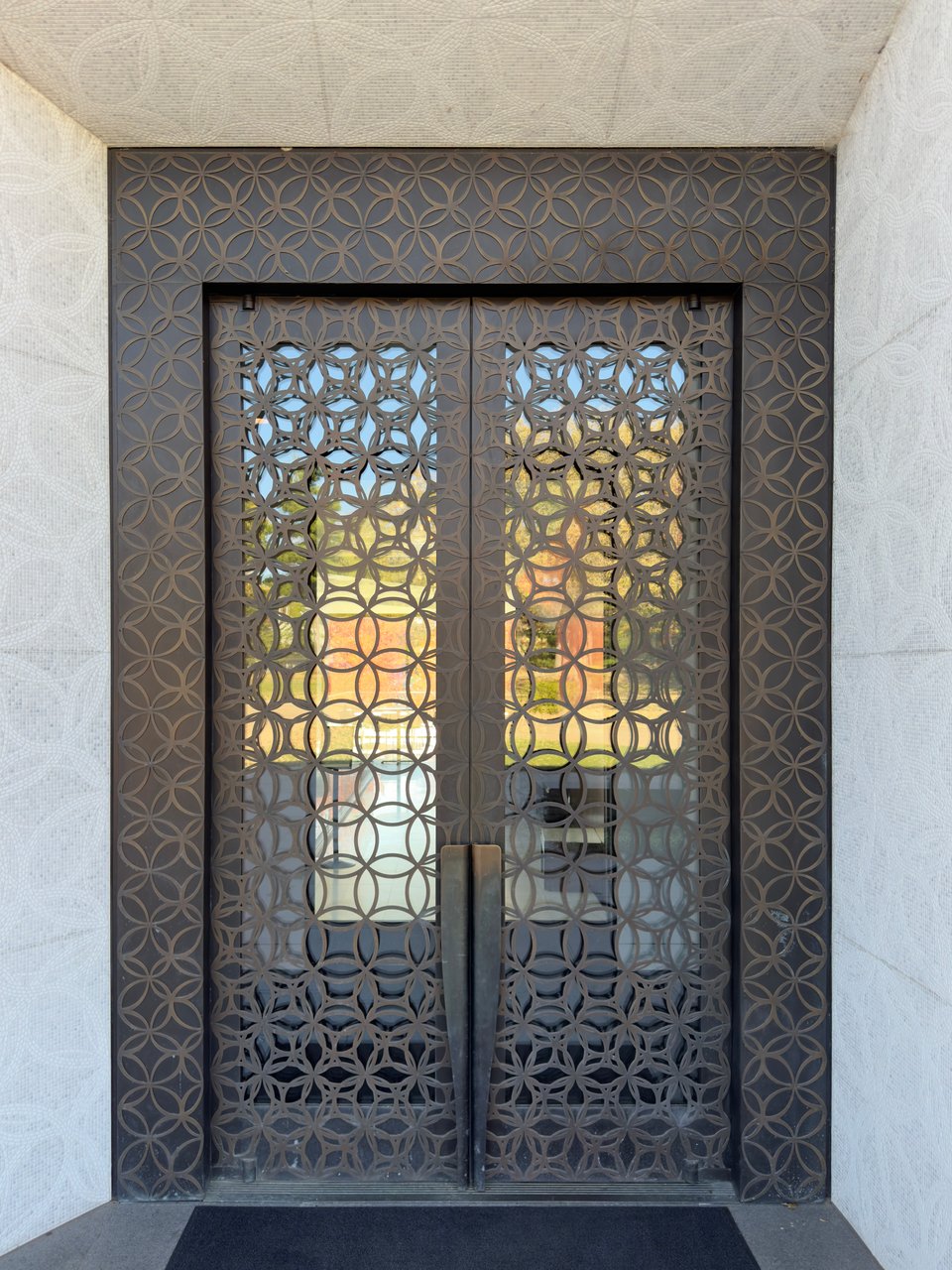
I started without a clear plan, improvising with polyethylene tubing—which has a semi-opaque white color that’s perfect for projection—and Christmas ornaments.
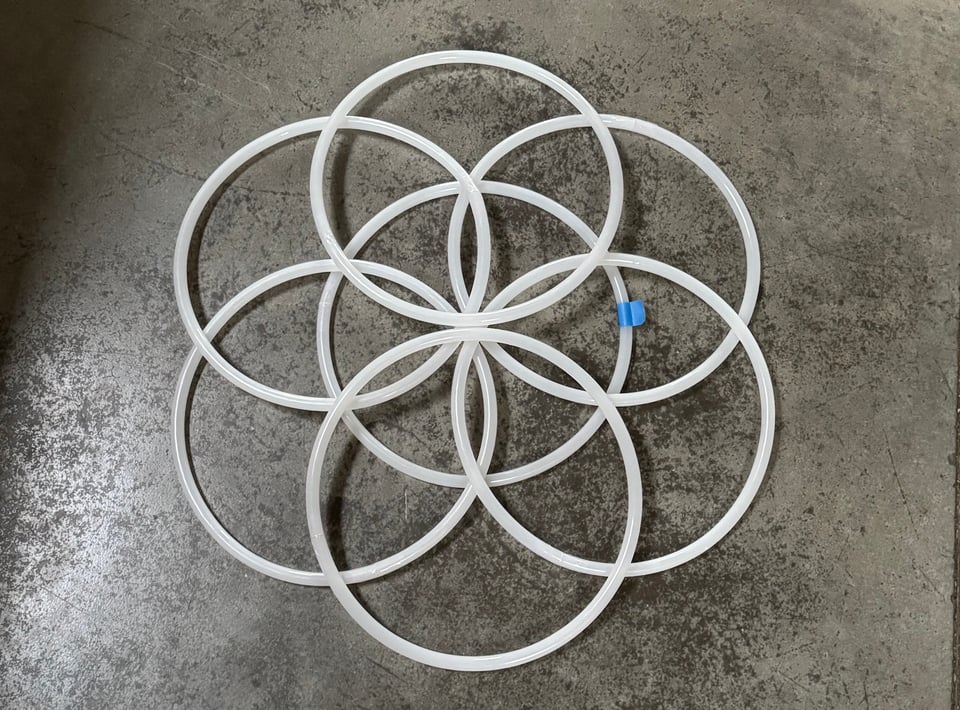
Initially, I attempted to work without a template, but my brain is not built for math, so I printed a basic one. I quickly realized after I cut the tubing that it was not flexible enough for the bends I needed to make. Not only that, the template wasn’t helpful at all.
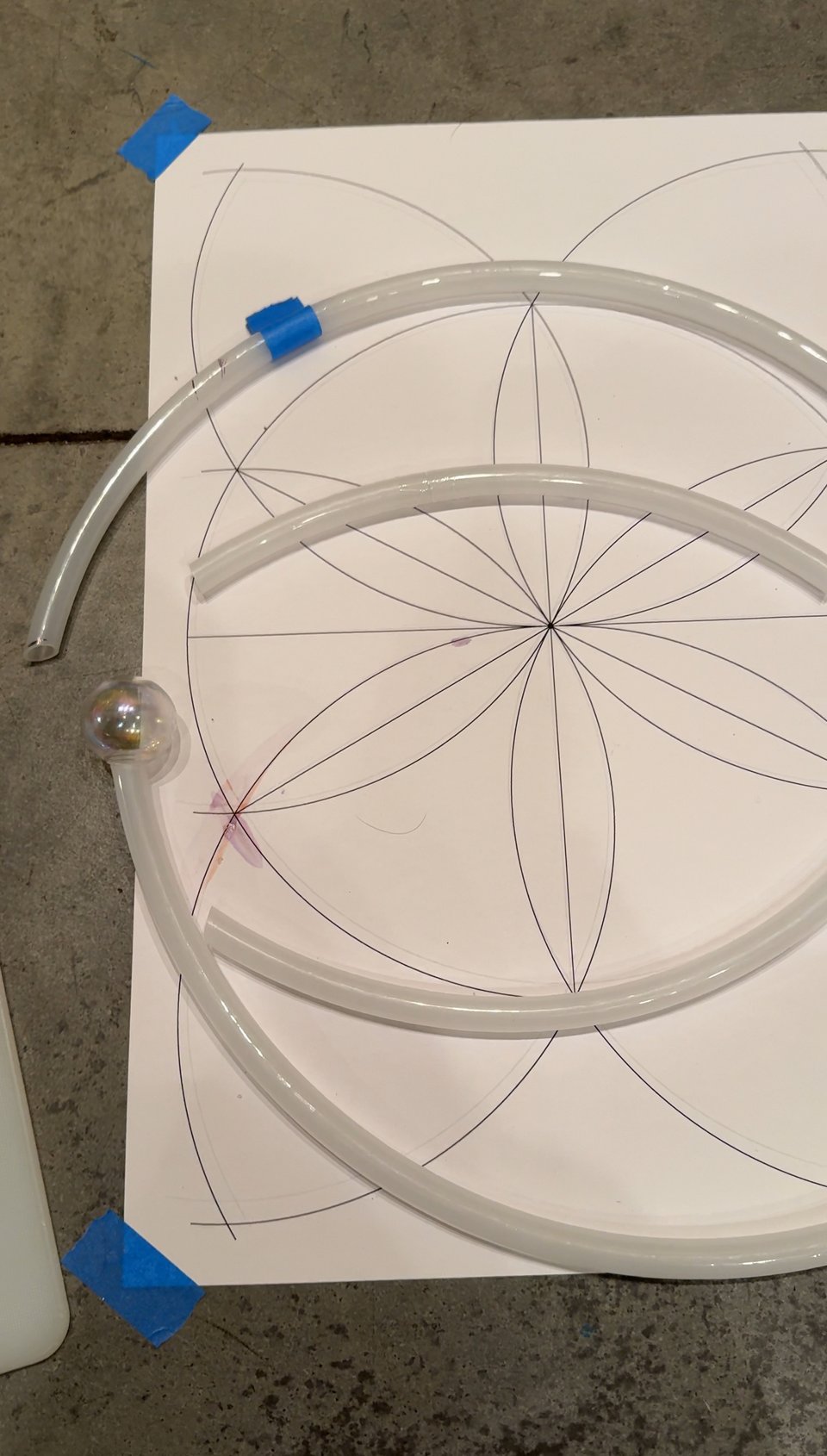
To solve these problems, I did some research and dug back into my memory banks.
When I took a neon bending class a few years ago, templates were drawn to match the tubing’s width and shape, allowing you to lay hot glass directly on them to make accurate bends. To fix my template I just had to adjust the thickness of the lines and add in a space for the ornaments so I could make the proper bends and cuts.
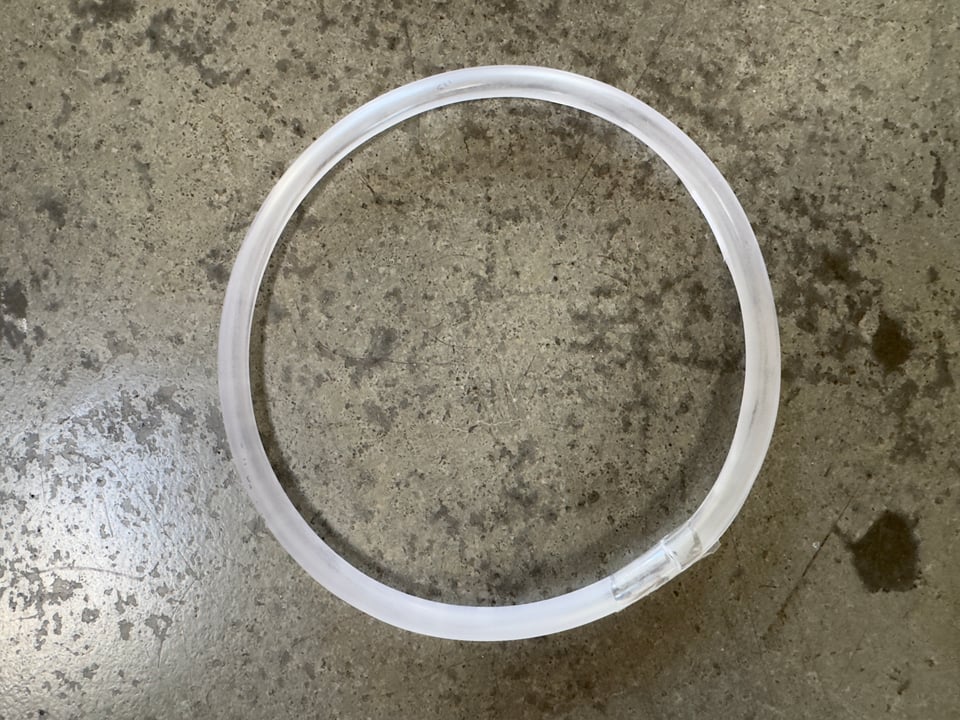
For the tubing, vinyl is more flexible than polyethylene but it’s also clear, which doesn’t work well with projections, as shown in the photo below.
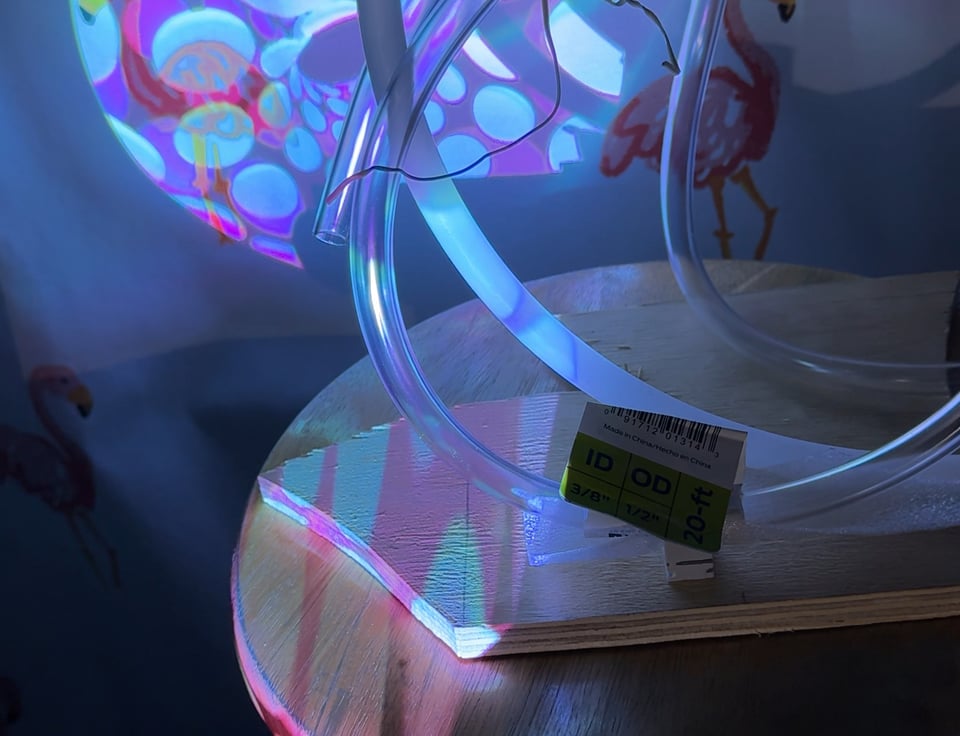
After trying to find semi-opaque vinyl tubing that was easily accessible and reasonably priced, I learned that clear tubing can be made cloudy by sanding it or brushing it with acetone. The only acetone I had on hand was nail polish remover, and that only partially worked. Sanding did the trick. (A quick Google search told me that 100% acetone nail polish remover has additives that construction-grade acetone does not, so I may still use that method as it would be a lot faster than sanding.)
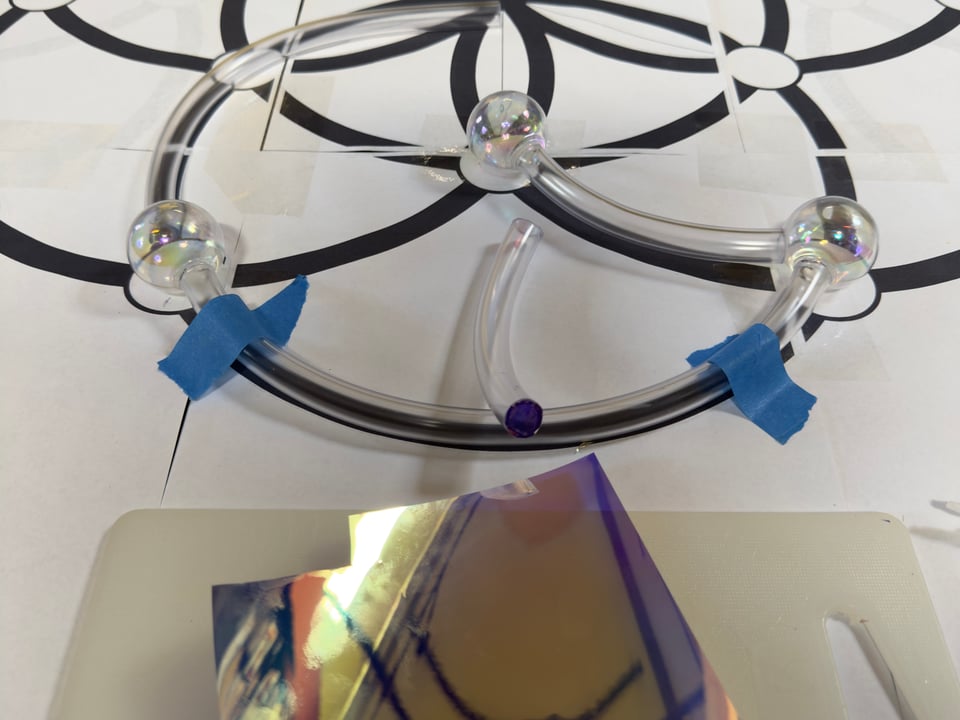
Another issue I had to troubleshoot was gluing. Despite the glue being incredible (more on that in a bit), the edge of the tubing wasn’t enough to create a strong bond with the ornament. While I was noodling on how I could make an end cap or something that would fill the hollow part of the tubing to make the end a flat surface, I remembered I had samples of iridescent film. Adhering the film to the end of the tube would close off the end as well as provide a somewhat flexible surface to glue to the ornament.
Now onto praise for the adhesive!
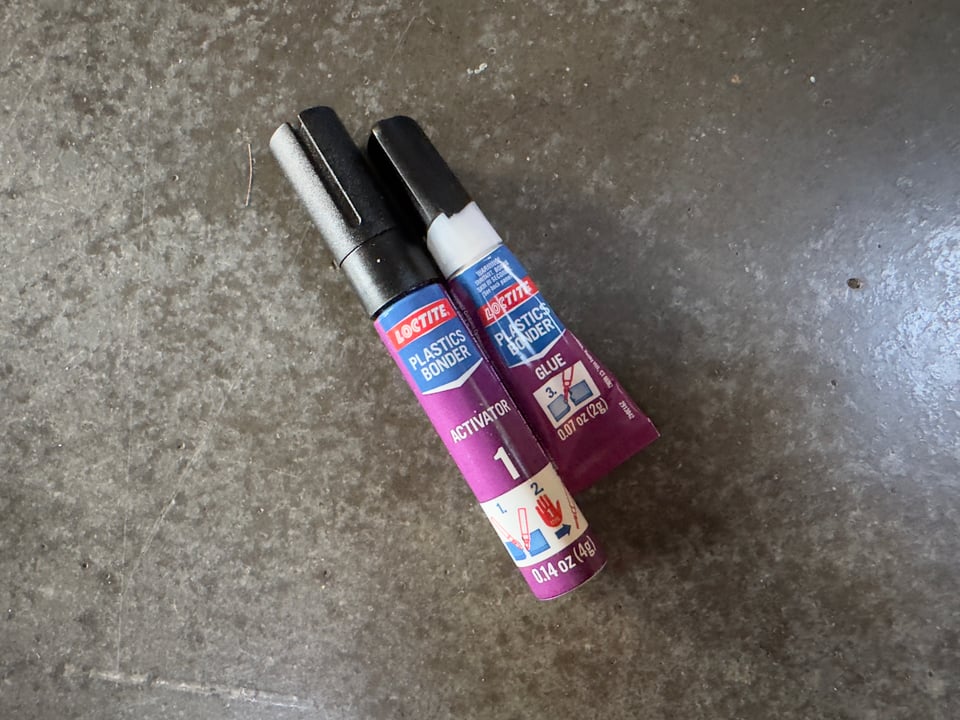
The adhesive is two parts, a felt tip activator pen that you rub on both surfaces and a glue that you only put on one surface. The dry time for the activator is 60 seconds and the adhesion time for the glue is 30 seconds, so thankfully I’m not holding onto the pieces forever, but a complete cure takes about 12-24 hours.
I’ve learned that as much as I want to hurry up and glue everything, because the pieces all flex together, I have to work slowly in sections to make sure the glue properly cures before I bend adjacent pieces into place.
There’s been a lot of trial and error, but I’m very excited about the possibilities if it all comes together! Thankfully I have the surface projection ideas for the residency so if the seed of life doesn’t work out, it’s not a make or break situation. I’ll still be applying.
As always, thank you so very much for being here. I greatly appreciate your support and I’m crossing my fingers that I’ll have a completed seed of life to show you next month!
Until the next newsletter, be well!
Giesla
If you’re able and would like to help support my work financially, click the button below to make a donation! I greatly appreciate your consideration.
Add a comment: