
Look at yourself squarely and deeply

For this week, I wrote about six more frames from SpongeBob SquarePants. There’s kind of a theme this time.
You can read that here.
The newsletter will be on a li’l break while I compile and mull over and fixate on all the music I loved over the past year. So nothing on the 16th, but I’ll be back with what might be a pretty huge piece on the 30th. Honestly shocked I made it this long without missing a week before.
Misc. Stuff I’m Into:
Movies:
Drive My Car [2021, dir. Ryusuke Hamaguchi]. Watched it twice in a week. “Why would anyone do that,” you ask? More below.
The Worst Person in the World [2021, dir. Joachim Trier]. Adults come of age too. Between this, Sentimental Value, and A Different Man, I am fully Renate Reinsve-pilled.
Chungking Express [1994, dir. Wong Kar-Wai]. I have now seen four films on my yellow Wong Kar-Wai shirt that always makes strangers talk to me. Faye Wong knocked my two front teeth out in this.
Petite Maman [2021, dir. Céline Sciamma]. This film reminded me of one last story about my father.
National Theater Live: Vanya [2024, dir. Sam Yates]. Wanted to see a version of Uncle Vanya to accompany my viewings of Drive My Car and in this one Andrew Scott plays every part and fucks a door, that’s just math.
Music:
Oneohtrix Point Never’s Tranquilizer. Possibly one of the most beautiful electronic music albums I’ve ever heard, and definitely one of Danny boy’s best.
The Mountain Goats’ The Sunset Tree. An album that I had for many years avoided listening to on purpose before making a Mountain Goats Album Exchange Pact last week. “Casting your gaze way out to no man’s land / sometimes I’ll meet you out there / lonely and frightened / flicking my tongue out at the wet leaves.” Well, now I know why I avoided it.
Skrillex - hit me where it hurts x - EP. The titular remix of the Caroline Polachek song is like a delicious sonic Red Bull.
Christopher Larkin - Hollow Knight: Silksong (Original Soundtrack). Pharloom, please. Take me back, I’ve been good…please…
The Avett Brothers - I and Love and You. That good kinda tummy hurt music.
Other stuff:
Em and I went to see The Nutcracker at Lincoln Center this past weekend. After a somewhat chaotic couple of Thanksgiving days, having Tchaikovsky reach across history with his music and story and seeing all those unbelievably talented dancers engage in remarkable feats of human strength and dexterity was such a salve. We both cried, and neither the Long Island moms yapping their heads off about nothing nor the child coughing like they’ve got black lung from three decades in the mines could sour the experience.
SPOILERS for the 2021 film Drive My Car below.
We see Yūsuke playfully criticize Oto’s driving.
Em says ‘that’s you.’
I giggle a little, then immediately burst into tears.
Today I’m writing about Drive My Car.
Last week, in the run-up to Thanksgiving and family overwhelm, I watched the two-hour and fifty-nine minute film twice. “Why would anyone do that?” you ask. I think I knew I needed more time, another chance. Also Em really wanted to watch it, and I really wanted to experience it without pausing every ten minutes to send an exhausted voice memo to a friend or jotting something in a notebook.
Much like a lot of media I engaged with in my mid-to-late twenties, the first time I saw Drive My Car back in 2022, I had a lot of emotional walls up. I loved the film, still thought it was excellent, but struggled to really understand the possible fault with the way the two leads behaved, why they needed their breakthroughs, why they couldn’t just keep living. When not talking about your feelings, or even feeling them for that matter, is your normal, how can you see it as conflict?
Then one day I went to a thing where I was blindfolded while the new Jon Hopkins album played and had a vision of taking a sledgehammer to the concrete walls around my heart and yadda yadda yadda I’m fixed now. I’m definitely being reductive regarding all the therapy I’ve been to and am still going to since 2022 but sometimes it really feels like that weird night flipped a switch.
On the note of ambient, so much of the score this film has a continuous synth pulsing, piano playing, snare being tapped. Chords are being laid out slowly and thoughtfully. An uneasy drone underlaid beneath a masterful, jazzy performance to accompany Yusuke and Misaki on their journeys once the conversation has died down. And the sounds! The hum of the air conditioner in the modular audition room/reading/rehearsal space. The sound of the Saab 900 Turbo putt-putting away as Misaki drives, fast and determined or soft and slow when she needs to be, the jingle of the keys, the shutting of the door, the ka-chunking of Oto’s tape of Uncle Vanya. The crunching of autumn leaves as the players work outside. The flick of a lighter. The rumble of the garbage dump. The barely audible un-mic’d acoustic guitar being played on stage during the production. The wall of rain outside of the tunnel. The churning of water beneath the ferry. The crunch of snow underfoot up the hill over Misaki’s collapsed home. Every sound is so considered, adds to the flow and naturalness and life of a movie world cradling you through its nigh-undetectable three-hour runtime.
With my newfound superpower of having feelings and sometimes even being able to talk about them, I found myself repeatedly frustrated with the character of Hidetoshi Nishijima’s Yūsuke. “Just read the text.” “I was basically asleep.” “If I were your father, I’d hold you round the shoulders and say ‘it’s not your fault. You did nothing wrong’ But I can’t say that.” At every moment for two-thirds of the film his calcified frustration and grief does not allow him to reach out or be reached out to, to acknowledge and engage with the feelings of those around him. The two moments of the film we witness him treating his glaucoma with an eyedrop, a tear rolls down his cheek, manufactured. The latter of these two moments immediately follows a player trying and failing to remind Yūsuke that they aren’t robots. The former, him delaying the conversation he’d never get to have with Oto, for what could have been crucial, life-saving minutes, idling in his driveway. “Sonya, I’m miserable. If you only knew how miserable I am.” She did know, and you never told her. Yūsuke was the stone in her story.
Tōko Miura’s Misaki Watari is simply cool as hell. Adaptable, malleable, quietly intelligent. Uses her dad cap as a little bag for her book, a thing I’ll probably start doing next summer. An excellent driver who immediately clocks Yūsuke’s latent misogyny as his reason for rejection. Walking (sometimes) talking ‘cigarettes are cool as hell’ propaganda. And, most importantly, the unstoppable force to Yūsuke’s immovable object. I find her character very similar to that of Asa from Chainsaw Man, silently and stoically holding a lot of the unreasonable expectations of others, having the mistakes a child would make beaten out of her early, questioning the validity of the guilt she has been saddled with. Plus, the scar on her face, evidence of a fate she avoided but felt she deserved. But, most importantly, I see it in the collision between her and Yūsuke, puzzle pieces finding each other in a moment of unknown need.
I think most of us have been in a car with someone we’ve known forever, in a car with someone we’ve just met, and in a car with someone we have known for very long but not truly. When loved, when seen, I can sit silently for minutes, hours. Holding hands, or legs on the dash, or one person on a phone, or staring straight forward, music optional, because the silence need not be filled, unless we want to share in its breaking. However, with the unease of newness or unknowing comes music, a podcast, forced conversation, a need to call out every sign, the price of every passed house, a fear of the same silence you can dwell comfortably in with another who you truly see. “Shall I play the tape” cuts in at these moments of unease between Yūsuke and Misaki, when a character begins to feel a little too seen, when a few too many questions are asked. However, with the bravery of youth and the desperation for connection, Misaki pelts Yūsuke’s concrete walls, little by little, ball-peen up to mallet up to sledge. Over the course of the film we see the two grow from uneasy playing of the tape, to curious little interviews featuring flares of trauma, to the comfort of silence, with Yūsuke finally taking up the front seat, and the flick of a lighter and the hum of the Saab gently encircling a moment of peace.
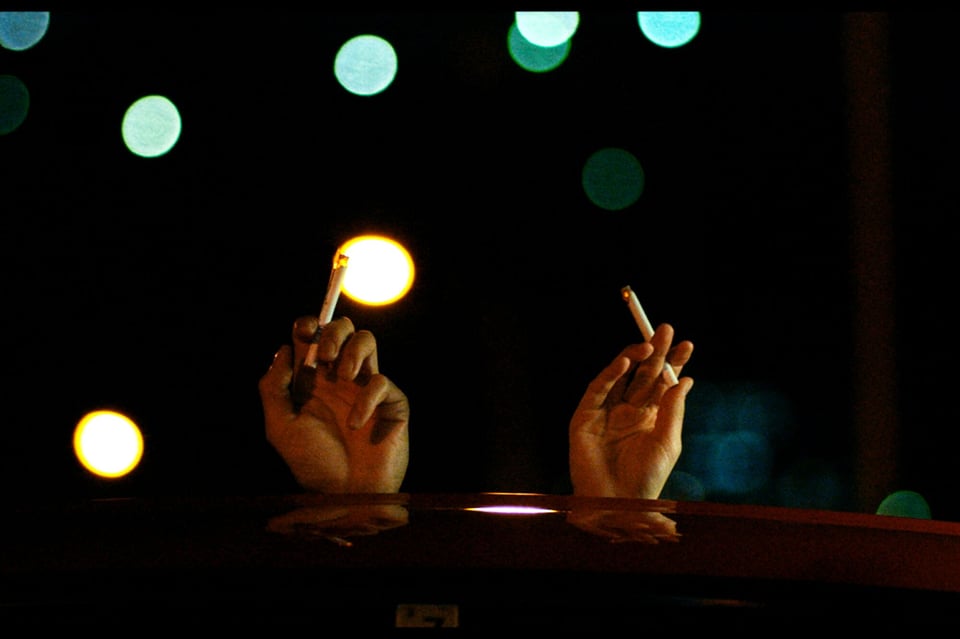
Speaking of cigarette propaganda, the way this little red Saab 900 Turbo erodes my convictions about the evils of the automobile is beyond belief. It’s just the perfect dream of a car? I learned that in the novel the film is based on, the Saab is actually yellow, and I’m glad Hamaguchi took the artistic license route. Every wide shot we see of the Saab circling about mountain roads, to the frames out the rearview window as the mouths of tunnels shrink to dots, to the way it looks, brilliant and scarlet, amidst pelting rain or white, white snow, is captivating. It’s a steel cage of emotion, wherein Yūsuke, Misaki, Yoon-soo, and Kōji make confessions, apologies, and connections. The passing streetlights, the landscape and city skyline of Hiroshima, and the mountains on the way to Misaki’s hometown dance around this tiny stage where Yūsuke is reminded by Kōji of the lessons he learned from acting in Chekhov’s plays: he has to look at himself squarely and deeply.
If Misaki is the eyes of the film fixed squarely on the path ahead, Yūsuke is the troubled mind that propels it forward, and Reika Kirishima’s Oto Kafuku is the body, with its impulses and failures and inconsistencies, Park Yu-Rim’s Lee Yoo-na has to be its beating heart. Watching her introduction and the power of her audition, captivating the entire room alone with the “give it back” scene, I was as shaken as Yūsuke. In my hazy memory of my first viewing of the film a few years back, the scene that stuck on the dumb rock of my brain and has never left was her delivery of the “we must live” monologue, wrapping herself around Yūsuke’s reluctant Vanya to deliver the thesis of the play. This time around, when the lights went down and only the flicker of the lantern is on screen, the reflection of my own face was visible in the TV right next to it, puffy and wet. Early on, when Yoo-na is first cast as Sonya, we see her elderly castmate Yumi sign ‘good job!’ It’s a blink-and-you-miss-it interaction, a moment that shows the potential for care and camaraderie cast members can and should have for each other, and a world of connection that the theatre should create. We learned that Yoo-na decided to start acting because her body could no longer summon the will to dance after a miscarriage. Despite everything, she finds strength, some borrowed, some from within, and keeps going. Her lack of a voice won’t stop her from expression, from speaking, from being heard.
“My hardships might be even greater than yours, but I don’t give into despair.”
After watching the film twice, I then sat down on Saturday to watch Andrew Scott’s one-man performance of Vanya (thanks for the National Theatre at Home login, Han). Andrew Scott was incredible, and distractingly hot. Being lent the greater context of infidelity, poor communication, unmet expectation, misery, and living despite it all amidst the original work aided in my understanding of the interweaving of Drive My Car and Uncle Vanya. However, what’s sticking with me even more is the work of another sad Russian man and contemporary of Chekhov’s, Tchaikovsky. Earlier that same Saturday, Em and I went to see The Nutcracker, and I could feel Tchaikovsky’s iconic music, motifs, and instrumentation making contact with my soul, moving me to tears. I think of how these dances have been interpreted and passed down for over a hundred years. I think of the tattered pages of the original composition being copied and shared across the world, eking their way into the cartoons I’d see as a kid. I think it’s less that sad Russian men have a monopoly on invading your heart and swelling it until it bursts, but more that it is terrifying, as Yūsuke admits to Kōji, to be seen at the core of your being across the canyon of over a century, by a stranger from another land, with an ease that the people close to you can barely manage. The magic of these works is that maybe, in listening to them, watching them, talking about them, they leave that door open for our loved ones to sneak in, too.
Em asked me if I was okay after I started crying. I said, yeah. It’s just that, that used to be me. I don’t think it is anymore.
-Will