
John, Jaar, Jeff, James, Jack
I wrote about The History of Concrete.

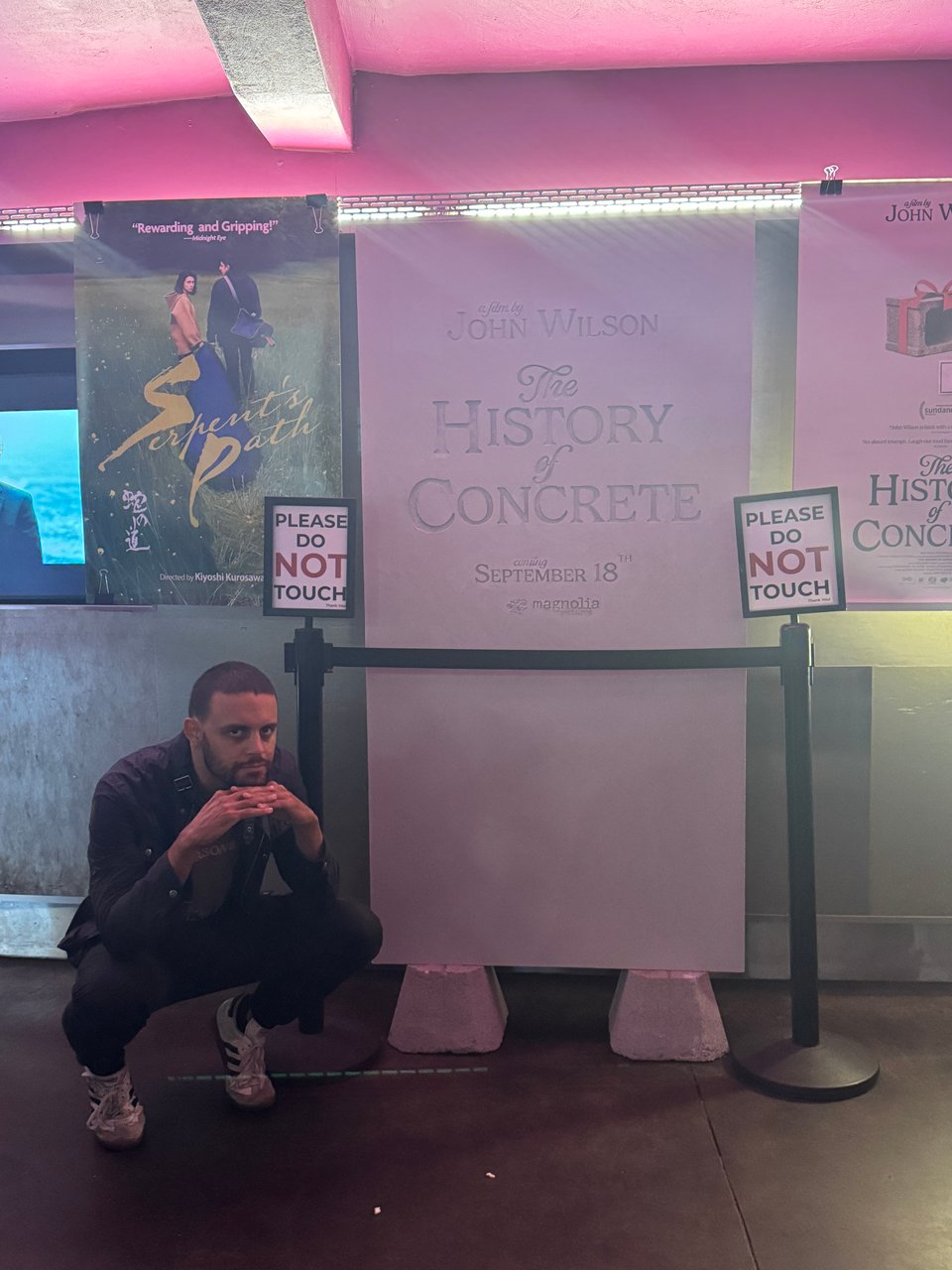
Come see Horsie on Halloween night! We’ll probably wear costumes.

Also if you like the newsletter, consider buying me a coffee about it :)
***SPOILERS FOR THE 2026 JOHN WILSON FILM THE HISTORY OF CONCRETE BELOW***
"Ever the mutable,
Ever materials, changing, crumbling, re-cohering,
Ever the ateliers, the factories divine,
Issuing eidólons."
-Walt Whitman, Leaves of Grass
I shift uncomfortably on a floor with no give as I sit in a warehouse watching experimental music. These are structures designed for little other than to not be moved, even as Nor'easter winds howl outside wide windows, carrying all manner of debris violently to new spots on faraway streets. I'm here to see Nicolas Jaar's new project AEAEA, yet more schemes from the mind of an electronic music master, himself no stranger to indifferent concrete rooms. He transforms the largely acoustic instrumental work of a band into ambience, texture, expression bent through machines into meticulous and expansive form. The show started so late that my friend had to leave before it even began, and I can only assume the extra time past doors was taken so Nico could get the room sounding just right, make these concrete walls care.
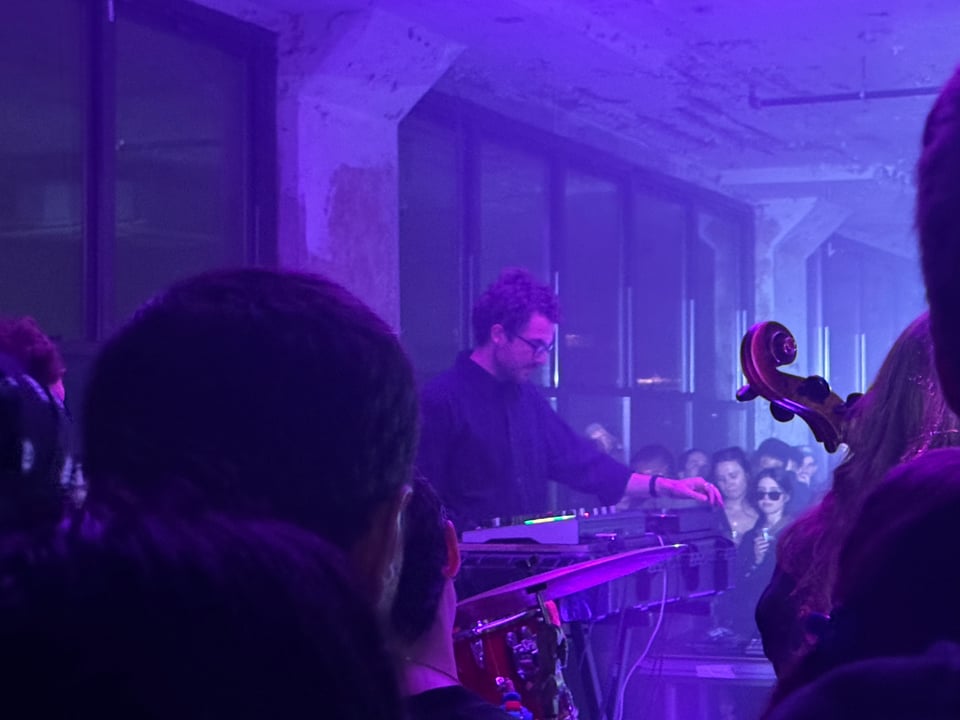
Watching Nicolas Jaar surrounded by gray walls and Brooklyn bodies, sampling crowd chatter, and acting as an instrument puppetmaster, I was reminded of John Wilson's penchant for folding B-roll into bits and making an unassuming man on the street our collective hero. When I read the conceit of Wilson’s debut feature film The History of Concrete, I was a bit confused: his plan was to filter a documentary about the drab grey building material through the unforgiving sieve of the Hallmark movie rubric. Confused, but ecstatic, as this crack in the wall was perfectly in the shape of my body. After forcing my way through the half hour that I could stomach of the mostly drone-filmed slog that was 2024’s Architecton, a lesser attempt at similar subject matter, I was hungry for a documentary about concrete with some organic handheld camera, heart, deeper meaning, or even a droplet of fun.
(Fuck Architecton. Boring ass movie.)
Outside of running this newsletter for my own sick kicks, I am a professional structural engineer, with an interest in buildings that ranges from passive to fanatical. I especially love brutalism, with its hard edges, slim windows, dull color, and refusal to buckle under the most dire of circumstances. This is probably some sort of Stockholm syndrome, having been surrounded by these buildings during my years at the University at Buffalo. I was often times trapped in them, with either horrific blizzards or the insurmountable heap of engineering coursework barring my exit.

The Barbican Centre, London, April 2026, 35mm
Despite my love of Legos as a kid and bridges and brutalism now, I'm not actually sure I really wanted to be an engineer. All I really knew was that as a child, I decided I didn't want to struggle, and structural engineering felt like the closest thing to marrying my appreciation for form, rigidity, and stability with a career that wouldn't force me to post a Venmo link every month to make ends meet. I also consider myself lucky that I didn't unknowingly step into the tar pit that is weapons manufacture with a mech-aero degree before I developed a moral compass dedicated to avoiding killing people to pay rent.
But John Wilson understands that whether you're passionate about it or not, whether or not you happen to be one of the structural engineers who knows who John Wilson is (unlike seemingly everyone at the national concrete conference he filmed), our crumbling infrastructure will come find you. New York City is lined with absolute ankle-twisters of sidewalk slabs. Scaffolds stay up to stave off the inevitability of a brick or façade joining hands with gravity to turn someone's day upside down. Zohran only recently decided that he should probably make a plan to prevent the Brooklyn-Queens Expressway's collapse (a potential structural disaster discussed in the film). I learned a few nights ago that a building across the way from me had its siding fly off in the recent windstorm, and it's now swarming with NYC Department of Building employees daily; and I learned from this movie that a train station entrance I once frequented had its awning fall down, thankfully harming no one by the providence of an empty street.

Alongside concrete fixation and fraught how-to guides, John Wilson seems to also be in a simultaneous prisoner and warden relationship with poetic form. In a post-film Q&A, Wilson revealed that unrelated footage is bent into a narrative that appears to flow freely, but is in reality meticulously constructed to fit an end, all rivers dammed toward one truly special stranger amidst many (for example, the boat name jokes about the importance of sand were recorded for a potential plot thread that didn't actually make it into the film). Still, that story has its many charming tributaries, in that way water always tends to find its way into places it's not supposed to be, in the way all the best poets know that you can still honor form by breaking it. A musician's story, the totalitarian framing required by the Hallmark movie machine, and New York City's concrete infrastructure are propped side by side in a triptych, by way of sly segue and serendipity. Yet, we still find our way to busting sidewalk gum, preservation of the tattoos of the deceased, a GQ dinner honoring Kim Kardashian and her soul-frying stare directly down the barrel of the camera, and the various lovable dregs of the Brooklyn/Queens noise scene, among other things.
In what appears to be a tongue-in-cheek inclusion of musique concrète, the score for The History of Concrete was composed by none other than synth legend and pioneer Suzanne Ciani. Nicolas Jaar's various synth explorations and the NYC underground of noise that Wilson filmed would likely not exist without her New Age adventures in the 70's. Her Buchla's arpeggios whirling around the footage of cracks, crumbles, floodwaters, and the city’s future failures felt apt in the way a warehouse is apt for a rave; having bookended the AEAEA show with viewings of this film, I thought of how synths and concrete feel made for each other. Having myself made concrete for a college course and synths for further sick kicks, the meticulous preparation of a simple and plain sine wave is not too dissimilar from the proper blend of sand, aggregate, cement, and water to make quality concrete. You want a synth line sounding steady, strong, and enduring despite whatever may surround or lay atop it, be it harsh noise, an orchestra, or a fat kick drum. With the right concoction of filters, resonance, or LFO's, the synth could also be the harsh noise or fat kick drum. Ain't that something.

I view John Wilson as an interloper in liminal spaces, or even a liminality in himself, bridging gaps between communities, acting as a connector between underground vacuum enthusiasts (“How To Watch the Game”) or mourners of the non-existence of James Cameron's Pandora (“How To Remember Your Dreams”), and us joes with slightly more conventional interests. Watching his art makes me believe in Walt Whitman’s idea of the eidólon, a soup of souls living and dead that connect our universal experience. Now, I have lived in New York City for three and a half years, and have been to a fair amount of noise house gigs as an electronic freak shit maker and appreciator myself. I was really curious, at this point, whether John Wilson and I would finally have evidence of intersecting, sliding past each other in the soup. Surely I'd recognize one of the guys hunched on the ground playing with a pedal or trying to honk into a woodwind through a mask in a packed basement. I didn’t. Before then, I was certain I'd spot a familiar face at the ACI conference, seeing as I have a decade-long career in structural engineering. No dice. But I still had a feeling it was coming.
As some readers know, my godfather Frank passed away in January of this year. He was widely beloved, especially by the vast majority of the staff of the New York City Parks Department, where he had worked faithfully for decades. I met a lot of his coworkers at his wake, shook a lot of hands, heard a lot of stories about the positive energy he consistently brought and shared with his colleagues. John Wilson interviewed one of those coworkers while he filmed in the office at the Crotona Park Pool, right near my grandma's house. I couldn't remember her name, and was only mildly shaken seeing her face again for the first time since January (and in this movie no less), but that little shaking made a micro-crack that the rest of the movie came along to blow wide open.
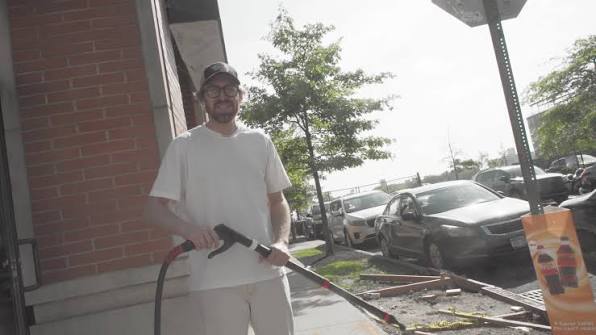
About halfway through the film, to secure funding for production, Wilson pivots to a "music documentary" largely centered on Jack Macco, a liquor store employee and frontman of the cover band-for-hire Nebulus. What initially seems like a casual interview with a Ridgewood man on the street unfolds into a tale of artistic fulfillment, alcohol tasting, and grief. Over the course of filming, Jack lost his fiancee, Judge Dorothy Chin Brandt of the Queens Supreme Court. Wilson captures the struggle in his face at he fights his way through covers at a local dive, and films Jack talking about Dorothy in his Long Island hotel room, delivering the line (as I remember it): "she's not supposed to be dead, she's supposed to be alive."
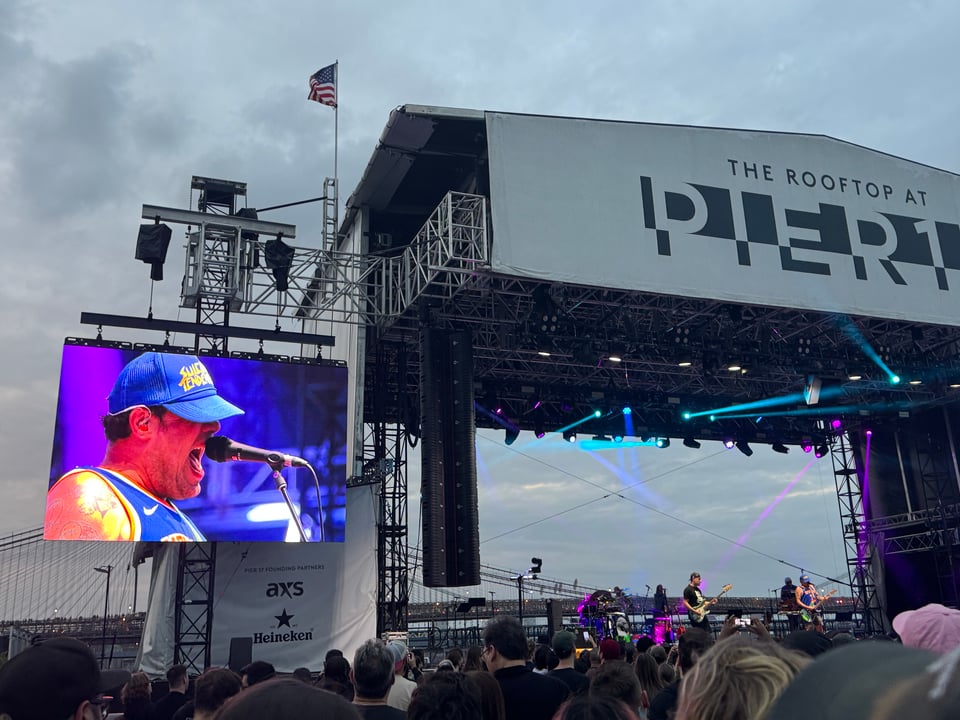
The week I am writing this, indie punk rocker Jeff Rosenstock's second solo album WORRY. turns ten years old. As I've been listening to it, reading about it, and hearing it played twice cover to cover live over the past month in preparation to (try to) write a big piece about it, I've instead been finding parallels between that album and The History of Concrete. Jeff and John use the tools of artistic DIY to put heavy spotlights on the nightmare New York is simultaneously hurtling towards and already in. Jeff Rosenstock may live in L.A. now, but he was born and bred in and by Long Island and NYC, and at the show he shared his continuing love for the city and stories of the bullshit he and his friends smiled through while living and organizing here. John DeDomenici, his bassist, followed up Rosenstock’s rant by saying "come back."
Because I'm no stranger to giving myself homework, I read James Acaster's book Perfect Sound Whatever, named after the closing track of WORRY., to make sure I wasn't unknowingly copying his homework for a piece about the album that may never get written. James weaved his personal struggles with art, love, and depression through the year 2017 among interviews with musicians and writing about 2016 releases in an attempt to defend the firmly held stance that 2016 was the greatest year for music of all time. Much like the tissue between Jeff and John, James' book reads quite a bit like an episode of Wilson's HBO series How To, constantly taking detours away from the stories about his own struggles to interview a musician and return to the stated purpose of music writing, and vice versa. Like John Wilson and his conveniently named boats, James Acaster draws parallels where one wouldn't expect, for example between the Law Holt album City and getting his dick checked by several begrudging doctors, or the Doomsday Student album A Self-Help Tragedy and being cyber-bullied by his former therapist.
"Pietro, 60 Years Old" is a song I thought was about a nice old man in Jeff's neighborhood, but per James' interview with Jeff for the book, I learned it was really about Jeff and Christine (his wife) meeting a nice old couple getting married at the same time as them, at the concrete Greek Revival wonder of Brooklyn's Borough Hall. The song is the opener of "The Worry Medley," a sequence of seamless tracks ranging in genre from hardcore punk to ska to power pop and everything in between. They make up the back half of the record and lyrically marry macro panic about police brutality, gentrification, and the largely negative-trending state of the world with the idea of trying to find stability amidst the titular ‘worry.’ In the context of this record, ‘worry’ is a definition of love wherein allowing yourself to care about someone, for people like Jeff and for people like me, often cannot be separated from the fear of losing them.
"It's not like the love that they showed us on T.V.,
It's a home that can burn, it's a limb to freeze,
it's worry. Love is worry."
Jack never married Dorothy, though they spent most of their years-long relationship engaged after they connected via a tarot reading. Despite Jack dwelling in grimier spaces, and Dorothy being a prolific member of New York's judicial system, he told us they were natural together, there was never any judgment exchanged between them, only understanding, only care. Despite John beginning his journey hoping to adhere to the stringent Hallmark rubric, what he found was not the love that they show us on T.V., something safe and palatable and clean. Instead, he uncovered the reality of how shoddily this is all held up, the fragility of our bodies and what they've created, what our tattooed skin holds in, how easy it is for the home you know to burn or crumble.
Despite it all, Jack is still willing to build a house, and John Wilson is excited to show us how.

“Lo, I or you,
Or woman, man, or state, known or unknown,
We seeming solid wealth, strength, beauty build,
But really build eidólons.”
-Walt Whitman, Leaves of Grass
“When our towns fall to the ground
It won’t shatter me and you.”
-Jeff Rosenstock, WORRY.
