
Gael's Erratic Pigeon Post | We're half-way there
A newsletter about learning, struggling, resisting and sometimes improv.

A newsletter about learning, struggling, resisting and sometimes improv.
Hello dear pigeon-reader! If you are new on these digital lands, please be welcomed. If you are part of the furnitures, I thank you for sticking around for what is officially the most erratic newsletter in the world!
Today’s Pigeon Post is covering some thoughts I’ve been brewing about improv and learning it, some feelings I’m having about the world, and of course some more projects coming up. It includes news about a certain festival! Read on until the end to discover it.
As usual, feel encouraged to answer to this Pigeon Post with anything you want, and if you liked it, feel free to share it with your friends!
THE IMPROV CHATTER
I started improv almost 20 years ago, while I just arrived in a new city: Strasbourg. Back then, I had played music for more than a decade, created juggling shows for half that time, and was studying at university. And then I encountered that strange community of improvisers, and fell in love with them late at night, sharing beers and a surprisingly delicious club sandwich.
Starting improv
Improvisation is one of the most accessible artistic practices in the world: it doesn’t require much prior knowledge—except maybe for some language, doesn’t require anything else than yourself to practice—except for a partner, and is practically accessible anywhere and anytime—aka life.
It makes the entry level incredibly accessible and low—theoretically at least—which is one of my favorite things about this artform, because the more different people join it, the richer and more interesting it gets.

Improv also gives one of the fastest satisfaction-yield of the arts: very quickly after you started you can find yourself on stage, getting a good adrenaline shot, and praises from the audience or your friends that saw you that night.
These two factors make beginning improvisers quickly draw the conclusion that they are past the beginner’s stage.
But then Gael, how long are we truly beginners?
The feeling of beginner
Research tends to show that we pass the first level of frustration while learning a new skill after 20h of focused practice. In improv terms, it is the equivalent of 10 sessions of 2h, which is in the average of what is practiced around the world. Often beginners courses range from 6 or 8 weeks, to 12 weeks sometimes, with some odd countries—I see you, France—doing a full school year (approx. 30 weeks).
This correlation could make us assume that a single beginner course is the time we need to not be a beginner anymore. But obviously, this is without counting on the fact that we’re talking here about a single new skill (eg. launching a basket ball through a hoop, juggling a cascade with 3 balls, shuffling cards in a cool manner, etc.), and not a whole skillset (eg. learning to play an instrument, a new language or, in our case, improv).
Obviously, there is little research about improvised theatre, but I think language is actually a good equivalent. A language practice requires a broad understanding of the practice to do simple things, it demands to listen and create content together, it needs a grasp of the context, and is often an intricate practice. To give an example with English, the language contains about half-a-million words, a native speaker knows about 30,000 words, but will only use 5,000 in their every-day life. Added to this, 3,000 words covers approximately 90% of the English literature, which is why 3,000 words is often described as the proficiency barrier for a non-native learner.
Alright Gael, but then … when do we stop being a beginner if it’s not after taking a beginner course?
Proficiency in the practice
We’ve all heard the 10,000h to master something, but the issue with this is that it may feel impossible to reach—and it also assumes that you want to become an absolute master.

If we look at research in the language field, still, there are different levels that we can talk about—still assuming focused practice:
200h: Makes us reach a basic level to get by in a shop. In language terms, this is still a beginner level, but where we can interact.
800h: Makes us reach a proficient level allowing us to interact in conversations, if the language is in the same category as ours—eg. Spanish for a French speaker.
In order to situate where this would place us within our improv practice, we would have the following steps:
Reaching the level of beginner turning into an intermediate—after 200h: it represents 100 weeks of classes, or a bit more than three years of courses.
To become an advanced student—using the 800h mark, assuming that the student is already familiar with the ‘language’ of theatre: it represents 400 weeks of classes, or about 13 years of courses and rehearsals.
Wow, that’s a lot. What if I also take workshops and all, and I go to jams, and also I sometimes do an intensive?
How the practice matters
A very important element of the research is the notion of practice. It always makes a difference between naïve practice and deliberate practice. Indeed, the hours that ‘count’ are the ones that are deliberate: they involve specific, effortful, and guided practice slightly outside of our comfort zone, constantly checking the performance against the desired outcome, making conscious adjustments and corrections, setting new goals, in order to improve the result of the practice.
Improv, like many other hobbies, is experiential: we can love doing it for the sake of doing it. This means that many classes, jams, workshops or rehearsals don’t tick the boxes of deliberate practice. This is still practice, but what we call naïve practice, and I’d say it covers at least half of our time practicing, being generous.
If we get back our data from above (3 years of beginnership), adjust it to a more intense approach of the discipline through workshops (bringing it down to 2 years), but also take into consideration that about half of our practice is naïve, we reach a point where we stop being a beginner at best after 4 years of regular practice. It also means that some of us will practice weekly for 20 years and still be beginners, as the process of experiencing naïve practice is what one can be looking for.
Isn’t there a variation depending on where you learn though? Also it doesn’t really speak to me to label myself as a ‘beginner’, don’t you have better?
Nuances and other ways
Obviously all of this is highly dependent on many things: how familiar you are with the stage when you start learning (eg. professional actors improve faster than someone who’s never done something on stage), what you feel about learning and your own skills in general (eg. men tend to feel expert at anything after half-an-hour and women have been told by society that no matter their actual competences they don’t deserve recognition as experts), and where you learn improv (having loads of examples of professional improv around will give a bigger perspective of what is possible), etc.

A philosophy that I really like in learning new complex intricate skills is one I got from back when I was in Judo as a kid: the Japanese Shuhari. It layers the mastering of anything in three concentric circles of competences:
Shu: that’s the beginner stage, where you learn to imitate and follow the established methods in the craft, and where you discover new things.
Ha: here is the understanding stage, where you have gone beyond what to do, and understand why you do it, and therefore can explore variations.
Ri: the stage of mastery, where you can start expressing your individual artistic vision, innovate, creating methods, etc.
What I love in this philosophy is that going from Shu to Ha isn’t discovering new things, but simply getting a new understanding of the same things. It also states the fact that wanting to move too fast to Ha without a solid Shu will result in wobbly results, not having a base that can support the exploration.
I relate very much to this approach because it doesn’t really set a time, a number of hours, or even a mention of what you are, but rather where you are in your journey as an eternal student. Especially because any learning curve is logarithmic (ie. it gets longer and longer to learn or refine the next step).
But then what’s your point? Why are you still talking about beginners? And isn’t it depressing to have to imagine spending 10 years to only become an intermediate student?!
I’m about half-way there
I have tried a lot of things in my life—both as a hobby and professionally, but the one thing that kept me in is improv. Why that? Very much because I feel like I am constantly half-way there!
This is obviously not unique to improv, but it somehow keeps striking me. When I was doing improv for a year, I felt like I was half-way there to understand improv fully. After five years, I felt half-way there. A decade? Half-way there. Another decade? I guess now I’m half-way there. So if I ever called you a beginner while you’re doing this with passion and dedication for the full length of your 6-weeks course, for a year every Tuesday, or even 5 years twice a week, excuse my language, I meant that you were half-way there.
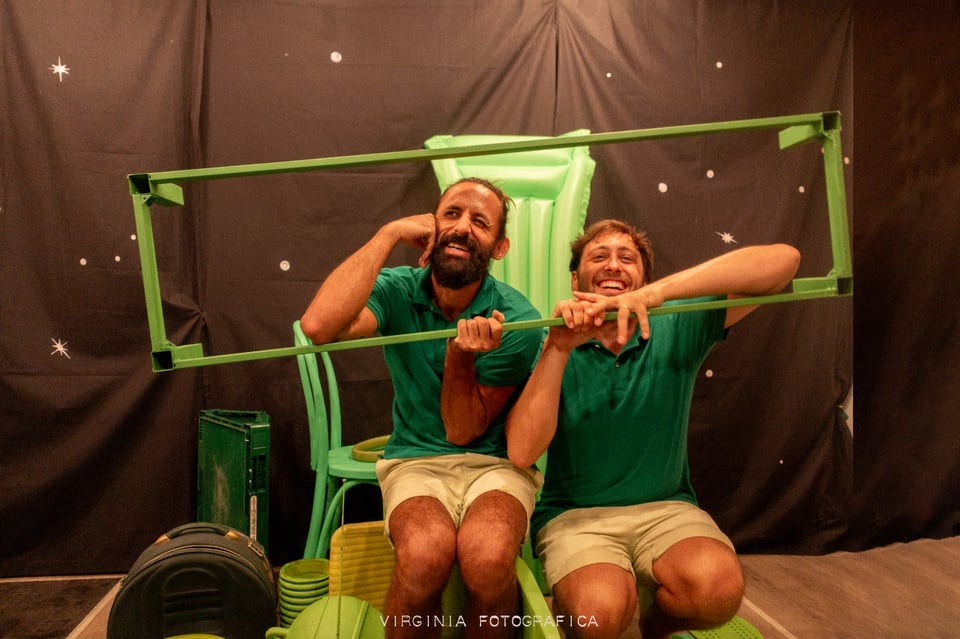
And this is beautiful, it’s a gift and I want to cherish it. I have dedicated my life, time, and energy to this craft. I have practiced it for more than ten thousand hours. I have performed thousands of shows. I have watched, taught, discussed, directed, analysed, and breathed improv. And yet, I feel like there is still so much to learn, so I can’t quit yet, I can’t get bored yet, I’ve not figured it out yet. I’m about half-way there.
SOME LIFE STUFF
I rarely get outwardly political in here, but everything we do, don’t do, say, don’t say is inherently political. And these days, I am an emotional mess, feeling all the feelings, with everything happening in my home country of France. If you desperately try to escape the news, skip to the next section!
The unrest, the violence, why we fight
In short, France is facing the consequence of decades of degradation of public services in general, and especially an escalation in the last ten years of the impunity, disdain, and casual violence from the most privileged layer of society against other 95% of people in it.
Two months ago, unrest started in high schools of our colonial islands—still part of the French country and often treated as sub-regions when it comes to public services. It grew into the movement that we know now: almost 800,000 people in the streets on Saturday, joining high-schoolers, teachers, unions, and just generally people. Media treats it through the lens of looking at the violence from a small minority in order to ignore both the actual issues, and the highly problematic police violence, unique in Europe by its intensity. On Saturday alone, about 20,000 grenades were used (that’s seven times more than the number of words in this really long newsletter), people lost eyes, hands, and got their skull cracked. And we also saw gorgeous symbols of resistance, images of solidarity, of collective humanity.
I could rant forever about this, but I rather get to why the protests happen: the general tendency of the French government—and most European governments—to defund any public service. It involves schools, universities, hospitals, health insurance, fire fighting, transport, and so much more. And it also involves the art.
Art as a public service
Let me state it here: art is not viable if we isolate it economically. And I believe that it should be seen as a public service. Creating a professional show (even an improv show) costs much more money than what people should pay to watch it. Art is for the people. We are the people, all of us. Not only the ones that earn loads of money. Art needs support, it needs skills, it needs time, it needs funding, because it is beautiful and essential.
Everywhere in the world, when you become aware of people resisting oppression, it means that they have had so much done to them, to their lives, to their hopes and dreams, that they don’t see any other possibility than doing this very uncomfortable thing: speaking up, resisting, struggling publicly. There are always reasons that we’d prefer to ignore, horrors that we’d like to avoid looking at, systems in place that are more comfortable to bend for than to break.
We’re about half-way there
Life is worth fighting for, though. History has proven it, over and over again. And sometimes, not so far from us, it takes different shapes and forms. My great grand-mother’s country, Algeria, reached independence from France despite the struggles and horrors. My grand-father’s exile from Spain after fascism won was still worth the fight of the republican forces. My mother’s drive to obtain the first diploma in her family allowed me to be where I am today. Our fights are worth it, even when they feel desperate, chaotic, and powerless in the moment. Because they serve the people, each in their own way: schools serve the people, hospitals serve the people, theatres serve the people.
People are worth fighting for.
A BIG OL’ SHOUT OUT
Lalalalala. Ok, welcome back to this light and fun newsletter. Today’s shout out is for an amazing multi-talented artist: Diego Ingold.
Diego is obviously a very talented improviser, you probably already know that if you’ve met him. If you’ve not met him: go meet him as soon as you have the opportunity! But he is also a very talented illustrator!
For a new project application I did with two other amazing people (Paul Berrocal and Donatienne Amann), he made beautiful illustrations, and we are so happy that it got selected! Multiple weeks of creation residency in a gorgeous theatre, already 10 shows scheduled straight after, and we are now looking at touring it. But I’ll tell you more about it in another Pigeon Post!
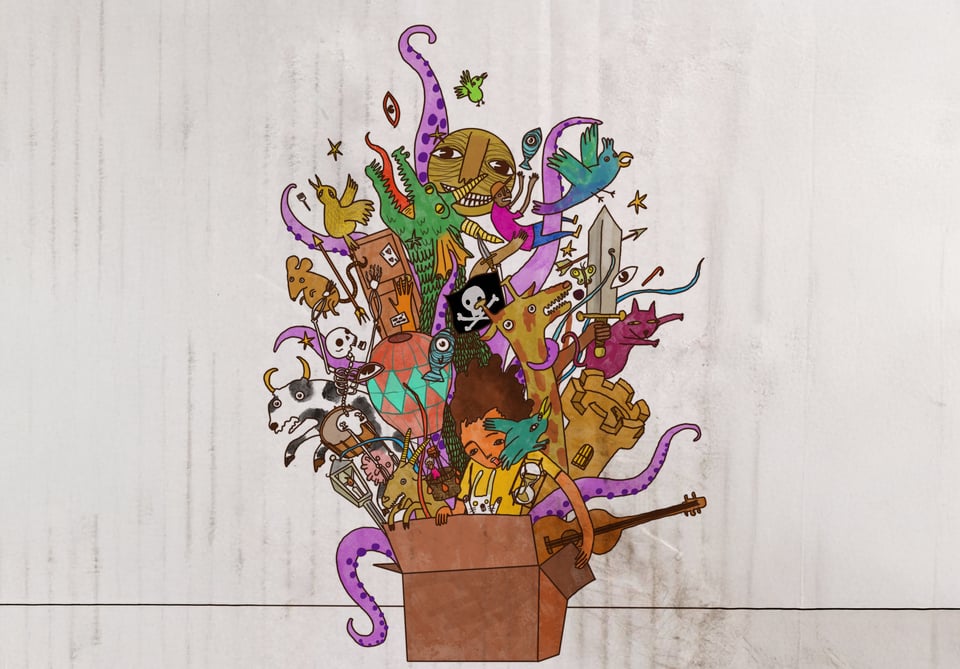
Diego is like a sibling to me, and I am of course partial because I love him to bits, but he is one of the most inspiring improviser, artist and human that I have the chance to know. So I guess I’m lucky to see him soon (cf. next section)!
A NEW PROJECT
This season, we are not doing a Flock Festival (booh). But because we can’t help ourselves, we will instead do another sort of festival: Improv x Soundpainting. It will be covering improv, of course, and multiple improvised disciplines, bringing them together using Soundpainting!
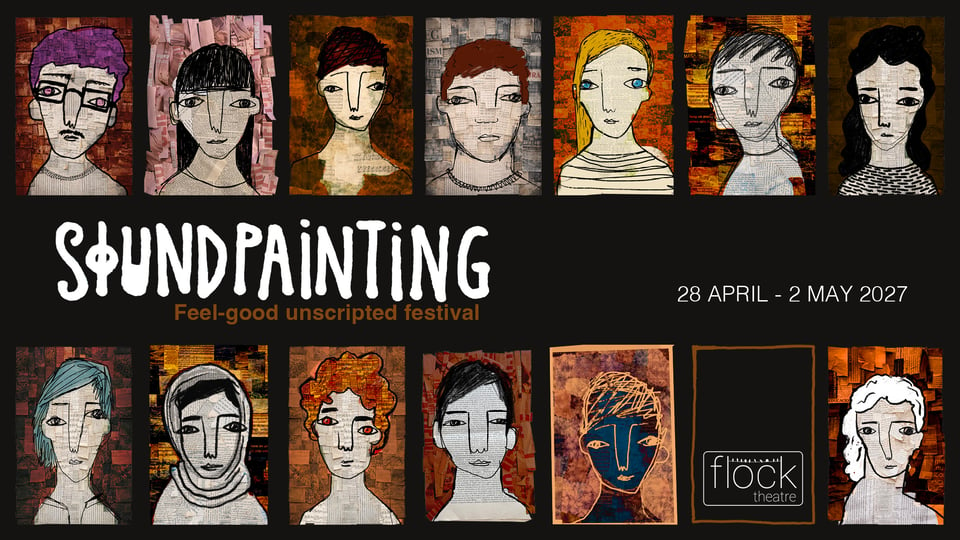
More information will be published soon, but I can already tell you that the author of the visuals, Diego Ingold himself, will be back in Amsterdam! On the program: 5 days of workshop with international artists to improvise differently, the possibility to practice Soundpainting, two nights of performances, etc.
The dates you can already keep are the following: Wednesday 28th of April to Sunday 2nd of May 2027! Come visit us in Amsterdam, and you can even come one day early to witness King’s Day—if celebrating monarchy is your thing.
It’s like a big improv festival, with world class improvisers, mixing disciplines in a beautiful unique manner.
RANDOM THOUGHT
For once, I’m not talking about food!
I like the sun. And I like the sea. And last weekend I got to see both, so it made me happy.
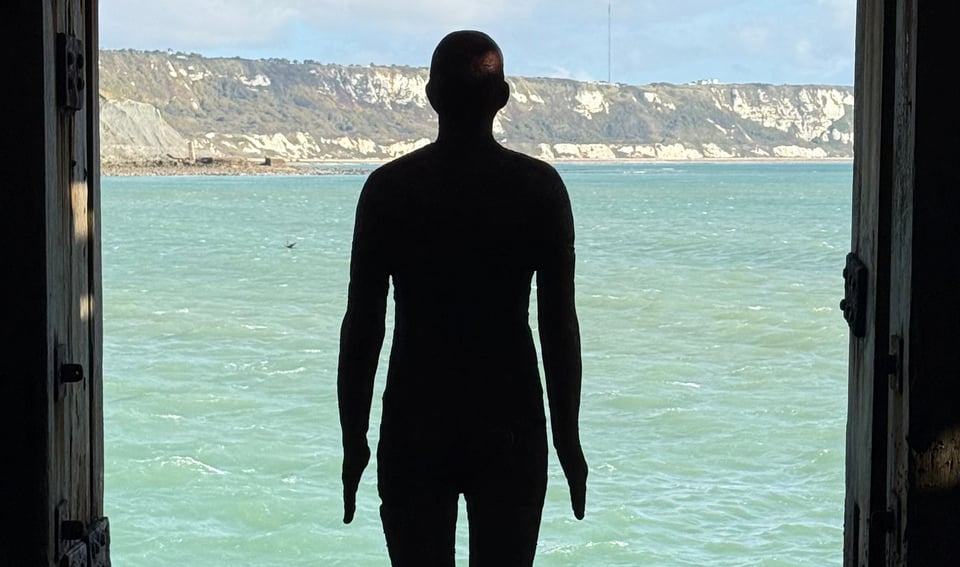
The sun warms my skin, enlighten my mood, brighten my thoughts. The sea brings me back to simple things, sheds me from worries, reminds me how big the world is.
I like the sun and the sea.
Thanks for reading this Pigeon Post, and for powering through the impressive number of words! I’m both overflowing with ideas and dried up on energy for so long now, that when it rains, it pours. As usual, if you want to chat, just hit the reply button, or if you prefer to silent-read, just do what makes you happy!
Take care, be kind and eat good food!
Gael