The Late Night Pour | Three Chairs
|
Four Fingers News
The News, Neat.
|
| TUESDAY, NOVEMBER 17, 2026 · DAY 263 |
| The Late Night Pour |
Three Chairs
Three Chairs, read aloud · 10 minutes.
This coming Thursday, Nov 19, 2026, Donald Trump is expected to sit down at one table with Xi Jinping, the president of China, and Vladimir Putin, the president of Russia. No American president has ever met with the presidents of China and Russia together. The White House calls it a first-ever trilateral sit-down between the leaders of the three countries.
The meeting is set for Shenzhen, the Chinese city across the river from Hong Kong. The reason everyone is in town is APEC, a yearly trade summit of 21 Pacific countries. The three-way meeting itself is about optics, and each of the three men gets something out of the picture.
Trump gets his photo with Xi and Putin and makes history. Made for TV. A senior administration official said, “We do not expect to get to any kind of agreement.” Who cares? That’s not the point.
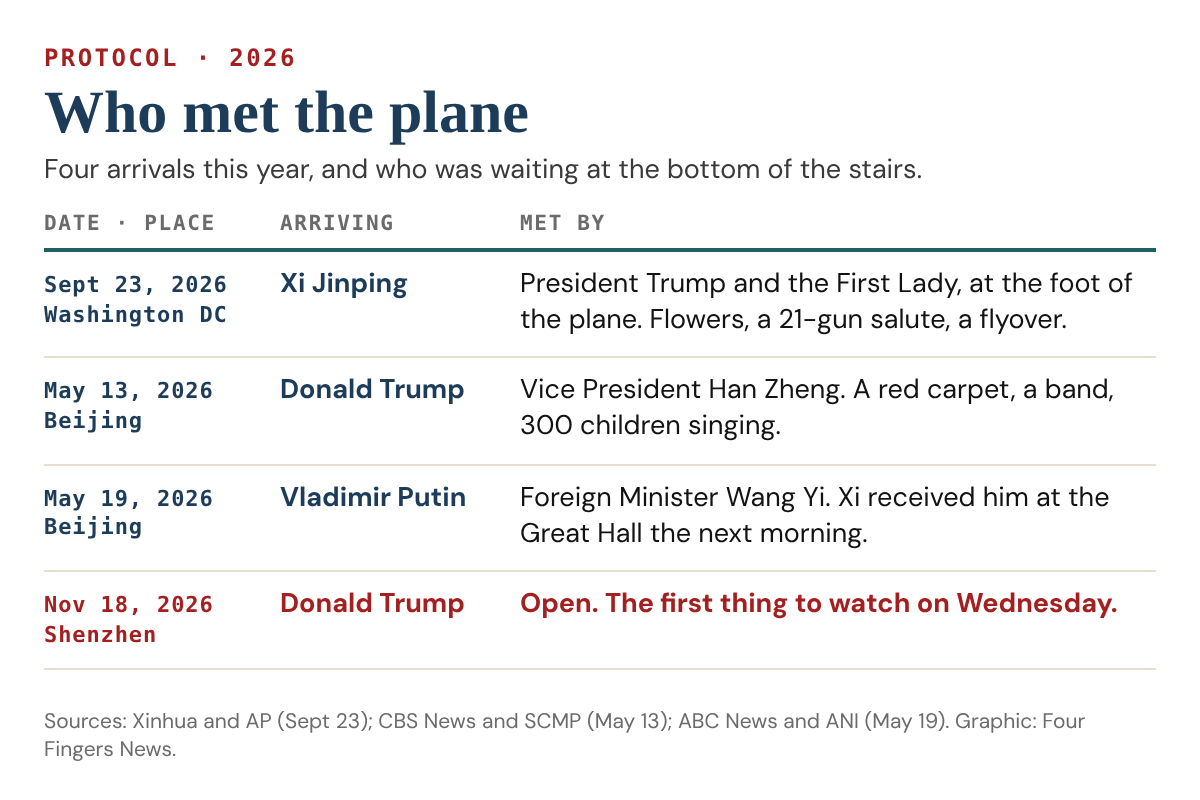
What’s worth watching is how Xi and Putin receive Trump. When Xi flew to Washington DC on Sept 23, 2026, Trump and his wife met him and his wife at the foot of the plane, a rare planeside welcome. Two American children handed over flowers, and there was a 21-gun salute, both national anthems and a military flyover. When Trump landed in Beijing on May 13, 2026, Xi didn’t come to the airport. Trump was met on the tarmac by Xi’s vice president, Han Zheng, with a red carpet and about 300 children singing a welcome and waving American and Chinese flags. It was a bigger show than Trump got in 2017, and it still wasn’t Xi.
Every diplomatic event is staged down to the shape of the table, the drinks, and whether anything is offered at all. The language counts too, and so does how it’s interpreted.
On Thursday, Nov 12, 2026, Putin hosted Jared Kushner and Steve Witkoff at the Kremlin. Kushner is Trump’s son-in-law and runs a private equity fund that took $2 billion from Saudi Arabia’s sovereign wealth fund in 2021. Witkoff is a real estate developer and Trump’s envoy. They came from Abu Dhabi, the capital of the United Arab Emirates, where two days of talks between Russia and Ukraine, run by the United States, had ended with a prisoner exchange and nothing else. Putin spoke through an interpreter. Watch the footage and the timing stands out. A speaker working through an interpreter normally waits for a cue that the translation is done. Putin didn’t wait. He started his next point as the interpreter landed the last word of his previous one, every time. A real estate developer and a private equity manager got a modern history lesson in who sets the pace in that room.
The warmth runs the other way with China. When Putin landed in Beijing on May 19, 2026, the foreign minister, Wang Yi, met him at the airport, and Xi received him at the Great Hall of the People the next morning. Both Trump and Putin got the red carpet in Beijing this spring. Putin’s visit came with a far more open show of friendship. These are small details in the production of a summit, and the message they send is clear to anyone paying attention. How Trump is received in Shenzhen won’t say anything about Trump. It’ll be a window into what Xi and Putin are thinking.
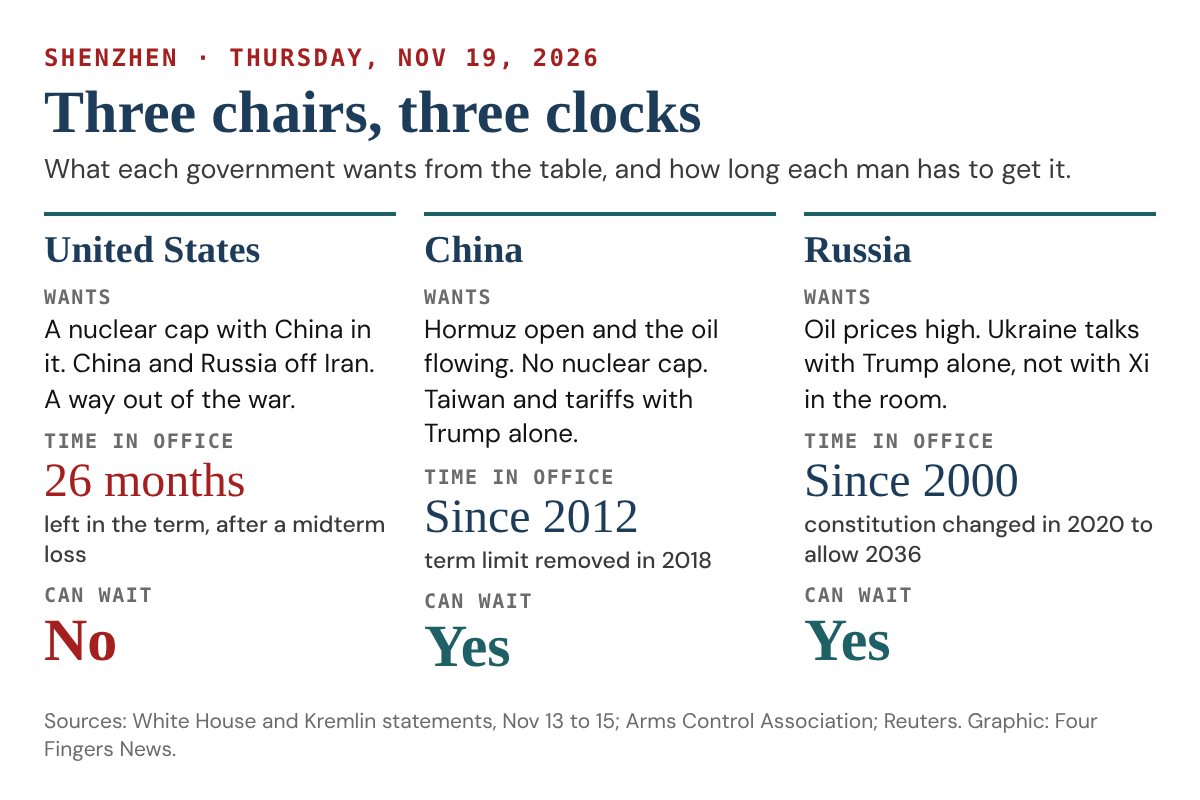
Each of the three wants something from Thursday. The stated American agenda is nuclear weapons. New START, short for the New Strategic Arms Reduction Treaty, was the last agreement that capped how many long-range nuclear weapons the United States and Russia could keep ready to fire, 1,550 warheads each. It ran out on Feb 5, 2026, after Trump rejected Russia’s offer to extend it for another year and demanded a “new, improved and modernised” deal that includes China. The real American ask is Iran. China buys most of the oil that pays for Iran’s war. On Aug 24, 2026, Treasury Secretary Scott Bessent announced what he called Operation Economic Outcast and said any bank or company that launders money for Iran “will be removed from the US dollar system.” Three months on, nothing has been done to China. Russia’s part is the targeting. Since the war began, Russia has passed Iran the locations of American warships and aircraft, three officials told the Washington Post on March 6, 2026, and the White House didn’t deny it. So Trump sits down with the government that buys Iran’s oil and the government that tells Iran where the American ships are, and asks them to stop. He also wants out of the war itself. JD Vance went on Fox News on Monday, Nov 16, 2026, and pledged the administration won’t allow the Iran war to be “even a two-year commitment.” The USS Theodore Roosevelt carrier strike group entered the US Central Command’s area of operations on Sunday, Nov 15, 2026, joining two other carrier strike groups already operating in the region.
China wants the oil flowing again. China has been Iran’s largest oil buyer for years, and it imports about a third of its oil through the Strait of Hormuz, the channel between Iran and Oman that the US Navy has blockaded since April 13, 2026. China’s seaborne crude imports in August 2026 ran about 7.14 million barrels a day, nearly 40% below the prewar average. On the nuclear question its answer is already on the record: “China will not take part in nuclear disarmament negotiations at this stage,” Shen Jian, China’s ambassador for disarmament affairs, said in February. China has about a tenth as many warheads as either of the other two and won’t sign a treaty that locks that in.
Russia is in no hurry. The war keeps oil prices high, Russia sells oil, and every month the fighting goes on the Russian government collects more tax from it. Reuters calculated that Russia’s tax on oil extraction would rise from 327 billion roubles in March 2026 to around 700 billion roubles in April 2026, about $9 billion, because of the Iran war. The United States sells oil too, and the difference is who gets the money. Russia’s biggest oil company, Rosneft, is owned by the state, and taxes on oil and gas paid for 23 percent of Russia’s federal budget last year, before this war pushed prices up, so a high price goes straight into the Kremlin’s accounts. American oil belongs to private companies and their shareholders. The federal government gets a corporate tax bill and some royalties, and everyone else gets the price at the pump. High oil pays for Russia’s war. In America it comes out of your wallet.
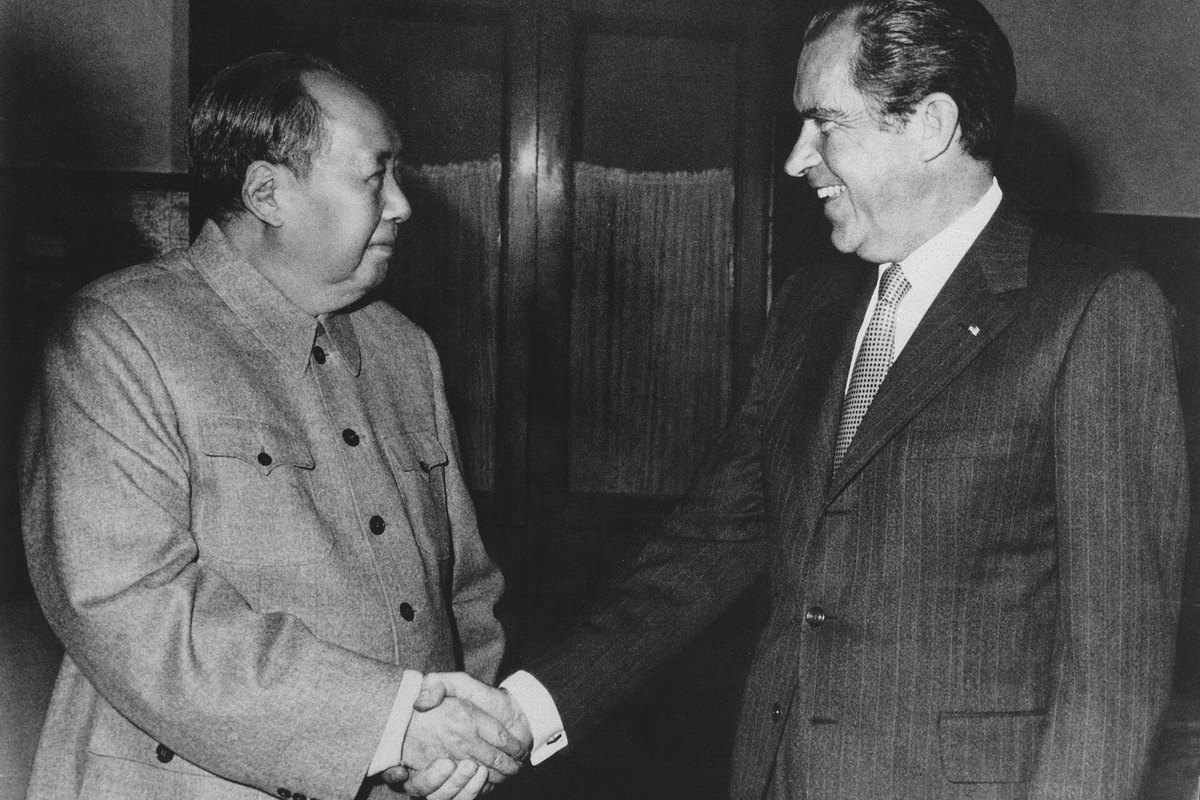
For fifty years the one fixed rule of American strategy toward these two countries was to keep them apart. In February 1972 Richard Nixon flew to Beijing and shook hands with Mao Zedong, the leader of Communist China, a government the United States had refused to recognize for 23 years. He became the first US president to visit mainland China while in office. The reason was the Soviet Union. China and the Soviets had fallen out in the late 1950s, and in 1969 their soldiers shot at each other along the border. Nixon saw two enemies who feared each other more than they feared him, and he made friends with the weaker one. Three months later he flew to Moscow and signed SALT I, the Strategic Arms Limitation Treaty, the first agreement that put a ceiling on the two countries’ nuclear missiles, with Soviet leaders who now worried about China and America getting close. For the next fifty years the United States could count on China and Russia distrusting each other more than they distrusted Washington DC.
That advantage is gone. Xi and Putin declared a partnership with “no limits” in Beijing on Feb 4, 2022, 20 days before Russia invaded Ukraine, and they’ve grown closer since. Trump has 26 months left in office and a midterm behind him that his own vice president called a shellacking. Xi has led China since 2012 and removed the term limit on his office in 2018. Putin has led Russia since 2000 and changed the constitution in 2020 so he can stay until 2036. Two of the three men at that table can wait. Russia is waiting. China is waiting for a better price on the blockade, and it won’t pay for it with a nuclear cap. The meeting costs them nothing. It gives them a photograph of the American president as one of three men at their table, nine months into a war they both opposed and he can’t close.
Nixon went to China to split the two. Trump is going to China because he can’t.
My expectation for Thursday is the same as the White House’s: no treaty, and no announcement that ends anything. The first thing I’ll watch is who’s standing at the bottom of the stairs when Air Force One opens its door in Shenzhen. The second is what the ships do in the week after. Whether any of the three strike groups turns for home. Whether tankers start loading at Iran’s ports again. Whether the statement out of Shenzhen uses the word Hormuz.
Sources (24), on the site.
US Jets Hit a Missile Site on Qeshm Hours After Iran’s Third Strike on Bahrain in a Week
US warplanes struck a Revolutionary Guards missile launch site on Qeshm Island, in the Strait of Hormuz, on Tuesday evening, a US military official said in a statement that called it self-defense after Iranian attacks on US personnel. Iran’s IRNA agency reported five to six explosions northwest of Qeshm city, and Hormozgan’s deputy governor, Ahmad Nafisi, said nothing residential or commercial was hit. Hours earlier the Guards said their drones struck a US radar at Bahrain’s Sheikh Isa air base, the third Iranian attack on the kingdom in less than a week; US Central Command said the drones were intercepted, and Secretary of State Marco Rubio condemned the strikes in a call with Bahrain’s foreign minister. Kuwait’s military said its air defenses were repelling drones Tuesday night. Iran’s army says at least five ships on routes it calls unauthorized hit mines or caught fire in the strait; no ship has been named and no shipping agency has confirmed the count.
| The strike: an IRGC missile launch site on Qeshm Island, Tuesday evening local time |
| Bahrain: a radar at Sheikh Isa air base, by the IRGC’s account; the third attack in under a week |
| Kuwait: air defenses engaging drones Tuesday night |
| Ships: Iran claims at least five hit mines or burned; unconfirmed |
| War: Day 263 |
Nvidia Doubles Revenue in Its First Quarter Without Huang; Board Says He Won’t Return
Nvidia reported $115.8 billion in revenue for the quarter, up 103% from a year earlier, and $65.3 billion in profit, up 105%, in its first report since Jensen Huang resigned on Nov 12. Board chair Harvey Jones opened the call by saying the board unanimously accepted Huang’s resignation and doesn’t intend to reinstate him. Interim CEO Colette Kress said demand is “far exceeding supply” and raised the growth outlook for fiscal 2028 to 75% from 70%. Shares rose more than 4% after hours after closing lower with the market.
Deutsche Bank Falls After 15 Million Internal Files Leak
Deutsche Bank shares fell more than 6% in Frankfurt on Tuesday before closing down 3.8%, after an international reporting consortium began publishing from more than 15 million internal files supplied by two whistleblowers. The reporting covers the bank’s dealings with Russian oligarchs, Jeffrey Epstein and Donald Trump, including a 2017 slip in which the bank sent one of Trump’s tax documents to another client’s accountant and kept it from the White House, the Financial Times reported. Chairman Alexander Wynaendts backed CEO Christian Sewing. Asked about the leak in Manila, Trump said: “It’s illegal for them to do it.”
Knesset Replaces Netanyahu’s Speaker After a Six-Hour Filibuster
The Knesset voted 66-52 late Tuesday to elect Matan Kahana of Gadi Eisenkot’s Yashar party as speaker, replacing Likud’s Amir Ohana, after Netanyahu’s bloc filibustered for six hours. Netanyahu’s allies hold 53 of 120 seats; Eisenkot’s bloc holds 48 and the Arab-led parties 19, and together they now control the chamber’s agenda. Earlier in the day the Shin Bet said its probe into election-day vote-buying claims had found “no evidence” so far of activity that could affect the result, and a police deputy chief stood by the arrests while conceding that sourcing from the Prime Minister’s Office “doesn’t sound good.”
Stocks Slip 1% as Musalem Says the Next Hike Should Come “Soon”
The S&P 500 closed about 1% lower Tuesday ahead of Nvidia’s report, after St. Louis Fed President Alberto Musalem said the central bank will need to raise rates again “soon” and that moving sooner lessens the risk to the broader economy. Every Fed official who has spoken since the Nov 5 selloff leans toward more increases; the Fed raised its rate in September for the first time in three years, and the next meeting is in December.
UW’s Classified Staff Walk Out at 2:30 PM
SEIU 925, the union for the University of Washington’s classified staff, walked off the job at 2:30 PM PT Tuesday across the UW system, a walkout the university’s own labor relations office had listed in advance. Members voted 83.3% in late September to reject UW’s contract offer and picketed on Oct 1. The office notes that state law doesn’t give UW employees the right to strike; bargaining continues.
Seahawks Rest at 6-4; Kraken Host Vancouver Thursday
The Seahawks are on their bye at 6-4 after Sunday’s 21-13 win at Las Vegas, and return Sunday, Nov 29, 2026 at San Francisco, 1:25 PM PT. The Kraken, 9-8-1 after Carolina’s two-game sweep in Helsinki, host Vancouver on Thursday, Nov 19, 2026 at 6:40 PM PT.
| Read the full dispatch |
You’re receiving The Late Night Pour, an edition of Four Fingers News.
History you haven’t heard yet, poured nightly. Pass the bottle.
Forward this to the most curious person you know.