
The Late Night Pour | The Price of Passage

|
Four Fingers News
The News, Neat.
|
| SATURDAY, SEPTEMBER 26, 2026 · DAY 211 |
| The Late Night Pour |
The Price of Passage
A ship paid $5.3M to secure a passage through the Panama Canal earlier this month. That was the auction premium for a reservation, on top of the ordinary toll. The gas carrier G. Spirit made its crossing on Sep 1. (Reuters, Reuters column)

Map: Four Fingers News · Route and lake: © OpenStreetMap contributors · Coastline: Natural Earth · View full-size map
The Iran war helps explain the demand. Disrupted Gulf shipping has pushed more energy cargoes toward Panama, where low rainfall has constrained the freshwater supply the locks depend on. A route that offers relief from one crisis has limits of its own. (Reuters)
Panama also has a history worth keeping beside those shipping figures. The U.S. invaded on Dec 20, 1989, and removed Manuel Noriega. We already operated the canal. Its transfer to Panama, agreed under the 1977 treaties, wasn’t completed until Dec 31, 1999. (Army history, Canal Authority)
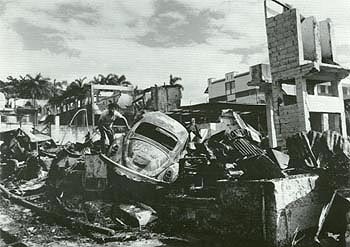
My film recommendation tonight is The Panama Deception, the 1992 documentary that won the 1993 Oscar for Best Documentary Feature. It examines the invasion’s civilian consequences and challenges the government’s explanation and American media coverage. With so much of today’s war discussed through the security of shipping routes, I think there’s value in revisiting what an American intervention looked like to the people living beside one.
Watch: The Panama Deception
Play the official trailer · 3:36 · The Empowerment Project
Preview image: El Chorrillo after the invasion, Panama, December 1989. Photo: Julio Cesar Guerra D., via The Empowerment Project.
Xinhua published eight results of Xi Jinping’s Washington visit on Saturday, then added that the two militaries agreed to sign a crisis-communication memorandum soon and keep searching for missing US servicemen’s remains — items the White House fact sheet doesn’t mention. The American list includes Chinese purchases of at least 10 million metric tons of US coal in each of 2027 and 2028, absent from Beijing’s account. Both describe tariff arrangements covering $30B in goods in each direction; the White House calls them recommendations for more favorable treatment. Both also announce an AI dialogue, with the next exchange due by November.
Donald Trump publicly rejected Iran’s proposal on Saturday, telling reporters outside the White House its terms weren’t acceptable. Tehran had offered to reopen the Strait of Hormuz and resume nuclear talks within seven days if Washington lifted its naval blockade, waived oil sanctions and observed a regional ceasefire that included Lebanon. Iran also sought the release of frozen assets estimated at at least $12B. Masoud Pezeshkian told CBS, in excerpts released by IRNA, that the proposal had been coordinated with Supreme Leader Mojtaba Khamenei; he said Iran would meet its obligations if the US accepted the plan and met its own.
| War: Day 211 · began Feb 28, 2026 |
| Iran’s terms: Blockade lifted · oil sanctions waived · frozen funds released · regional ceasefire |
| Proposed timetable: Hormuz reopening and nuclear talks within seven days |
| Negotiating team: Six members from military, parliament and government, Pezeshkian says |
| Hormuz traffic: Nine tracked passages Sep 24 · vessels with transponders off excluded |
| Crude: Brent $104.32 · WTI $92.41 · Friday settles |
| US response: Trump publicly rejected the proposal Saturday |
The Saudi-led coalition said it intercepted two ballistic missiles aimed at Khamis Mushait and two drones headed for Riyadh early Saturday; civil defence sounded alerts in Khamis Mushait and Abha. The launches came hours after the Saudi, Pakistani and Turkish military chiefs met in Riyadh under the Makkah defence agreement, and Ansarallah has kept up strikes on Saudi cities, energy sites and shipping since declaring its own blockade in July.
WTI traded as much as $12.02 a barrel under Brent on Thursday, the widest gap since May 6, as traders priced in the chance that a diesel export ban would force US refiners to process less crude. US diesel touched a record $6.528 a gallon this week; Morgan Stanley puts net exports at roughly 1.2 million barrels a day against production of 5.1 million. The White House denied preparing a 90-day ban, while Reuters reports that Energy Secretary Chris Wright has sounded out refiners on voluntary restraint.
Bob Ferguson hasn’t approved any of the 15 commutations Washington’s Clemency and Pardons Board has recommended since he took office in January 2025, InvestigateWest reports. As of Sep 14, he’d granted 10 pardons, with 32 petitions awaiting a decision. A 2025 law provides for 10 board members and five-member hearing panels; chair Raymond Delos Reyes says the governor’s office redoes work the board spends hundreds of hours on. More than 40 organizations sought clearer decisions and communication in May, and the governor’s office replied that he weighs the interests of petitioners, victims and public safety.
Uganda hasn’t deployed its promised troops to Gaza, despite parliamentary approval on Aug 6. Lt. Gen. Jack Bakasumba told lawmakers that training continues and no binding agreement is in place, according to Nile Post’s Saturday report. The international stabilization force’s commander set a long-term target of 20,000 soldiers and 12,000 Palestinian police in February; Uganda’s contingent is still awaiting clearance to join the mission.
The Mariners broke a 4–4 tie Saturday when Taylor Ward drove in two runs with a single and J.P. Crawford followed with a two-run homer. Seattle finished with 12 hits and improved to 75–86, leaving Sunday’s finale against the Angels as its last game of the season. The win came after Seattle surrendered a four-run lead in the sixth; Gabe Speier closed out the ninth.
| Read the full dispatch |
You’re receiving The Late Night Pour, an edition of Four Fingers News.