
The Late Night Pour | Red Handed

|
Four Fingers News
The News, Neat.
|
| FRIDAY, OCTOBER 16, 2026 · DAY 231 |
| The Late Night Pour |
Red Handed
Red Handed, read aloud · 6 minutes.
Pull up to the diesel pumps at a farm co-op and you’ll find two kinds of fuel. One’s clear, and it carries 24.4 cents a gallon in federal tax plus whatever your state adds. The other is the exact same fuel with a splash of red dye in it, and it’s tax-free, because it’s meant for tractors, bulldozers and generators that never touch a public road. The dye is the whole difference. It’s the cheapest, dumbest, most effective piece of tax enforcement this country’s ever come up with, and we have the mob to thank for it.
In the early 1980s, a few émigrés from the Soviet Union working the fuel business in New York noticed that the federal fuel tax was collected from wholesalers, and wholesalers could vanish. The trick was called a daisy chain. Fuel got sold on paper from one company to the next, a dozen or more times, until the tax bill landed on a firm that was nothing but a mailing address, a phone line and a front man. That firm, the “burnout company,” sold the fuel to gas stations on invoices stamped all taxes paid, then went bankrupt before anyone came to collect. Next week, a new chain.
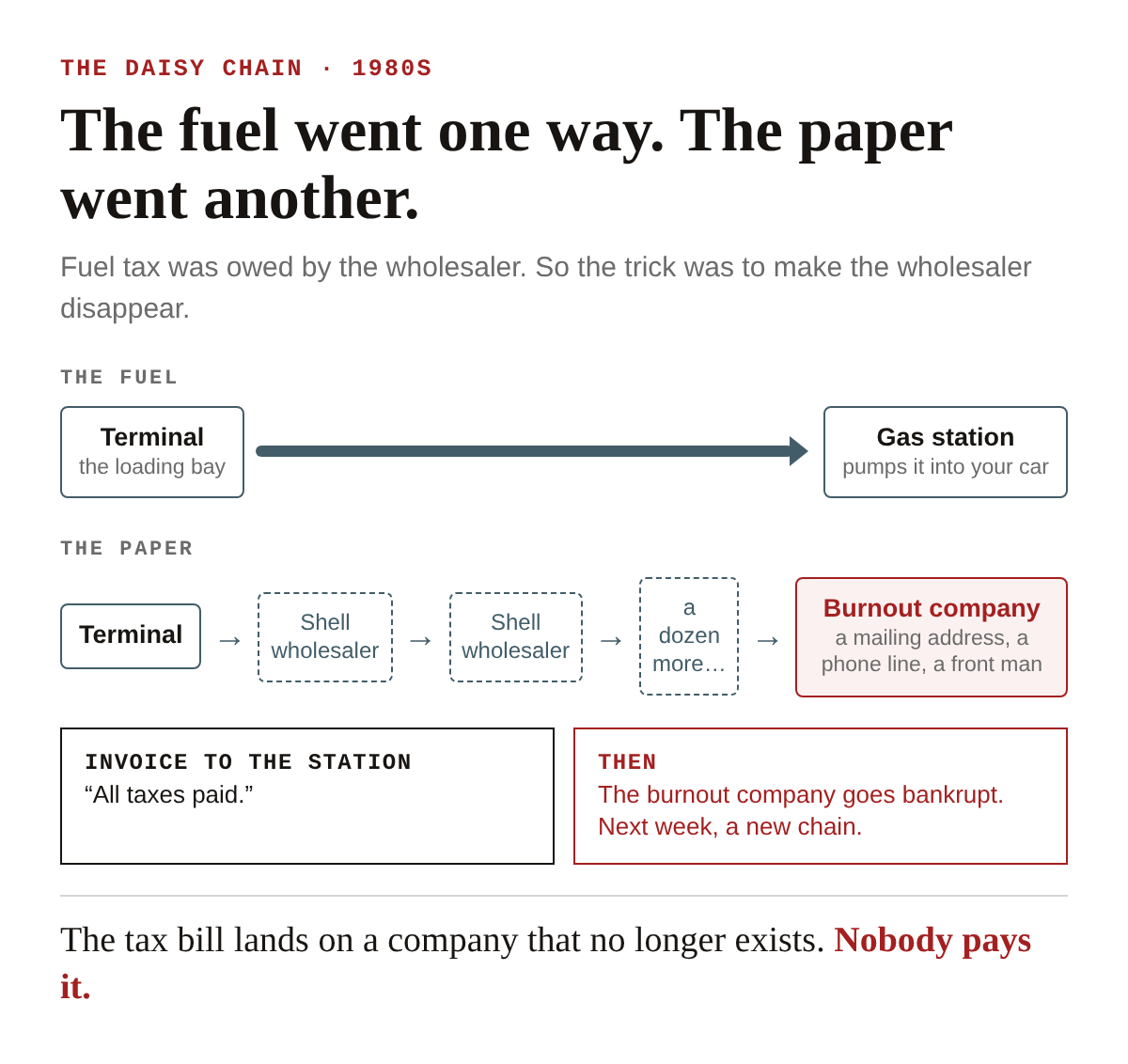
The Italians noticed. Michael Franzese, a captain in the Colombo crime family, got pulled in around 1980 to lean on someone over a $70,000 debt from one of these swindles, and before long he was running chains of his own through shell companies in Panama. An associate testified Franzese was clearing $1 million a week. Fortune put him 18th on its 1986 list of the country’s 50 biggest mob bosses. New York figured it was losing $250 million a year in gas tax to the racket. Years later Franzese summed up his conscience on the matter: “I didn’t have a moral issue with taking tax from the government.”
Congress plugged gasoline in 1986 by moving the tax up to the terminal rack, the loading bay where fuel pours into tanker trucks, which cut down the number of hands the tax passed through. So the crooks switched to diesel. Diesel had a hole gasoline didn’t: a huge share of it is legitimately tax-free. Farms, boats, trains, construction sites. Nobody could tell a gallon headed for a combine from one headed for an 18-wheeler. By the early 1990s the Federal Highway Administration put combined federal and state fuel tax losses near $3 billion a year.
On Jan 1, 1994, the government quit chasing paper and marked the fuel instead. Diesel got taxed at the rack, and any gallon leaving tax-free had to leave red. Diesel tax collections jumped about $1.2 billion that first year, and Treasury figured $600 million to $700 million of it was people simply paying what they owed.
I’ve always had a soft spot for this one. When I was learning the Internal Revenue Code, the most useful trick was to ask two questions of every section: what loophole was somebody abusing that this closes, or what behavior is the government trying to get out of us? Nearly every rule answers one or the other. The dye answers the first, and it’s the only one I know of that’s a color. Enforcement is gloriously low-tech: an IRS compliance officer, or here in Washington State a state trooper, slides a long straw into your fuel tank and looks at what comes up. If it’s pink, the fine is $10 a gallon or $1,000, whichever’s more, and it climbs with every repeat. They’ll check the storage tank you filled from, too. In 2005 the Washington State Patrol dipped more than 25,000 vehicles and caught 95. One street-sweeping company turned out to have bought roughly 98,000 gallons of red since 2003, and the fine was figured at $10 a gallon, plus extra for the storage tank and its fleet of 25 trucks.
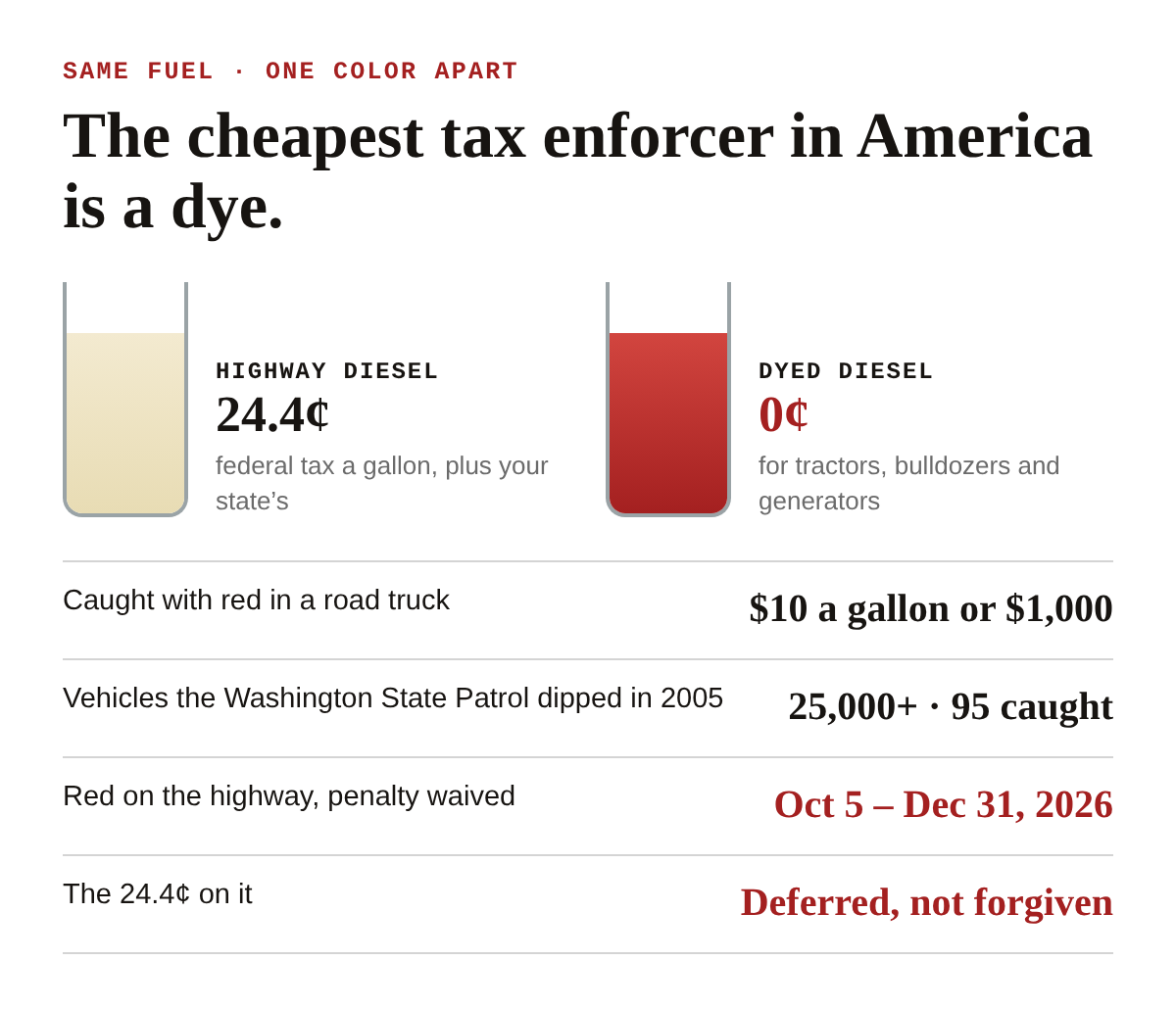
Since Oct 5, 2026, the straw’s been in the trunk. With diesel hitting a record $6.53 a gallon on Sep 22, 2026, against about $3.76 before the war, an executive order out of Washington DC told the IRS to stop penalizing red diesel on the highway through Dec 31 and to hold off collecting the 24.4 cents on it. Ten states, Texas, Oklahoma, North Carolina and Alabama among them, had already waved it through in the days before. California still hasn’t.
Read the fine print, though, because that’s where the tax guy gets interested. The order defers the tax. It doesn’t cancel it; Treasury’s only been told to look into forgiving it. “Deferred” is the most misunderstood word in the tax code, because people hear “free.” A deferred tax is a bill with the date left blank.
For 32 years the dye answered the first question. This fall it’s answering the second: keep the trucks moving. The government built a system on the idea that nobody can be trusted with cheap fuel, and the first time fuel got expensive enough, it trusted everybody for 88 days. On January 1 a lot of tanks out there will still be pink. The fuel won’t change color at midnight. What the color means will. And on January 2, somewhere on I-90, a trooper’s going to get the straw back out.
Sources (12), on the site.
Iranian Crude Hits Zero While 4.1 Million Barrels of Gas Slip the Blockade
Iran shipped no crude at all in September, the first blank month since Kpler began tracking it in 2013 — and yet at least eight gas tankers carrying 4.1 million barrels of Iranian LPG have left the Gulf of Oman since mid-July, hidden inside the ship-to-ship transfers other Gulf producers run off the Omani towns of Shinas and Sohar, four maritime security sources told Reuters. Six of the eight are already under US sanctions, most of the cargo moved on to Malaysia’s Eastern Outer Port Limits for another transfer and probably China, and one tanker of Iranian jet fuel reached Myanmar in September. CENTCOM, which counts four commercial vessels disabled and 135 ships turned around in the three months since the blockade came back on Jul 14, calls the cordon “ironclad”; UANI’s Jemima Shelley reads the shipments as opportunism rather than a new route, and a US military official said a ship getting through isn’t proof it evaded anything, since each is judged on its own and some are waved past for humanitarian reasons. Tehran reads the same water the other way round. “You are smuggling, but the strait is under Iran’s control, and we manage it,” said Mohsen Rezaei, Iran’s security chief, on Sunday night; CENTCOM’s reply was that the IRGC navy commander “has no navy.”
| Iranian crude in September: zero shipments · first blank month since Kpler began tracking in 2013 |
| Out anyway: eight gas tankers · 4.1 million barrels of LPG since mid-July · six of them US-sanctioned (UANI) |
| CENTCOM’s three months: four commercial vessels disabled · 135 ships turned around · the cordon called “ironclad” |
| Attacks on shipping: 15 from Oct 6 to 14, 11 of them in four days (UKMTO) · threat rated “severe” |
| Through the strait: 20.8 million barrels Oct 8 · 2.9 million Oct 11 · 17.1 million a day before the war |
| Brent: $106.67 on Oct 15 · down 1.9 percent on the day · up 70 percent on the year |
| The war: Day 231 |
Kyiv Runs Out of Patriot Interceptors as Starshield Slows
Ukraine has fired its last Patriot interceptors, a source told CNN: almost nothing in Russia’s latest ballistic salvo was stopped, and the Air Force claimed four. Zelensky put the stock at a tenth of what Ukraine needed back in mid-August, and the Iran war is eating the world’s supply. Starshield, the military Starlink, was throttled Wednesday — Kyiv says drone intercepts and logistics suffered; Musk says Washington owns and controls it. Zelensky told the FT he’d pause strikes on Russian energy for more interceptors, “at a minimum.”
Ansarallah Missiles Hit the Government’s Palace in Aden
Missiles struck Maashiq Palace in Aden, the headquarters of Yemen’s internationally recognized government, killing five people and injuring at least 16, health officials said. Prime Minister Shaya al-Zindani wasn’t hurt, Information Minister Moammar al-Eryani said. The strike lands as Ansarallah keeps up its campaign on Saudi airports and oil sites and the coalition presses on the Marib front.
Eighty Settlers Burn an Olive Grove at Abu Falah
About 80 settlers, many masked and in black, came down a hill into a grove at Abu Falah on Friday with gas canisters, burned olive trees and threw rocks at villagers gathered for the harvest. Two people were hurt, one of them Washington Post photojournalist Heidi Levine; a Reuters photographer watched an armed settler fire, and Israeli soldiers fired tear gas toward Palestinians. Yesh Din, an Israeli monitoring group, counts at least 170 settler attacks since the harvest opened Sep 27. Netanyahu has criticized the violence and done little; Britain says sanctions are coming.
Tigray Gets a Six-Month Caretaker Government
Abiy Ahmed named a caretaker administration for Tigray and said a regional election should follow inside six months, after a TPLF offensive last month reopened a war an agreement was supposed to have closed in 2022. The people of Tigray “must break free from this cycle of conflict,” he wrote. Roughly 750,000 Tigrayans were still displaced in February, four years on from fighting that killed hundreds of thousands. Addis Ababa and Asmara have cut ties over the new round: Ethiopia says Eritrea is backing the rebels, and Eritrea denies it.
Albertans Get Ten Ballots Monday, One of Them Separation
Five of the ten questions on Oct 19 ask about provincial control of immigration and proof of citizenship to vote, and polled 58 to 66 percent support in August; four ask about amending the Constitution so provinces pick judges, the Senate goes and provincial law outranks federal. The tenth asks whether Alberta stays a province or starts the legal path to a binding separation vote. Carney spent the week in Calgary arguing to stay. Elections Alberta verified 404,293 signatures on a Forever Canada petition; a separatist one claims over 301,000.
356 Arrests Trace Back to Washington Driver Data
The UW Center for Human Rights has documented 356 arrests that followed federal queries of Department of Licensing records, and found four routes in; Nlets, the network states use to swap driver data across state lines, turns up more than 100 times. The 2019 Keep Washington Working Act was meant to shut that door, and the report’s finding is that the steps taken “have been ineffective.” Director Angelina Godoy says blocked agencies log in anyway, “just like you might share your Netflix password.”
Huskies Get Their First Big Ten Win at Purdue
Washington beat Purdue 38-26 in West Lafayette behind Elijah Brown, the Stanford transfer making his first start as a Husky in place of Demond Williams Jr.: 21 of 27 for 302 yards, three touchdowns and three interceptions. The Huskies are 4-3, 1-3 in the Big Ten, with a bye next. The Seahawks, 3-3, are idle until Kansas City visits Oct 25.
| Read the full dispatch |
You’re receiving The Late Night Pour, an edition of Four Fingers News.