
The Late Night Pour | Pacific Time

|
Four Fingers News
The News, Neat.
|
| SATURDAY, OCTOBER 31, 2026 · DAY 246 |
| The Late Night Pour |
Pacific Time
Pacific Time, read aloud · 8 minutes.
At 2 AM tonight the clocks in Washington State go back an hour, and across the line in British Columbia, they won’t. B.C. changed its clocks for the last time on Mar 8, 2026, named its new year-round zone plain “Pacific Time,” and from tomorrow until March, Vancouver and Seattle, 140 miles apart on the same coast, will disagree about what time it is. Whether that’s good or bad depends on whether you’d rather have light at 8 in the morning or at 5 in the afternoon, but how it happened is the better story: the whole West Coast spent seven years waiting on one vote in Washington DC, and the one government on the coast that didn’t need the vote stopped waiting.
The waiting started in 2019, when the Washington State legislature passed a bill from Marcus Riccelli, a Democrat from Spokane, putting the state on daylight time all year, and Governor Jay Inslee signed it in May 2019. Oregon passed its own version, and California’s voters had approved a 2018 ballot measure letting their legislature do the same. B.C. did the same after asking its residents first: 223,000 people answered and 93% wanted daylight time all year. Then B.C. said it wouldn’t flip the switch until Washington State, Oregon and California did, so the coast would move together. A federal law from 1966, the Uniform Time Act, lets a state opt out of daylight time altogether, which is why Arizona and Hawaii never touch their clocks, but it doesn’t let a state stay on daylight time through the winter without Congress changing the law. Washington State’s bill even says so: it takes effect “on the first Sunday in November following the effective date of federal authorization.” Tonight is the eighth first Sunday in November since Inslee signed it.
The latest push came on Jul 14, 2026, when the House passed the Sunshine Protection Act 308 to 117 and the bill went to the Senate and stopped. In 2022 it went the other way: the Senate passed a version and the House never took it up. John Thune, the Senate majority leader, said in October there’s “no clear path forward or consensus on it yet.” The loudest objector is Tom Cotton of Arkansas: “Arkansans don’t want their kids going to school in the pitch dark, and I’ll always put Arkansas first.”
B.C. had watched six winters of that. On Mar 2, 2026 Premier David Eby announced the province would change its clocks one more time, on Mar 8, and then never again. “We are done waiting,” he said. The news release explained why in a sentence that didn’t need to be there: “Recent actions from the U.S. have shifted how B.C. approaches decisions that merit alignment, including on time zones.” Eby said he was “hopeful that our American neighbours will soon join us.” Instead, the rest of western Canada did. Alberta followed in May with what it’s calling Alberta Time, the Northwest Territories followed Alberta, and Manitoba’s premier Wab Kinew signed his province’s proclamation on Sep 25, 2026. Ontario, which has refused for years to move without Quebec and New York, announced on Oct 13 that its northwest corner would follow suit, so Kenora, near the Manitoba border, wouldn’t end up an hour off Winnipeg; the minister announcing it called the result “Wab Kinew time.” So the map tomorrow morning has a line down it, at the 90th meridian, a line of longitude in northwestern Ontario a short drive west of Thunder Bay. In B.C., Alberta, Saskatchewan, Manitoba, Yukon and the Northwest Territories, almost nobody changed a clock tonight. East of it, from Toronto to Montreal to Halifax, everyone did, along with every American state but Arizona and Hawaii. For the Montreal readers: Vancouver is two hours behind you this winter instead of three, and Winnipeg is on your clock exactly.
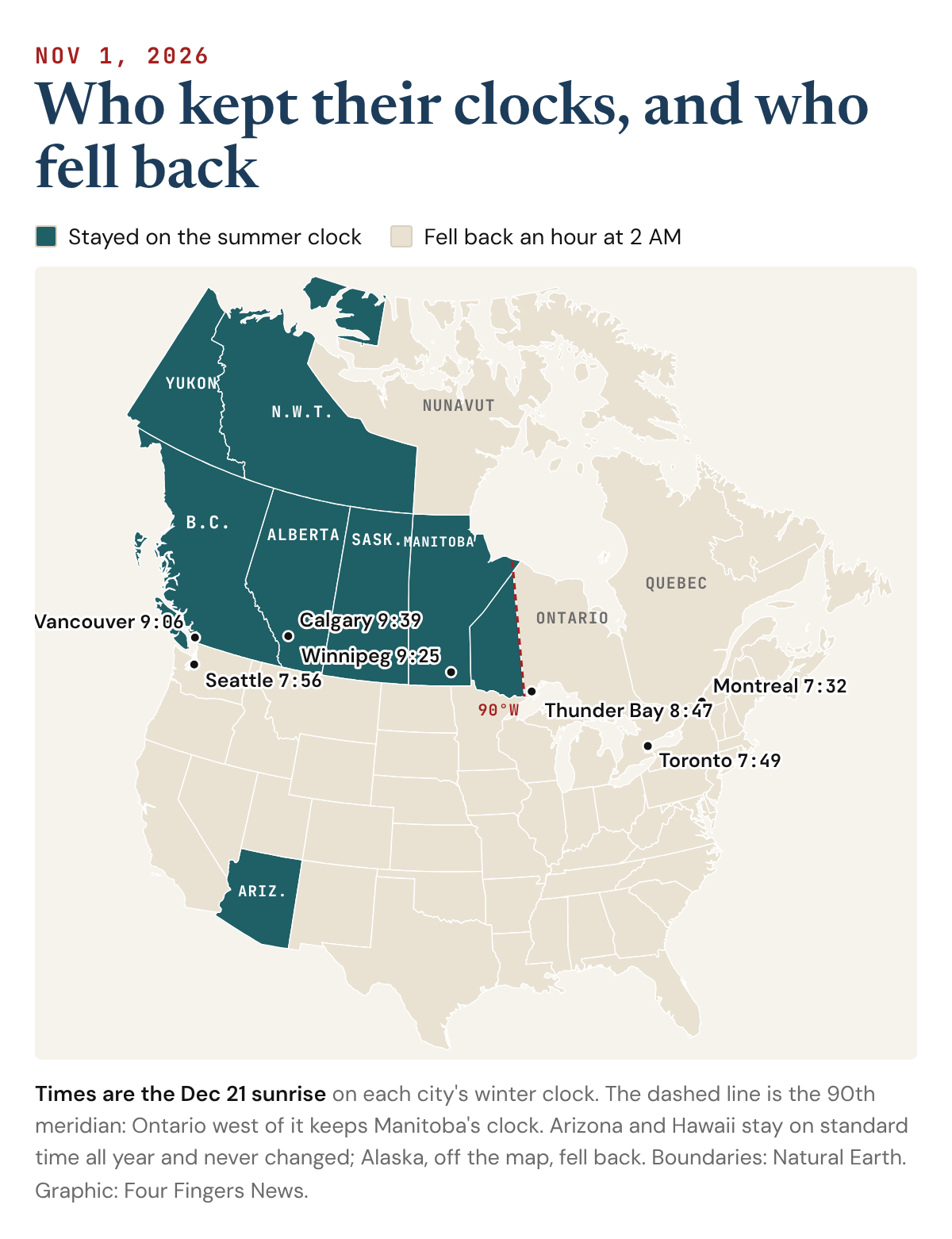
Nearly everyone in this story says the switch itself is miserable; in Manitoba and northwestern Ontario, around 90% of the people who answered said stop, and in B.C., 93% chose permanent daylight time. The fight is over which clock to keep, and that’s the part the “lock the clock” slogans leave out. Standard time is the one where noon is roughly when the sun is highest; daylight time moves every clock an hour ahead of it. Keep standard time all year and you get the Arizona deal: in Vancouver and Seattle, light in the morning and the sun down a little after 4 in the afternoon in December. Keep daylight time all year and those cities get light until after 5, with a sunrise an hour later all winter. Sleep doctors have been clear which one they’d pick: the American Academy of Sleep Medicine has asked for permanent standard time, because morning light is what sets the body’s clock. Every government in this story picked the other one, though not always for the same reason: Manitobans who answered their survey preferred daylight time 58% to 34%, northwestern Ontario just wanted to stay on Winnipeg’s clock, and Alberta’s voters actually turned permanent daylight time down in a 2021 referendum, 50.2% to 49.8%, before the government did it anyway this year. Washington State could have ended its clock changes any year since 2019 by taking Arizona’s option, which needs no permission from Congress, but it wanted the evening.
The United States last tried year-round daylight time in the 1970s. In December 1973, in the middle of the Arab oil embargo, President Nixon signed a law putting the whole country on daylight time year-round to save fuel, and it took effect on Jan 6, 1974. Support fell from 79% in December 1973 to 42% by February 1974. Florida reported eight children killed in traffic in the dark mornings of those first weeks, against two in the same stretch the year before. Congress gave up that fall and President Ford signed the repeal on Oct 5, 1974, less than ten months in. That’s the history behind Cotton’s objection, and one reason other senators are hesitant: a mid-January sunrise in Indianapolis would come up after 9 AM.
So B.C. is running the 1974 experiment again. By the shortest days of December the sun will come up in Vancouver a few minutes after 9 AM, in Prince George around 9:30, and in Calgary, on Alberta Time, closer to 9:40. In Seattle, on standard time, it rises at 7:56 and sets at 4:21. And there’s Point Roberts, the 1,200 or so Americans on a peninsula that hangs off the B.C. coast with no road out except through Canada, who will spend the winter an hour behind the only road out.
The first town anywhere to try daylight time was Port Arthur, Ontario, in 1908. It’s part of Thunder Bay now, just east of the new line, so it changed its clocks tonight along with Toronto. I don’t have a strong opinion on which clock is right; the sleep doctors make a good case, and so does anyone who’s left an office at 4:30 into the dark. What I noticed is that B.C. settled its side of this long-running argument only when it stopped waiting on Washington DC. Tomorrow morning the sun will come up over Bellingham and over Vancouver within about five minutes of each other, 50 miles apart, and the two cities will disagree by an hour about what to call it.
Sources (11), on the site.
Khamenei Orders a “Geographically Unrestricted” Reply to Any Attack, Rezaei Says Vance’s Letter Changed the Tone, and Iran’s Team Sits in Doha Without a Meeting
Iran’s supreme leader, Mojtaba Khamenei, told his top commanders on Saturday that any threat must meet an “immediate, impactful, and geographically unrestricted response” and ordered the target list widened to US and Israeli assets. The same day, Mohsen Rezaei, the security chief who received Vice President JD Vance’s letter last week, said he’d read it, hadn’t answered it, and that the US tone “has completely changed,” while Foreign Minister Abbas Araghchi called the outreach a “positive step” and said no meeting with the Americans is planned; his aide is in Doha with the Qatari mediators, a day after their team spent 12 hours in Tehran. At the G20 in Atlanta, Secretary of State Marco Rubio said Trump hasn’t decided on new strikes and set no deadline; Gulf officials have told MS NOW that strikes could resume Nov 4, the day after the midterms. In the strait, the Revolutionary Guard says a fourth tanker since Friday, a supertanker carrying two million barrels, hit a mine and burned; the UK’s maritime watch counts more than 30 October incidents, the most of any month of the war. Brent settled Friday at $117.64 and WTI at $104.12, six-month highs.
| War: Day 246, counted from Feb 28, 2026 |
| Crude: Brent $117.64 · WTI $104.12 · Friday’s settle · markets closed until Monday |
| The letter: Vance to Rezaei, carried by Qatar · read, unanswered |
| Talks: Iran’s aides in Doha · no US meeting planned, Araghchi says |
| Strikes: no decision, no deadline (Rubio) · Nov 4 per Gulf officials, unconfirmed |
| Hormuz: 30-plus incidents in October, a wartime high (UKMTO) |
A Third Saturday of Youth Protests Across France, Now with 30 German Cities Alongside
France’s government counted 320,000 marchers on Saturday, down from 550,000 on Oct 17 and 410,000 on Oct 24, after Interior Minister Laurent Nuñez warned of a “very high risk” of disorder once Halloween got dark; 70,000 police were deployed, masks were banned at marches, and 40 Paris metro stations closed. The movement started with high school students over school conditions and widened into the cost of living. In Germany, a youth initiative called “GenZ regelt” drew crowds in about 30 cities, with 10,000 expected at the Brandenburg Gate, demanding action on schools, housing costs and no return of conscription.
Zelensky and Erdoğan Agree to Work on a New Black Sea Grain Corridor as Ships Keep Getting Hit
In Istanbul on Saturday, Erdoğan said attacks on civilian ships “serve no one’s interests” and that Türkiye “cannot accept these attacks under any circumstances, regardless of who carries them out”; a Liberian-flagged container ship was hit by drones off Bulgaria on Oct 28. Zelensky said the two agreed to work on a grain corridor, and Rubio said the US is reviewing Turkish and Indian proposals for a limited Black Sea ceasefire. On Friday the State Department cleared a $2.1B sale of 500 Patriot interceptors, paid for by Canada, Germany and Norway, with no delivery date.
Chevron Posts Its Biggest Quarter Ever and Exxon Doubles Its Profit, on $6.32 Diesel
Chevron earned $9.9 billion in the third quarter on revenue up 36%, and Exxon’s profit per share more than doubled from a year ago on revenue of $113.16 billion, up 33%, with its Gulf Coast refineries running at 100% and diesel output the second-highest on record. Exxon raised its dividend and set a $20 billion buyback. Diesel is $6.32 a gallon, up 71% in a year, and regular gasoline is up about 38%, per AAA. NPR puts the three largest Western oil companies’ combined profit at $404 million a day for the quarter.
Poland’s Top Court Chief Is Suspended, the Court Calls It a Coup, and the President Turns His Plane Around
Riot police guarded Warsaw’s Constitutional Tribunal on Friday after judge Anna Korwin-Piotrowska announced the suspension of its president, Bogdan Šwięczkowski, and Justice Minister Waldemar Żurek asked for his and his deputy’s immunity to be lifted. The tribunal’s own account called it a “coup d’état” and says Korwin-Piotrowska isn’t a judge there. President Karol Nawrocki, who has blocked Donald Tusk’s court appointments, abandoned a trip to Senegal mid-flight; three protesters were detained.
Egypt’s Foreign Minister Tells a Gulf Security Summit a Second Round “Will Lead Nowhere”
At the IISS Manama Dialogue in Bahrain, Badr Abdelatty said he’s “extremely worried” about renewed US-Iran fighting and called Gulf security “inseparable” from the wider region’s. On the same panel, Saudi Deputy Foreign Minister Waleed Elkhereiji said Prince Khalid bin Salman’s Tehran visit was meant to back Qatar’s and Pakistan’s mediation, and called the US a “major partner.” In New York, Qatar’s UN envoy demanded the strait’s “immediate, unconditional reopening.”
ICE Gives GEO Group $1.5B and 10 More Years at the Tacoma Detention Center
GEO was the only bid considered for the 1,635-bed Northwest ICE Processing Center on the tideflats, and the contract’s terms haven’t been published. Rep. Emily Randall wants an investigation; Rep. Pramila Jayapal says she’s been told the deal exempts the center from state inspections, which GEO already resists. CEO George Zoley says the company is “proud of our 40-year public-private partnership with ICE.”
Huskies Stun Nebraska 17-10 with Two Touchdowns in 15 Seconds; Seahawks Host the Bears Monday
Washington trailed 7-3 in Lincoln until Demond Williams Jr. hit Chris Lawson for a 25-yard touchdown with 1:30 left, Alex McLaughlin returned an interception 48 yards for another 15 seconds later, and Lawson recovered the onside kick. Lawson had 12 catches for 155 yards; the defense picked off Anthony Colandrea three times. The Huskies are 5-3, 2-3 in the Big Ten, and host Penn State next Saturday at 12:30 PM PT. The 4-3 Seahawks host the 5-2 Bears on Monday at 5:15 PM PT on ESPN as three-point favorites, with left tackle Charles Cross doubtful. The Kraken, 8-5-1, are off until Calgary visits on Wednesday.
| Read the full dispatch |
You’re receiving The Late Night Pour, an edition of Four Fingers News.