The Late Night Pour | Inside the House
|
Four Fingers News
The News, Neat.
|
| TUESDAY, OCTOBER 13, 2026 · DAY 228 |
| The Late Night Pour |
Inside the House
Inside the House, read aloud · 11 minutes · a synthetic British voice, not the publisher’s.
Day 228. Saudi Arabia’s crown prince, Mohammed bin Salman (“MBS”), hasn’t been seen in public since Oct 6. Saudi officials told the Wall Street Journal on Monday that he’s moving between palaces built with bunkers, with a security detail he hand-picked, while Saudi Arabia runs low on the interceptors meant to stop what Ansarallah, the movement that governs northwest Yemen from Sanaa (Yemen’s capital), keeps firing at Riyadh (Saudi Arabia’s capital). The worry in those accounts is a missile from the south. The record of his own house points somewhere else. (The New Arab · The Journal’s report, Oct 12; Times of Israel · Interceptors and batteries, Oct 12)
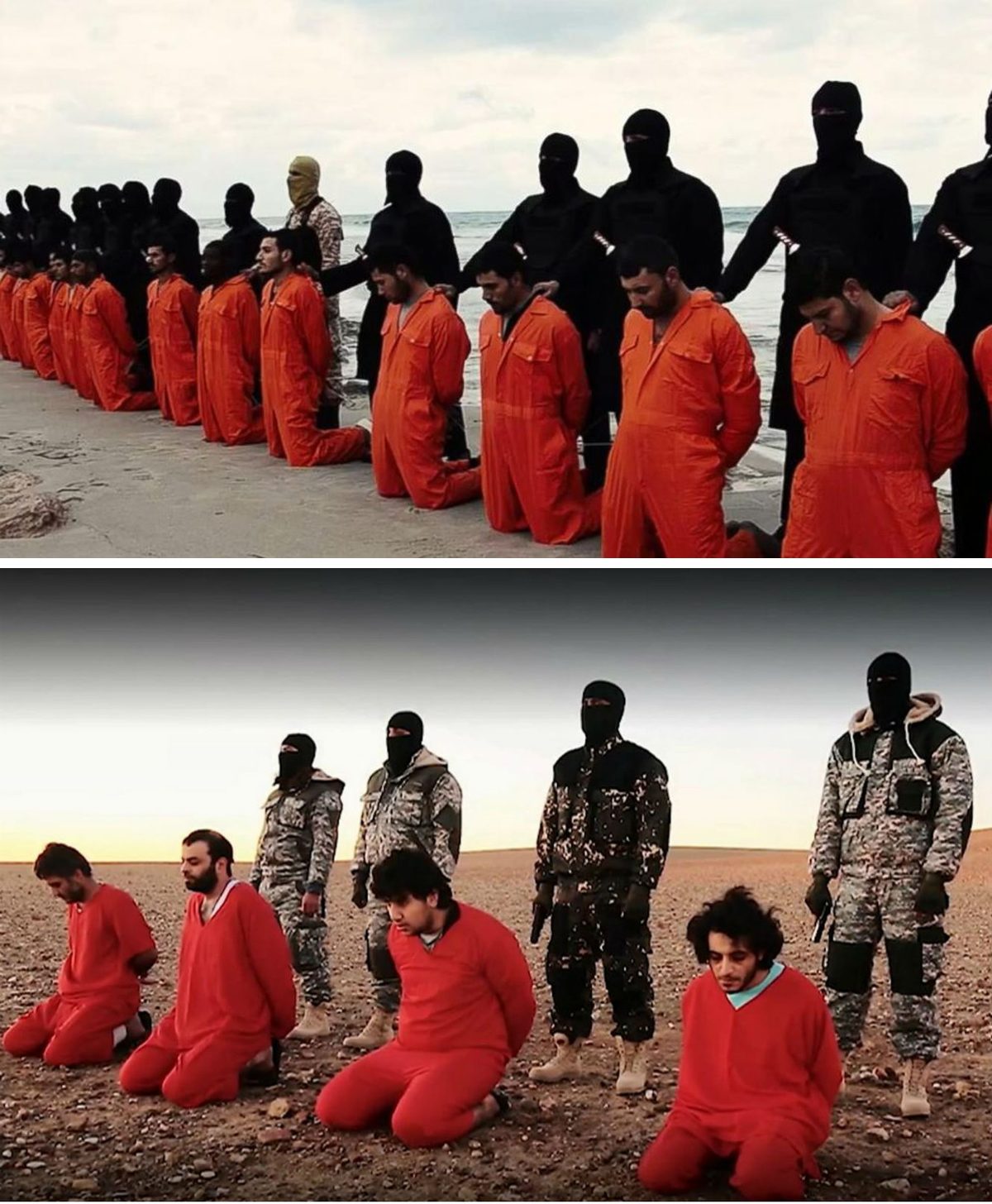
The deal is older than Bitter Lake, and I’ve told that part before: since 1744 the Saudi family has held the sword and the clerics the pulpit, and the United States signed on to protect the pair in 1945. What I didn’t explain is what the clerics teach, and it sits behind two words that come up every time this region is on the news. The first is Wahhabi. Islam has two main branches, Sunni and Shia, and the preacher who made the pact at Diriyah, outside what’s now Riyadh, was a Sunni named Muhammad ibn Abd al-Wahhab. A Wahhabi follows his teaching: that most Muslims had slid back into idolatry, and that the shrines they prayed at had to be leveled. The second is Takfiri. It comes from Takfir, the act of declaring another Muslim no Muslim at all, an apostate, which the groups that practice it treat as a license to kill, and a Takfiri is someone who does it. The men who built al-Qaeda and ISIS were Takfiris. They’re the ones you remember from the videos, sawing the head off the Wall Street Journal’s Daniel Pearl in Pakistan in 2002, and they came out of that house, the one the United States calls its ally, not the one it calls its enemy. The United States helped pay the bill: through the 1980s the CIA and Saudi Arabia funded the Afghan war against the Soviets dollar for dollar, and that’s the fight Osama bin Laden came out of. For a lot of Americans it was the only Islam the news ever showed them, and a good share of what Americans believe about Muslims comes from mistaking that fringe for the whole. The Takfiris are a sliver of a faith of about two billion people, most of whom they’d count as apostates too, and the people they’ve killed are overwhelmingly Muslims. (Wikipedia · Emirate of Diriyah; Wikipedia · Takfir; Wikipedia · Daniel Pearl; Wikipedia · Operation Cyclone)
The house in the title is the House of Saud, the family the country is named after, and every time it’s been hit, the blow has come from inside it. The family’s first army was a brotherhood of Bedouin called the Ikhwan: tribesmen settled into camps, taught the preacher’s doctrine and pointed at the family’s enemies. They won Mecca and Medina for Ibn Saud in the 1920s, and then they turned on him, because he drove cars, used the telegraph and honored borders the British had drawn, and the doctrine they’d been taught said all of that was sin. So in 1929, at a watering place called Sabilla, the king lined up machine guns mounted on cars, with four British aircraft and British pilots overhead, and cut down the tribesmen who’d won him his kingdom, men from the same tribes he’d married into, a wife from each one he conquered. That’s the founding: British guns, a wife from every tribe, and the tribesmen machine-gunned when they got in the way. Why the British were there at all is the empire’s two reasons for anything, the road to India and oil. They’d been paying Ibn Saud a stipend since 1915 to keep the peninsula quiet, and by 1929 the borders his Ikhwan were raiding across had oil behind them: Britain’s company had struck it at Kirkuk, in Iraq, two years earlier and had been pumping Persia’s since 1908. That company is BP today, and in 1953, when Iran’s elected prime minister nationalized it, Britain and the CIA overthrew him to keep it, which is where the Iran the United States has been bombing since February starts its own count of grievances. Saudi Arabia’s own oil was nine years from being found, and when it was, it went to the Americans, which is the deal Bitter Lake sealed. Five years later he took three provinces from Yemen in a short war, and this month’s missiles have been landing on exactly that ground. (Wikipedia · The Ikhwan; Wikipedia · Battle of Sabilla; Wikipedia · Kirkuk, 1927, and the Gulf’s oil; Wikipedia · The 1953 coup in Iran; Wikipedia · The 1934 war and the Treaty of Taif; TASS · Najran and Khamis Mushait, Oct 8)
That pattern held for the next 50 years. In 1975 the king was Faisal, the one who’d turned off the oil to America two years earlier, and like every Saudi king he held a majlis, an open audience where a subject can walk up and put a petition in his hand. On Mar 25 his nephew, Prince Faisal bin Musaid, joined the line, bent to kiss the king’s head, and shot him twice in it. Ten years earlier the nephew’s brother had been killed by police while leading an attack on Saudi Arabia’s first television station, because pictures of human beings were sin, which is the Ikhwan’s complaint about cars and telegraphs in a new generation. The nephew was beheaded in a public square in Riyadh. (Wikipedia · King Faisal’s assassination; Wikipedia · Faisal bin Musaid)
Then came 1979, the year this story turns on. In February, Iran’s revolution put Shia clerics in power across the Gulf. On Nov 20, the first morning of a new Islamic century, a former National Guardsman named Juhayman al-Otaybi, from the Otaybah, the tribe that rode as Ikhwan and was cut down at Sabilla, and whose grandfather had ridden with them, walked into the Grand Mosque in Mecca, the holiest place in Islam, with hundreds of armed followers and announced that his brother-in-law was the Mahdi, the redeemer Muslims expect at the end of days. He’d raised his followers in the Ikhwan’s image, and his charge against the royal family was the Ikhwan’s charge again: that it worshipped money and spent it on palaces, that it kept company with Christian infidels, that it was letting the West in. It wasn’t revenge for Sabilla so much as Sabilla unfinished. The family couldn’t send troops into the mosque without the clerics’ permission, and the clerics gave it. The fighting lasted two weeks, the official count was 255 dead, and 63 of the rebels were beheaded in eight cities on one January morning. The same week, on the oil coast, the Shia of Qatif, who’d just watched Iran, marched for the holy day of Ashura in defiance of a ban, and the National Guard put them down with about two dozen dead. Neither blow came from a foreign army, and both came from people the house had made. (Wikipedia · Grand Mosque seizure, 1979; Wikipedia · Qatif uprising, 1979)
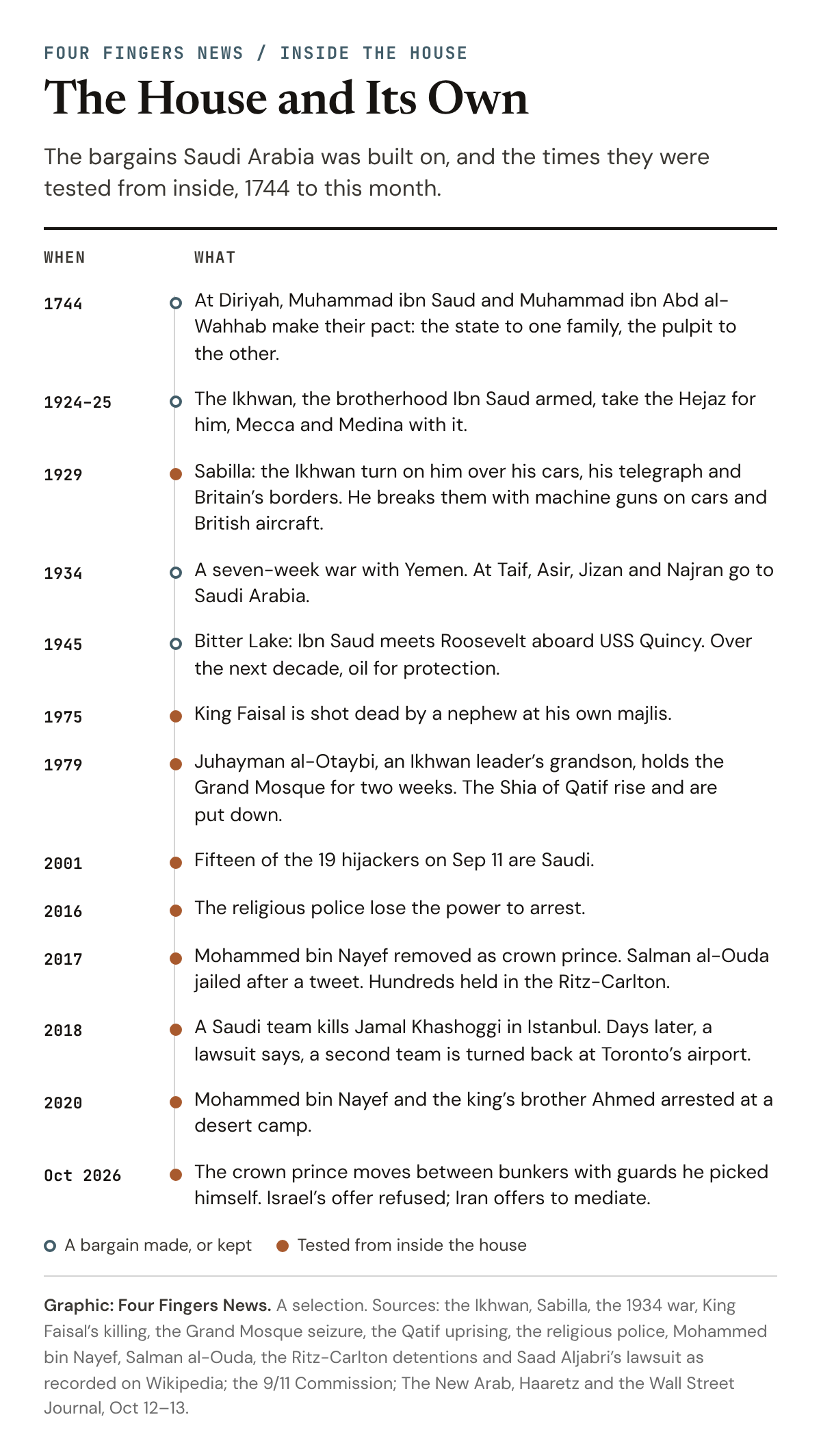
The royal answer to 1979 was more religion, not less, at home and abroad, and the crown prince himself said in 2018 that Saudi Arabia spread it at its Western allies’ request during the Cold War. Fifteen of the 19 men who flew into the towers on Sep 11, 2001, were Saudi. (Wikipedia · Grand Mosque seizure, 1979; Washington Post via Gulf Times · The crown prince on the Cold War, March 2018; 9/11 Commission Report · Chapter 7)
I laid out his record on Oct 2 in The Grandson: the cousin he pushed aside as crown prince in 2017, the princes locked in the Ritz-Carlton that same year, the killing of the columnist Jamal Khashoggi in the Istanbul consulate in 2018, which earned his initials a second reading, Mister Bone Saw, the arrests of that same cousin and the king’s own brother in 2020. In the same years Saudi Arabia’s wealth fund, which he chairs, started a golf tour, LIV, and last fall put on a comedy festival in Riyadh with Dave Chappelle, Kevin Hart and Bill Burr on the bill. Read from inside the house, that record is a list of the people it crossed. (Wikipedia · LIV Golf; Wikipedia · Riyadh Comedy Festival)
The clerics. In 2016 the religious police lost the power to arrest anyone, and in 2017 one of Saudi Arabia’s best-known preachers was jailed hours after a tweet, and prosecutors later asked for his death. (Wikipedia · The religious police, April 2016; Wikipedia · Salman al-Ouda)
The family. Among the princes held in the Ritz until they signed over their fortunes was the one who’d commanded the National Guard, the Ikhwan’s descendant, a second army raised from loyal tribes and kept separate from the first for one purpose, to protect the family from a coup. (Wikipedia · The Ritz-Carlton detentions; Wikipedia · Saudi Arabian National Guard)
The old security men. The cousin had run Saudi Arabia’s counterterrorism work, and the CIA had given him a medal four months before his removal. His intelligence chief, now in Canada, says in a US lawsuit that days after the Istanbul killing a second team flew to Toronto for him and was turned back at the airport. (Wikipedia · Mohammed bin Nayef; Wikipedia · Saad Aljabri’s lawsuit)
The detail in the Journal’s story isn’t the bunker, it’s the guards he picked himself.
Now put an offer of help in front of a man who doesn’t trust the people around him. Israel’s prime minister, Benjamin Netanyahu, asked through US intermediaries to join the campaign against Ansarallah, Haaretz, Israel’s oldest daily and one of its leading papers, reported on Monday, and the crown prince said no, because cooperation with Israel could provoke anger among the Saudi public, the paper’s source said. Israeli outlets have reported since September that intelligence on Ansarallah reaches Saudi Arabia from Israel through US Central Command. Neither government has confirmed it, and the reports come from papers with an interest in the warming. What’s on the record is a phone call on Sunday night in which Iran’s foreign minister, Abbas Araghchi, told his Saudi counterpart that Iran was ready to help bring Saudi Arabia and Ansarallah into dialogue. The king’s title is Custodian of the Two Holy Mosques, and the pulpit is the one source of legitimacy the family hasn’t replaced yet. An Israeli jet over the holy cities would hand every cleric he jailed and every prince he locked in the Ritz the argument they’ve been missing. The crown prince can take help from Iran before he can take it from Israel, and that’s the deal of 1744 still running. (The New Arab · Haaretz’s report, Oct 13; Jerusalem Post · Neither government has confirmed, Oct 12; The New Arab · Araghchi’s call, Oct 12)
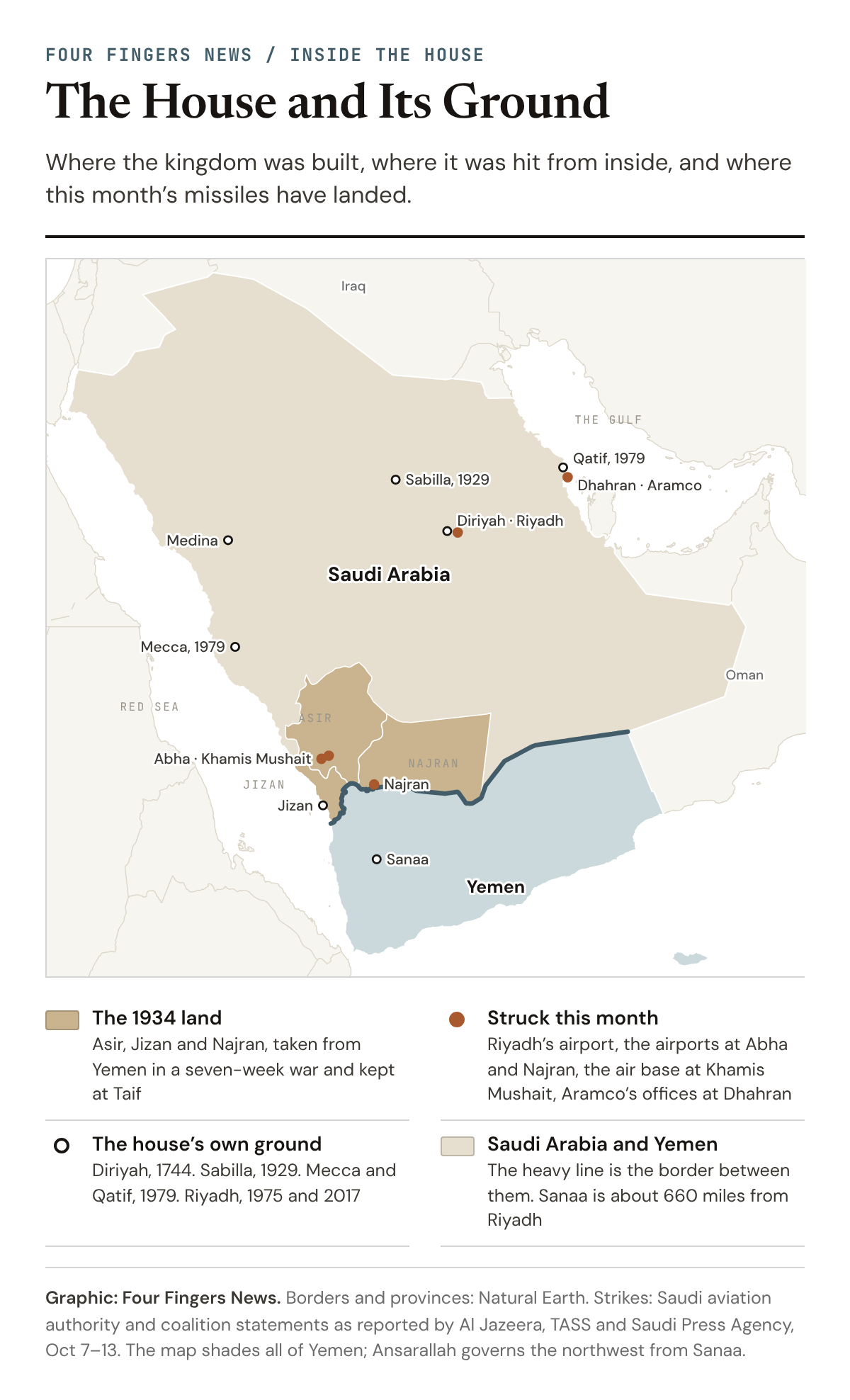
The groups that run on Takfir count the Shia as their first apostates. Ansarallah is Zaydi, a branch of Shia Islam, and its worst day at ISIS’s hands came on Mar 20, 2015, when suicide bombers killed 137 people at two Sanaa mosques its followers prayed in. Iran is Shia too. So the creed Saudi Arabia spent 40 years exporting and the movement firing at Riyadh tonight are enemies of each other. The United States has been bombing the Shia country since February, and the ally it may be about to defend is the one the men in the videos came out of. Whose side are we on? The missiles that closed the airport come from more than 500 miles to the south, and the Journal says that’s why he’s underground. The record of this house has said something else since 1929. It’s October, and anyone who’s sat through a horror movie knows the line. It’s from When a Stranger Calls, which came out in 1979, the year this story turns on. “We’ve traced the call… it’s coming from inside the house!” (Wikipedia · Takfir; Wikipedia · The Sanaa mosque bombings, March 2015; BreakThrough News · Trump on joining the strikes, Oct 13; Four Fingers News · Silver or Lead?, Oct 12; Wikipedia · When a Stranger Calls, 1979)
Ansarallah Hits Aramco’s Offices in Dhahran Hours After the Coalition Bombs Sanaa’s Oil Depot
A missile struck an administrative building of Saudi Aramco in Dhahran, the oil company’s home on Saudi Arabia’s Gulf coast, on Tuesday, starting a fire and injuring no one, an energy ministry official told the Saudi state news agency. It came hours after the Saudi-led coalition told civilians to leave the Yemen Petroleum Company’s al-Sabah station in Sanaa and then bombed it, saying the fuel depots beneath it held Ansarallah’s missiles and drones; the oil company said its tanks were empty, and people in Sanaa queued for gasoline. The coalition also hit the oil tanks at the port of Ras Isa, where the health ministry in Sanaa counted two dead. Before the Sanaa strike, Ansarallah’s military spokesman, Yahya Saree, named what a strike on the capital would cost: Aramco’s headquarters in Dhahran, King Khalid International Airport in Riyadh and Aramco’s refinery in Riyadh. The airport stays closed through Saturday, about 700 flights a day, and the coalition said it shot down three drones north of Riyadh on Tuesday morning.
| Dhahran: an Aramco administrative building hit · a fire, no injuries, per the energy ministry |
| Sanaa: the al-Sabah fuel station bombed after an evacuation order · the coalition says missiles and drones were stored beneath it; the oil company says the tanks were empty |
| Ras Isa: oil storage tanks struck · two dead, per the health ministry in Sanaa |
| Saree’s list: Aramco’s Dhahran headquarters, King Khalid airport, the Riyadh refinery |
| Riyadh’s airport: closed through Oct 17 · about 700 flights a day, per Flightradar24 |
| Saree’s count: 104 Saudi strikes in 24 hours, 2,281 since July · unverified |
Iranian Officials Say the Hormuz Attacks Are Paced to the US Midterms
Iran changed how it attacks ships in the Strait of Hormuz about 10 days ago and is pacing the strikes to keep oil high through the Nov 3 US vote, two senior Iranian officials told Reuters. “This is a game of chess,” one said; the other said a “complete closure” is coming. UN shipping data put the attack rate back at the level of Oct 3 to 5, and the Royal Navy office that takes reports from merchant ships said a tanker leaving the strait was hit on Monday. President Trump said Tuesday that he’ll decide on Iran “very soon” and that the midterms will have “no impact.”
Stocks Slip as Bank Earnings Begin and Memory Chips Sell Off
The S&P 500 closed at 7,805.45 on Tuesday, down 0.02 percent, the Nasdaq fell 0.15 percent to 27,204.38 and the Dow lost 180 points to 51,670.10. Samsung and SK Hynix fell hard in Seoul after China’s CXMT said it had made progress on a new memory chip design, and Micron dropped 5 percent. JPMorgan’s profit rose 6 percent to $15.3B and still missed; Goldman Sachs earned $17.01 a share against $13.02 expected. Brent settled at $105.69, down 0.9 percent, and gasoline has now tied 2022 for the most days above $4 a gallon in a year. The consumer price report comes Wednesday morning.
Bellingham Resident Charged in the Tumbler Ridge Shooting Is Ordered Held
A federal judge in Seattle on Tuesday ordered Melody Bryant, 30, of Bellingham, held on a charge of conspiring to murder people in a foreign country. Investigators say Bryant corresponded for months with Jesse Van Rootselaar, who killed eight people in Tumbler Ridge, British Columbia, in February, her mother and stepbrother at home and then five children aged 12 and 13 and an educational assistant at the secondary school, and that Bryant declined to report the plan, agreed to share a livestream and sent money. The victims’ families are also suing OpenAI, saying ChatGPT should have alerted police.
Missiles Hit a Kyiv Power Plant and an Apartment Block with No Warning from Allies, Zelensky Says
Russian ballistic missiles struck Kyiv’s CHP-4 power plant and a nine-story apartment building in the Desnianskyi district late Tuesday, killing at least two people and injuring 21, an eight-year-old among them. President Zelensky said the missiles were detected “practically as they were approaching Kyiv,” the second night running that Ukraine got no launch warning from its partners, and the Air Force said it had received none. Two days into the energy ceasefire President Trump announced on Sunday, Zelensky said Russia was “targeting yet another power plant,” and Trump declined to accuse Russia of breaking it, saying Ukraine had hit sites the day before.
Pope Leo Has Lung Cancer, and Surgeons Removed Part of His Right Lung
Surgeons at Rome’s Gemelli hospital removed the lower lobe of Pope Leo’s right lung on Tuesday, and the Vatican’s bulletin said tests “confirmed a diagnosis of lung adenocarcinoma.” The 90-minute operation, led by the hospital’s chief thoracic surgeon, Stefano Margaritora, went without complications, the Vatican said. Oncologists had said before the operation that his outlook was excellent because the nodule was caught early. The pope, 71, will recover in a room at the hospital while the papal apartment is renovated, and his audiences are canceled through Oct 20.
| Read the full dispatch |
You’re receiving The Late Night Pour, an edition of Four Fingers News.