
The Evening Pour | The Letter

|
Four Fingers News
The News, Neat.
|
| THURSDAY, OCTOBER 29, 2026 · DAY 244 |
| The Evening Pour |
The Letter
The Letter, read aloud · 7 minutes.
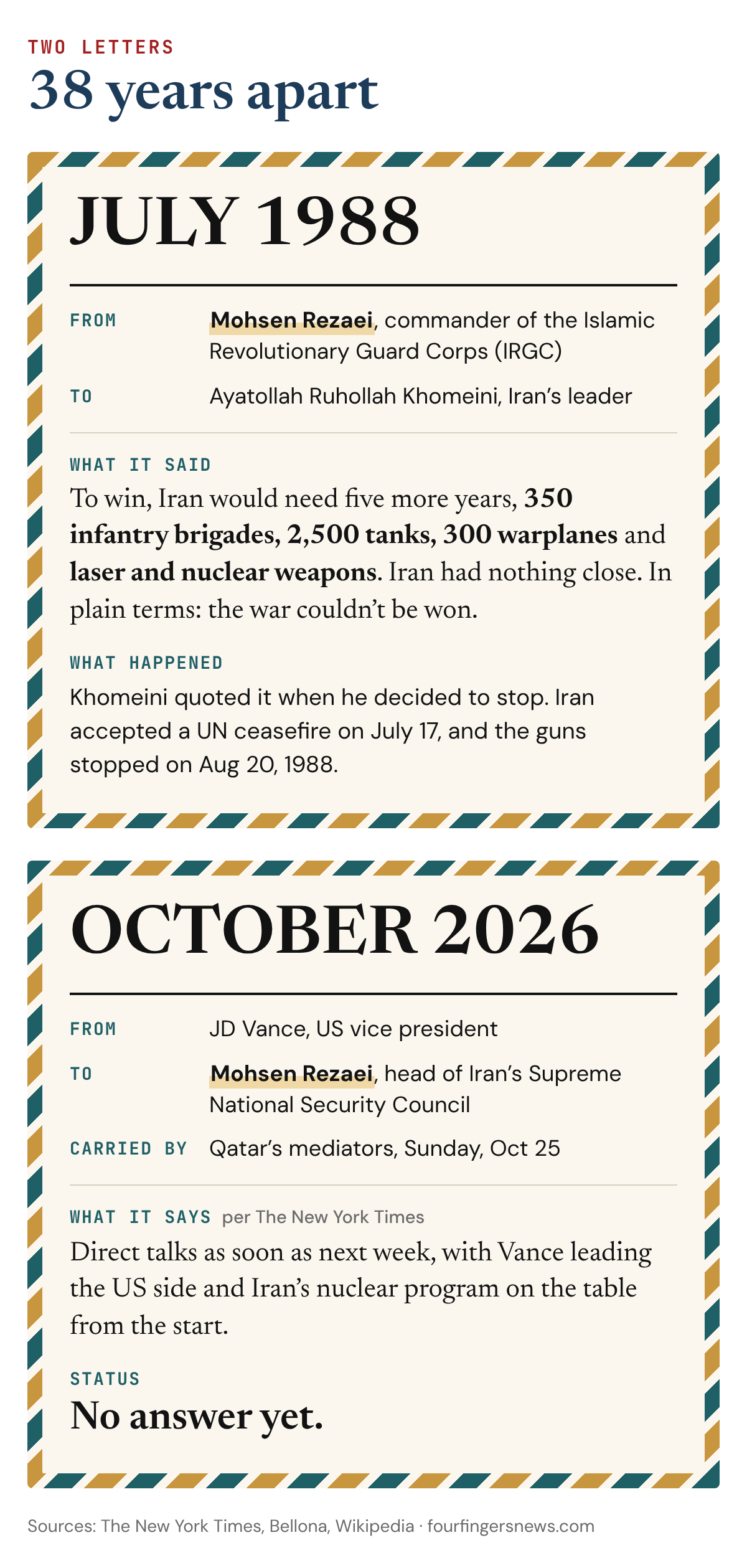
Day 244, and the most hopeful thing to happen in this war in weeks is a letter. On Sunday, mediators from Qatar handed it to Mohsen Rezaei, who runs Iran’s Supreme National Security Council, the body where the country’s president, generals and top ministers settle questions of war and peace, subject to the Supreme Leader’s approval. It came from Vice President JD Vance, and according to The New York Times it proposes direct talks as soon as next week, in Qatar or Türkiye, with Vance leading the American side and Iran’s nuclear program on the table from the start. The Wall Street Journal described the aim as a framework for negotiations, not a set of peace terms. On Thursday Iranian state media confirmed the letter had arrived and said no answer had been sent yet.
Is it an opening or a deadline? It’s both, an opening because someone is writing letters instead of drawing up target lists and this one went to a man who could help deliver a yes, and a deadline because a source told The Wall Street Journal that the point is to find out whether there’s enough common ground to talk the president out of ordering a short, intense attack after next Tuesday’s midterms. Gulf governments have already been told to prepare for one. The man reading the letter has said Iran won’t return to negotiations or reopen the Strait of Hormuz until seven conditions it’s sent through the mediators are met, among them an end to the US blockade of its ports and to the fighting on every front.
There’s also a contradiction at the center of the outreach: Trump publicly downplayed the letter on Wednesday, saying it concerned medical supplies rather than a restart of peace negotiations, and on Thursday, the Journal reported, the admiral who commands US forces in the Middle East briefed him at the White House on military options. Vance may be opening a door, but only Trump can decide whether to walk through it, or to order another round of strikes. Gas prices have moved with that strait since March, so whether the next month brings talks or bombs also runs partly through the man holding the letter, and he’s worth knowing.
Rezaei was born in 1954 in Khuzestan, the oil province on Iran’s border with Iraq, and as a young man he was jailed by the Shah’s secret police. After the 1979 revolution, the new leader, Ayatollah Ruhollah Khomeini, created the Islamic Revolutionary Guard Corps, known as the IRGC, as a force loyal to the revolution itself, separate from the old army, and in 1981, at 27, Rezaei became its commander. He ran it for 16 years, through all eight years of the war that began when Saddam Hussein’s Iraq invaded Khuzestan in 1980 and that killed hundreds of thousands of people on both sides. He was one of the hawks: after Iran pushed Iraq’s army back out in 1982, he was among those who wanted to keep going.
By the summer of 1988 Iran was losing the war: Iraq was firing missiles into Tehran and using chemical weapons on Iranian troops, and the US Navy was fighting Iran’s navy in the Gulf; on July 3 an American warship in the Strait of Hormuz shot down an Iranian airliner it mistook for a fighter jet, killing all 290 people aboard. That summer Rezaei, still the IRGC’s commander, wrote to Khomeini to say what it would take to win: five more years, 350 infantry brigades, 2,500 tanks, 300 warplanes, and laser and nuclear weapons. Iran had nothing close to that, nuclear weapons least of all, so in plain terms one of the war’s leading hawks was telling his leader it couldn’t be won. Khomeini quoted Rezaei’s list in a letter to his top officials explaining why he’d decided to stop, a letter that stayed secret until 2006. On July 17 Iran told the United Nations it would accept a ceasefire, Khomeini told the country the decision was “more deadly than drinking from a poisoned chalice,” and the guns stopped on Aug 20, 1988.
His record also runs through Buenos Aires, where on July 18, 1994, a bomb destroyed the AMIA, the city’s main Jewish community center, and killed 85 people. Argentine prosecutors concluded that Iran’s leadership ordered the attack and that Hezbollah, the Lebanese armed group Iran backs, carried it out. In 2006 an Argentine judge ordered Rezaei’s arrest along with other Iranian officials, and since 2007 Interpol has carried a red notice for him, a request to police in its member countries to find him and hold him for extradition. Iran and Rezaei have always denied it, and Argentina has protested when he’s traveled abroad; it once asked Qatar, the same country that just delivered Vance’s letter, to arrest him, which Qatar didn’t do.
He’s also run for president four times and lost every time, and in 2021 he got 3.4 million votes, fewer than the number of ballots that were spoiled or left blank. Voters have never wanted him, but the system always has.
The war is why he’s the one holding the letter: the first American and Israeli strikes on Feb 28 killed the Supreme Leader, Ayatollah Ali Khamenei, along with about 40 senior commanders, and in March the clerics who choose Iran’s Supreme Leader picked his son, Mojtaba Khamenei. The security council’s secretary, Ali Larijani, was killed in a later Israeli strike, and his replacement quit after about four months. In August the new Supreme Leader made Rezaei his personal representative on the council, and hours later the president named him its secretary. Hamidreza Azizi, an analyst at the International Crisis Group, said addressing the letter to Rezaei may signal a shift in the US government’s view of who holds influence in Tehran.
There’s an old line in American politics that only Nixon could go to China: in 1972 a lifelong anti-communist could open the door to Mao because nobody could call him soft. I think that’s the bet in sending this letter to Rezaei instead of to Iran’s foreign minister. A deal Rezaei helps deliver may be easier for the IRGC to accept, and easier for a new Supreme Leader to endorse without looking weak. I don’t know whether he’ll take it, because his public line is that Iran won’t negotiate or reopen the strait until its conditions are met, the letter puts the nuclear program on the table from the start, and those aren’t the same list.
In 1988 his letter gave a Supreme Leader who’d vowed to fight on a reason to stop. This time, his answer could offer a new Supreme Leader the same opening. The immediate test is smaller but urgent: whether there’s enough common ground to give diplomacy a foothold before the military clock runs out.
Sources (12), on the site.
Iran Says Four Tankers Hit Mines as It Pitches Its Own Plan to Reopen Hormuz
Iran’s Revolutionary Guard said Thursday that three tankers that had switched off their navigation systems caught fire after hitting mines on a route south of the Strait of Hormuz, and the army later reported a fourth; no ship has been named and none of the claims has been independently confirmed. Foreign Minister Abbas Araghchi said Wednesday that Iran is working with mediators on its own plan to reopen the strait within seven days, on conditions that include a regional ceasefire, the release of frozen Iranian money abroad and an end to the US naval blockade. The Wall Street Journal reported that Gulf allies were told to prepare for a short, intense US campaign after the Nov 3, 2026 midterms, and Iran has warned it would answer new strikes by hitting Gulf oil sites, undersea cables and data centers.
| War: Day 244, counted from Feb 28, 2026 · Pentagon cost estimate past $47B, more than $29B of it to replace munitions (Reuters) |
| Crude: Brent $114.88 · Dec contract, which expires Friday · WTI $102.00 · both at Thursday’s settle |
| Mines: Iran says four tankers caught fire in a day · no ship named, no claim confirmed |
| Talks: Qatar mediating · Iran pitching its own seven-day plan to reopen the strait |
| Next: US midterms Nov 3, 2026 · Gulf allies told to expect a short, intense US campaign after (WSJ) |
Spain Mourns 68 People After a Train Was Sent Past a Red Signal
A state-run RENFE high-speed train ran into the back of a stopped train from the private operator IRYO near Urda, in Toledo province, Wednesday morning, killing at least 68 people; both were headed from Madrid to Seville. Transport Minister Óscar Puente says a computer failure knocked out the signalling on a 39-mile stretch and halted every train on it, and a controller then cleared the RENFE train to carry on past a red signal with no speed limit. He called the order “inexplicable” and said the drivers weren’t to blame. It’s Spain’s second deadly high-speed crash this year, and the country votes in a national election Nov 29, 2026.
A Russian Drone Hits a Crowded Station Platform in Dnipro, Killing 13 People
The drone struck a platform at a railway station in Dnipro, in central-eastern Ukraine, where “a regular commuter train and a regular passenger train were standing,” Volodymyr Zelensky said Thursday. The regional governor, Oleksandr Ganzha, counted 13 dead, and police at least 10 wounded. Ukraine’s railway chief said a threat alert had gone out first, “but unfortunately there were still a large number of people on the platform.” Moscow’s mayor, Sergei Sobyanin, said 613 Ukrainian drones flew toward the Moscow region overnight and that most were brought down far from the city.
An Oil Slick Closes Sharjah’s Beaches and Drifts Toward a Desalination Plant
Authorities in Sharjah, one of the seven emirates, closed all its beaches Wednesday as oil spread along the UAE’s northern coast, where fishing and several other beaches were already off-limits. Reuters verified footage of the slick about 2 km (1.2 miles) from the Naqa’a plant, which turns seawater into drinking water on the border of Umm Al Quwain and Ras Al Khaimah; desalination supplies more than 80% of the UAE’s drinking water. Reuters reports the oil came from the tanker Gem No. 2, hit by an unidentified projectile in September 2026. No plant has announced a shutdown, and officials said last week the smell wasn’t a health risk.
Alphabet Sinks 12%, and Lagarde Sets a Date to Leave the ECB
Alphabet’s shares fell about 12% Thursday, a day after it reported a record $51.4B quarter of spending on buildings and equipment, and the Nasdaq lost 1.4%. The S&P 500 slipped 0.3% to 7,720.39, and the yield on 10-year Treasury bonds, which helps set mortgage rates, eased to about 4.99% from 5.05%. Christine Lagarde told the European Central Bank’s governing council she’ll step down as its president on Feb 7, 2027, months before her term ends. The European Council, made up of the EU’s national leaders, will choose her successor at the bank, which sets interest rates for the countries that use the euro.
Dolores Huerta, Who Helped Build the Farmworkers’ Union, Dies at 96
Dolores Huerta, who started what became the United Farm Workers with César Chávez in 1962 and inspired its rallying cry “Sí, se puede” (“Yes, it can be done”), died Wednesday of cancer, her family said. A former teacher in California’s San Joaquin Valley, she was the union’s vice president for almost four decades, leading strikes and boycotts and negotiating contracts with growers. She was jailed 22 times and received the Presidential Medal of Freedom in 2012. This year she said Chávez had raped her in the 1960s, and that she’d stayed silent because she “just didn’t want to hurt the movement.”
GEO Gets 10 More Years and $1.5B to Run Tacoma’s Immigration Lockup
US Immigration and Customs Enforcement has given GEO Group, a private prison company, a 10-year contract worth $1.5B to keep running the Northwest ICE Processing Center on the Tacoma tideflats, which has 1,635 beds, after about a year of deliberation. The terms aren’t public, so it isn’t clear whether the deal exempts GEO from state and local rules, as ICE proposed in an earlier notice citing “federal supremacy.” GEO still won’t let state health inspectors tour the center and doesn’t pay detained workers the state’s minimum wage. Its CEO, George Zoley, said the center helps meet “the need for federal immigration processing center bedspace.”
The Kraken Visit Calgary, the Huskies Play at Nebraska, and the Bears Come to Seattle
The Kraken, 8-4-1 after Wednesday’s 5-4 win over Toronto at Climate Pledge Arena, play the Flames in Calgary on Friday, and the Huskies (4-3) play at Nebraska on Saturday at 5 PM PT on the Big Ten Network. The Seahawks, 4-3 after Sunday night’s 20-3 win over the previously unbeaten Kansas City Chiefs, host the Chicago Bears at Lumen Field on Monday night.
| Read the full dispatch |
You’re receiving The Evening Pour, an edition of Four Fingers News.