A Case for Co-Territorialism and Some Notes on Absence
Dearests,
For most of July I was in Warsaw (and in Berlin and in Milejczycze but only briefly). I was there studying Yiddish at the Centrum Kultury Jidysz. My time here has felt complicated to say the least, it feels impossible to say anything conclusive about it. I’d like to share a few vignettes and a little trickle of theory that has helped me make some sense out of an experience of place and history that is leaving me feeling a little bit undone.
First the theory, if you get through it I promise you descriptive and poetic language:
I learned about the concept of co-territorialism through the work of Zev Feldman and people who have studied with him. He uses the term to describe a category of musical repetoire that klezmorim picked up from living alongside their non-Jewish neighbors. I have seen the term used and expanded to help describe the way that proximity in place and time shapes culture across Jewish/non-Jewish lines in Eastern Europe. He mostly uses the term historically, but co-territorialism maybe, probably, I think, still shows up today. What’s the difference between co-territorialism, assimilation, cultural evolution, etc? Maybe relation to place? Forms of integration? Timeline? I don’t know but co-territorialism was heavy on my mind in Warsaw.
Ambasada Muszyki Tradycynej:
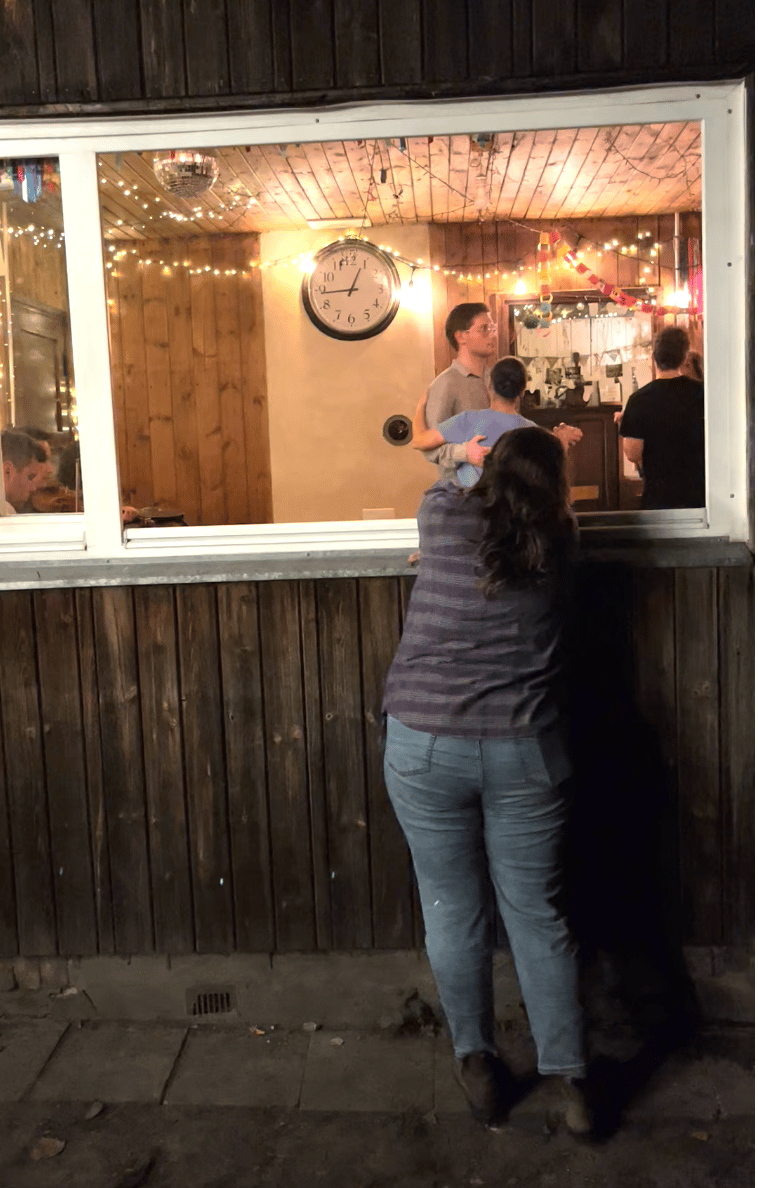
It’s my last Saturday night in Warsaw. Yankl and I are wandering through these Finnish style wood houses that were built quickly after the war to house the workers who were rebuilding the city. We find what we are looking for. A dark brown wood house with both warm light and the sound of a fiddle emanating from the windows. Our friends, Baymele, are playing a joint bill concert with the Polish band, Napięcie. We’ve walked into the Embassy of Traditional Music. Everyone is sitting, listening to Baymele’s set until Dimitri says, “this is dance music, so get up and dance.” For the rest of the night the dance floor, both the one inside and the improvised one that spills over into the yard is full.
Baymele and Napięcie go back and forth playing sets of Klezmer and traditional Polish music. Throughout the evening there are these fascinating moments of rubbing up against each other. I lead a bulgar and a zhok outside, I dance a Mazurka. At one moment as an amalgamation of the two bands play Lomir Zikh Iberbetn people are trying to do multiple forms of dancing, Polish partner dances and solo Yiddish dance, at the same time. There is literal bumping up against each other. Are we reconciling, encroaching, sharing? It’s hard to tell. As darkness settles, the clarinetist from Napięcie plays Shnirele, Perele and the small group of Yiddishists who are there outside of the window start singing across the threshold to/with him.
My friend Agnieszka tells me about the traditional music and dance scene in Poland. She tells me about how after the war, the Polish government took traditional culture and codified it as national culture to create a folk. She told me about how people are trying to return to source material outside of the government’s official designation of national culture to find something they feel like belongs to them and not to a country. This sounds familiar, and also it sounds so so different to do that while still connected to place and land in a day to day capacity. It sounds so so different to do that by learning from living sources as opposed to (obviously some living sources) and mostly archival sources. In both cases there is rupture and there is continuity, there is an intentional turning away from something nationalized and towards something else, the texture of what that looks like is both unique and interconnected.
This double bill and the dancing that it brought about was an embodied contending with rupture, with folk/traditional culture, with being neighbors, with being distant, all at once.
Milejczyce/מילייטשיץ:
On a random Wednesday, I rented a car and drove 2.5 hours East to Milejczyce. Milejczyce is the town Rabbi Aaron Tamares (The Sensitive/Pacifist Rabbi) lived and died in. To be totally honest, I hadn’t heard much of him before but was along for the ride and the adventure along with people who had a deeper connection to him and his legacy. As we pull up, the group we are meeting (a tour of Jews from Northern California) are heading towards the Jewish cemetery, we join them.
Once we get to the cemetery, Monika (who has acted like the guardian of the cemetery for years) tells us that her neighbor found a gravestone in their backyard and brought it to the gates of the cemetery but could not bring it all the way to the wall where the recovered stones are placed. This group of Jews who have never before been to Mieljeczyce argue about the best way to move the stone until they begin rolling the square stone over the length of the cemetery. Who does the stone belong to? Who gets to decide how it is moved and what happens to it?
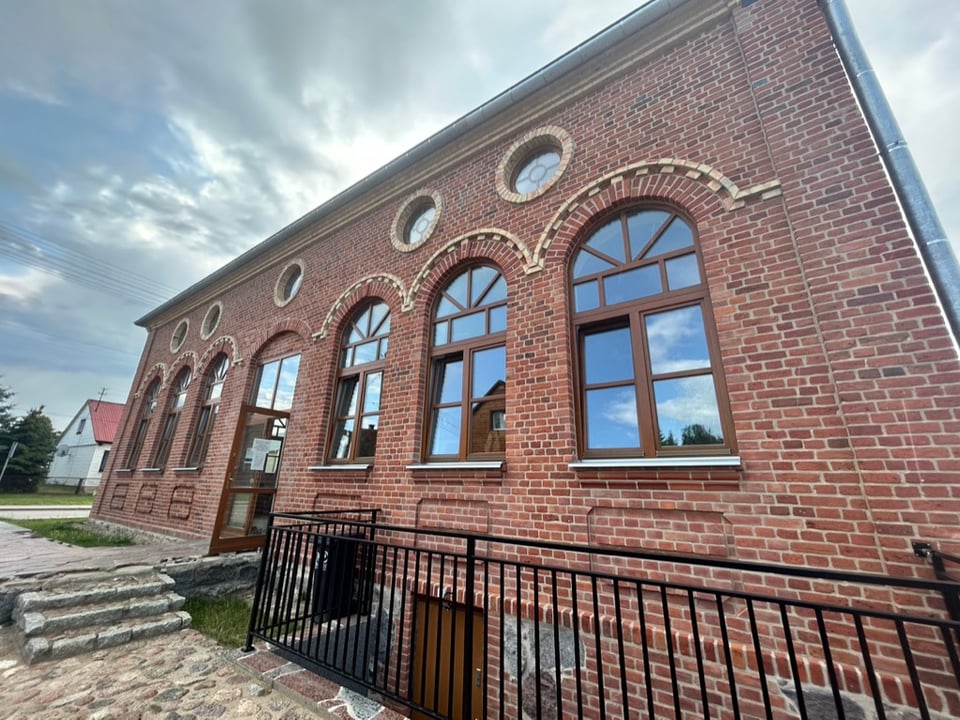
The shul that Tamares presided over is a community center now. An older woman shows us photos of her wedding there and of her 35 year anniversary party there. In a small window nook, a gilded icon of the Virgin Mary watches us. Monika tells us about how the townspeople of Mieljeczyce came to the shul during the liquidation of the ghetto to wave goodbye to their Jewish neighbors as they were deported to Treblinka. The tour has to get to their hotel so they get on a bus at 6:30, and the neighbors of Mieljeczyce go outside to wave good-bye to them. As they leave, there is one more stone stacked up against the wall in a completely overgrown cemetery. The dead Jews wave goodbye to the strange living ones, too.
2 am by the ghetto wall:
One night at 2 am I walk out of a bar and through a park and look down at my feet and see I am standing on the Warsaw Ghetto wall marker. I am speaking Yiddish with people from my program. I jump back and forth over the marker, in the ghetto, out of the ghetto. How easy it is to cross the confines of the ghetto wall. How hard it is to leave the history. How hard it is to grapple with its legacy, a legacy and a story currently being exploited to create a ghetto in Gaza.
Thunder storm at the Bródno cemetery:
As cliche as it sounds, the two Jewish cemeteries in Warsaw were the places I felt most grounded and at peace. Finally, here were all the Jews. My time in the larger Okopowa cemetery was spent measuring An-sky’s grave (and Peretz’s and Dinezon’s, the throuple is burried together), getting got by stinging nettles and ticks, and wandering into the far reaches where the cemetery seemed more forest than burial ground. Time stretched.
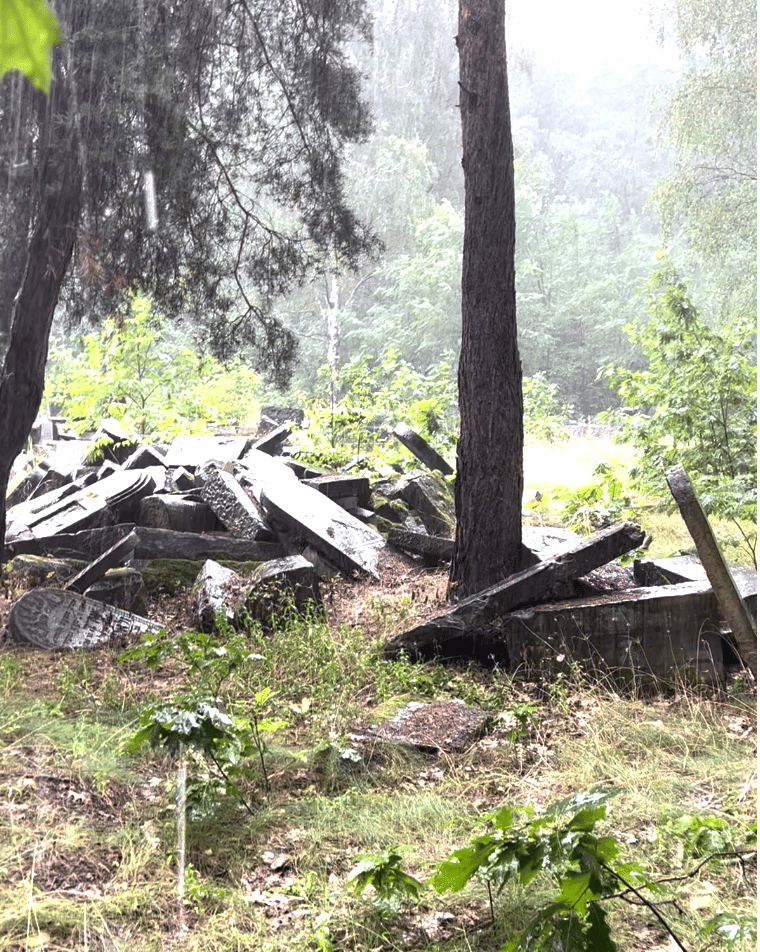
The Bródno cemetery, across the river in Praga, was the poor people’s cemetery. Whereas most of the matzevahs still stand in Okopowa, in Grodno they lie on their sides in piles, they are formed into caged walls, they recede further and further into the earth. As I walked around alone, the sky split open and I was caught in the middle of a downpour. I continued walking around, the rain dripping down from my hair and skin and clothes into the earth were the dead were resting. I felt undone by the destruction of the cemetery, by the idea that people were now lying in unmarked graves, that even the dead are not safe from genocidal terror. And that even the dead are not safe from having their memories exploited for the sake of genocidal terror. I thought of 20 years from now, when markers are put up to mark the genocide in Gaza and everyone pretends that they, too, were helpless to stop it. I thought of the layered deaths, the one of leaving the mortal realm, and the one of leaving memory, and the one of not being marked anymore. And yet, the rain was still able to reach them, dripping from the sky to me to the dead.
One thing that I am coming away thinking about, which feels sort of obvious, is that you actually cannot tell the story of Polish history without Jewish history and you cannot tell Jewish history without Polish history. We (Jews) are not the only ones entitled to our history. To me, it feels crucial to uproot this isolationist idea as we are facing the total moral corruption of being unable and unwilling (for some) to stop a genocide. Our history and our trauma is not ours alone, it cannot be ours alone, it does not make us special or exceptional, it makes us a part of the world it does not set us apart from it. The opposite of being part of the world is the kind of isolation and separatism that Zionism thrives on. There have to be existences that are not just a choice between assimilation and forgetting and total isolation. Intertwining and co-territorial and co-temporal relationships need to mean something for those of us who are trying to tell those histories, in Poland and elsewhere. It feels more clearly intertwined for me after this summer, both in terms of the past but also in terms of possible futures. Before, Poland often seemed like an imagined place where people came from and less like a living, nuanced place, I think this is common amongst Diasporas—the idea of place versus the place itself. It feels crucial to bring those disparate senses of place together and to do so with people. We have to leave our specialness, our exceptionalism, our entitlement to history, to trauma, and to place behind in order to meet reality.
The map of Warsaw is totally different now than it was before the war. It was decimated and rebuilt, the streets bear the same names but are not in the same locations. There is a ghost map that hangs over the map of the city.
Yours, really yours,
Yael/Tsigele