
week four of foiaday + request 026
Let's request records about drugs. (My drugs, kind of.)

Request 026 — 1/26/2026
Let’s request records about drugs. (My drugs.)
Happy Monday! It’s foiaday!
We are in week four of foiaday! Can you believe it!
Today is January 26th, and I’ve made… quite a few requests. Definitely more than 26 — yesterday had requests sent to three different agencies — and we’ll have full details of every request in the monthly roundup, which will be sent this Saturday.
(If you’re a daily subscriber, you’ll get it like normal! If you’re a weekly subscriber and want monthly updates as well, you can change your subscription at the bottom of this email.)
To start, let’s request some documents about drugs.
If there's a coworker or friend you think would benefit from this newsletter, feel free to forward it to them! If they subscribe, they'll also get a link to a template for the tracker I like to use to keep tabs on requests I've filed.
Not just any drugs. My drugs.

In late September, I was diagnosed with an autoimmune disease after almost a year of wild symptoms, chronic pain and unending fatigue. It was pretty unexpected, and I had a very steep learning curve.
But one of the steepest was navigating insurance and medication — namely, Humira, the miracle drug for my condition and a whole host of conditions like it. It’s one of the most profitable drugs on the market, and since the patent for the drug lapsed a few years ago, it’s been notoriously difficult to get ahold of the og medication, leaving insurance companies covering high costs of drugs and patients to scrape together the rest.
Before insurance touches it, it’s almost $7,000 for two doses every month. I did one of the doses, which is an auto-injector pen, tonight. (Which is why I’m talking about it to begin with!)
Full disclosure: I benefit from programs from Abbvie, the drug manufacturer, that ensure I get my medication at a low cost. Without it, I’d be right back where I started, with joint pain, fatigue and all that jazz.
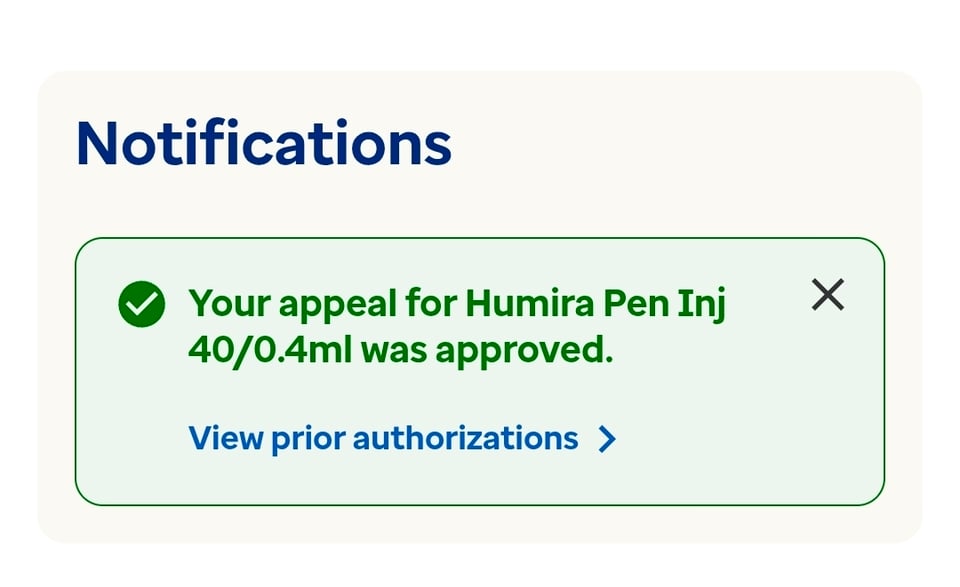
For people who need the drug, like me, it can make a world of difference. And since I was prescribed it, like a true journalist, I’ve thought endlessly about how hard it was to obtain it, how difficult it can be to adjust to administering it (which is an injection that has to be refrigerated), and the logistics involved.
I’ve particularly thought about people who may be incarcerated with autoimmune diseases like mine who need biologics, the medication class that Humira is in, in order to slow, stop or alleviate their disease progression.
People behind bars receive healthcare dictated by that facility’s corresponding agency. For example, someone incarcerated at MCC Chicago, in the heart of the Loop, would be serviced by the Bureau of Prisons Health Services Division, because it’s a federal facility; someone at Danville Correctional Center would be serviced by IDOC’s new health contractor, Centurion, because it’s state-operated.
Prison and jail populations across the U.S. are also the only population to have a constitutionally enshrined right to healthcare (thanks to the 1976 Supreme Court case Estelle v Gamble), but the quality of that healthcare varies dramatically. Disabled and chronically ill people behind bars can face massive barriers to obtaining proper care, and research indicates systemic underuse of prescription medications within incarcerated populations.

So weighing the facts here:
1. Humira is an expensive but essential medication,
2. medications are routinely underprescribed behind bars and
3. jails and prisons are constantly trying to save costs and
4. the healthcare contractors they hire sometimes have problems,
it begs the question: how much are prisons and jails prescribing Humira or its alternatives to people, and how much does it cost?
When it comes to FOIA — I can hardly ask for a list of every person using Humira or a biosimilar drug (which is a “generic” version). That would be a violation of PII and unreleasable probably due to HIPAA. But.
Doing some digging (and Google dorking) pulls up a few different types of documents I might be able to get my hands on. For one, searching for Humira, FOIA and prisons and looking for PDFs pulled up:
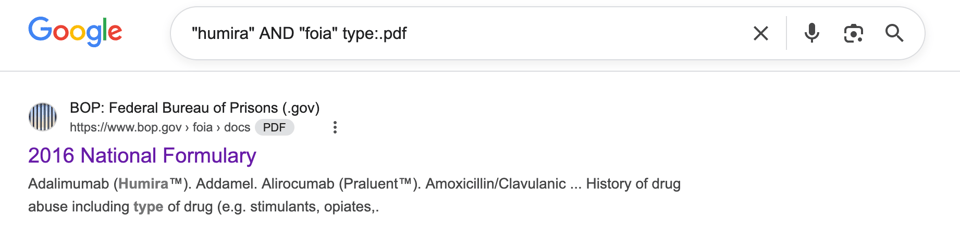
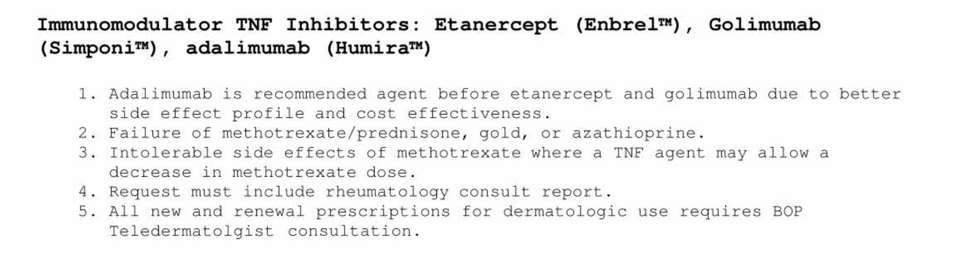
The 2016 drug formulary for the (federal) Bureau of Prisons. If you’re really dialed into your health insurance plan, you might be familiar with your policy’s formulary and different additions and revisions to it. The formulary describes different dosage, prescription and treatment plans, which seems relevant here. It also outlines the possible limits or step therapy needed for the prescription.
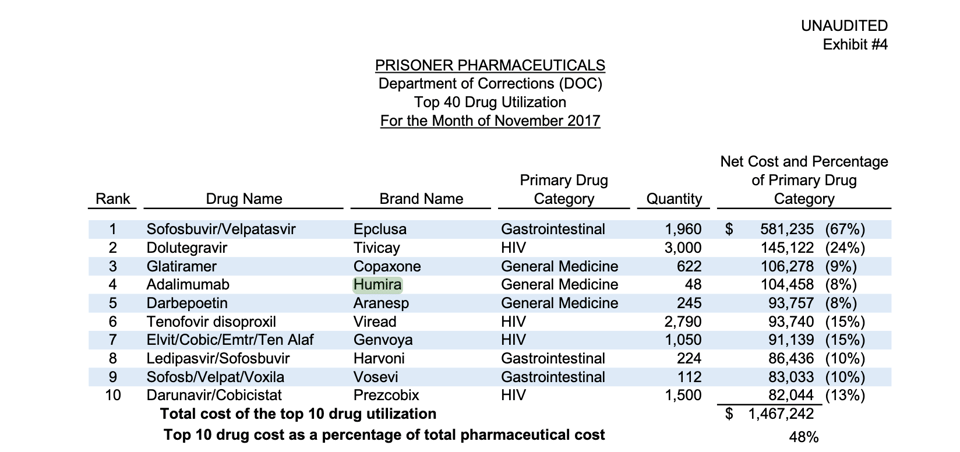
Also: a May 2019 audit of Michigan State Prisons pharmaceutical costs. It highlights just how expensive Humira is — 48 doses in a month means it’s probably (maybe) 24 patients across the state receiving this medication per month at a cost of ~$2,176 a dose. (Per month! As someone with insurance, that sounds about right.)
Moving to the other side of the country, an audit of Mule Creek State Prison in California by the IG’s office in 2016 was returned with those keywords, in part because of improper care and observation after the administering of Humira, which can cause potentially severe side effects. (Like all the ones they read out at a fast pace in those commercials while people dance in a field in slow motion on TV.)

Aside from PDFs, one thing that came up about Illinois was the deficiencies in Wexford, the previous healthcare contractor used by the state in jails and prisons. A report from Uptown People’s Law Center from September 2021 found serious issues with the storage, dosing, timing and administration of pharmaceuticals behind bars; it also mentions monthly pharmacy inspections and audits of medication administration records (MARs), which will be relevant here document-wise.
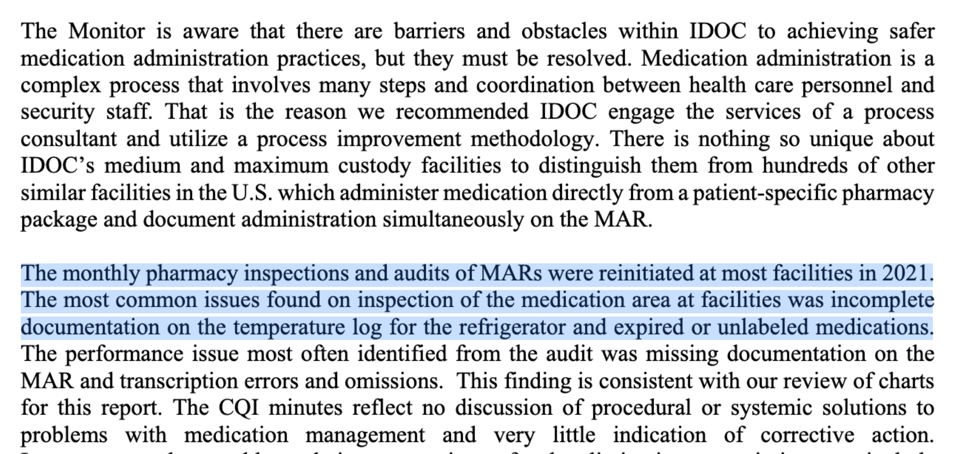
Unfortunately, there are a lot of examples of this. (This being medical mismanagement of Humira specifically.)
So. Let’s request a series of documents:
- The current IDOC drug formulary (and maybe a few other states, too)

- Monthly pharmacy inspection reports from the past year

- Audits of any medication administration records (MARs) in the past year

- Costs of prescription drug orders for jails and prisons for the most recent fiscal year

- Specific policies, memos, analyses or discussions of specialty medications like tumor necrosis factor (TNF) blocker drugs and biologic medications (like Humira!)

- The new contract between Centurion and the Illinois Department of Corrections

- Any MOUs, agreements, bids, contracts, invoices or correspondence between Abbvie Pharmaceuticals (including patient support programs like Humira Complete) and the facility.

- Complaints filed by patients or providers about the distribution of specialty medication, including biologics or immunosuppressant TNF blocker medication like Humira (adalimumab), Enbrel, Cytelzo, Rinvoq or biosimilar medication.
I think that just about covers it. Don’t you?
While most of these documents are probably going to be found with IDOC directly, I also want to file a copy with the Illinois Department of Juvenile Justice (IDJJ), which manages state-operated youth correctional facilities specifically.

Okay, quick updates!
Documents are being uploaded and sorted out in this DocumentCloud project.
I shared this survey last week, but just re-upping:
How would you like your docs?
Again... mull it over. Let’s get to some quick hits about the back and forth of the week!
DuPage Air Authority very nicely called to confirm I received the records retention and FOIA log I requested from them! That doc is up in DocumentCloud and features some familiar names. (Hi Carlos and Greg!)
Illinois State Police accidentally sent me someone else’s FOIA request response, right after extending their response to my request for ChatGPT logs.
Quite a few schools got back to me about their public safety budgets, including Illinois State University and Northeastern Illinois University.
The Illinois Department of Natural Resources said my request for financial disclosure forms was unduly burdensome. If the question was “what does this even look like for IDNR,” the answer is “there are over 7,000 individual documents,” and… yeah. So we’ll narrow.
Chicago’s Department of Streets and Sanitation fulfilled my request for fleet deets, but said that my request for parking and speeding tickets for them had to be re-filed with the Department of Finance. (Fair.)
As promised, here's a list of the requests I’ve put in so far for the past week. If you’re curious, you can click the slug name in order to read the corresponding foiaday issue and the request language in the archives:
request no. | slug | agency | status |
|---|---|---|---|
020 | various Missouri and St. Louis agencies | Filed | |
021 | FAA | Filed | |
022 | GDOT, Iowa DOT, TxDOT, IDOT, CODOT, MDOT | Filed | |
023 | Department of Defense Concessions Committee | Filed | |
024 | Illinois Department of Labor | Filed | |
025 | Chicago Park District, DCASE, CPS | Filed | |
026 | Records on Humira and specialty medication | Illinois Department of Corrections + others | Will be filed on Tuesday (womp) |
If you have any ideas for requests, feedback, or thoughts about foiaday, we now have a form! Feel free to pop by to share inspiration to help get me through this year’s worth of requests.
Otherwise, if you have any questions, comments, love letters or conspiracy theories, you can always drop me a line by replying to this email.
I changed the design of the archive page to make it hopefully a little bit easier to follow and piece through different requests. I might try and port some things over to a standalone blog — I’m having visions of a calendar with tooltips that’s color coded — but that’s a project for maybe a little later in the year.
These emails keep going out later and later, but the important thing (in my mind, at least) is that it’s forcing me to think of not just new FOIA ideas, but new story ideas and reporting questions. As difficult — yes, difficult — as this project has been so far, it’s really very fulfilling. Thank you for being a part of it!
Happy filing, and have a good week!
Cam


Add a comment: