
Primer for geospatial embeddings
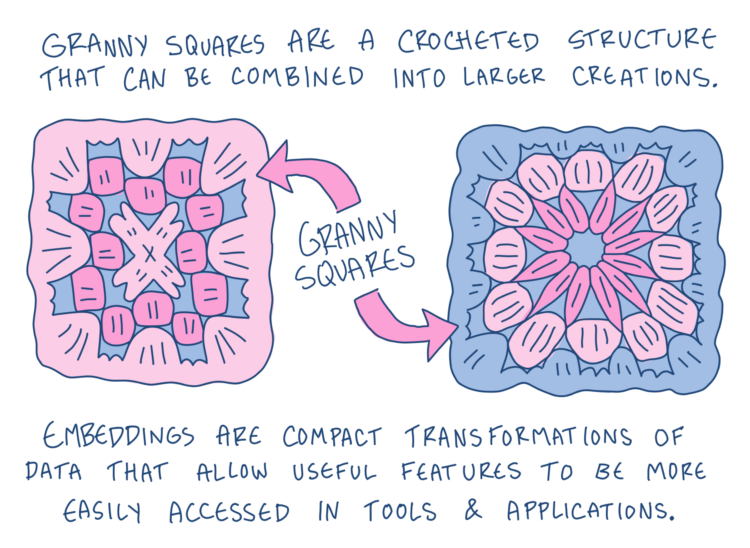
For Development Seed, Kiri Carini and Martha Morrissey explain what embeddings are and what they are used for.
An embedding represents this information as numbers grouped into dimensions of a “latent space.” We are used to describing our world with three spatial dimensions, but dimensions in latent space are mathematical rather than physical. Together, they encode patterns and relationships the model has learned from the data.
As humans living in a three-dimensional world, it’s hard to imagine a space with dozens, hundreds, or even thousands of dimensions. This makes embeddings difficult for humans to interpret directly, but computers have no problem working with these mathematical representations. In practice, an embedding is usually stored as a list of numbers.
Illustrations by Gus Becker provide a crochet metaphor to help you mentally link the steps. While in the context of geospatial data, the guide should also be helpful in understanding embeddings in general.
Tags: Development Seed, embeddings, geospatial, guide, training
What happens to math going forward
Terence Tao has become the unofficial spokesperson for the future of mathematics. Elisabeth Bumiller, for the New York Times, reports on the soured relationship between Tao and OpenAI:
OpenAI’s releases have now left him feeling used. “As recently as a year ago, I had a pretty good relationship with many employees at OpenAI,” he said in a recent phone conversation.
“A lot of people I interacted with shared a very common vision of how A.I. should be used — you know, to empower scientists.” But the rush to publish new findings, he said, shows their true purpose. They “used math for what they needed, which was to evaluate their models,” he said. “At this point, I don’t see a way to constructively engage.”
I feel for the PhD students who are four years into research and OpenAI comes along. I think the only successful path forward involves figuring out how these new tools intertwine with existing work.
Tags: math, New York Times, OpenAI, Terence Tao
FlowingData is 100% made possible by members. Join today and get access to courses, guides, and more resources from this real person (me, Nathan).