
florilegia #8: on profanity
This past winter, two slices of media tailored to my interests dropped almost simultaneously: the Netflix show American Primeval and the album Profanation of the Adamic Covenant, by Ritual Ascension. Although I haven’t been a Netflix subscriber in some time, I contrived to view the series due to its prominent Mormon-pioneer plotline; it’s not often you see Brigham Young as a significant side character in mainstream television. Ritual Ascension is a new band, composed of members of other bands, and their debut was an insta-buy for me again due to its Mormon themes, unusual for either mainstream or fringe music.
In the case of Ritual Ascension, we’re dancing on the fringest of the fringe. Not content with devoting their sound to death, doom, or black metal, the record is a seething amalgamation of all three. It’s a sound well-suited to the record’s content, in this listener’s opinion, though it’s hard to imagine church brass or the faithful agreeing. To do so would be to admit that the LDS religion is a violent one, and thereby open to interpretation through violent or transgressive art. Yet to any casual student of US history, or scholar not engaged in apologetics, this violence is obvious and entrenched—as depicted in American Primeval.
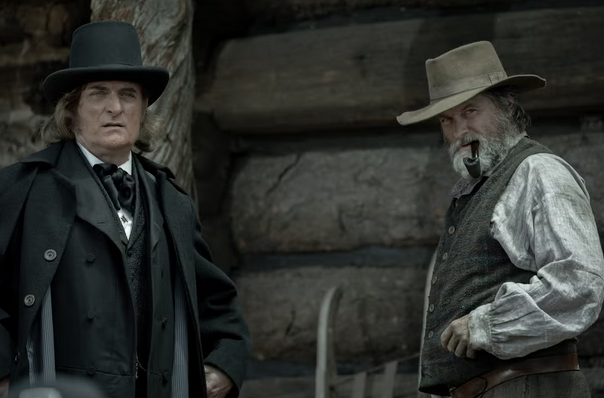
Now. Can I honestly recommend American Primeval as a television show? No. It’s not very good overall; it’s mired in current irritating norms such as “sepia tone, high contrast ONLY” and “fuck a sound mixer” and every actor talks too fast, although the Explosions in the Sky score is very good. Despite unflattering portraits of Brigham Young and other historical LDS figures, these characters still function, bafflingly, as the church’s mouthpieces. At one point, “Wild Bill” Hickman (Alex Breaux) tells Jim Bridger (man of all prestiges Shea Whigham) not to say “Mormon,” a laughable c. 2018 conceit. At another, Young (a truly evil Kim Coates) hand-waves his plural wives with an old saw about many of them being older than him, and therefore sexually unappealing. Perhaps in an attempt to rebut misty-eyed and childish tropes about Old West adventures, the show’s violence is unrelenting. Yet it over-corrects; the blood on display barrels past confrontational and becomes rote.
American Primeval is an ugly program. Profanation of the Adamic Covenant is an ugly album. We’re an ugly country in its ugliest era yet.
A not-uncommon way of understanding the world is a sort of group narcissism, a vision of the in-group that posits its constituents as more human than most. In this mode, “primeval” is understood not as a reference to untouched wilderness—since we know the land that would become the American West was long-shaped by human hands—but as a question of essential Americanness.
Who is American, and how do they become that way?
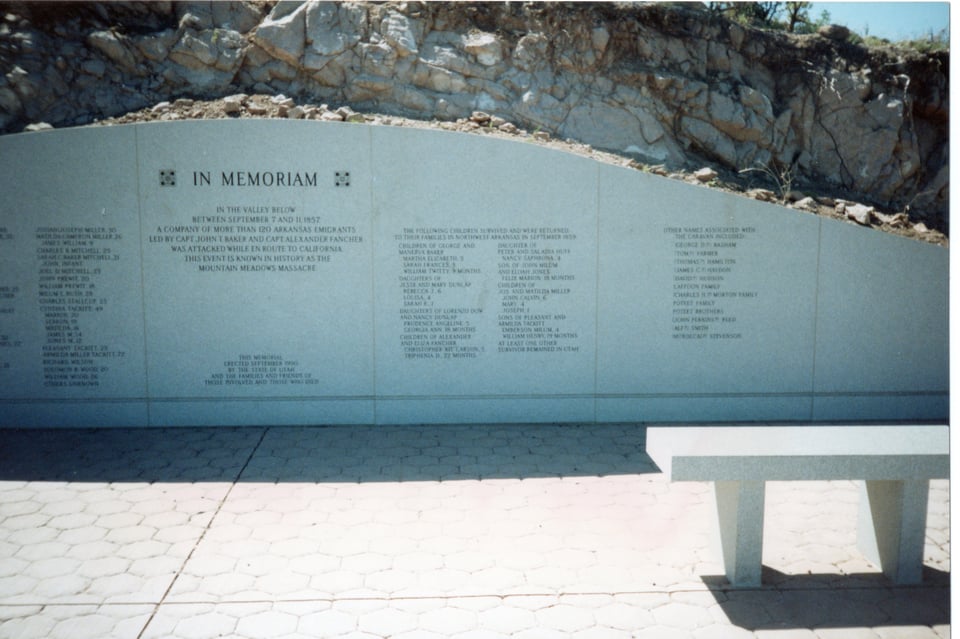
The most “American” of all people in the Plains and Mountain West—Native peoples—were inversely non-American, barely treated as humans by waves of white settlers, governments ad hoc and official, and military. The most damning aspect of the Mountain Meadows Massacre was what amounted to redface: Mormon militia members donning Native garb to pin their crimes on an uninvolved populace. American Primeval doesn’t shy from the implications of this, yet it also positions Shoshone culture as a cleansing fire by which white characters can relinquish their whiteness. The Mountain Meadows Massacre made national news, strengthening public opinion against Brigham Young’s desert theocracy. Young had no federal mandate nor a democratic election, let alone legal or ancestral claim to the Shoshone land the church occupied. Theology justified Mormon control of the Salt Lake Valley—a theology overtly hostile to Native people in its declarations and practices.
A mid-point episode uses real instances from Mormon history to pit the LDS against all other groups within America, Native or white. Their religious peculiarity overrides their whiteness when interacting with other whites, an in-group truism rooted in some actual truth, as the historical church saw itself feared for its putative voting power and driven from various locations by state-sanctioned (and enacted) violence. Mormon popular history is rife with lauded outlaws and its legacy, stemming from the heart of Deseret, is a persecution complex.
That complex is at odds with the Mormon church’s status as the most assimilated… and thereby successful… fringe sect in US history.
Black metal has experienced its own assimilation over the years. Once the absolute last frontier of heavy music, “blackened” is now a common flavor for death, doom, hardcore, shoegaze, and even certain corners of pop music. The metal subgenre most overtly aligned with satanic themes, it’s something that would have been of extreme concern to my parents if I’d discovered it in high school. LDS music is largely devotional, and its popular offerings meager. I was raised to understand a clear, hard line between worldly media and appropriate art—to know that if I had any ambitions to create art, it would have to be within the church’s context.
(The Catholic ability to create non-devotional religious art, and to make secular art while retaining belief, is fascinating to me.)
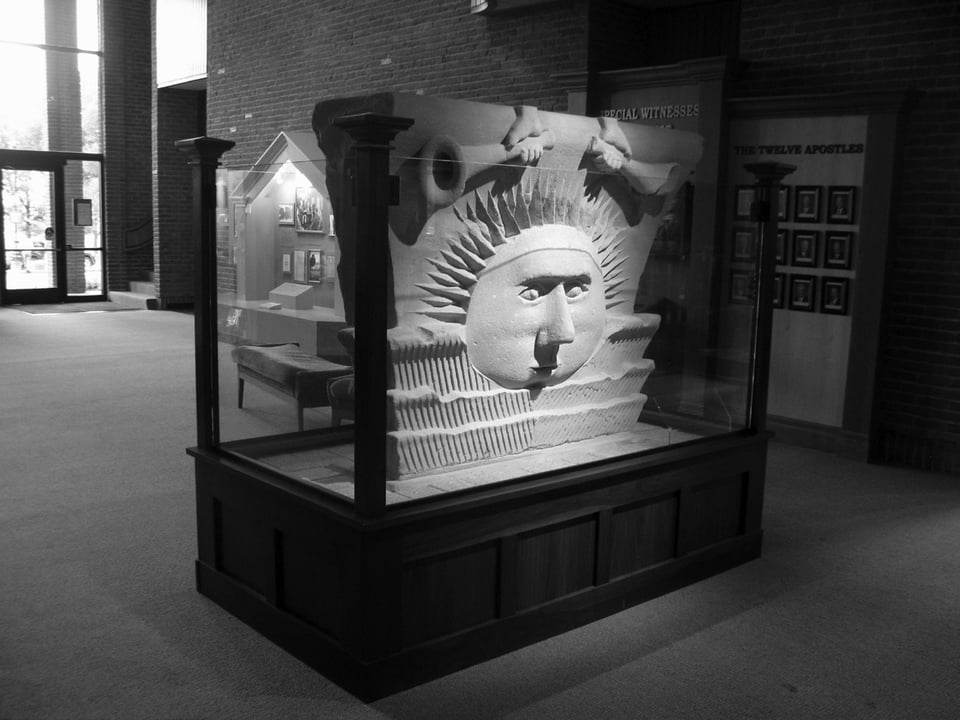
Black metal is an occult subgenre in the popular sense; it’s more famous in the mainstream for church-burnings and ritualized murders than its sound. Mormons might bristle at their religion being termed “occult,” but the church’s history and much of its contemporary theology is steeped in western esoterica. Joseph Smith had Freemason associations, apocryphally calling out a Masonic distress signal while falling to his death from a Carthage prison window. He came of age during the Second Great Awakening, influenced by the proliferation of visionary Christian cults in western New York. Mystical symbolism pervades church architecture and pagan features, such as God the Mother and apotheosis, are baked into LDS dogma. The church’s own Apocrypha, the Book of Abraham, was derived from Egyptian papyri. Any group with occult elements can naturally be understood through occult art. In this mode, Ritual Ascension’s work is no more violent, ugly, off-putting, or transgressive than the realities it draws from.
And that reality is often violent and transgressive. Even the most outre Mormon news stories exist not so far across the spectrum from the millenarian beliefs still contained in mainline LDS theology.
Profanation of the Adamic Covenant is, for the post-Mormon listener, appealing due to its seeming transgression: from album title to track titles, it’s uniquely Mormon, ritual phrases made blasphemous by proximity to intentional abrasiveness—but also via exposure to daylight. The record centers on Mormon temple rites, ceremonies that are part of a closed tradition and not for public consumption. “Kolob (At the Throne of Elohim)” opens and closes with murmured recitations of ceremonial texts. These are not words intended to be spoken outside specific times and places, by specific people. They call to promised profound spiritual experiences and the mythic legacy of the true gospel’s restoration. There’s a Gnostic horror in viewing the church from this angle, a bleakness to the Mormon necessity for knowledge, its rigorous policing of doubt. There’s also a regret I feel each time a little more strangeness is sanded away from the contemporary church.
And there’s a dark thrill in beholding fellow travelers beyond the pale, a certain relief. I’d love to talk with these dudes, these former Kolob-hiers to whom I wouldn’t need to interpret myself.
I should say that, subjective themes aside, Profanation of the Adamic Covenant is heavy as fuck, complex and sonically impressive, and often beautiful. Rather than trafficking in juvenilia—your upside-down crosses and so forth—it seems interested in the real darkness at the heart of Mormon belief, the violence and occultism elided by current church movements toward four-quadrant appeal. It joins the ranks of Mizmor and Givre in exploring (or exorcising) Christianity through what’s popularly considered evil music. It’s far more a success of its constituent parts than American Primeval, which relies on bog-standard Hollywood violence at the expense of its more interesting ecumenical and spiritual violence.
Profanity, more accurately obscenity, is verboten in Mormon speech; I didn’t say the word “fuck” until well into college, and have never really adopted a habit of taking the Lord’s name in vain. Yet to make something profane is ultimately to affirm the possibility of the sacred. Sister Abish (Saura Lightfoot-Leon) encounters the divinity her beliefs promised her not as part of the white settler movement westward, but among the Shoshone. Later encountering the Nauvoo Legion, she knows of Brother Hickman’s murderous actions against his own people, and this awareness makes the prayer he offers her profane.
Having the experience of personal revelation described to me so frequently did prepare me for its eventuality. It never arrived in the places it should’ve—in the temple, or during prayer—a source of distress for my younger self, who truly believed but didn’t know. When it did arrive, live music was the source. Heavy music. God, it turns out, speaks in harsh vocals.
The profanation of Ritual Ascension’s album title is a core aspect of Mormon theology. As the scripture runs, Adam fell that men might be, and men are that we might have joy.
Add a comment: