
florilegia #24: sab-whatsit
Simon said, “I don’t see how Great-Uncle Merry could know—I mean he isn’t even in Britain, is he? Taking that year off from Oxford. Sab—whatsit.”
“Sabbatical,” Jane said. “In Athens. And not even a card at Christmas.”
Greenwitch wasn’t the first time I encountered the word and concept of “sabbatical,” but I can’t remember an earlier instance, so we’ll call it for Susan Cooper. It wasn’t until recently that I knew any professional academics who were granted sabbatical; most of the professors I encountered in undergrad weren’t even tenured. And although I never seriously entertained thoughts of entering academia, the idea of sabbatical stuck with me. Six months or a year to just… study? To read and write and think? And get paid?
The dream.
“Sabbatical” comes from the same root as “sabbath,” and was started at Harvard as a method of providing rest for faculty. An insane concept in our era of constant, widespread professional burn-out, to be sure. Yet within the rest period is what really interested me as a younger person, and now: the renewal. A sabbatical isn’t just recovery from intense course loads, low pay, and departmental bullshit; ideally, it revives your love for your subject. It germinates new ideas for future publications or permits space to pursue indirectly-related research. It lets you woolgather, noodle, and goof off.
In some ways, I suppose the sabbatical does edge dangerously close to “productive rest,” a notion I find poisonous (despite—or perhaps because of—my brain’s need to be doing three things at once). But also: what does the phrase “witches’ sabbath” bring to mind? That’s the kind of energy we need, more than ever. True sabbaticals are really only accessible to certain parts of academia, or certain types of non-academic professionals. But what if the rest of us took an attitude of sabbatical?
This is what I’m trying in 2026. 2025 was a very grindful year for me, and I’m not too interested in doing that again.
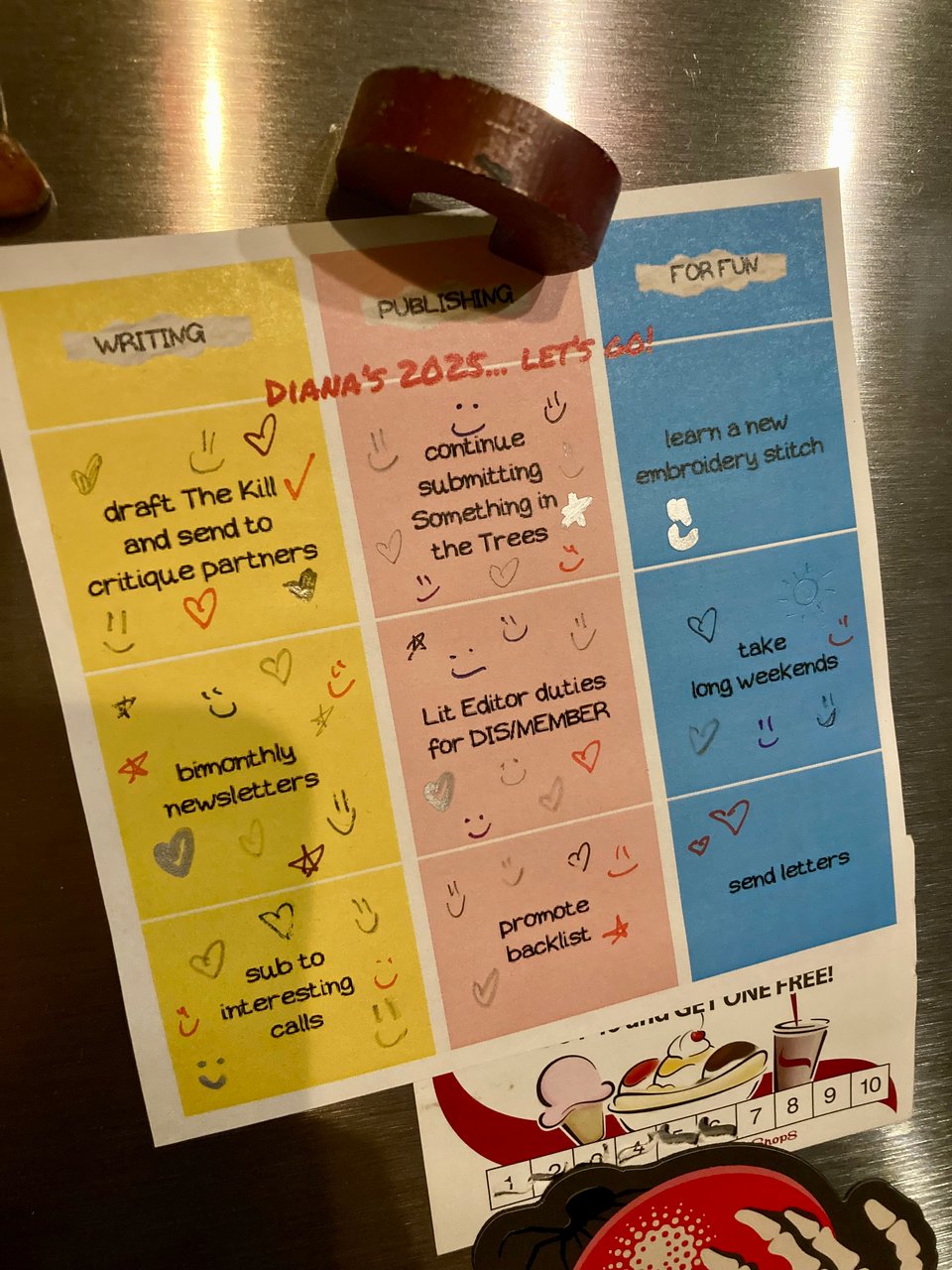
Instead, I’ve picked some core aspects of a sabbatical—reading, research, and craft growth—and am going to attempt to lean into them. To read as much as I want and whatever I want; to do deep dives both on topics I’m already interested in, and new ones; and to take workshops toward the goals of moving out of my typical writerly wheelhouse and improving certain aspects of my craft. In order to embrace the generative spirit, some self-assigned obligations and old habits will be relinquished. We are going Bartleby in 2026.
I’m also ushering into existence something called “Daemon Days” because I’m trash for both Gorillaz and His Dark Materials. The Ancient Greek daimon relates to divinity and spirit, rather than being a strictly malevolent entity, and is analogous to the Roman concept of genius. Nowadays, we say someone is a genius, whereas in older times, it was said that someone had a genius. A daemon or genius is something to be cultivated, cared for, and welcomed.
Daemon Days, then, are days to spend making the creative genius welcome—specifically by keeping company with friends of similar creative mindsets.
Finally, because everyone loves an “in versus out” list, here’s mine for the new year:
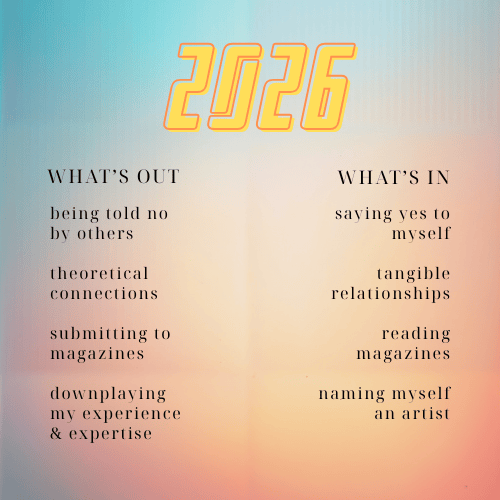
The culture does not want us to rest. Increasingly, the culture doesn’t want us to research, read, learn, make, try, or even truly acquire. So in the new year, let’s bring back counter-culture—it’s already begun! Thank you for joining me in this newsletter’s first year, friends. I’ll see you all in the next one.
Add a comment: