Emergent AI Review: Is This AI App Builder Worth Your Money?
Discover whether Emergent AI lives up to the hype in our in-depth review covering pricing, features, real user complaints, and whether this vibe-coding platform is worth your money.
If you've ever had an app idea and stopped because you can't code, can't afford a developer, or can't wait six months, Emergent AI was built for exactly you. You describe what you want in plain English, and AI agents design it, code it, test it, and put it online. I dug through Emergent's official site and docs, its pricing page, Trustpilot, G2, Product Hunt, independent review sites, and the company's funding and product announcements so you don't have to. This review covers what Emergent really does, what it really costs, where users get burned, and who should (and shouldn't) sign up. Want to skip ahead and try it? Start building on Emergent free here and test the platform before you spend a dollar.
Emergent AI Review at a Glance
What it is: an AI app builder (often called a "vibe coding" platform) that turns plain-English prompts into full-stack web and mobile apps.
Starting price: free plan with 10 monthly credits and no credit card, then $20/month (or $17/month billed annually) for Standard.
Top plan: Pro at $200/month (or $167/month billed annually) with 750 credits, a 1M context window, Ultra thinking, and custom AI agents.
Best for: non-technical founders, solo builders, freelancers, agencies, and small teams who want a working MVP fast.
Biggest strength: it builds the whole stack (front end, back end, database, login, payments, hosting), not just a pretty screen.
Biggest watch-out: credit-based billing means a messy prompt or a debugging loop can burn credits quickly.
Backing: Khosla Ventures, SoftBank Vision Fund 2, Lightspeed, Y Combinator, Prosus, Together, and Google's AI Futures Fund.
My verdict: a powerful tool that rewards people who prompt clearly and budget their credits, and the free plan lets you find out risk-free.
Try Emergent free with my link and see what it builds from your first prompt.
What Is Emergent AI?
Emergent is an AI-powered software creation platform. Instead of learning to code or hiring developers, you chat with AI agents that plan and build your product from start to finish. On the platform you can start a job as a Full Stack App, Mobile App, Landing Page, or a Brainstorm session to talk through your idea first.
Emergent launched in 2025 and grew at a pace that even surprised investors. The company announced $50 million in annual recurring revenue within seven months of launch, and its homepage now claims 10M+ builders and 15M+ apps created across 200+ countries.
No coding required: you describe the app, the agents write the code.
Full-stack output: you get a front end, a back end, a database, authentication, and hosting setup.
Web and mobile: build websites, web apps, dashboards, CRMs, SaaS tools, and native-style iOS and Android apps.
You own the code: Emergent says you own what it generates, and Standard and Pro plans include GitHub integration so you can export and host it anywhere.
If you want to see it in action rather than read about it, open a free Emergent account here and type your first idea into the chat box.
How Does Emergent AI Work?
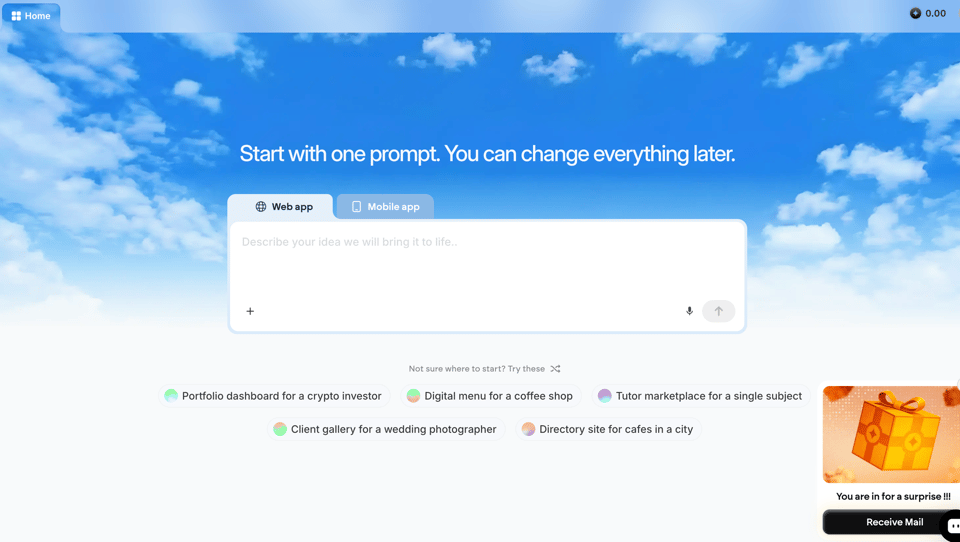
The workflow is a simple conversation: describe, refine, launch. Here is what happens behind the scenes in plain terms.
Step 1: Describe your idea
You pick an app type and type what you want. Emergent's own guidance says a good first prompt has three ingredients: what the app is, who uses it, and the one core action people take. Something like "a habit tracker where I can add habits and check them off daily" is plenty to start.
Step 2: The agents plan and build
The AI generates a plan, then builds the screens, the logic, and the database. You watch the app come alive in a live preview. Emergent says you can expect a working app in under 20 minutes for a simple idea.
Step 3: Chat to refine
You test the preview and ask for changes in the chat: new features, different colors, extra pages, bug fixes. No code editing needed. There is a Build and Plan switcher, so you can talk through ideas in Plan mode before the agent starts spending credits on building.
Step 4: Undo anything with checkpoints
Emergent has a checkpoints feature so you can roll back when a change goes wrong, which matters a lot when you're paying per action.
Step 5: Publish
When you're happy, you publish to a live address, connect your own domain if you want one, and your app is online on Emergent's hosting. Mobile apps can be prepared for Google Play and the App Store.
Ready to turn your idea into a live app? Start for free with my link.
Who Owns Emergent AI?
Emergent is owned by Emergent Labs, a venture-backed startup co-founded by brothers Mukund Jha (CEO) and Madhav Jha. It is headquartered in San Francisco, was founded by Indian entrepreneurs, and went through Y Combinator.
Seed round: $7 million.
Series A: $23 million.
Series B (January 2026): $70 million led by Khosla Ventures and SoftBank Vision Fund 2, with Prosus, Lightspeed, Together, and Y Combinator participating.
Total raised: about $100 million, reported at a roughly $300 million valuation.
Also backed by: Google's AI Futures Fund, plus angels including Jeff Dean.
That matters for the "will this company still exist next year" question. Emergent is not a two-person side project. It has serious capital, a big user base, and SOC 2 and ISO 27001 certification badges displayed on its site.
Who Is Emergent AI For?
Non-technical founders who want to validate an idea with a real working product instead of a mockup.
Solopreneurs and creators building tools, communities, booking sites, or paid apps.
Freelancers and agencies delivering client apps faster, without hiring a full dev team.
Product managers turning requirements into a working prototype to test with real users.
Small business owners building internal tools like CRMs, dashboards, schedulers, and inventory trackers.
Teams on Business and Enterprise plans that need roles, SSO, and shared workspaces.
If that sounds like you, create your free Emergent account here and build your first project today.
What Can You Build With Emergent AI?
Emergent's own product pages list a long set of use cases, and here are the categories you'll actually use.
Websites and landing pages: portfolios, restaurant sites, real estate listings, online course sites, booking pages.
Web apps: full applications with logins, databases, and user roles.
Mobile apps: habit trackers, fitness apps, food delivery apps, event ticketing, personal finance trackers.
Dashboards: sales analytics, marketing performance, project management, and customer support dashboards, including ones that connect to your spreadsheets.
SaaS products: content tools, email automation, social schedulers, invoicing tools.
CRMs and internal tools: lead management and operations tools without a developer.
AI agents and chatbots: custom agents that live inside your app or run on their own.
Emergent AI Features Explained
This is where Emergent separates itself from simple "prompt to pretty page" tools. Here is every major feature in plain English.
AI agents that plan, code, test, and deploy
You are not talking to one chatbot. You are talking to a team of agents that handle design, code, testing, and deployment. They plan the build first, then execute, then test their own work with automated checks.
Full-stack generation
Emergent builds the front end, the back end, and the database in one go. Describe your data (users, products, bookings) and it creates the structure and connects everything for you. You don't pick a tech stack, because the agent chooses tools like React and MongoDB automatically.
Web and mobile app building
Build for the web, or build mobile apps with export-ready builds for Google Play and the App Store. You can also build progressive web apps that install on any device, and you can convert a web project to mobile. Mobile docs cover pre-publish health checks, push notifications, and in-app purchases and subscriptions.
Chat-based editing and Plan mode
Change anything by asking. Use Plan mode to brainstorm and think through your idea before the agent starts building, which can help you save credits on avoidable rework.
Built-in authentication
Add email login, OTP, and social logins with a simple prompt. Emergent Auth is built in, and you can define user roles and permissions for who sees what.
Payments integrations
Accept payments and subscriptions through Stripe, Razorpay, Paystack, and PayPal. This is a big deal for monetizing quickly, and the Paystack and Razorpay support is especially useful for builders outside the US.
AI model integrations
Connect OpenAI, Claude, and Gemini inside your app. The Universal LLM Key lets your app call language models through your Emergent credits instead of juggling separate API accounts.
Messaging, email, media, and commerce integrations
The documentation lists Twilio, Resend, and SendGrid for messaging and email, ElevenLabs and AI media generation for audio, image, and video, and Shopify for commerce. You can also connect other tools by adding your API keys, so you're not locked into a closed ecosystem.
One-click publishing and hosting
Publish on built-in, production-ready hosting with secure databases and APIs already set up. Add a custom domain, share your app, and get found on Google using Emergent's guides.
Forking
Fork a task or project to try a different direction without wrecking your working version. Fork tasks are included from the Standard plan up.
GitHub integration and code ownership
Save your code to GitHub on paid plans. You own the code and can download, modify, or host it anywhere.
Custom AI agents
On the Pro plan, create your own custom AI agents and edit the system prompt to control behavior.
Ultra thinking and a 1M context window
Pro includes deeper AI reasoning (Ultra thinking) and a 1 million token context window, which lets the agent keep more of a large app and your instructions in view at once.
Team features
Business adds role-based access control, single sign-on, shared team workspaces, and real-time co-editing. Enterprise adds audit logs, user groups, user-level credit limits, self-hosted database support, VPC deployment, and a credit usage analytics dashboard.
Wingman, Emergent's autonomous agent
In April 2026, Emergent launched Wingman, an always-on agent that lives in WhatsApp, Telegram, and iMessage. It connects to tools like Gmail, Outlook, Google Calendar, Slack, CRMs, and GitHub to handle scheduling, research, sales support, and routine tasks. It pauses for your approval before consequential actions such as messaging a large group. It launched with a limited free trial, and the company has been open about its current limitations.
Build from your phone
There is a dedicated Emergent mobile app so you can build and manage projects from your phone.
Seeing the features is one thing, but nothing beats testing them yourself. Claim your free Emergent plan with my link and try building something real.
Emergent AI Models: E1, E2, E3 and Maxx
Emergent's documentation explains its agent models as E1, E2, E3 and Maxx. In simple terms, newer and more autonomous models reason more deeply and verify more of their own work, and they can cost more credits per task. One independent review reports that E3 uses roughly 30% more credits than a standard build because of the extra autonomy and verification pass. The practical tip is to match the model to the job: use the lighter option for small edits and the heavier one for complex builds.
Emergent AI Integrations
Payments: Stripe, Razorpay, Paystack, PayPal.
AI models: OpenAI, Claude, Gemini.
Messaging and email: Twilio, Resend, SendGrid.
Media: ElevenLabs and AI image, video, and audio generation.
Commerce: Shopify.
Storage: Emergent's built-in object store.
Auth: Emergent Auth built in, plus email, OTP, and social login.
Developer tools: GitHub, plus MCPs and connectors, and any other service through API keys.
Emergent AI Pricing (2026)
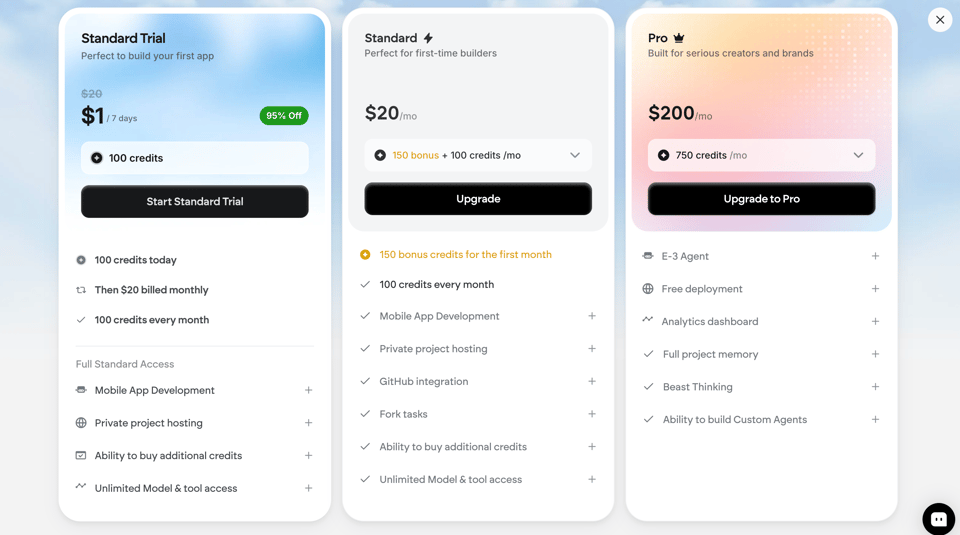
Emergent runs on a subscription plus a credit system. Every AI action costs credits, and your plan decides how many credits you get each month. These are the prices listed on Emergent's official pricing page.
Emergent Free Plan: $0
10 free credits per month.
No credit card required.
Build web and mobile experiences and access the most advanced models.
One-click LLM integration.
Best for: testing the platform and seeing what an AI-built app looks like before you pay.
Reality check: 10 credits won't carry a real project to launch, and publishing needs more credits than the free plan provides.
Start on the free plan with my link and see the quality yourself.
Emergent Standard Plan: $20/month ($17/month billed annually)
100 credits per month.
Build web and mobile apps.
Private project hosting.
GitHub integration.
Fork tasks.
Purchase extra credits whenever you need them.
Annual billing saves $36 per year.
Best for: first-time builders, solo founders, and freelancers.
Emergent Pro Plan: $200/month ($167/month billed annually)
750 credits per month.
Everything in Standard.
1M context window.
Ultra thinking for deeper reasoning.
System prompt editing.
Custom AI agents.
High-performance computing.
Priority customer support.
Annual billing saves $396 per year.
Best for: serious creators, startups, agencies, and anyone building several projects.
Emergent Business Plan: custom pricing
Everything in Pro.
Role-based access control and single sign-on.
Shared team workspaces.
Real-time co-editing and coworking.
Book a demo with the Emergent team for a quote. (Older third-party pages list a fixed "Team" price, but the current official pricing page shows Business as custom.)
Emergent Enterprise Plan: custom pricing
Everything in Business.
User-level credit limits and audit logs.
Self-hosted database support.
Priority SLA and support.
User groups.
Deploy apps in your own cloud (VPC setup).
Credit usage reports and an analytics dashboard.
Emergent annual vs monthly pricing
Annual billing works out to about 17% off. On Standard that is $204 per year instead of $240. On Pro that is $2,004 per year instead of $2,400. If you already know you'll build for months, annual is the easy saving.
How Emergent credits work
Credits measure work: writing code, running tests, debugging, integrations, database operations, and making your app live all use credits.
Monthly credits don't roll over: subscription credits refill to your plan cap each billing cycle.
Top-up credits never expire: credits you buy separately stay in your account, and Emergent spends expiring credits first.
Publishing has a fixed fee: per Emergent's docs, going live uses a monthly tier fee rather than a charge based on build time. Publishing starts at a minimum of 50 credits, and third-party reviews commonly cite about 50 credits per month per live app.
Runtime AI calls cost credits too: if your app calls language models through the Universal LLM Key, those calls draw from your credits.
You get a warning: Emergent emails you when your balance falls below 20% of your monthly allowance.
How many credits does an app really cost?
Emergent doesn't publish a price list per feature, because cost depends on complexity. Based on user-reported estimates, treat these as rough guides, not guarantees.
Landing page with a form: roughly 10 to 20 credits.
User authentication: roughly 25 to 40 credits.
Payment integration (like Stripe): roughly 35 to 60 credits.
Full app restyle: roughly 30 to 50 credits.
Keeping an app live: around 50 credits per month.
A simple complete app: commonly 50 to 100+ credits, so a single MVP can use up a Standard month.
Emergent hidden costs to know about
Debugging costs credits: if the agent loops on a problem, you pay for the attempts.
Hosting eats into Standard: if a live app takes 50 credits a month, that's half of a 100-credit plan before you build anything new.
Spent credits are generally non-refundable: reviewers quote this policy, so use Plan mode and checkpoints to avoid wasting them.
Monthly credits expire: use them or lose them.
The good news is you can control most of this. I cover credit-saving tips further down, and you can test everything on the free plan first using my link.
Does Emergent AI Have a Free Plan or Free Trial?
Yes. Emergent has a permanent free plan with 10 credits every month, and you don't need a credit card to start. It's enough to learn the interface, run a small build, and judge the quality for yourself. It's not enough to build and publish a complete product, so most serious builders move to Standard once they know it fits. Get started free with my link.
Is Emergent AI Legit?
Yes, Emergent is a real, well-funded company with a real product and millions of users. It is backed by Khosla Ventures, SoftBank, Lightspeed, Y Combinator, Prosus, and Google's AI Futures Fund, it publicly announced its funding, and it displays SOC 2 and ISO 27001 certification badges.
Now the honest part, because you deserve it. Emergent's Trustpilot score sits around 3 out of 5 across several hundred reviews, which is mixed. The legit complaints are almost all about credits: reviewers say the agent can get stuck in loops, make mistakes, and burn credits while fixing its own errors, and some say support was slow or that spent credits weren't refunded. At the same time, many reviewers say it changed how they build, with people describing community apps, SaaS products, an ATS for their company, and MVPs shipped in days.
What this tells me: the platform is legitimate and capable, but it's a usage-based tool, and results depend heavily on how well you prompt and manage credits.
How to protect yourself: start on the free plan, use Plan mode, give clear prompts, build in small steps, and use checkpoints.
Try Emergent free and judge it on your own project.
Is Emergent AI Safe? Security and Data Ownership
Certifications: the site displays SOC 2 and ISO 27001 badges.
Code ownership: Emergent states you own the code it generates.
Documentation: the help center covers GDPR and privacy, data processing agreements, where your data is stored, AI model training, retention and deletion, and your data ownership.
Access controls: Business and Enterprise plans add role-based access, SSO, and audit logs.
Good practice: never paste secrets into prompts. Use the secrets and environment variables feature for API keys.
Is Emergent AI Worth It?
It's worth it if your alternative is paying a developer thousands of dollars or waiting months to test an idea. Founders on Emergent's own site describe saving over $10,000 and building an MVP in days, though treat site testimonials as marketing and weigh them against the independent reviews above.
Worth it if: you're a non-coder with a real product idea, an agency that wants to deliver faster, or a founder who needs a working MVP to show users or investors.
Worth it if: you'll invest a little time learning to prompt well, since people who do report far fewer wasted credits.
Think twice if: you need a fixed monthly bill you can predict to the dollar, or you're building a highly complex product with zero patience for iteration.
Smart move: start free, test one real idea, and upgrade only when you've seen the output.
See if Emergent is worth it for you. Start free here.
Is Emergent AI Good?
For what it promises, yes. Independent reviewers rate it among the most commercially successful vibe coding platforms, and G2 users praise its ability to create a complete app from a single prompt. Its strengths are real: full-stack builds, built-in auth and payments, web and mobile output, and hosting included. Its weak spot is predictability, since credits are consumed by every action, including attempts that don't work. In plain terms: it's a strong builder with a usage meter, so it rewards clear thinking.
Emergent AI Pros
Truly full-stack: front end, back end, database, auth, payments, and hosting in one place.
Web and mobile: build for the web, iOS, Android, and PWAs from one platform.
Generous way to start: a permanent free plan with no credit card.
Fast: a simple app can be previewed in minutes.
You own the code: export through GitHub and host anywhere.
Strong integrations: Stripe, Razorpay, Paystack, PayPal, OpenAI, Claude, Gemini, Twilio, Shopify, and more.
Safety nets: checkpoints, forking, and Plan mode help you avoid expensive mistakes.
Serious backing: funded by top investors and showing real traction.
Room to grow: Pro, Business, and Enterprise tiers add agents, SSO, roles, and audit logs.
Extras: Wingman for always-on task automation and a mobile app to build from your phone.
Emergent AI Cons
Credit burn: the most common complaint. Debugging loops and agent mistakes can use credits fast.
Unpredictable costs: you can't know exactly what a feature costs before you build it.
Hosting overhead: a live app uses credits every month, which hits the Standard plan hardest.
Mixed ratings: around 3 out of 5 on Trustpilot, with support complaints from some users.
Spent credits are generally non-refundable.
Pro is expensive: $200/month is steep next to many alternatives.
Learning curve: clear prompting matters, and beginners can waste credits at first.
Free plan is small: 10 credits is a test drive, not a build.
What Real Users Say About Emergent AI
I read through reviews on Trustpilot, G2, Product Hunt, and independent review sites. The pattern is consistent.
What users love
Speed from idea to working app: people describe shipping MVPs, community apps, SaaS tools, and internal systems far faster than they could before.
No coding needed: non-technical builders say the barrier "dissolved."
Power: several reviewers call it the most powerful builder they tried, with one comparing it to a Ferrari that needs a good driver.
Learning to prompt pays off: users who communicate clearly say they burn fewer credits and see fewer bugs.
What users complain about
Credit consumption: the loudest complaint, especially when the agent loops or breaks working features.
Transparency: reviewers want clearer visibility into what each task costs.
Support and refunds: some say replies were slow or generic and that spent credits couldn't be refunded.
Complex projects: a few warn against using it for important, expensive builds without careful checks.
Emergent replies to a large share of negative Trustpilot reviews and invites users to contact support with their job ID, which is worth knowing if you ever hit an issue.
How to Save Credits on Emergent AI
Start in Plan mode: talk through the idea before the agent builds anything.
Write a clear first prompt: state what the app is, who uses it, and the one core action.
Build in small steps: add one feature at a time instead of requesting a giant rebuild.
Use checkpoints: roll back a bad change instead of paying to repair it.
Fork before risky changes: protect your working version.
Test in the preview before asking for fixes: describe the exact problem, not "it's broken."
Use annual billing: about 17% cheaper once you know you're staying.
Buy top-up credits only when needed: they never expire, while monthly credits do.
Watch the 20% balance alert: plan your remaining credits before you run out.
Put these habits to work. Start your free Emergent account with my link.
How to Get Started With Emergent AI
Step 1: open Emergent through my link and sign up with Google or email.
Step 2: choose Full Stack App, Mobile App, Landing Page, or Brainstorm.
Step 3: type your idea using what, who, and one core action.
Step 4: watch the preview build, then refine it in chat.
Step 5: add login, payments, and integrations with simple prompts.
Step 6: publish, connect a domain, and share your app.
Emergent AI for Beginners and Non-Coders
Emergent is designed for people with no coding experience, and its docs say you don't need technical language or perfect specs to begin. Start with something small, like a tracker, a booking page, or a simple directory. Learn how the preview, chat, and checkpoints work on the free plan, then move to a bigger idea. Start your first build free.
Emergent AI for Mobile App Development
Emergent builds native-style iOS and Android apps with export-ready builds for the Play Store and App Store, plus PWAs that work everywhere. Docs cover pre-publish health checks, package names and bundle IDs, push notifications, in-app purchases, and subscriptions. Emergent lists web and mobile building on its plans, but publishing to the stores takes credits, so plan your balance before you ship.
Emergent AI for Startups, Freelancers and Agencies
Startups: validate faster with a working product in front of real users before hiring engineers.
Freelancers: take on app projects without outsourcing the build.
Agencies: deliver client apps faster, and use Pro, Business, or Enterprise for heavier usage and team controls.
Product managers: turn a spec into a clickable, working prototype.
Emergent AI vs Lovable, Bolt, Replit and Cursor
Emergent vs Lovable: both use credits. Reviewers say Emergent goes deeper on heavier full-stack and backend logic and is more autonomous, while Lovable is often described as more predictable on credits and more focused.
Emergent vs Bolt: Bolt bills by tokens and is known for fast prototypes, while Emergent bills by credits and aims at fuller backend, auth, payments, and deployment in one workflow.
Emergent vs Replit: Replit is more IDE-centered and developer-friendly, and reviewers often call its pricing more predictable. Emergent is more hands-off for people who don't want to touch code.
Emergent vs Cursor: Cursor is for developers who want to stay in control of the code. Emergent is for people who don't want to write code at all.
Bottom line: if you want the most hands-off path from idea to full-stack product, Emergent is a strong pick. If predictable billing matters most, compare the alternatives first.
Best Emergent AI Alternatives
Lovable: friendly for non-coders and often described as more predictable on credits.
Bolt.new: quick browser-based prototyping with token billing.
Replit: developer-friendly with a full IDE and deployment.
Cursor: best for developers who want AI inside a code editor.
v0 and Base44: other AI app builders worth comparing.
Even so, you don't have to guess. Emergent's free plan costs nothing, so try it with my link and compare it with whichever alternative you're considering.
Emergent AI Customer Support
Emergent has a help center with guides on credits, publishing, mobile apps, integrations, and troubleshooting, a community and Discord, and email support. Pro includes priority customer support, and Enterprise includes a priority SLA. Reviews on support are mixed, with some praising helpful responses and others reporting slow or unsatisfying results, so keep your job ID handy when you contact the team.
Emergent AI Refund and Cancellation Policy
You can change or cancel your plan, and Emergent publishes a cancellation and refunds page in its help center. Based on user reports, credits that have already been consumed are generally not refunded, even when a build didn't work as hoped. Read the current policy before you pay, and start on the free plan so you aren't putting money in until you've seen real results.
Emergent AI FAQs
What is Emergent AI?
Emergent is an AI app builder that turns plain-English prompts into full-stack web and mobile apps, handling design, code, database, authentication, testing, and deployment through AI agents.
How does Emergent AI work?
You describe your app, the agents plan and build it, you refine it in chat, and then you publish it to live hosting. You can start with a Full Stack App, Mobile App, Landing Page, or Brainstorm.
Who owns Emergent AI?
Emergent Labs owns it. It was co-founded by Mukund Jha (CEO) and Madhav Jha, and is backed by Khosla Ventures, SoftBank Vision Fund 2, Lightspeed, Y Combinator, Prosus, Together, and Google's AI Futures Fund.
Is Emergent AI free?
There is a free plan with 10 credits per month and no credit card. Paid plans start at $20/month.
How much does Emergent AI cost?
Free is $0, Standard is $20/month ($17/month billed annually), and Pro is $200/month ($167/month billed annually). Business and Enterprise are custom-priced.
How many credits do I get on each Emergent plan?
Free gives 10 monthly credits, Standard gives 100, and Pro gives 750. Business and Enterprise credits are custom.
Do Emergent credits roll over?
Monthly subscription credits don't roll over. Credits you buy as a top-up never expire.
Can I buy extra credits on Emergent?
Yes, paid plans let you purchase extra credits whenever you need them.
How much does it cost to publish an app on Emergent?
Publishing uses a fixed monthly fee in credits. Emergent's docs set a minimum of 50 credits to publish, and reviewers commonly cite about 50 credits per month per live app.
Is Emergent AI legit?
Yes. It's a funded, certified company with millions of users. Reviews are mixed at roughly 3 out of 5 on Trustpilot, mainly over credit usage, so start free and build carefully.
Is Emergent AI a scam?
It isn't a scam. It's a real product backed by major investors. Some users feel frustrated by credit burn and refund policy, which is why testing on the free plan first is smart.
Is Emergent AI worth it?
It is if you want a fast, full-stack path from idea to working app without a developer, and you're willing to prompt clearly and watch your credits.
Is Emergent AI good for beginners?
Yes. It's built for non-coders, and the docs walk you through your first prompt. Start small to learn how credits behave.
Can Emergent AI build mobile apps?
Yes. It builds iOS and Android apps with export-ready builds for the app stores, plus progressive web apps.
Do I own the code Emergent generates?
Emergent says you own the code. Paid plans include GitHub integration so you can export it and host it anywhere.
Does Emergent AI have a free trial?
It has a permanent free plan instead of a time-limited trial, with 10 credits each month.
Can Emergent AI build a SaaS product?
Yes. It handles logins, databases, payments, and hosting, so people use it for SaaS tools, CRMs, and dashboards.
Does Emergent AI support payments?
Yes. It integrates with Stripe, Razorpay, Paystack, and PayPal.
Which AI models does Emergent use?
Emergent's docs describe its agent models as E1, E2, E3, and Maxx, and apps can connect to OpenAI, Claude, and Gemini.
What is Emergent Wingman?
Wingman is an always-on autonomous agent from Emergent that works in WhatsApp, Telegram, and iMessage, connects to tools like Gmail, Calendar, Slack, and CRMs, and asks for approval before consequential actions.
Why does Emergent use so many credits?
Every agent action uses credits, including testing, debugging, and failed attempts. Clear prompts, small steps, Plan mode, and checkpoints reduce waste.
How can I save credits on Emergent?
Use Plan mode first, write specific prompts, build one feature at a time, use checkpoints and forking, and choose annual billing.
Can I connect my own domain?
Yes. Emergent's docs cover using your own web address for published apps.
Can teams collaborate on Emergent?
Yes. Business adds shared workspaces, real-time co-editing, role-based access, and SSO, and Enterprise adds audit logs and user groups.
Is Emergent secure?
Emergent displays SOC 2 and ISO 27001 badges, provides GDPR and data processing documentation, and offers role-based access and audit logs on higher plans.
Can I get a refund on Emergent credits?
Users report that spent credits are generally non-refundable, so check the current policy and test on the free plan first.
What is the difference between Emergent Standard and Pro?
Standard gives 100 credits, private hosting, GitHub integration, and forking. Pro gives 750 credits plus a 1M context window, Ultra thinking, system prompt editing, custom AI agents, high-performance computing, and priority support.
Is annual billing worth it on Emergent?
If you plan to build for several months, yes. It saves about 17%, which is $36 per year on Standard and $396 per year on Pro.
What are the best alternatives to Emergent AI?
Lovable, Bolt.new, Replit, Cursor, v0, and Base44 are the most common comparisons.
How do I sign up for Emergent AI?
Use this link, sign up with Google or email, choose an app type, and type your first prompt. No credit card is needed for the free plan.
Emergent AI Review Conclusion
Emergent AI delivers on a big promise: a way for non-coders to turn an idea into a real, full-stack web or mobile app in minutes to hours, with login, payments, hosting, and code ownership included. It's backed by serious investors and a huge user base, and plenty of builders have shipped real products with it. The honest trade-off is the credit system. Used carelessly, credits drain fast, and mixed Trustpilot ratings reflect that. Used with clear prompts, Plan mode, checkpoints, and small steps, it's a seriously capable builder.
My recommendation is simple. Don't pay first. Start on the free plan, build one real idea, and see the quality for yourself. If it clicks, Standard at $17/month billed annually is the sensible entry point, and Pro makes sense once you're building multiple projects or serving clients.
Start building on Emergent free with my link, no credit card needed.
Emergent AI Discount Code: Is There One in 2026?
Here is the straight answer. I couldn't find an official, verified public Emergent AI discount code. Some coupon sites list codes with huge percentages, but I couldn't confirm any of them are valid or that Emergent honors them, so I won't give you a code that may not work. Here are the real ways to pay less today.
Free plan: start with 10 free monthly credits and no credit card, so you can test before paying.
Annual billing: pay $17/month on Standard instead of $20, saving $36 per year, or $167/month on Pro instead of $200, saving $396 per year.
Use my link: sign up through this link so you start on the right page and see the current plans and any live offers on Emergent's own checkout.
Save credits instead: Plan mode, clear prompts, checkpoints, and forking protect the credits you've already paid for, which is often a bigger saving than any coupon.
Also remember that offers can change at any time, so check Emergent's pricing page for current terms before you buy.
