So you want to stop DJing from Spotify
How to make the leap to what you should already have been doing

First Alternate: A Lindy Hopper's Newsletter

As Spotify Wrapped discourse goes around this year, I want to generously address a growing trend.
While there are all kinds of ways of using Spotify that are different levels of ill-advised, I think as Lindy hoppers, many of us know two things:
You really shouldn’t be DJing a dance from a streaming platform. For any number of reasons: said streaming platform is evil, you don’t own music that you stream, streaming doesn’t give as much money to the living artists you may be DJing, what if you lose service while you’re playing, etc.
A growing number of newer DJs know this, and are doing this anyway, largely because they don’t have a digital library of any kind.
I think as local organizers, sometimes you just gotta have someone playing music at the dance, and I think many local organizers, not being DJs themselves, don’t realize this is a taboo. But DJs do.
People correctly recognize streaming as a way to be exposed to a lot more of this music we love, and to develop taste without investing money into a bunch of music and finding somewhere to store it. I think that’s great, honestly. I think streaming can be a great tool for getting to know jazz.
However, DJing is a job. DJs are often (and should always be, in a just world) paid for their expertise, taste, and curation. They are also paid for their knowledge of their own library, and the fact that they have their own library. And that library cost some money to build!
I share the opinion that no one should be hired to DJ until they have enough mp3s on their own device to DJ the gig—100 songs is the guideline people generally give for an hour. This is not as difficult as it sounds. If you have the Duke Ellington Blanton-Webster Band compilation, The Count Basie Decca Recordings compilation, and Jonathan Stout’s Spreadin’ Rhythm Around, congrats! You have 153 songs.
I suspect DJing from Spotify also discourages new DJs from DJing live. It’s much harder to do without an organized library! And these two habits—DJing from a streaming platform, with a set playlist—which people intend to only do when they’re new, are starting to calcify into practice, due to their relative ease.
I DJ locally pretty frequently, and I’m good! I’m at least good enough that I get consistently positive feedback both from dancers and from DJs I respect, and newer DJs I know have started coming to me with questions about DJing. I’ve had a few conversations this year with newer DJs who seem pretty attached both to their streaming platforms and their playlists, fearing both the heft of developing a library and the pressure of DJing live. They know they shouldn’t be doing these things, but breaking the habit feels insurmountable. Here is some stuff I’ve told those folks in conversation.
The necessary caveats: I am myself pretty new to DJing. I DJed some in college (right before Spotify had really taken hold), but I only started DJing again in earnest in 2022. I will attest that I followed my own advice, and did not take a gig until I had rebuilt my barebones mp3 library. I don’t think much of this is novel, and I’ll be linking to blogs and resources that have helped me and many others.
I also owe a lot to my DJ friends and other DJs who have entertained my incessant questions: Shelby Johnson, PJ Ryan, Allen Kerr, Bryan Soto, Kevin Nguyen, Nicole Zuckerman, Alex Fernandez, Mattie Kelly, Michael Quisao, Tom Yi, and basically any DJ I’ve ever approached to ask what song that was.
How to develop an mp3 library from Spotify
Don’t reinvent the wheel
All the work you’ve done so far curating and organizing your music on Spotify is useful. When you’re building your library, consult your favorites first.
I love making playlists to help myself remember what I like and what I am drawn to, and I use the “liked songs” function a lot. When I started building my library, I went to playlists I’d made for beginner classes, playlists of favorite songs, and a playlist called “songs I can never remember the damn name of.” This is a playlist I built over a couple years when I was trying to build a better musical knowledge. Whenever I heard a song at a dance that I liked but could never remember the name of, I’d ask my friend or the DJ what the song was and immediately put it in the playlist.
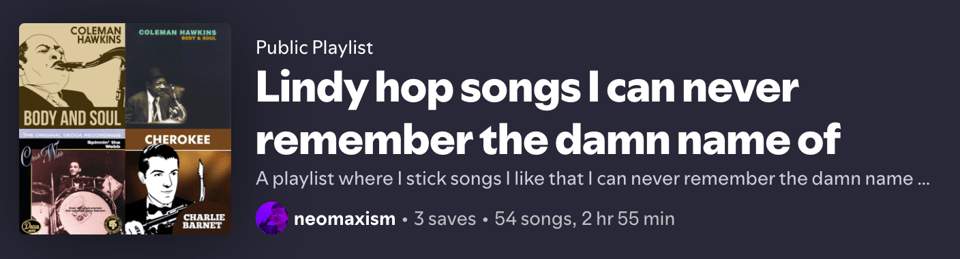
You don’t have to stop using it for discovery, either! I still use streaming to find stuff I like, and I still bookmark songs on streaming platforms so I remember to go back and get them in hard copy.
Go slowly
Building a library is a task that’s never finished, and it takes time. Create a cadence for yourself: once a month (or once a week, or whatever you can handle), pick one album (or ten songs, or two albums, etc) to download.
Practice cataloguing that music: where does it live on your computer or tablet? I use an iTunes clone called Swinsian, but other people I know just have folders in Finder (or whatever it’s called on Linux or Windows etc) that they feed to their DJ software. On Swinsian, I have bucketed folders in ranges of 20 BPM, all the way up to 300+.
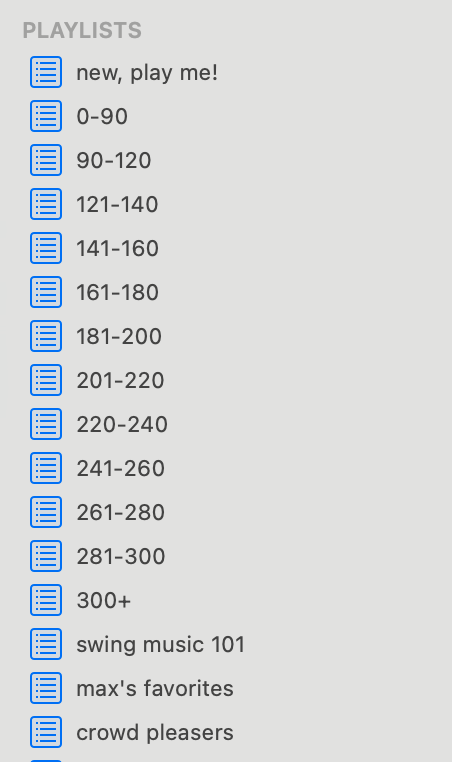
Then, add some metadata to it. Find its BPM (everyone I know does this manually, track by track, and I just use a simple tap to find website), and as you’re listening, add a note if you want. Is the intro long? Is there a weird solo? Is there talking on the track? Is it a banger?
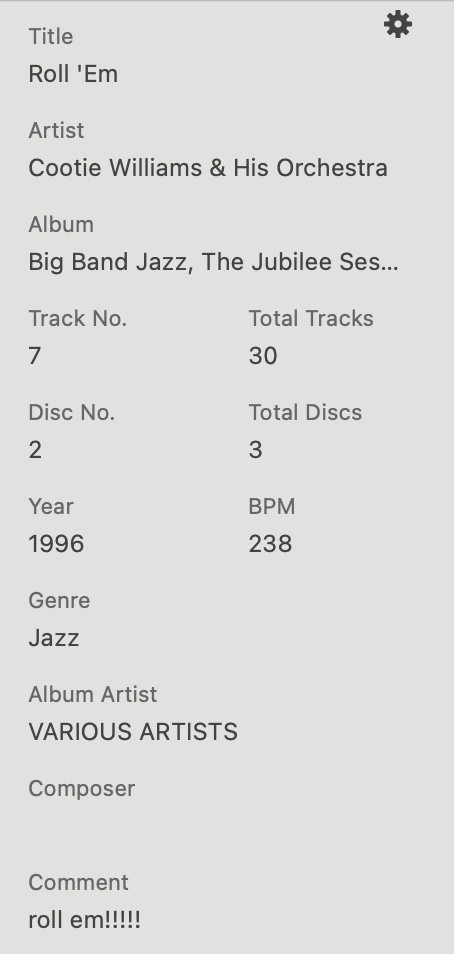
This helps you get to know the music you have. If you end up being a voracious collector (like me and most DJs I know), you don’t have to limit your downloads, but set aside some time for yourself (especially when you’re starting out) on a regular basis to just sit down and spend time with your music.
Vary your avenues
You should always pay for music from living artists, especially artists that play in the lindy hop community. Buy new stuff and stuff from the twenty-first century off Bandcamp when you can, and off another digital media platform like Apple Music when you can’t.
But much of swing music is very, very old, and there are a lot of ways to be thrifty about getting the classic stuff. In college, my club shared a Dropbox full of the classics, so people could have something to get started with. There used to be a website that just hosted jazz music available for download, hosted out of the goodness of a bunch of jazz aficionados’ hearts and vinyl collections (it’s down now, because the person hosting it died. But that library has been preserved—ask me about it!), and countless DJs I know built the fundamentals of their library this way. I personally think it’s OK to ask DJs you know to share a few of the basics, especially within a local scene where you’re just trying to get started. Be prepared for a no and take it gracefully, but in my experience this has happened rarely. There’s also the classic internet way of obtaining files on the internet without paying for them.
You can also get old(er) school with it: get a CD drive off Marketplace or eBay from Best Buy, and check out CDs from the public library, or go to any used record store with a CD section. Swing CDs are really cheap (like, $2-$10 cheap), and the CD drive will quickly pay for itself.
It’s all investment
Music has, for most of the history of recorded music, cost money to obtain; we’re just living in a time where corporations want you to believe things cost less labor, time, and money to produce than they actually do, so you’re okay with incredible amounts of exploitation on their part. They’re also invested in you not owning anything, so they can take it away any time and charge you more to access it. But buying music digitally has actually stayed pretty stagnant in price from when I first bought Death Cab for Cutie’s 2005 album Plans on iTunes 20 years ago, and secondhand CDs are a steal.
Yes, some of this stuff costs money: I paid for my iTunes clone, some people pay for their DJ software, it costs money to pay for music, if you get a lot of music, it costs money to get an external hard drive. You are investing in your own expertise.
How to make DJing live less scary
Use playlists—just not like that
As you develop your library, I find it useful to develop playlists of types of music—Shelby’s post about DJing includes great tips about having a “bangers” playlist to pull from whenever you just need to get people on the floor. I have playlists like “Max’s favorites,” “crowd pleasers,” and “Swing music 101” for this purpose. This isn’t rocket science: every DJ has these kinds of playlists. I also try to keep my playing fresh by putting my favorite tracks from stuff I just downloaded into a “new—play me!” playlist.
It’s also fine, especially early on, to create buckets of stuff you think you might want to play. I keep a playlist of stuff I want to play at BalHaus, the balboa venue here, because I get to play fast songs so rarely that I want to use that opportunity when I have it. When I’m DJing that night, I’ll visit that playlist to see if anything fits the mood of the room. And sometimes if it’s been a while since I’ve DJed the weekly dance, I’ll make a playlist of stuff I’ve been jamming on, to remind myself to play those songs if the opportunity arises.
All of these playlists are idea buckets, not set lists, and they’re made with the knowledge that I might not play much or anything from them on any given night. They’re generally organized by BPM or artist or whatever is most useful. They’re for inspiration, not prescription.
Have a way to preview your songs
Ask a more gear-focused DJ about sound cards and DJ software [a writer’s note: I linked to Dan Newsome’s classic blog post about DJing there, and in doing so I discovered it’s a victim of link rot. Folks, we gotta prepare for lindy hop blog link rot]. I’m a little barebones about this; I’m working on it but it’s slow progress. I have a simple DJ software that my laptop plugs directly into, and then I preview my songs on Swinsian with my AirPods. When something’s not working and I have to DJ off Swinsian, I pull up a streaming platform on my phone and preview that way.
Get to know your library
I am of the radical opinion that DJs should love swing music and be listening to it for pleasure. You should want to get to know your library because theoretically you love this music and want to know it deeply. It also pays off to listen to it a lot, so that if there’s an emergency situation and you can’t preview your stuff, you know enough songs that you don’t necessarily always have to.
Don’t be afraid to mess up
If one song rolls into another song on accident, or your sound cuts out, or you blare over the emcee doing announcements—it’s OK! It’s happened to literally every DJ in the world. With practice, it’ll happen less.
And if you play a song you think is gonna kill and the floor just clears out, that’s OK too! Take note of that, but don’t let it weigh you down. Pull out a banger from your bangers playlist and move on. With experience, that will happen less, too.
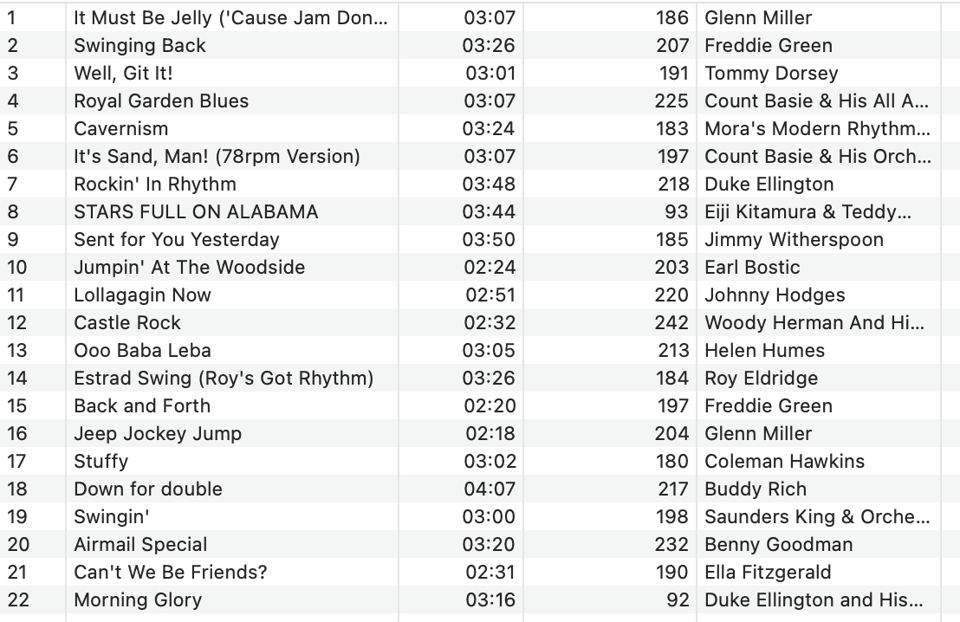
Thank you for reading! I am always happy to talk music, because I love it. Also, hire me! Here’s a set list from the last BalHaus I DJed.
You just read issue #12 of First Alternate. You can also browse the full archives of this newsletter.