The FOMC decides at 2 PM ET with a 25-basis-point hike to 3.75-4.00% fully priced in; the real signal is whether the dot plot shows rates staying above 4% through 2027, locking in higher mortgage and credit-card costs for another year.
▸
Global sovereign yields surged in July, Japan +27bp, Germany +21bp, UK +19bp, while U.S. financial conditions (NFCI -0.56) and volatility (VIX 17) stay eerily calm; that divergence resolved violently in 1994, 2013, and 2018.
▸
Saudi Arabia's East-West pipeline remains shut after drone strikes, removing up to 5 million bpd that bypassed the Strait of Hormuz; combined with Houthi control of the Bab el-Mandeb, roughly 12% of global oil trade now faces dual chokeholds.
The big story
The Federal Reserve concludes its two-day meeting at 2 PM ET today. Futures price a 92% chance of a 25-basis-point hike to 3.75-4.00%, the first increase since July 2023, but the move itself is the least interesting part. What matters is the dot plot and Chair Kevin Warsh's 2:30 PM press conference. The June dot plot had the median rate at 3.8% for year-end 2026. If the September median jumps above 4.0%, several strategists expect 4.1% or higher, the Fed signals not just one hike but a sustained "higher for longer" stance that keeps mortgage rates above 6.75% and credit-card APRs north of 22% well into next year.
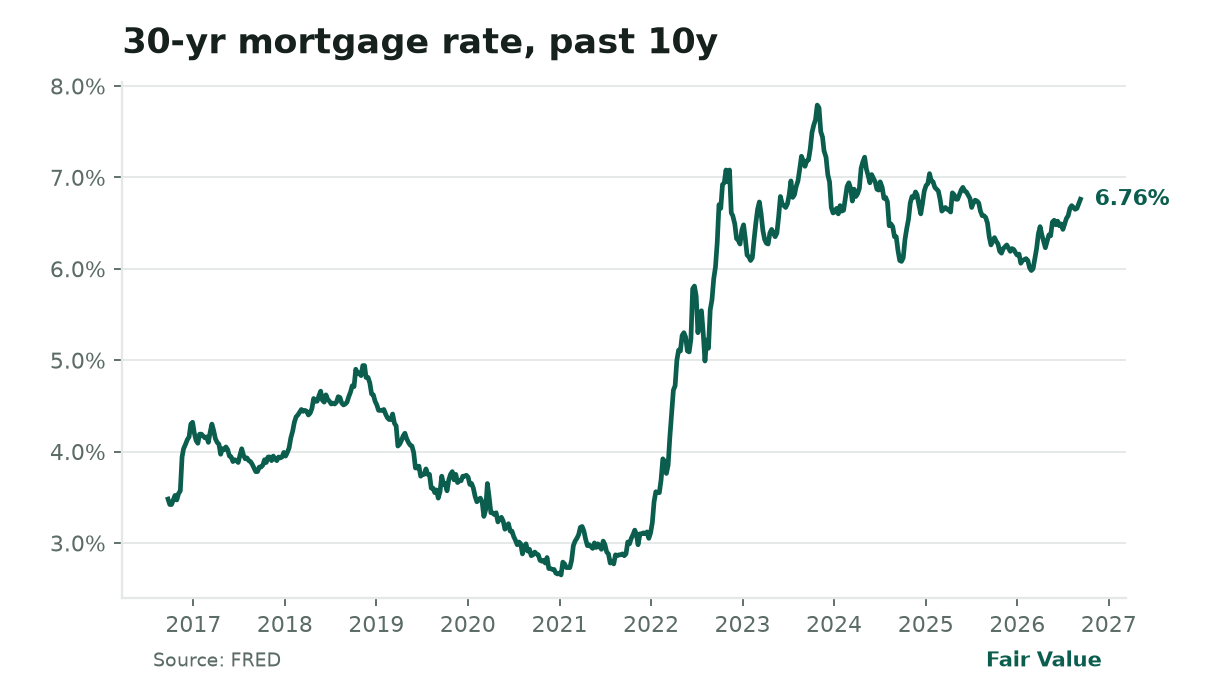
Mortgage rates at 6.76%, near the 2022 peak. The 10‑year line shows rates climbing from about 3.5% in early 2020, spiking to a 7.2% high in November 2022, then falling back before rising again to 6.76% today, the highest level since that 2022 peak, when home‑building permits dropped sharply.
This isn't happening in a vacuum. While the Fed held policy at 5.25% through July, the rest of the developed world tightened: the ECB hiked to 2.5% deposit rate on September 9, the Bank of Japan is expected to raise to 1.25% tomorrow, and the Bank of England meets Thursday with inflation at 3.1%.
In July alone, Japanese 10-year yields jumped 27 basis points to 2.94% (highest since 2011), German Bunds rose 21bp to 3.18% (2011 highs), and UK gilts climbed 19bp to 4.99% (2008 highs). This synchronized global duration selloff, investors worldwide demanding more compensation to hold long-term bonds because inflation proves sticky (core PCE 2.7%, services/shelter elevated) and energy stays bid (Brent $107), is transmitting to U.S. assets through two channels.
First, the dollar: DXY at 99.66 on wider rate differentials (Fed 5.25% vs ECB 2.25%) tightens financial conditions for emerging markets and U.S. multinationals. Second, the term premium: the 10-year/2-year spread has compressed to 33bp from 39bp as long yields rise faster than shorts, a bear-flattening that historically pressures equity multiples. Yet the NFCI sits at -0.56 (easing) and VIX at 17.1 (below average).
This divergence, global bond stress vs. U.S. risk complacency, is the widest gap in this cycle. The housing market is already feeling it: 30-year mortgages at 6.76% have starts at 1.24 million and permits at 1.43 million signaling a cautious forward pipeline. Energy stocks (EOG +3.5%, COP +3.3% Tuesday) are the only equity sector benefiting, confirming the oil→inflation→rates→energy equity loop is live.
What's going on today
Markets open with S&P 500 futures up 1.1% and Nasdaq futures up 1.5% after Tuesday's session saw the broad indexes slip, S&P 500 down 0.45%, Nasdaq 100 down 0.65%, while energy rallied 2.2%. The 10-year Treasury yield sits at 4.97%, just off the 5% level it briefly kissed Tuesday (a 2007 high).
Brent crude eased to $107.68 after four-month highs, but the structural supply picture hasn't improved: Saudi Arabia's East-West pipeline (4-5% of global supply) has been shut since Friday's drone strikes; Houthi forces seized Perim Island on September 11, tightening control of the Bab el-Mandeb; and U.S. interceptors are being depleted rapidly, 60-70 Patriots and over a dozen THAADs fired against ~20 Iranian missiles in a single attack on Jordan. The geopolitical risk premium in oil is no longer a headline; it's a math problem.
A violent rotation continues under the surface. Coinbase plunged 10.1% to $172.11 as the DOJ alleged Binance customers funneled $1.5 billion to Iran through crypto wallets and Iran-linked exchange CoinEx announced it would cease operations. Software and cloud names sold off, Adobe, Netflix, Oracle, Shopify all -3%, while semiconductors showed mixed signals: Qualcomm +4.2% on the week, but ARM -7.5% and Intel -7.0%. Today's session will test whether the FOMC's language on energy pass-through and the dot plot's 2027 trajectory accelerate or arrest this rotation.
The big picture
The bond market is telling a different story than the equity market. The 10-year yield at 4.97% (up from 4.56% on September 10) and the 30-year at 5.34% reflect a global repricing of term premium. Japan's 10-year at 2.94%, Germany's at 3.18%, and the UK's at 4.99% all hit multi-year highs in August.
This isn't a U.S. story; it's a Japan/Europe/UK story landing on U.S. shores. The Fed held policy at 5.25% through July while these moves happened, meaning the backup in U.S. long yields is imported: foreign investors selling their own sovereign bonds buy U.S. Treasuries as a relative safe haven, but the sheer volume of global duration selling overwhelms that bid.
The yield curve is bear-flattening, the 10-year/2-year spread at 33bp, down from 39bp, which historically signals the market expects tighter policy to slow growth. Yet the NFCI at -0.56 says financial conditions are easing, and the VIX at 17.1 says equity volatility is complacent. This exact divergence resolved via sharp risk-asset repricing in 1994, 2013, and 2018. The housing market is the canary: mortgage rates at 6.76% have already slowed starts to 1.24 million and permits to 1.43 million. Investment-grade credit spreads at 0.81% and high-yield at 2.71% remain tight, but they have almost no buffer if the global term premium backup transmits to U.S. credit.
The dollar sits at DXY 99.66, up 0.9% on the week, supported by the Fed-ECB rate differential. USD/JPY at 155.13 has recovered from Monday's 1.7% yen surge, but the yen's seven-month high earlier this week signaled carry-trade unwinding as the U.S.-Japan rate differential narrows. EUR/USD at 1.1542 is range-bound. Oil-linked currencies are soft: CAD at 1.393, AUD at 0.713, NZD at 0.60, all pressured by the supply squeeze keeping Brent near $108.
Around the world
The Middle East supply disruption has become structural, not episodic. Saudi Arabia's East-West pipeline, 1,200 km carrying 4-5 million bpd to the Red Sea port of Yanbu, was shut Friday after drone strikes from Iraqi territory attributed to Iranian-backed militias. Repairs could take three to five weeks. Saudi Arabia has only five to seven days of stored oil at Yanbu to maintain exports if the pipeline stays down.
Simultaneously, Houthi forces seized Perim Island on September 11, controlling the Bab el-Mandeb Strait where 8.1 million bpd transited in Q2. The dual chokehold, Hormuz effectively closed to commercial shipping, Bab el-Mandeb under Houthi threat, removes roughly 12% of global seaborne oil trade from reliable transit. U.S. Energy Secretary Chris Wright said "substantial volumes" still move through Hormuz (12 million barrels the night of September 13), but tanker insurance costs are rising and shipping lines are rerouting around the Cape of Good Hope, adding 10-14 days and $1-2 million per voyage.
The U.S. is burning through its interceptor inventory defending allies. In a single Iranian ballistic missile attack on Jordan's Muwaffaq Salti Air Base, the U.S. fired 60-70 Patriot interceptors and over a dozen THAADs against ~20 missiles, roughly a week's expenditure at prior conflict intensity.
Iranian warheads now separate into multiple projectiles with varied attack profiles, overwhelming defense systems. By mid-July, U.S. forces had expended ~1,700 Patriots and 200+ THAADs. This depletion rate is unsustainable without ramped production, creating a secondary supply-chain stressor for defense contractors (LMT, RTX) and a strategic vulnerability if conflicts expand.
In Europe, the ECB's September 9 hike to 2.5% deposit rate was unanimous, driven by eurozone inflation jumping to 3.3% in August. Lagarde declined forward guidance, but markets price two more hikes by March 2027. The UK reports August CPI at 3.1% today (forecast 3.1%, prior 2.9%), the Bank of England meets Thursday with a divided vote expected (some members want 4%, most want hold at 3.75%). The euro at $1.154 and pound at $1.347 both face downside pressure from the ECB/BoE tightening cycle narrowing the dollar's yield advantage. Germany's 10-year Bund at 3.18% (up 21bp in July) reflects this restrictive stance.
Japan's BOJ meets tomorrow with a 25bp hike to 1.25% widely priced. Governor Ueda's guidance on the pace of further tightening will matter more than the move itself. The yen at 155.13 has given back Monday's gains, but the 10-year JGB at 2.94% (highest since 2011) signals Japanese investors are repricing domestic duration risk. The Nikkei at 63,923 is down 7.7% on the month, a stronger yen normally compresses exporter margins, but the index rallied 2.1% on September 8 while USD/JPY fell 1.5%, suggesting domestic reflation or foreign inflows are driving Japanese equities, not export competitiveness.
Companies making news
Coinbase crashes 10% as DOJ exposes Iran crypto pipeline. Coinbase fell 10.1% to $172.11 in Tuesday's session after the Department of Justice alleged Binance customers moved ~$1.5 billion to Iran through interrelated digital wallets. The Iran-linked exchange CoinEx simultaneously announced it would cease operations, less than three months after a WSJ investigation spotlighted its role. The double hit, regulatory scrutiny + exchange shutdown, signals a broadening crackdown on crypto's use in sanctions evasion that could pressure the entire digital-asset ecosystem.
Energy stocks lead while software sells off. EOG Resources +3.5% to $153.74, ConocoPhillips +3.3% to $141.22, Occidental +2.8% to $63.52, and Chevron +2.6% to $217.77 all rallied in Tuesday's session as Brent holds near $108. The energy sector (XLE) is up 5.4% month-to-date. Meanwhile Adobe -3.0% to $257.76, Netflix -3.0% to $77.90, Oracle -3.1% to $140.35, and Shopify -3.0% to $129.86 extended losses, the software/cloud rotation that began with AI safety warnings continues.
Qualcomm bucks the chip selloff. Qualcomm rose 4.2% to $187.80 in Tuesday's session, up 7.9% on the week and 15.8% on the month, while ARM fell 7.5% on the week and Intel 7.0%. Qualcomm's smartphone and auto exposure gives it a different revenue mix than pure-play AI compute names, and its valuation (lower multiple) offers a margin of safety as investors question whether unbounded AI capex is priced in.
Thermo Fisher surges on life-science demand. TMO jumped 4.5% to $641.39 in Tuesday's session, up 6.4% on the week and 9.5% on the month. The lab-equipment and diagnostics giant benefits from sustained biopharma R&D spending and the reshoring of critical supply chains, a quiet compounder in a noisy market.
OpenAI eyes $1.2T pre-IPO valuation. The ChatGPT maker is in preliminary talks for a funding round that would value it above $1.2 trillion, up ~41% from its $852 billion March valuation. Annualized revenue passed $40 billion in August. CEO Sam Altman has said an IPO is unlikely before 2027 as the company prioritizes safety work, but investor demand remains ferocious, pushing private valuations higher even as public AI names (NVDA -5.7% on the month) correct.
Apple's new Siri still trails AI agents. iOS 27's Siri overhaul (beta in English, requires iPhone 15 Pro or newer) adds personal context, onscreen awareness, and systemwide app actions. But WSJ reports AI agent apps like Instinct and Muse are "stealing its thunder", the consumer-facing AI race is shifting from voice assistants to autonomous agents that execute multi-step tasks, a paradigm where Apple's walled-garden approach may be a disadvantage.
From Washington
The FOMC statement and dot plot drop at 2 PM ET, followed by Chair Warsh's press conference at 2:30 PM. The August CPI (headline +0.4% MoM, core +0.29% MoM) was described by the WSJ as "warm" and removed "a lot of the guesswork" from this decision. The July meeting had a 9-3 vote to hold, with three dissenters wanting a hike.
Today's unity of vote, and whether the dot plot's 2027 median rises above 4.0%, will signal if the Fed has shifted from reactive to proactive tightening. Warsh's Jackson Hole speech ("inflation is a choice") laid the groundwork for higher-for-longer; the market will parse every word for whether he sees the energy shock as transient or embedding in services/shelter.
Treasury sanctioned Russia's VTB Bank on Monday for facilitating Iran sanctions evasion, the latest turn in the financial-pressure campaign that has Iran's oil exports plummeting and its currency collapsing. The EU adopted its 21st sanctions package against Russia (218 new designations, expanded financial/crypto restrictions). The U.S. also banned imports of Canadian motorcycles, dairy, and alcohol effective September 29, escalating a trade dispute that could disrupt integrated supply chains.
The Fed's balance sheet continues to shrink via quantitative tightening. The effective federal funds rate held at 3.63% through September 14 (per FRED), unchanged for weeks, today's hike will move the target range to 3.75-4.00%, but the effective rate (what banks actually pay) will follow with a lag. The distinction matters: the target is policy intent; the effective rate is what transmits to the economy.
Under the hood
A synchronized global sovereign duration selloff is transmitting into U.S. long rates while U.S. financial conditions remain anomalously easy, a divergence that historically resolves via sharp risk-asset repricing.
Why now: Today's delta confirms JGB 10y +27bp, Bund 10y +21bp, Gilt 10y +19bp in July alone, a coordinated global backup that pushed the U.S. 10y briefly to 5% (2007 highs). Yet the NFCI sits at -0.56 (easing) and VIX at 17.1 (below average), creating the widest gap between global bond stress and U.S. risk complacency in this cycle.
The sharper edge: Professionals are debating whether the VIX/NFCI complacency reflects a genuine soft-landing pricing (inflation falling without recession) or a dangerous lag, the "pain trade" is a sudden NFCI spike to >0 and VIX >25 as the global term premium backup finally transmits to U.S. credit spreads (IG OAS 0.81%, HY 2.71% still tight) and equity risk premia. The 10y briefly kissing 5% may be the line where "higher for longer" becomes "higher forever" for discount rates.
Watch: NFCI turning positive (currently -0.56) or VIX closing >25 would confirm the divergence is resolving; 10y-2y spread inverting (<0) would signal the bear-flattening has become a recession signal.
Worth learning today: Other countries' debt
Yesterday's prediction resolved: The UK Claimant Count Change for August was not in today's data releases, the series hasn't updated since the prior -11.0K. When it does print, remember the mechanism: a rising claimant count signals labor-market slack, which would normally push the BoE toward easier policy (lower rates), pulling gilt yields down and the pound with them. But with UK CPI at 3.1% today (forecast 3.1%, prior 2.9%), the BoE faces a stagflationary bind, weak jobs and hot inflation, which is why tomorrow's vote will be divided.
You see "sovereign debt crisis" in headlines. What does it actually mean for your 401(k)?
Start with a concrete instance: Norway's $2.3 trillion sovereign wealth fund, the world's largest, has proposed cutting its U.S. Treasury allocation from 34.1% to 21.9% of its bond benchmark. That implies selling roughly $80 billion of U.S. Treasuries by early 2027. When a buyer that large steps back, yields rise to attract new buyers. Higher Treasury yields push up mortgage rates, corporate borrowing costs, and the discount rate on every stock in your index fund.
The mechanism: governments borrow by issuing bonds. Foreign central banks, pension funds, and sovereign wealth funds buy them. If Japan's pension funds (the largest foreign holder of U.S. Treasuries) or China's State Administration of Foreign Exchange reduce purchases, because their own aging populations need cash, or their currencies weaken, or they want to diversify, the U.S. must offer higher yields to sell the same debt. Remember the yield-price seesaw from our bond lesson: when yields rise, existing bond prices fall.
Your bond fund's NAV drops. Remember the discount-rate lesson: higher long-term yields mean future corporate earnings are worth less today. Your equity index fund feels it too.
Contagion channels are real. In 1994, a U.S. rate hike triggered a Mexican peso crisis that ricocheted through emerging markets. In 2013, the "taper tantrum" hit India, Indonesia, Brazil, and U.S. equities corrected 5.8% in weeks.
In 2018, Italian budget fears spiked Italian yields, widened European credit spreads, and the S&P 500 fell 19.8% peak-to-trough. The transmission is: foreign sovereign stress → dollar funding strain → emerging-market capital flight → tighter global financial conditions → U.S. risk-asset repricing.
Right now, Japan's 10-year at 2.94% (highest since 2011), Germany's at 3.18% (2011 highs), UK's at 4.99% (2008 highs), all rose 19-27bp in July while the Fed held rates steady. This is a global term-premium backup, not a Fed story. Norway's $80B Treasury sale is a symptom: the world's largest sovereign fund is diversifying away from U.S. government debt toward corporate bonds and MBS. If Japan's GPIF (Government Pension Investment Fund, $1.5T) or China's SAFE follow, the U.S. loses its "buyer of last resort", and yields must rise further to clear the market.
Concept 60 of 83 in the Fair Value course.
Tomorrow's prediction: UK CPI y/y prints at 8:30 AM ET (forecast 3.1%, prior 2.9%). If it comes in above forecast, which way does the 2-year gilt yield move, and why? We'll walk through the mechanism tomorrow.
What to watch this week
▸
Today 2:00 PM ET, FOMC Rate Decision: — 25bp hike to 3.75-4.00% priced at 92%. The dot plot's 2027 median and Warsh's press conference (2:30 PM) matter more than the move.
▸
Today 8:30 AM ET, UK CPI y/y: — Forecast 3.1% vs prior 2.9%. Above forecast = BoE hike odds rise = pound strengthens, gilt yields climb.
▸
Tomorrow 7:00 AM ET, Bank of England Rate Decision: — Hold at 3.75% likely (80% probability), but divided vote expected. Watch for dissenters advocating 4%.
▸
Tomorrow 10:30 PM ET, Bank of Japan Rate Decision: — 25bp hike to 1.25% fully priced. Governor Ueda's guidance on pace of further tightening is the signal.
▸
Friday, University of Michigan Consumer Sentiment (Sept preliminary): — Watch 1-year and 5-year inflation expectations. If they re-anchor, the Fed's job gets easier; if they drift up, "higher for longer" gets harder.
Not financial advice. This brief is for informational and educational purposes only and does not constitute investment advice or a recommendation to buy or sell any security.
Data: macro indicators per FRED® (Federal Reserve Bank of St. Louis); not endorsed or certified by the Federal Reserve Bank of St. Louis. Energy data per the U.S. Energy Information Administration (EIA). Auction data per U.S. Treasury Fiscal Data. Filings per SEC EDGAR. Market prices per Yahoo Finance. Earnings calendar per Financial Modeling Prep.