Britain deploys fighter jets to Saudi Arabia after new tanker attacks in the Strait of Hormuz, two vessels struck in 48 hours, Iran's exclusion zone enforced by naval mines, and a G7 power puts combat aircraft into the theater.
▸
The five largest hyperscalers spent $586 billion on AI infrastructure in the trailing year, 83% of operating cash flow, and free cash flow collapsed 38% to $121 billion, the "megacap cash fortress" narrative underpinning index valuations just broke in the reported numbers.
▸
Markets price an 80% chance the Fed holds rates October 27-28 but a near-certain 25-basis-point hike December 8-9, 10-year real yields have fallen to 2.78% from 2.92% three weeks ago, even as core CPI runs 2.57% and core PCE 3.01%, because the bond market is hedging growth risk more than inflation.
The big story
Britain is sending fighter jets to defend Saudi Arabia. The UK Ministry of Defence confirmed the move overnight, reported by the Washington Post and Wall Street Journal. Two oil tankers were attacked in the Strait of Hormuz in the past 48 hours, one struck by unknown projectiles, the other by naval mines, per the Wall Street Journal and AP News.
Iran has stated security in the Strait will not normalize while the broader conflict continues. This is not another round of Houthi drone strikes on southern Saudi facilities; it is a declared exclusion zone backed by mining, and now a G7 power is putting combat aircraft into the theater.
The market's first reaction shows in oil: Brent futures climbed 1.2% overnight to $110.06, and dated Brent spot, the price refineries actually pay for barrels delivered now, was last recorded at $126.55 on October 14, a $16.50 premium over futures. That backwardation is the steepest in months.
Physical barrels are scarce today, not in some theoretical future. Every tanker transiting Hormuz now carries a war-risk insurance surcharge brokers say exceeds one-third of the cargo's value. That surcharge is a non-monetary tax on global trade, it feeds directly into diesel, jet fuel, and petrochemical costs, and from there into core CPI and core PCE.
The second-order effect most coverage misses: the dollar. The broad trade-weighted dollar index sits at 121.4, a cycle high. When oil is priced in dollars and the world needs dollars to pay for suddenly more expensive energy, the dollar strengthens even if the Fed pauses.
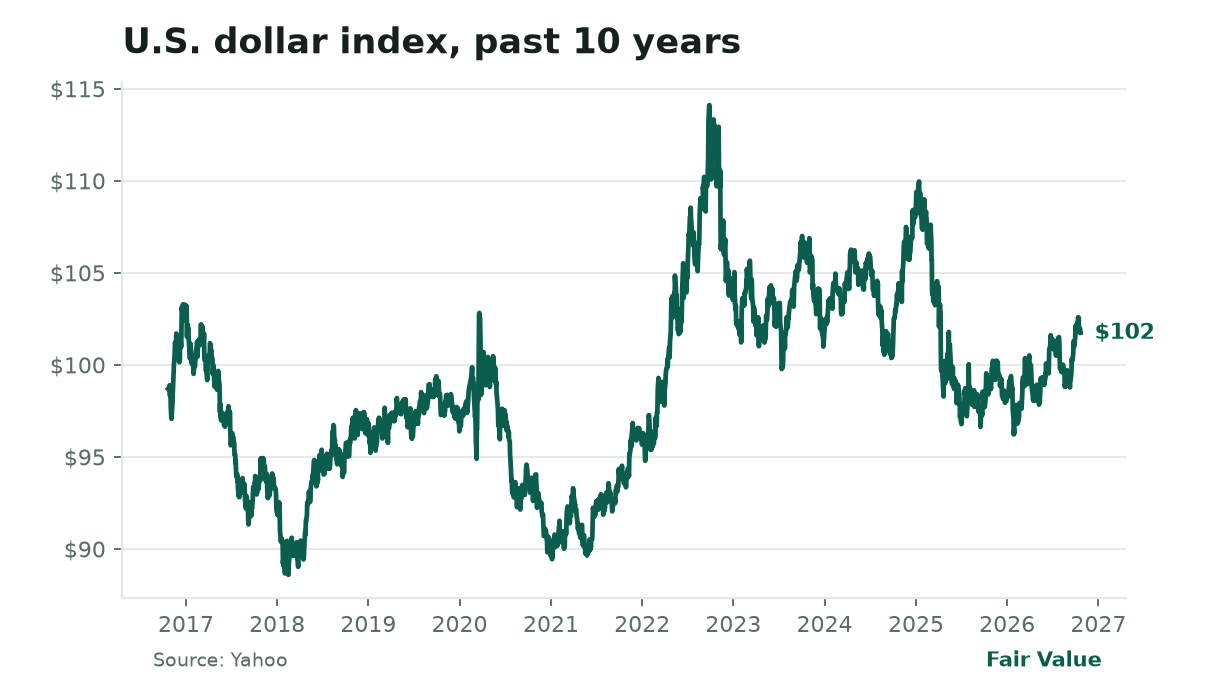
Dollar hits cycle high. The index sits at 121.4, its highest since March 2024 when it briefly reached 122.5, and well above the sub‑115 levels that dominated 2020‑22.
That tightens financial conditions globally, emerging-market borrowers roll dollar debt at higher rates, multinational earnings get compressed on translation, and the Fed's own "higher for longer" stance gets reinforced by a channel it doesn't control. The 10-year Treasury yield ticked up 6 basis points to 5.15% Tuesday; the 10-year/3-month spread is 0.86 percentage points. The curve is flattening, not steepening, because the bond market sees the growth drag from energy costs outweighing the inflation impulse.
For a normal person: gasoline and diesel prices at the pump have a new floor. Heating oil has already jumped 70% in some Northeast markets per The Bridge. If you're renewing a mortgage, the 30-year rate at 7.4% isn't coming down while this risk premium persists. And if you hold a 401(k) heavy in S&P 500 index funds, the energy sector (XLE) just hit a new 52-week high, but the same index is also carrying the hyperscalers whose free cash flow just collapsed.
What's going on today
Overnight, S&P 500 futures edged up 0.1%, Nasdaq-100 futures rose 0.4%, and Dow futures were flat. The VIX sits at 17.4, down from Monday's 20 but still above the 16.5 level that prevailed for weeks. Bitcoin trades at $83,500 (+26% in three months but still 33% below its October 2025 peak), Ether at $2,463 (+27% in three months, 50% below its August 2025 high), and Solana at $107, today is the scheduled activation of its Alpenglow upgrade, which aims to cut transaction finality to ~150 milliseconds from six seconds.
The UK CPI report lands at 8:30 AM ET (forecast 3.4% year-over-year, up from 3.1%); New Zealand CPI follows at 1:45 PM ET (forecast 0.8% quarter-over-quarter, down from 1.5%). After the close, Meta, Tesla, Lam Research, SAP, and Texas Instruments report earnings, the first real test of whether AI capex is translating into revenue or merely accumulating debt.
The big picture
The 10-year Treasury yield at 5.15% and the 2-year at 4.77% leave a 33-basis-point spread, the curve is modestly steep but flattening on the week. The 10-year/3-month spread at 0.86 percentage points is the bond market's clearest signal: it expects restrictive policy to persist but growth to slow. High-yield spreads at 3.29 percentage points (OAS) are elevated but not distressed; investment-grade spreads at 0.87% are tight, meaning the corporate bond market sees no credit crisis yet.
The dollar's broad index at 121.4 and DXY at 101.8 reflect the "dollar smile" in its right-side regime: strong U.S. growth and geopolitical safe-haven demand both push the dollar up. USD/JPY at 158.1 holds near the 158 level where Japanese intervention risk rises, the BOJ's Himino signaled readiness to raise borrowing costs Wednesday, and the 375-basis-point Fed-BOJ differential sustains the carry trade.
Oil is the bridge between geopolitics and inflation. WTI fell 2.6% Tuesday to $99.13 on headlines about U.S.-Iran diplomacy, but Brent held near $110 because the physical market, dated Brent at $126.55, tanker insurance at record multiples, prices the Hormuz risk that paper markets keep discounting.
U.S. crude stocks at 415.6 million barrels (week ending October 9) are 10-15% above the five-year average, and refinery utilization at 93.5% is near historic peaks, so domestic supply is not the issue. The issue is that every barrel leaving the Gulf now carries a war-risk premium that futures don't fully capture. Gold at $4,139 is 22% below its January high but holding, it's acting as a dollar hedge, not an inflation hedge.
Equities: the S&P 500 at 7,713 is 1.4% below its all-time high; the Nasdaq-100 at 29,490 is 5.5% off its peak. The Russell 2000 jumped 1.6% Tuesday to 2,773, and Brazil's BOVESPA rose 1.6% to 208,296, small caps and commodity-exporting EM are leading, not mega-cap tech. The semiconductor ETF (SOXX) is 23.6% below its June high; the software ETF (IGV) is up 16.5% in three months. Health care (XLV +2.4% Tuesday, +6% on the month) and staples (XLP +4.2% on the week) are the quiet leaders, defensive sectors outperforming while yields stay above policy rates.
ETF inflows drive crypto rebound but leverage stays low. The three-month rally, SOL +37%, ETH +27%, BTC +26%, IBIT +24% to October 21, was led by $10.2B of net US spot ETF inflows in Q3 2026, the first positive quarter in a year, though October flows swung from ~$750M of outflows through October 16 to a $527M inflow on October 19, leaving a 13-day net of just -$88M. Stablecoin supply at $304B on October 20 remains $16.6B below its May 2026 peak and flat year-over-year, signaling no fresh on-chain liquidity.
Perpetuals structure shows funding rates rising (BTC +11% annualized, ETH +9.4%) while open interest falls (BTC -11.8% in coins, ETH -2.7% since September 21), indicating short-covering on reduced size rather than new leveraged longs; BTC perp OI at ~$7.8B is 16.5% below pre-crash averages versus $92B at the October 2025 top.
Macro is stable but tight: Fed funds 3.75-4.00%, 10-year real yield ~2.1%, DXY 101.7. The SEC's "Regulation Crypto Assets" comment period closed October 20 with ~140 submissions proposing registration exemptions and a safe harbor, a shift from enforcement to rulemaking. For the rally to extend, ETF flows must turn sustainably positive and stablecoin supply must grow; a reversal would likely require renewed ETF outflows, a leverage rebuild toward 2025 levels, or a macro shock.
Around the world
UK inflation jumped to an 11-month high in September, with headline CPI expected at 3.4% year-over-year (up from 3.1%) when the data releases at 8:30 AM ET. The Bank of England is now openly considering a rate hike, Governor Bailey has said the energy-price pass-through from Middle East disruptions could keep services inflation sticky.
The pound has strengthened to $1.339, and gilt yields at 5.24% are the highest in the G7. In Japan, BOJ board member Himino signaled readiness to raise borrowing costs, and the 10-year JGB yield at 3.05% is at multi-decade highs. The yen at 158.1 per dollar is in the intervention zone; MUFG warns intervention risk offsets trade pressure, but the 375-basis-point rate differential with the Fed keeps the carry trade alive.
The European Union adopted its broadest sanctions package yet on Russia, 1,569 individuals and entities, including 826 companies and 743 CEOs, targeting the military-industrial supply chain. Simultaneously, the Trump administration paused new Russia sanctions for a 60-day review, citing national interest. The divergence creates uncertainty: EU sanctions tighten the screw on Russian war production, while the U.S. pause could allow sanctions evasion through dollar-clearing channels. In Ukraine, Russian missile and drone strikes killed four overnight as Zelenskyy seeks help in Norway; the Kremlin's "new doctrine" of targeting civilian energy infrastructure continues.
China announced tariff cuts on U.S. farm goods (corn, wheat, beef, pork) but excluded soybeans, the largest agricultural export by value. Taiwan accused Beijing of using the October 12 sanctions to influence domestic elections. Meanwhile, Chinese chip exports surged 136% year-over-year to $45 billion in Q3, driven by AI-related demand.
The PBOC nudged the yuan fix slightly stronger at 6.6779 vs. 6.7200 prior. In energy, the UK approved a natural gas project off Scotland despite environmental objections, and Cumberland County supervisors approved a massive gas-fired power plant in the U.S., both signals that gas-fired baseload is still being built to backstop intermittent renewables and data-center demand.
Companies making news
SpaceX and Tesla formed merger committees. Elon Musk confirmed preliminary talks to combine the two companies he controls, calling it "a lot of merit." SpaceX reported earnings Tuesday projecting $500 billion in annual revenue, a figure that assumes Starlink saturation and Starship launch cadence that don't exist yet. If a merger happens, Tesla shareholders get a space-internet business with no public comps; SpaceX shareholders get an auto manufacturer with declining margins. The Nasdaq would gain a combined entity worth ~$2 trillion; index funds would buy it automatically.
Meta reports after the close. Consensus expects EPS of $6.54 on $63.3 billion revenue. The real question: capital expenditure guidance. Meta's TTM capex is $89 billion (+71% YoY), 39% of revenue. If they guide higher, the FCF hole deepens; if they guide flat, the market may read it as AI infrastructure saturation.
Tesla reports after the close. Consensus EPS $0.45 on $28.1 billion revenue. Margins are the watch item, automotive gross margin has compressed to ~18%, and FSD (Full Self-Driving) revenue recognition is the swing factor. Musk's merger comments may dominate the call.
Adobe surged 3.9% Tuesday to $256.73, extending a week-long rally (+8.7%). The move came on no company-specific news, it's a short-covering bounce after the stock fell 45% from its 52-week high. Creative Cloud ARR growth has decelerated to 11%; the market is pricing a trough.
General Electric fell 3.7% to $299.87. after missing EPS ($1.66 vs. $2.02 estimate) and guiding 2027 free cash flow below consensus. The aerospace cycle is still up (shop visits rising), but the margin bridge is slipping on supply-chain costs.
Eli Lilly rose 3.5% to $1,283.66, passing its prior 52-week high. Mounjaro/Zepbound demand remains the story, weekly prescription data shows no saturation. The stock is up 22.8% in three months (z-score +2.27, 99th percentile), the rare large-cap pharma name acting like a growth stock.
Health care broadly led: UnitedHealth +3.0% (week +11%), Merck +3.2%, Novartis +7.9% on the week, AstraZeneca +8.3% on the week. The XLV health care ETF rose 2.4% Tuesday and 6% on the month. Defensive earnings visibility + demographic tailwinds + GLP-1 drug cycle = the sector behaving like a bond proxy with growth optionality.
ARM fell 3.1% to $221.06, down 31.5% in a month. The SoftBank-owned chip designer is caught between the AI capex boom (it licenses cores to Nvidia, Apple, cloud vendors) and the smartphone cycle trough. Royalty revenue is recurring but growth is tied to unit volumes that aren't accelerating.
Defense stocks retreated. The Wall Street Journal noted smaller defense names have fared worse, L3Harris, Leidos, and Curtiss-Wright are down 10-15% from recent highs. The thesis: a potential Trump administration would audit Pentagon spending, and the Saudi "Davos in the Desert" cancellation signals Gulf defense budgets may plateau.
From Washington
The Fed's reaction function is the only game in town. The September 25-basis-point hike (first since 2023) brought the target range to 3.75-4.00%; effective fed funds sits at 3.88%. Since then: headline CPI accelerated to 3.72% (energy), core CPI 2.57%, core PCE 3.01%. September payrolls rose only 29,000 vs. 90,000 expected with downward revisions, yet unemployment holds at 4.2% and initial claims at ~199,000. The Fed's own minutes (October 7) said commodity spikes alone don't automatically trigger hikes, but AI data-center capex ($586 billion TTM, +84% YoY) is now cited by officials as adding to input-cost pressures.
Market pricing has shifted: October hold probability rose to ~80% (from ~85% a week ago), while December hike odds remain near 90%. The 10-year real yield fell to 2.78% from 2.92% on October 2, the bond market is hedging a growth scare, not an inflation scare.
The easing bar is core PCE sustainably →2.5% or unemployment →4.5%. The hike bar is core CPI/PCE >2.5% month-over-month annualized with resilient growth. November 6 jobs and November 13 CPI (October data) are the next hard gates.
Housing data Tuesday: starts fell to 1.221 million annualized in September (from 1.275 million), permits held at 1.400 million. The 180,000-unit gap between permits and starts is a pipeline cushion, but with 30-year mortgages at 7.4%, new-home sales at 684,000 annualized (40% below the 12-month average), and builders permitting more than they can sell, inventory build-up risk rises into 2027. The mortgage spread over the 10-year is 230 basis points (7.4% vs. 5.15%), the widest in decades.
Under the hood
Hyperscaler AI capex is consuming 83% of operating cash flow, collapsing free cash flow 38% YoY and forcing a structural repricing of megacap equity quality.
The chain: frontier AI breakthroughs (GPT-5.5's 400k-token context, autonomous planning; Nvidia-backed 67% compute-cost cuts) drive a capex supercycle → the five hyperscalers (MSFT, GOOGL, AMZN, META, ORCL) generated $507B operating income on $1,853B revenue (TTM to Aug 2026) but deployed $586B in capex, 31.6% of revenue, 82.9% of operating cash flow. Free cash flow fell to $121B from $196B a year earlier (-38%). This is the first time post-2010 that megacap tech runs a collective FCF deficit while ramping investment.
Second-order effects the market hasn't priced: (1) Net equity supply rises as buybacks shrink, the S&P 500's largest weight cohort historically retired 2-3% of shares annually; that bid is disappearing. (2) Investment-grade corporate bond issuance must absorb the funding gap; IG OAS at 0.87% offers almost no concession for incremental supply. (3) The productivity payoff is uncertain and lagged, inference is 10-20x less compute-intensive per dollar of revenue than training, but revenue attribution remains opaque. Meanwhile, semis (SOXX -23.6% from 52-week high) price infrastructure cyclicality; software (IGV +16.5% 3m) prices application-layer recurring revenue. The divergence says the market doubts infrastructure ROI but believes in the application moat.
At Shiller CAPE 40.9 (99th percentile) and megacap forward P/E 21.8x, the valuation buffer for an FCF disappointment is near zero. The sharper edge: professionals debate whether this is a new structural regime (AI as general-purpose technology requiring railroad-scale buildout) or a transient over-investment cycle (Cisco 2000 analog).
The test: do operating margins inflect as workloads shift from training to inference? If combined FCF doesn't turn positive by Q1 2027 (vs. $121B TTM), the buyback bid vanishes and IG spreads widen 30-50bp. Watch the SOXX/IGV ratio, sustained below 0.8 confirms the market has written off infrastructure ROI.
The long view: What is the Fed doing and why, what is it reacting to, and what does the market price for the next meetings?
See From Washington above for the Fed's reaction function, current pricing (80% October hold, firm December hike), and the hard gates ahead (Nov 6 jobs, Nov 13 CPI, Dec 8-9 FOMC). The 10-year real yield at 2.78% confirms bonds are hedging growth risk, not inflation.
Worth learning today: Moats, the durability test, not the width test
You've heard "moat" used as shorthand for "good business." The deeper question: what makes a moat survive a regime change?
Network effects look impenetrable until a new protocol makes them irrelevant (ask MySpace). Switching costs feel high until a platform shift resets the baseline (ask on-premise software vendors). Brands endure until trust breaks (ask Boeing). Scale advantages compound until fixed costs become stranded assets (ask Intel's foundry model).
The real test isn't width, it's adaptability. A moat that requires the world to stay the same is a trap. The moats that survived 2000, 2008, 2020, and 2022 share one trait: the company reinvested its moat rents into building the next moat before the old one eroded.
Microsoft's Windows moat funded Azure. Google's search moat funded Android and Cloud. Amazon's retail moat funded AWS. Meta's social moat is funding Reality Labs, the jury's out on that one.
Today's hyperscalers are running the same play: AI capex is the reinvestment of cloud/search/social moat rents into the next platform. The FCF collapse is the cost of that transition. The question isn't whether they have moats, it's whether they're building the next one fast enough to justify the cash burn.
Quick check: Why would a company with a wide moat choose to run negative free cash flow? Because the return on the new investment exceeds the return on defending the old moat, but only if the new moat materializes.
Tomorrow's prediction prompt: New Zealand CPI q/q releases at 1:45 PM ET (forecast 0.8%, prior 1.5%). If the print comes in above forecast, which way does the 2-year New Zealand government bond yield move, and why? We'll walk through the answer tomorrow.
What to watch this week
▸
Wednesday, Oct 21 — , UK CPI y/y (8:30 AM ET, forecast 3.4%, prior 3.1%): Bank of England hike signal if energy pass-through keeps services sticky.
▸
Wednesday, Oct 21 — , NZ CPI q/q (1:45 PM ET, forecast 0.8%, prior 1.5%): RBNZ policy hinge; a hot print revives hike bets.
▸
Wednesday, Oct 21 — , Meta, Tesla, Lam Research, SAP, Texas Instruments earnings (after close): AI capex vs. revenue test.
▸
Thursday, Oct 22 — , US initial jobless claims (8:30 AM ET): claims ~199k; any move toward 250k shifts Fed easing odds.
▸
Friday, Oct 23 — , S&P Global flash PMIs (9:45 AM ET): manufacturing/services composite; sub-50 = contraction.
▸
Monday, Oct 26 — , New home sales (10:00 AM ET): August 684k annualized; mortgage rate 7.4% is the choke point.
▸
Tuesday, Oct 27 — , FOMC meeting begins (2-day): 80% priced for hold; watch dot-plot median and "meeting-by-meeting" language.
▸
Wednesday, Oct 28 — , FOMC statement + Powell press conference (2:00 PM ET): the December hike signal lives or dies here.
▸
Thursday, Oct 29 — , Q3 GDP advance estimate (8:30 AM ET): consensus ~2.3%; AI capex shows in equipment investment.
▸
Friday, Oct 30 — , Core PCE price index (8:30 AM ET): Fed's preferred gauge; Aug 3.01% y/y; Sep print sets Dec hike probability.
Not financial advice. This brief is for informational and educational purposes only and does not constitute investment advice or a recommendation to buy or sell any security.
Data: macro indicators per FRED® (Federal Reserve Bank of St. Louis); not endorsed or certified by the Federal Reserve Bank of St. Louis. Energy data per the U.S. Energy Information Administration (EIA). Auction data per U.S. Treasury Fiscal Data. Filings per SEC EDGAR. Market prices per Yahoo Finance. Earnings calendar per Financial Modeling Prep. Crypto data per Binance and CoinGecko. World events per GDELT, WSJ, Reuters, AP, Bloomberg, and other cited outlets.