The Fed meets today and tomorrow with rates at 3.75-4.00%, markets price a 91% chance of a hold, but an 84% chance of a December hike. Your mortgage, car loan, and credit-card APR stay elevated; the December meeting is the real pivot point.
▸
Natural gas surged 17% to $3.04/MMBtu while oil fell 4% to $111. Gas prices reflect a physical winter squeeze, low European storage and heating demand; oil prices reflect a dollar-driven demand scare. The Fed's core PCE at 3.01% captures neither.
▸
Brazil's BOVESPA crashed 13.9% as the real tumbled on fiscal fears. A strong dollar (broad index 121.3, near multi-decade high) exports U.S. tightness, emerging markets feel it first, but transmission hits U.S. multinationals' earnings and your 401(k) next.
The big story
The Federal Open Market Committee convenes this afternoon for a two-day meeting that will almost certainly leave the target range at 3.75-4.00% (91% probability). The meeting is a sideshow. The main event is what the statement, dot plot, and Chair Powell's press conference signal about December and 2027.
Here is the tension most coverage misses: core PCE ran at 3.01% year-over-year in August, a full point above the 2% target. Core CPI sits at 2.57%. Unemployment is 4.2%, payrolls grew just 29,000 in September, GDP tracks below 2%.
In a normal cycle, the Fed would be cutting. Instead, the September dot plot raised median 2026 and 2027 year-end projections to 4.10%, and futures price roughly 4.6% by October 2027, two more hikes from here.
Why? Three forces the Fed cannot ignore. First, energy: Brent crude climbed 32% in three months to $111, dated Brent spot trades at a $12 premium to futures, signaling physical scarcity. Second, AI capex: five hyperscalers spent $601 billion trailing year, 83% of operating cash flow, pulling forward demand for chips, power, construction.
Governor Waller estimates this adds 50-70 basis points to long-term yields. Third, the dollar: broad trade-weighted index at 121.3 tightens global financial conditions by an estimated 50-75 basis points without the Fed lifting a finger.
The market bets the Fed threads a needle: hold today, hike in December, then pause. But the bar for easing is high, core PCE sustainably below 2.5% or unemployment above 4.5%. Neither is close. If the dot plot median ticks to 4.35% or language shifts to "further tightening likely," the 10-year yield (5.00%) retests 5.25%, mortgage rates push past 7.5%, and the S&P 500 at 7,677 (Shiller CAPE 40.7, 99th percentile) gets a valuation stress test not seen since 2022.
What's going on today
Markets open with S&P 500 futures up 0.1%, Nasdaq-100 flat, digesting Monday's 0.7% S&P gain to 7,677 on fragile breadth (59% above 50-day MA). The real action: natural gas spiked 17% on storage draw and cold forecasts, while Brent fell 4% to $111 despite Iran closing the Strait of Hormuz and Houthi missiles striking Saudi infrastructure. Oil is priced in dollars; a surging dollar (121.3) makes energy expensive everywhere, crushing demand. Gas is priced in molecules; European storage at 75% vs. 92% five-year average means a physical shortfall no currency move can fix.
Brazil's BOVESPA plunged 13.9%, worst day since 2020, after Lula's victory triggered fiscal panic. The real weakened past 6.0, central bank burned reserves. Nikkei rose 1.7%; Hang Seng slipped 0.7%, Hang Seng Tech dropped 2.1% as China property woes deepen. Stoxx 600 little changed ahead of Thursday's ECB hold at 2.5%.
Earnings kick in: Visa after close ($3.44 EPS), Coca-Cola pre-market ($0.88), Boeing ($-0.25), PayPal ($1.31). Microsoft, Alphabet Wednesday; Amazon Thursday. Hyperscaler trio updates capex guidance, $601 billion annualized, 84.7% of operating cash flow. Anthropic filed for IPO; Broadcom sealed $63 billion debt deal for AI infrastructure, largest such raise ever.
The big picture
The bond market sends a clearer signal than equities. The 10-year yield holds at 5.00% (down 17 bp in five days), 2-year at 4.69%, 10s-2s spread at 31 bp. In every soft landing since the 1990s, falling risk-free yields tighten credit spreads. Instead, high-yield spreads widened from 327 to 338 bp, the cleanest "hard landing" signal since 2022. Chicago Fed NFCI at -0.50 signals accommodative domestic conditions, but ignores the broad dollar at 121.3, which IMF estimates shaves 0.5-1.0 pp off emerging-market growth within a year.
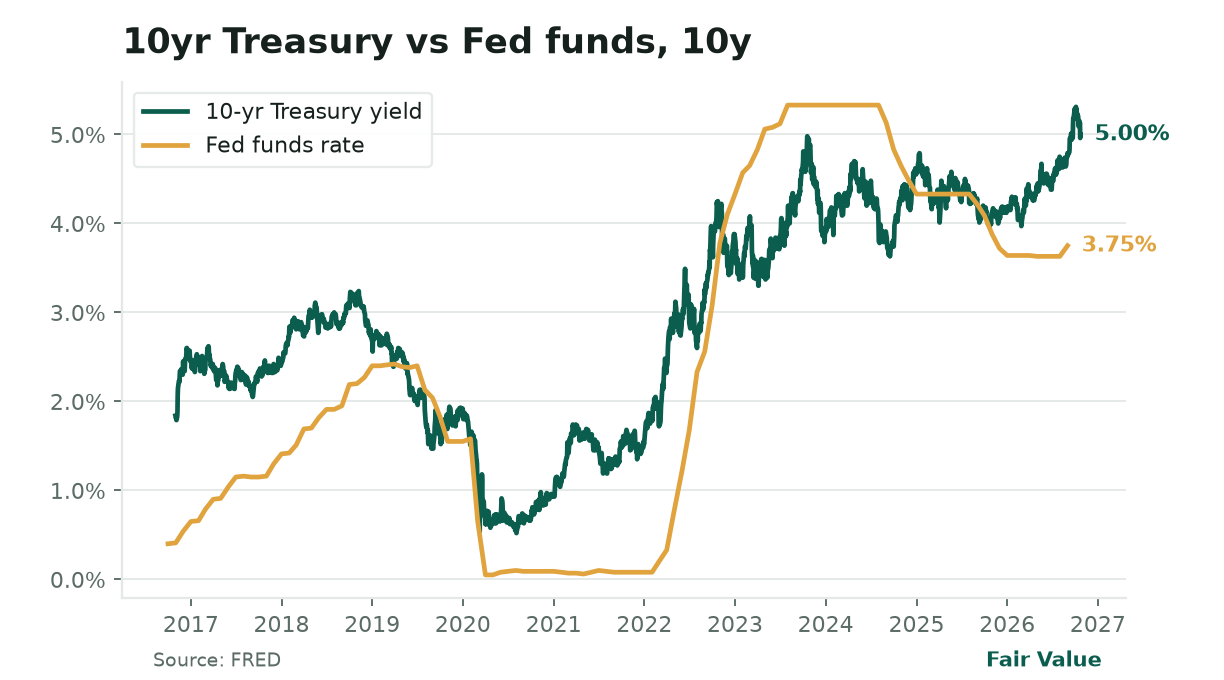
5.00% 10‑yr yield sits above the Fed funds rate. The 10‑yr yield has hovered above 4.5% since 2021, and the last time it was at 5.00% was in 2018‑2019, when the Fed funds rate was 2.25‑2.50% and the economy was in a post‑recession expansion.
Oil's 4% drop looks like a dollar story, not supply. Dated Brent spot at $115.22 still carries $12 premium to futures, VLCC rates doubled to $1.3M/day, Iran's exclusion cut Hormuz transits to ~4 vessels daily from 85. Saudi East-West Pipeline attacked twice in six weeks. OPEC+ meets Sunday; quotas likely unchanged. Physical market screams scarcity; paper market listens to the dollar.
Gold at $4,009 (down 0.7%, up 25% YTD) prices both fiscal and geopolitical risks. Real yields (10-year TIPS 2.65%) normally suppress gold, but central-bank buying and U.S. deficit at $1.99 trillion with interest topping $1 trillion changed the calculus. 10-year breakeven at 2.34% says market trusts the Fed; gold says it doesn't.
Crypto consolidating. Bitcoin $79,545 (-0.5%, -26% from $126,080 peak), spot ETF net outflows $40M over 13 days. Ethereum $2,306 (-0.5%, -53% from peak), Solana $99.6 (-1.1%, -66% from peak). Perpetual funding positive but modest (BTC +0.008%/8hr, ~9% annualized), open interest down 3.7% since late September, deleveraging, not crash.
Crypto rally stalls as ETF flows reverse. Three-month rally lifted Bitcoin 25% to $79,576, Ether 20% to $2,307, Solana 35% to $99.64 by Oct 27, but all remain 30-65% below Oct 2025 highs. Driven by $6.3B net Bitcoin ETF inflows and $3.1B Ether ETF inflows through September, plus regulatory progress (SEC proposed rules Aug 18, OCC stablecoin rule Oct 21, EU MiCA July 1).
Solana's Alpenglow upgrade activated Oct 21. October shows deterioration: Bitcoin ETFs -$443M, Ether ETFs -$225M week ending Oct 26; 13-day net Bitcoin outflow -$635M since Oct 7. Stablecoin supply $302B, flat 30 days, $18.6B below May peak. Binance BTC perpetual funding ~11% annualized from ~7.6% late September, open interest $7.5B well below $92B Oct 2025 peak. Rally cleaner and more institutionally sponsored than 2025 blow-off, but negative ETF flows and rising funding signal fading marginal demand.
Software ETF rallies on hyperscaler AI spend but remains below 2025 peak. IGV surged 23% in three months to 111.4, led by Microsoft +37%, ServiceNow +50%, Salesforce +43%, all rare three-month z-scores above +2. Reflects $601B trailing-twelve-month capex at five hyperscalers, up 83% YoY, consuming 85% of operating cash flow, 2026 guidance near $800B, FY2027 projected above $1.3T.
Yet IGV sits 5% below Sep 2025 high, down 4% past year; megacap forward P/E 21.4×, Shiller CAPE 40.7 (99th percentile). Aggregate hyperscaler FCF fallen 43% to $109B, Amazon and Oracle negative; 32% of capex debt-funded. For advance to extend, AI capex must keep accelerating into 2027 and convert to recurring software revenue. Slowdown in capex, further FCF deterioration, or sustained 5% ten-year yields pressuring duration-sensitive multiples would reverse the move.
Around the world
Middle East remains primary flashpoint. Iran's IRGC closed Strait of Hormuz Oct 26 after striking two tankers, halting Saudi loadings, pushing tanker war-risk premiums to levels unseen since 1980s. Houthis, controlling Mayyun Island at Bab al-Mandeb, launched missiles at Riyadh airport and Saudi pumping stations; coalition intercepted.
Israel votes today, Netanyahu vs. fragmented opposition, but both support Iran campaign, so security posture unlikely to shift. U.S. ordered non-essential personnel out of Saudi Arabia. Oil falling amid escalation is the dollar's work, not supply resolution.
Bank of Japan meets Thursday. Ex-Governor Kuroda backed further hikes; Governor Ueda signaled underlying inflation above 3% (BOJ price trend indicator jumped above 3%). Policy rate ~0.25% vs. Fed's 3.75-4.00%, 375-bp differential sustains yen carry trade.
USD/JPY 157.6 little changed. BOJ hike to 0.5% would narrow gap but likely not unwind trade, hedge funds flipped to yen shorts in two weeks per GDELT.
China chip exports jumped 136% YoY to $45B in Q3 on AI demand, but Bank of Korea warned Korean chip exports could fall $50-100B if U.S. AI capex slows. Taiwan accused Beijing of using Oct 12 sanctions to influence elections; China opened anti-dumping probe into EU imports ahead of trade talks. PBOC nudged yuan fix stronger at 7.12, but USD/CNY 6.67 reflects broad dollar strength.
Europe faces quiet ECB Thursday, deposit rate held at 2.5%, main refinancing at 2.65%, but French fiscal fragmentation keeps 10-year Bund/OAT spread in focus. Moody's affirmed France at Aa3 Friday, tightening spread to 55 bp from 70 in September. UK budget Wednesday; Reeves expected to raise employer National Insurance and tweak fiscal rules for investment borrowing.
Companies making news
Visa. reports after close, consensus $3.44 EPS. Real-time consumer spending gauge, cross-border volumes show if strong dollar is biting. Net revenue grew 10% last quarter; watch 2027 volume guidance.
Coca-Cola. pre-market $0.88 EPS. KO up 6.3% this month, 52-week high. Pricing power: raised prices 9% last quarter while volumes fell 1%; if mix shifts, defensive bid evaporates.
Boeing. pre-market $0.25 loss. 737 MAX cap (38/month) and defense margins in focus. Cash burn $3.9B last quarter; improvement changes aerospace supply-chain narrative.
PayPal. after hours $1.31 EPS. Stock down 3.6% today, 27% from 52-week high. Branded checkout volume growth slowed to 7%; market wants proof Fastlane and Venmo monetization can re-accelerate top line.
ARM. +6.2% to $223.35 on reports SoftBank exploring stake sale to strategic investors, possibly NVIDIA. Still down 21% this month, narrative rotated from "ARM wins everything" to "show me royalty growth."
Intel. +4.0% to $90.47, down 22% this month. AMD collaboration on x86 PyTorch optimization is long-play; near-term, foundry losses and 18A yield rumors dominate.
Tesla. +5.2% to $391.62 on FSD v13 chatter and Q4 delivery optimism. Up 9.6% this month, trades at 179x forward earnings, call option on autonomy, not car company.
Lockheed Martin. +5.1% to $635.20, new 52-week high, up 22.6% this month. Defense budget trajectory (FY2027 request due February) and F-35 TR-3 delivery timeline drive move.
Brazil BOVESPA. -13.9% to 176,608, worst day since March 2020. Lula victory triggered fiscal expansion fears; real hit 6.05. Petrobras -18%, Vale -14% led decline. Central bank intervened; real recovered to 5.95.
General Electric. -7.3% past week to $288.43 without single large down day. Aerospace supply-chain delays and power segment margin pressure are quiet drag.
From Washington
FOMC statement 2:00 PM ET Wednesday, Powell 2:30 PM. Fed funds futures: effective rate 3.88% (unchanged), 4.13% by January, 4.60% by October 2027. September dot plot median 4.10% for both year-end 2026 and 2027; upward revision is hawkish surprise. Watch dissenters, if more than one voter wants hike today, December near-certain.
Treasury announces 2-year, 5-year, 7-year auctions this week ($183B combined). 10-year at 5.00% means government pays $50B annually per $1T issued, up from $15B at 2021 rates. Interest on debt now exceeds Medicaid spending.
House Financial Services Committee hearing Thursday on stablecoin regulation after OCC finalized GENIUS Act rule Friday. Rule preserves two-business-day redemption window but dropped proposed seven-day extension for high-demand periods. Banking groups say it allows "economically equivalent yield" through third parties; crypto advocates call it congressional intent. Hearing previews 2027 legislative fights.
Under the hood
Energy complex split into opposing inflation signals, oil pricing dollar-driven global growth scare, natural gas pricing physical winter squeeze, and Fed's core-PCE framework captures neither, leaving equities to rally on AI narrative ignoring transmission cracking underneath.
Brent $111.29 (-3.9%), WTI $102.16 falling despite Iran-Israel tension because market prices three demand destroyers: (1) broad dollar at 121.3 (strongest since 2022) makes energy expensive in local currency; (2) U.S. crude inventories 415M barrels well above five-year average; (3) refinery runs 93.5% show no supply panic.
Simultaneously, Henry Hub natgas surged 16.9% to $3.04/MMBtu on storage draw and heating-degree-day forecasts, purely physical, Northern Hemisphere signal carrying almost zero weight in core PCE (ex. food & energy). Fed's preferred gauge 3.01% YoY (August) driven by services wages (average hourly earnings +4.1%), not commodities. So Fed holds at 3.88% effective, 10-year at 5.00%, 30-year mortgage 7.32% freezes housing starts at 1.22M (below 1.3M five-year average).
Strong dollar transmits mix to emerging markets: Brazil BOVESPA -13.9% is the canary. Meanwhile, S&P 500 at 7,677 (CAPE 40.7, 99th percentile) carried by software layer (IGV +22.5% 3m, NOW +50% 3m, MSFT +37% 3m) decoupled from semiconductor hardware (SMH -14% 1m, INTC -26% 1m) and real economy (GE -20% 3m, CAT -16% 1m). Three tiers, three different inflation inputs, one Fed watching only the middle.
Sharper edge: professionals debate whether natgas spike is one-off weather trade or leading edge of structural LNG-export-driven baseload shift keeping U.S. gas linked to global JKM prices, if latter, core PCE's energy exclusion becomes policy error. Second-order fight: does AI software rally broaden into capex (benefiting semis, power, industrials) or stay multiple-expansion trade collapsing when 10-year breakeven (2.34%) re-anchors to 2.5%+?
Watch: Henry Hub vs. JKM Asian LNG spread, if sustains above $2/MMBtu, U.S. gas structurally global and core PCE blind. Watch 10-year breakeven: move above 2.5% forces Fed to acknowledge energy's second-round effects.
The long view: What is the Fed doing and why?
Fed holds at 3.75-4.00% because inflation above target (core PCE 3.01%, core CPI 2.57%) and growth resilient enough to absorb restriction. September 25 bp hike latest in cycle raising upper bound from 0.25% (March 2022) to 4.00%. Oct 27-28 meeting pauses (91% priced); Dec 8-9 has 84% chance of 25 bp hike. Futures ~4.1% by January, ~4.6% by October 2027.
Three forces. First, inflation composition: September CPI 3.72% YoY on gasoline (+9.1% MoM), core CPI 2.57%. Fed watches core PCE (3.01% August) for substitution effects, but it excludes energy and food households actually pay.
Second, AI capex: $601B from five hyperscalers (83% of operating cash flow) is fiscal-monetary hybrid stimulus Fed cannot offset with rate hikes alone. Waller estimates +50-70 bp to long yields. Third, dollar: at 121.3 broad trade-weighted, tightens global conditions by 50-75 bp, doing Fed's work abroad while keeping U.S. conditions accommodative (NFCI -0.50).
For you: 30-year mortgages 7.32% (near 20-year highs), auto loans 9-11%, credit-card APRs 22-28%. Housing affordability historic lows; existing home sales 3.8M annualized vs. 6M in 2021. S&P 500 at 7,677 prices soft landing; bond market prices hard one. Divergence resolves when core PCE sustainably falls toward 2.5% (allowing cuts) or unemployment crosses 4.5% (forcing them).
Catalysts: Oct 29 core PCE (Sep) above 3.1% raises Dec hike odds; below 2.9% revives pause talk. Nov 6 jobs (Oct payrolls) unemployment ≥4.5% shifts toward pause. Nov 10 CPI (Oct) core ≥0.3% MoM makes Dec hike near-certain.
Dec 8-9 FOMC key near-term catalyst. Sustained dated Brent >$115 feeding into core via transport/input costs raises hike odds. 10-year TIPS below 2.65% signals growth concerns outweighing inflation.
Worth learning today: Risk is not volatility
"Risk" and "volatility" used interchangeably. They aren't. Volatility is daily price wiggle. Risk is probability of permanent capital loss, or chance you can't meet a real obligation (rent, tuition, retirement) when due.
Quick check: hot CPI pushes mortgage rates up because lenders price off 10-year Treasury. Inflation runs hot → Fed hikes short rates → long yields rise to compensate for purchasing-power erosion → mortgage rates follow. Daily wiggle (volatility) doesn't change your payment; sustained level (risk) does.
Time horizon flips the script. 25-year-old's 401(k) in S&P 500 experiences high volatility (2020 drop 34% in a month) but near-zero risk of permanent loss over 30 years, market always recovered. 65-year-old drawing 4% faces sequence risk: 20% drop in year one forces selling at bottom, permanently impairing portfolio. Same asset, opposite risk profile.
Leverage turns volatility into risk. Borrow to buy stocks (margin), 20% drop triggers margin call, forced selling at worst price. 2022 crypto blowups (Celsius, Three Arrows) weren't caused by volatility; caused by leverage layered on volatility.
Sharper edge: professionals measure risk as drawdown magnitude × recovery time. 2000-2002: S&P down 49%, 7 years to recover. 2008-2009: down 57%, recovered in 4 years. 2020: down 34%, recovered in 5 months. Same asset class, wildly different risk outcomes. Your job isn't to avoid volatility, it's to structure life so volatility never forces you to sell.
Tomorrow's prediction prompt: Australia reports monthly CPI tonight (forecast 0.7% vs. prior 0.4%). If print comes in above forecast, which way does the 2-year Australian government bond yield move, and why? We'll walk through the answer tomorrow.
What to watch this week
▸
Tuesday, Oct 27 (today): — AUD CPI y/y (forecast 4.2%, prior 4.0%), RBA's key gauge; hot print keeps Australian rates restrictive.
▸
Tuesday, Oct 27 (today): — RBNZ Official Cash Rate (forecast 3.00%, prior 2.75%), NZ likely hikes 25 bp; first major central bank move this week.
▸
Wednesday, Oct 28: — FOMC rate decision (forecast 4.00%, prior 4.00%), main event. Statement 2 PM ET, Powell 2:30 PM.
Wednesday, Oct 28: — UK Annual Budget Release, Reeves' first budget; watch fiscal rule changes and employer NIC hike.
▸
Thursday, Oct 29: — ECB Main Refinancing Rate (forecast 2.65%, prior 2.65%), hold expected; focus on Lagarde's December guidance.
▸
Thursday, Oct 29: — BOJ Policy Rate (forecast <1.25%, prior <1.25%), Ueda press conference 1:30 AM ET Friday; watch hike timing signals.
▸
Thursday, Oct 29: — US Advance GDP Q3 (forecast 3.2%, prior 1.5%) and Core PCE m/m (forecast 0.3%, prior 0.2%), Fed's favorite inflation gauge.
▸
Friday, Oct 30: — US Employment Cost Index Q3, wage pressure gauge; feeds directly into services inflation outlook.
Not financial advice. This brief is for informational and educational purposes only and does not constitute investment advice or a recommendation to buy or sell any security.
Data: macro indicators per FRED® (Federal Reserve Bank of St. Louis); not endorsed or certified by the Federal Reserve Bank of St. Louis. Energy data per U.S. Energy Information Administration (EIA). Auction data per U.S. Treasury Fiscal Data. Filings per SEC EDGAR. Market prices per Yahoo Finance. Earnings calendar per Financial Modeling Prep.