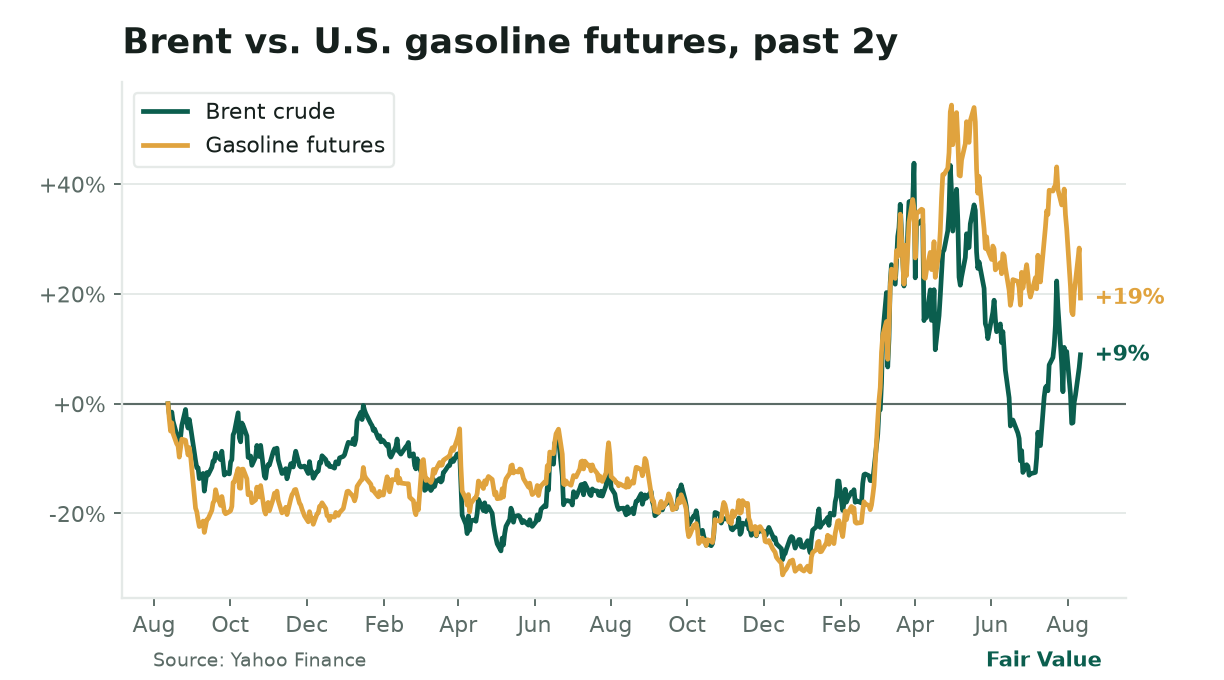
Brent crude climbed 2.4% to $89.84 as Iran’s Strait of Hormuz blockade stretched into a third week, with Tehran linking reopening the chokepoint, handling about one-fifth of global oil, to U.S. troop withdrawals and sanctions relief. The price jump risks reigniting inflation just as the Fed weighs cuts amid signs of consumer stress.
▸
Wall Street’s AI infrastructure push splits from semiconductor stocks. Nvidia, Apollo, Blackstone, and BlackRock closed a $500 billion financing deal for AI data centers, but chipmakers ARM (-5.2%), Marvell (-4.7%), and Intel (-4.1%) fell Monday, pointing to a shift from hardware makers to AI adopters.
▸
The U.S. consumer, 70% of GDP, shows strain. Credit card delinquencies rose, July payrolls shrunk by 23,000 jobs (against forecasts of 80,000 additions), and Wednesday’s CPI report will help decide whether the Fed eases or stays put.
What’s moving markets
Brent crude rose 2.4% to $89.84 Monday, with WTI up 2.6% to $84.29, as Iran’s Strait of Hormuz blockade entered its third week with no resolution in sight. Daily traffic through the critical passage has dropped to six ships, down from 130-140 before the crisis, with Tehran demanding U.S. troop withdrawals and sanctions relief to reopen. The prolonged closure adds a structural risk premium to oil ahead of Wednesday’s CPI report (expected: 3.4% year-over-year), which may shape the Fed’s next step.
The oil shock intersects with two other trends: a $500 billion AI infrastructure deal and signs of consumer fatigue. Nvidia, Apollo, Blackstone, and BlackRock finalized their landmark financing pact for AI data centers, while Intel locked in $20 billion for chip expansion. Yet semiconductor stocks ARM (-5.2%), Marvell (-4.7%), and Intel (-4.1%) all declined Monday, hinting at a rotation from chipmakers to cloud and enterprise users.
Meanwhile, the consumer, driving 70% of U.S. GDP, faces growing pressure. Retail sales held flat in June, but credit card delinquencies are climbing, and July’s 23,000-job loss (versus expectations of 80,000 gains) signals a cooling labor market. The Fed now weighs a key question: Does the jobs weakness clear the way for rate cuts, or warn of a downturn? Wednesday’s CPI data will be pivotal.
The big story
Strait of Hormuz closure becomes a lasting factor in oil markets
Markets are adjusting to Tehran’s stance: the Strait of Hormuz won’t reopen soon. Brent crude gained 2.4% to $89.84 Monday, WTI rose 2.6% to $84.29, and vessel traffic stayed at six ships per day, far below the pre-crisis 130-140. Iran’s conditions, U.S. troop withdrawals and lifted sanctions, remain unacceptable to Washington, which responded with new restrictions on Iranian banks and shipping.
The economic impact is immediate:
▸
U.S. gasoline prices are set to rise further, with refineries already at 96.5% capacity.
▸
Wednesday’s CPI report (forecast: 3.4% year-over-year) may show energy-driven inflation, complicating the Fed’s rate-cut plans.
▸
OPEC+’s July production increase of 1.17 million barrels per day fails to offset the Strait’s closure, locking in a persistent geopolitical premium for oil.
Oil shock hits the pump. Brent crude ($89.84) has surged 7.85% this month, while U.S. gasoline futures ($2.85/gal) are nearing 2024 highs. The Strait of Hormuz blockade, cutting daily traffic from 130-140 ships to just 6, adds a geopolitical premium that could push gas prices higher, complicating the Fed’s inflation fight ahead of Wednesday’s CPI report.
Capital is shifting fast. The XLE energy ETF jumped 4.7% Monday, led by Exxon (+4.4%), Chevron (+4.5%), and EOG Resources (+5.5%). But the bigger move is in tech: semiconductor stocks ARM (-5.2%), Marvell (-4.7%), and Intel (-4.1%) all dropped as funds flow toward AI infrastructure. Nvidia’s $500 billion financing partnership with Apollo, Blackstone, and BlackRock highlights this shift.
The big picture
Markets price in a soft landing, but the data suggests otherwise
Bonds and stocks are sending conflicting signals. The 10-year Treasury yield reached 4.65% (FRED DGS10), the 2-year hit 4.19% (FRED DGS2), widening the 10y-2y spread to 0.47%, a curve shape hinting at cautious optimism, not recession. Yet the high-yield credit spread narrowed to 2.70% (FRED BAMLH0A0HYM2), and the VIX at 15.52 (FRED VIXCLS) lingers near multi-year lows, reflecting complacency.
The contrast is sharp:
▸
Oil prices have climbed 7.85% this month. If Brent hits $100 per barrel, inflation expectations could delay Fed cuts.
▸
Equities stay resilient. The S&P 500 and Nasdaq-100 saw little change Monday, but sectors diverged: energy (XLE +4.7%) and healthcare (XLV +1.67%) led, while semiconductors (XLK -0.88%) trailed.
▸
Currencies reveal unease. The dollar index (DXY 99.85) firmed on safe-haven demand, the yen weakened to 159.28 per dollar, and gold rose 1.62% to $4,432 per ounce, hedging against inflation and instability.
Around the world
Hormuz crisis deepens as Europe’s energy transition stumbles
The Strait of Hormuz stays closed, with Iran insisting on U.S. troop withdrawals and sanctions relief before allowing ships through. Traffic has plunged to six vessels daily (from 130-140 before the blockade), and Washington imposed new sanctions on Iranian financial firms. Meanwhile, Houthi attacks in Yemen have escalated, raising fears of a dual blockade, Hormuz and the Bab el-Mandeb, that could push oil prices sharply higher.
In Asia, Malaysia now requires permits for U.S.-made AI chips passing through its ports, targeting smuggling to China. The yuan held at 6.74 per dollar, though capital controls are tightening.
Europe’s energy transition is losing momentum. Germany’s industrial output keeps weakening under high energy costs, France’s nuclear reactor restarts face delays, and the European Central Bank remains split over a September rate cut. The euro traded at 1.154 against the dollar, but growth risks are rising as energy prices climb.
Companies in focus
Energy surges, tech splits, and a mortgage bet backfires
Energy stocks led Monday’s gains, with the XLE ETF up 4.7%, Exxon rising 4.4%, Chevron 4.5%, and EOG Resources 5.5%.Schlumberger climbed 5.3% to multi-week highs.
AI financing reshapes tech.. Nvidia, Apollo, Blackstone, and BlackRock’s $500 billion AI data-center deal contrasts with weak semiconductor performance: ARM fell 5.2%, Marvell 4.7%, and Intel 4.1% Monday. Funds are moving into AI adopters, with Salesforce up 2.47% and Oracle 2.74%.
A $600 million mortgage misstep..United Wholesale Mortgage (UWM) founder Mat Ishbia lost $600 million after a failed acquisition attempt and poorly timed interest-rate bets.
From Washington
CPI and jobs data to guide the Fed’s September move
The Federal Reserve stays in wait-and-see mode. With the fed funds rate at 3.63% (FRED DFF) and CPI due Wednesday (forecast: 3.4% year-over-year), markets see little chance of a September cut. But July’s 23,000-job decline complicates the picture. A hotter-than-expected CPI could push cuts further out, keeping mortgage rates at 6.69%, while a cooler report might revive easing hopes, unless the Hormuz crisis reignites inflation concerns.
Under the hood
Calm markets hide liquidity risks, oil could disrupt the balance
The risk-on mood in stocks and crypto rests on three supports: low volatility (VIX 15.52), easy financial conditions (NFCI -0.53), and stable term premiums. Yet cracks are showing:
▸
Equities: Low volatility is lifting high-beta sectors like energy and AI cloud.
▸
Crypto: Bitcoin ($64,299) and Ethereum ($1,885) stay range-bound, backed by ample liquidity.
▸
Bonds: The 10-year yield at 4.65% assumes a soft landing, but the 10y-2y spread of 0.47% suggests skepticism.
▸
Commodities: Brent at $89.84, up 7.85% this month, could push core CPI higher, possibly forcing the Fed to hold off on cuts.
Worth learning today: Why the consumer drives Fed policy
Your spending habits shape the economy, and interest rates
Consumers account for 70% of U.S. GDP, meaning $19 trillion of the $27 trillion economy depends on household spending. Three key metrics show the current pulse:
Consumer confidence: Fading as gas prices rise and job growth stalls.
▸
Savings rate (~3.5%): A shrinking cushion leaves households exposed to shocks.
The chain reaction. Weaker spending → fewer business orders → slower manufacturing → layoffs → delayed corporate investment. The Fed watches this closely, which is why July’s 23,000-job loss has officials on alert.
Why it matters now. The oil surge to $89.84 acts like a tax on consumers, adding about 25 cents per gallon at the pump for every $10 increase in crude. With mortgage rates at 6.69% and student loan payments restarting, disposable income is squeezed. The Fed’s challenge: Cut rates to ease the pressure (risking inflation) or stand pat (risking a spending freeze). Wednesday’s CPI will offer the next critical clue.
GBP GDP (month-over-month) — , August 13; forecast -0.1%, prior 0.1%.
▸
30-Year Treasury Bond Auction — , August 13; $25 billion issuance.
Not financial advice.Fair Value is not investment advice. Do not buy or sell any security based on this content. Past performance is not indicative of future results. Investing involves risk, including the potential loss of principal. Consult a financial professional before making any financial decisions.
Data sources: Bloomberg, FactSet, Federal Reserve Economic Data (FRED), CME Group, U.S. Bureau of Labor Statistics, EIA, OPEC, Bank of England, Eurostat. ```