Binance suffered a $6.3 billion hack, the largest in crypto history, and stablecoin issuers froze $3 billion of the stolen funds. Withdrawals are halted; the breach shakes trust in centralized exchanges just as Bitcoin tests $77,300 support.
▸
Intel collapsed 28.6% in Friday's session, its worst day ever, after warning its foundry business will bleed cash longer than expected. The chip sector erased $1 trillion in October as investors stop rewarding AI spending and start demanding payback.
▸
OPEC+ is expected to keep December production quotas unchanged despite Brent at $117.64 and tanker attacks in the Strait of Hormuz. The cartel's discipline is now a deliberate supply constraint, not an accident, and it's feeding directly into long-term bond yields.
The big story
The AI trade hit its first real reckoning Friday. The trigger wasn't a missed earnings number, it was the cost of money.
Intel plunged 28.6% to $65.76, its worst single-day drop on record, after guiding that foundry losses will persist deeper into 2027. AMD fell 10.9%, Marvell 10.1%, ARM 10%, Qualcomm 11.1%. The Nasdaq-100 shed 3.5%, its third correction of 2026. The number that explains why sits in OpenAI's fundraising: the ChatGPT maker raised $13.5 billion at a $1.25 trillion valuation, 90% below its $1.4 trillion target.
The same lenders who threw billions at AI infrastructure six months ago now demand stricter terms, higher coupons, and actual cash-flow visibility. Anthropic's $63 billion debt deal, the largest AI financing ever, required a syndicate of Wall Street's biggest balance sheets and covenants that would make a private-equity partner blush.
Five hyperscalers, Microsoft, Google, Amazon, Meta, Oracle, spent $691 billion on capex in the trailing twelve months through September, up 93.5% year-over-year, equal to 35.8% of revenue and 95.5% of operating cash flow. Their aggregate free cash flow collapsed from $201 billion to $33 billion. They are spending more than they generate, and capital markets are saying: show us the return.
Simultaneously, OPEC+ confirmed it will hold December quotas steady. Brent futures closed Friday at $117.64, up 31% in three months, while dated spot trades at $123.10, a $5.50 premium signaling physical scarcity. The cartel completed its voluntary cut unwind in September, but Saudi Arabia still produces 8.37 million barrels a day against a 10.5 million quota; it can't raise output even if it wanted to. The Strait of Hormuz remains a shooting gallery: Iran claims four tankers struck mines this week, Oman rescued 25 crew from a burning vessel yesterday, and the U.S. has advised commercial ships to avoid the strait entirely.
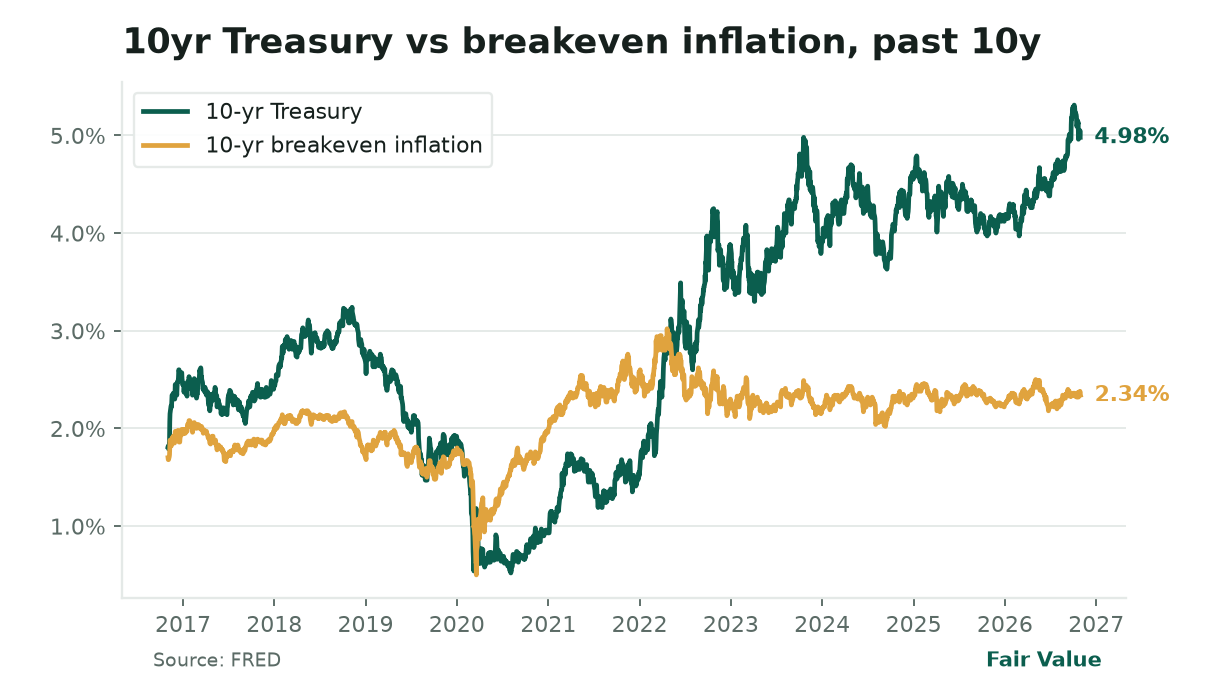
The bond market has connected these dots. The 10-year Treasury yield sits at 4.98%, the 30-year mortgage at 7.24%. The term premium, the extra yield investors demand for locking up money long-term, has flipped from an AI productivity bet to an oil inflation hedge.
In September, the 10-year breakeven inflation rate was 2.32%. Now energy feeds through to core PCE at 3.12%, and the Fed's September projections assumed AI productivity would offset supply shocks. Both legs are gone.
For a normal person, this transmission chain hits three places: your mortgage rate (7.24% freezes housing), your 401(k) (tech leads the index down), and your gas pump (Brent at $117 means $4+ gasoline isn't going away). The market isn't pricing a recession, it's pricing a world where capital is expensive and energy is scarce. That's a very different regime than the one that built the 2024-25 rally.
What's going on today
Markets are closed for the weekend, but crypto and FX are live. Bitcoin trades at $77,300, down 4.3% on the week and 8.9% on the month, but still up 23% over three months. Ether at $2,242 has given back 17% this month. The Fear & Greed index sits at 30, deep fear, down from 74 a month ago.
Stablecoin supply has contracted to $299 billion, $21.5 billion below its May peak, and both USDC and USDT are shrinking. The Binance hack, $6.3 billion stolen, attributed to North Korea's TraderTraitor unit, has frozen withdrawals and forced Tether and Circle to freeze $3 billion in linked assets. U.S. spot Bitcoin ETFs saw a $410 million outflow Thursday, breaking a two-week streak of modest inflows.
In equities, Friday's session was a violent rotation. The S&P 500 closed at 7,580, down 1.8%. The Nasdaq-100 fell 3.5% to 28,385. But defensive sectors hit multi-year highs: healthcare (XLV) up 9.8% on the month, staples (XLP) up 10.9%, utilities (XLU) up 10.1%.
Walmart gained 18.9% in October, Visa 15.1%, Mastercard 15.7%. Institutional capital is rotating from duration to cash-flow certainty at speeds last seen in 2000, 2008, and 2022.
The dollar is mixed. DXY at 101.9, the broad trade-weighted index at 121.3, below the 122 level that triggers acute emerging-market stress. USD/JPY at 157.8 after the Bank of Japan declared victory on inflation (underlying prices hit 2% after 13 years) and held rates at 1.25%, accelerating ETF sales instead of hiking. The 375-basis-point rate differential with the Fed keeps the yen carry trade alive.
The big picture
Credit markets are signaling a hard landing. High-yield spreads at 326 basis points have widened while Treasury yields fell, the classic divergence. In every soft landing since the 1990s, falling risk-free rates tighten credit spreads; the opposite is happening now. The ICE BofA High Yield OAS is at its widest since 2022.
The dollar's strength (broad index 121.3) exports this tightening globally. Emerging-market currencies are under pressure, and the 122 stress threshold is close enough to matter. China's property sector continues its slow unwind, Evergrande liquidators recovered 1% of claims after 30 months, while new sanctions on Taiwanese entities and EU anti-dumping investigations escalate trade friction.
Housing is the transmission belt. Building permits at 1.398 million exceed starts at 1.221 million by 177,000 units, builders want to build but can't sell at 7.24% mortgages. New-home sales at 676,000 annualized are 12% below the 2022-23 peak. That overhang will bleed into construction employment, which feeds back into the unemployment rate (currently 4.2%).
Around the world
Middle East dual-chokepoint crisis. In the Strait of Hormuz, Iran's exclusion zone has escalated to active mining: four tankers struck mines this week per Iranian claims, Oman rescued 25 crew from a burning vessel yesterday, and the U.S. has advised commercial shipping to avoid the strait. In the Red Sea, Houthi forces struck Riyadh airport on October 10 (three Saudi fatalities), hit Saudi pumping stations and Aramco facilities repeatedly, and a Saudi-led coalition intercepted a drone over the Eastern Region yesterday. The Saudi-backed Yemeni government offensive launched October 5 has not broken Houthi capability, they still reach deep into Saudi territory.
Saudi Arabia's East-West Pipeline (Petroline) restarted October 1, moving up to 5 million barrels/day via Red Sea ports and bypassing Hormuz entirely. It's operational but hasn't capped the risk premium, Brent at $117.64 with dated spot at $123.10 proves physical scarcity persists. OPEC+ meets next week; all signals point to unchanged December quotas.
Europe. The ECB holds rates at 2.5% deposit / 2.65% main refi. Eurozone headline inflation hit 3.72% year-over-year in September, a three-year high, driven entirely by energy. Core at 2.57%.
Christine Lagarde announced she'll step down early, letting EU leaders pick her successor before France's 2027 election. The political dimension of the next appointment is already pricing into Bund spreads.
Japan. The BOJ declared victory on inflation, underlying prices "at target" after 13 years, but held rates at 1.25% and accelerated ETF sales. Governor Ueda's October 30 press conference confirmed conditions for further hikes are satisfied, but the board remains divided on timing. The yen at 157.8/USD reflects the 375bp differential with the Fed.
Russia-Ukraine. Putin agreed October 22 to resume trilateral talks in November. Zelenskyy says Russia has adopted a "new doctrine" deliberately targeting civilian infrastructure, drone strikes on Kyiv gas stations since September 12, a missile strike killing 22 on October 8. The U.S. proposed UAE as host for three-way talks before winter.
China. New sanctions on Taiwanese entities (October 12) restrict financial and shipping links. Taiwan formally accused Beijing of using sanctions to influence domestic elections. EU Trade Commissioner Šefčovič's Beijing talks were preceded by a Chinese anti-dumping investigation into EU imports. Evergrande liquidators sold a 51% stake in Evergrande Property Services for $513 million, 1% recovery on debt claims after 30 months.
Companies making news
ServiceNow crashes 27% on guide-down. The enterprise AI software poster child fell 26.9% after guiding lower, signaling corporate IT budgets are scrutinizing AI ROI. The Nasdaq-100's third correction of 2026 is being led by the companies that were supposed to benefit most from AI adoption.
AstraZeneca surges 7% on China data. AZN rose 7.0% Friday to $186.65 after positive China trial data for a lung cancer drug. The stock is up 15.6% on the month, a rare large-cap biopharma winner in a market punishing growth.
Exxon and Chevron beat on high oil prices. Both reported blowout Q3 profits Friday as Brent's 31% three-month rally flowed to the bottom line. XOM +2.2%, CVX +1.8% on the day. Energy sector XLE +13.9% on the month.
From Washington
The Fed held rates at 3.75-4.00% at its October 28-29 meeting, but Governors Lisa Cook and Beth Hammack dissented for a 25-basis-point hike, the first split vote since the tightening cycle began. Markets price a 71-88% chance of a December hike. The dissent wasn't about current data (core CPI 2.57%, unemployment 4.2%) but about what the Fed can't see yet: the lagged effect of energy prices on core PCE, and the private capital demand from AI capex lifting term premiums independently of policy.
Yield outpaces inflation expectations. The 10‑year Treasury sits at 4.98% while the 10‑year breakeven inflation rate is about 2.8%, the widest gap since early 2022 when the yield rose above 4.5% and breakeven hovered near 2.5% before the 2022‑23 inflation surge.
The 10-year/3-month spread at 0.78 percentage points and the 10-year/2-year at 0.37pp reflect a bear steepener driven by term premium, not rate expectations. The ACM term premium estimate turned positive for the first time since 2022. Thirty-year mortgages at 7.24% anchor housing starts at 1.22 million (below pre-pandemic) even though permits at 1.40 million show builders want to build.
Treasury's doubled long-dated buybacks (weekly limit $14.5B, long-term limits doubled to $4B/session from September 9) removed ~$38 billion in September, easing bond-market pressure temporarily. But the $2 trillion+ issuance needed in 2027 collides with the Binance stablecoin freeze, a potential dollar funding liquidity drain just as supply peaks.
The Eighth Circuit vacated the Fed's debit-card interchange fee cap (Durbin Amendment implementation), a win for banks that could mean higher merchant fees passed to consumers.
Under the hood
The long-end rate driver has flipped from AI productivity premium to oil inflation fear. Three simultaneous developments confirm the regime flip: (1) OPEC+ formally maintains December quotas despite Hormuz tanker attacks and Ukraine refinery strikes, making the oil supply shock intentional policy not accident; (2) Intel collapses 28.6% in a single session (-45% 1m, z-score -3.6) while OpenAI raises only $13.5B vs $1.4T target, proving the AI capex supercycle is funding-constrained; (3) defensive sectors (XLV, XLP, WMT, V, MA) hit 5-year highs at z > +2.2 while semis lead the Nasdaq-100 down 3.5%, showing institutional rotation from growth to quality at statistically extreme velocity.
The chain: commodities-energy (OPEC+ discipline + geopolitics → Brent $117.64, +31% 3m) → inflation (energy feeds CPI/PCE, core PCE 3.12% sticky) → rates-fed (long end prices persistence, 10y 4.98%, 10y-3m 0.78pp steep) → bonds-credit (term premium up, HY OAS 326bps) → housing (30y mortgage 7.24% freezes demand, sales 676k vs 1,398k permits) AND equities (discount rate kills growth/tech, SOXX -17% 1m, rotation to defensives at 5y highs).
The surface story is "tech selloff on earnings disappointment." The deeper transmission is a term premium regime change. From late 2024 through mid-2026, the 10-year yield climbed on AI productivity optimism: investors priced a "Roaring 20s" supply-side boom, bidding up growth stocks and steepening the curve via term premium, not inflation expectations (10y breakeven 2.35%). That trade is unwinding violently.
Intel's -28.6% today and OpenAI's $13.5B raise vs $1.4T target signal the private capital wall. Simultaneously, OPEC+'s quota discipline at $117 Brent, with dated spot at $123, confirms a structural oil supply constraint. Energy now adds 0.5-0.7pp to core PCE via second-round effects. The 10y at 4.98% and 30y mortgage at 7.24% now reflect oil inflation fear, not AI optimism.
The sharper edge: Professionals are debating whether the 10y breaks 5.5% (oil inflation persistence) or 4.5% (growth scare forces Fed cuts). The key is the term premium decomposition: if ACM term premium stays >50bps while growth data softens (NFP 159k, unemployment 4.2%), the Fed faces a true stagflationary bind, cannot cut with core PCE 3.1%, cannot hike with housing frozen and credit widening. The Binance $6.3B breach adds a plumbing wildcard: stablecoin freezes could drain dollar funding liquidity just as Treasury needs to issue $2T+ in 2027.
Watch: 10y term premium (ACM) vs Brent correlation (currently +0.7 30d); HY OAS vs SOXX relative performance; defensive (XLV/XLP) vs growth (XLK/QQQ) 20d momentum spread. Confirmation: term premium >60bps with Brent >$120 and SOXX making lower lows. Refutation: term premium <30bps with Brent <$105 and SOXX reclaiming 50dma.
The long view: What is driving the crypto rally of the last three months, and how does it differ fundamentally from the run to the October 2025 high and the crash after it?
The July-October 2026 rally lifted total crypto market cap ~39% to a Q3 peak near $3.0T, but a sharp pullback in the last week has erased ~$370B. Total cap now $2.63T (Oct 31), BTC $77,393 (-4.2% 1w, -8.8% 1m, +23.3% 3m), ETH $2,246 (-4.7% 1w, -17.0% 1m, +21.8% 3m), SOL $96.53 (-5.9% 1w, -18.1% 1m, +34% 3m). All remain 27-65% below October 2025 highs (BTC ATH $126,080 on Oct 6, 2025; ETH ATH $4,946 on Aug 24, 2025; SOL ATH $293 on Jan 19, 2025).
The rally was spot-ETF-led, institutionally sponsored, and low-leverage, four drivers: (1) U.S. Treasury doubled long-dated buybacks (weekly limit $14.5B, ~$38B removed in September), easing bond-market pressure; (2) ETH outperformed (+71% in Q3) on $3.1B ETH ETF inflows; (3) Regulatory progress: SEC proposed Regulation Crypto Assets Aug 18 (comment deadline Oct 20 passed, 171 comments, 70% conditional support; final rule possible Q1 2027), OCC finalized stablecoin rule Oct 21 under GENIUS Act, FinCEN withdrew unhosted-wallet rules Oct 10, EU MiCA fully effective Jul 1; (4) Solana Alpenglow upgrade activated Oct 21, cutting finality to ~150ms.
October's deterioration reflects: Fed hike expectations repriced (10y 4.98%, VIX 19.42, modestly improved from a week ago), ETH ETF outflows accelerating (-$105M/day, -$1.26B October monthly through Oct 27, second-largest on record), stablecoin supply stagnating below $305B (no net new supply in a year, $21.5B below May peak), and BTC ETF flow momentum broken (Oct 30 -$410M largest single-day outflow). The Binance $6.3B hack headline remains unconfirmed; no withdrawal halts or material loss verification reported.
Contrast with Oct 2025 blow-off: BTC perp OI hit $92B, funding >26%/yr, and a geopolitical shock (Trump 100% China tariffs) triggered >$19B liquidations in 24-48h. Current structure is far cleaner, no unified-margin concentration, funding modest on Binance (5-11%/yr for BTC, negative for ETH/SOL).
For a normal investor: watch whether BTC ETF flows revert to positive >$50M/day for 3+ days (broken Oct 30), whether ETH ETF outflows reverse (custody rule Dec 7 catalyst), whether stablecoin supply resumes expansion above $320B, and whether ETH/SOL negative funding persists (signals short positioning/hedging). Macro tripwires: VIX >25, 10y yield >5.5%, DXY >104 would tighten risk appetite further.
What would change the view: BTC ETF flows negative >3 consecutive days; ETH ETF outflows >$200M/week for two more weeks; stablecoin supply <$295B 30d; BTC perp funding >+0.01%/8h with OI rising toward $90B+ aggregate; ETH perp funding < -0.01%/8h with OI rising; VIX >25 or 10y >5.5%; SEC final rule restricts more than proposed; Binance hack confirmed >$1B loss with withdrawal halts.
Worth learning today: The dollar smile
Yesterday's lesson ended with a prediction question about the BOJ press conference (scheduled Oct 30). The outcome: BOJ held rates at 1.25%, accelerated ETF sales, and Governor Ueda confirmed underlying inflation is "at target" after 13 years, clearing the path for a December hike.
The yen initially pared gains on the hold, then stabilized at 157.8/USD. The mechanism: markets had priced a hike probability; the hold was a relief, but the "at target" language keeps December live. The 375bp differential with the Fed (3.75-4.00%) keeps the carry trade intact.
Now, the dollar smile, a concept we taught early in the course, but today's market gives it a sharper edge.
The dollar smile is the pattern where the U.S. dollar strengthens in both booms and panics, but weakens in the muddy middle. Left side of the smile: global crisis → flight to safety → dollar up (2008, 2020, 2022). Right side: U.S. growth outperforms → capital chases U.S. returns → dollar up (late 1990s, 2021, 2024). The middle: synchronized global growth, Fed cutting, risk appetite high → dollar down (2003-2007, 2017).
Today we're in a rare dual-smile moment. The left side: Middle East dual-chokepoint crisis (Hormuz mining, Houthi missiles), Russia-Ukraine civilian targeting, China-Taiwan sanctions escalation, geopolitical fear bids the dollar.
The right side: U.S. rates at 3.88% vs ECB 2.5%, BOJ 1.25%, yield differential pulls capital. The broad trade-weighted dollar at 121.3 sits below the 122 stress threshold but is climbing. DXY at 101.9.
For your money: a strong dollar lowers import prices (helps inflation) but crushes multinational earnings (S&P 500 companies get ~40% revenue overseas) and raises debt-service costs for every dollar-borrower globally, emerging markets, European corporates, even U.S. households with floating-rate debt. The smile is why "good news is bad news" for the dollar sometimes, and "bad news is good news" other times. It's not a contradiction, it's two different regimes.
Sharper edge: The smile breaks when the Fed and other central banks cut together (synchronized easing), the dollar loses both legs. Watch the ECB December meeting and the BOJ December hike decision. If both move toward easing while the Fed holds, the right side of the smile collapses. That's the 2027 setup.
Next week's prediction: The OPEC+ meeting (Dec quotas) and U.S. CPI (Nov 13), which moves the dollar more? Write it down; we'll check.
What to watch this week
▸
Monday, Nov 2 — , Apple (AAPL) and Palantir (PLTR) earnings after close. Apple's China iPhone sales and services margin; Palantir's government AI revenue trajectory.
▸
Monday, Nov 2 — , ISM Manufacturing (Oct). The forward-looking gauge of factory activity; sub-50 signals contraction.
▸
Tuesday, Nov 3 — , AMD earnings after close. Data center GPU ramp vs. gaming/embedded weakness; MI300X supply chain color.
▸
Wednesday, Nov 4 — , U.S. Presidential Election. Policy uncertainty peaks; markets historically volatile the week of.
▸
Thursday, Nov 5 — , Bank of England rate decision. BoE exploring easing mortgage lending limits; decision impacts GBP and UK housing.
▸
Friday, Nov 6 — , U.S. Employment Situation (Oct). Nonfarm payrolls, unemployment rate, wage growth. The Fed's last hard data before Dec 9-10 FOMC.
▸
Ongoing — , OPEC+ December quota decision (date TBD). Brent at $117.64 makes this a live macro catalyst.
▸
Ongoing — , Binance withdrawal resumption timeline (stated 48 hours from Oct 30). Stablecoin freeze unwind signals crypto plumbing health.
Not financial advice. This brief is for informational and educational purposes only and does not constitute investment advice or a recommendation to buy or sell any security.
Data: macro indicators per FRED® (Federal Reserve Bank of St. Louis); not endorsed or certified by the Federal Reserve Bank of St. Louis. Energy data per the U.S. Energy Information Administration (EIA). Auction data per U.S. Treasury Fiscal Data. Filings per SEC EDGAR. Market prices per Yahoo Finance. Earnings calendar per Financial Modeling Prep. Crypto data per Binance and CoinGecko. WSJ headlines per WSJ RSS feeds.