Semiconductors staged a sharp Friday bounce but remain in a historic downtrend, AMD climbed 11%, Intel 7.7%, TSMC 6.3% on the day, yet SOXX is still down 30% in a month (z-score -3.6), signaling a bear-market rally, not a bottom.
▸
Binance's $6.36 billion hack triggered $4.7 billion in net withdrawals and $1.28 billion in Bitcoin ETF outflows, institutional trust in crypto infrastructure is fracturing, Fear & Greed at "Extreme Fear" (25) for the first time since August.
▸
Berkshire Hathaway's Pacific Power seeks a 57% California rate hike, typical residential bill would jump $120/month, the first major utility to pass AI-driven grid costs directly to households.
The big story
The market has stopped paying for AI revenue and started pricing its cost. That repricing, driven by a surge in the discount rate applied to distant cash flows, is the spine of this week. Friday's semiconductor rally is just the latest tremor.
Five hyperscalers (Microsoft, Google, Amazon, Meta, Oracle) spent $691 billion on capital projects in the trailing twelve months through September, up 93.5% year-over-year. That equals 35.8% of their combined $1.93 trillion revenue and 95.5% of operating cash flow.
Aggregate free cash flow collapsed from $201 billion to $33 billion, an 84% drop. Amazon alone burned $42.4 billion in trailing free cash flow; Alphabet posted a second straight quarter of negative free cash flow (-$9.1 billion). Microsoft guided FY2027 capex near $170 billion.
To fund the build-out, hyperscalers issued $230 billion in investment-grade bonds in the first nine months of 2026, more than double all of 2025, raising debt's share of capex funding from 9% to 32%. If the build-out slows, that debt service becomes harder to justify, and chipmakers' order books, mostly sold through 2027, start looking like inventory risk. CoreWeave, a "neocloud" GPU rental firm, saw shares fall over 20% and its five-year CDS spread imply a 60%+ default probability. That is the canary.
Against that backdrop, Friday's bounce was real money covering shorts and systematic funds rebalancing after a 12.25% single-day plunge in SOXX on November 5, the worst since March 2020. AMD surged 11%, Intel 7.7%, TSMC 6.3%, the whole complex bouncing 5-11%. But zoom out: SOXX has fallen 29.7% in one month, a z-score of -3.6 (roughly a 1-in-6,000 event in five years). The sector erased $1.64 trillion in market cap since early October. Forward P/E collapsed from 28 in June to 16 today, a 43% valuation reset, even as chipmakers report record revenues.
The structural pressure has not changed. The 10-year Treasury at 4.84% discounts distant AI cash flows heavily. The dollar at 102.3 DXY tightens global financial conditions.
The midterm Democratic sweep in Texas, Georgia, and Ohio threatens to slow data-center permitting, the bottleneck hyperscalers cite as their biggest constraint. Until capex growth decelerates or free cash flow inflects positive, every rally is a sale.
What's going on today
Equities and bonds are closed for the weekend; crypto and FX trade 24/7, confirming the same risk-off impulse.
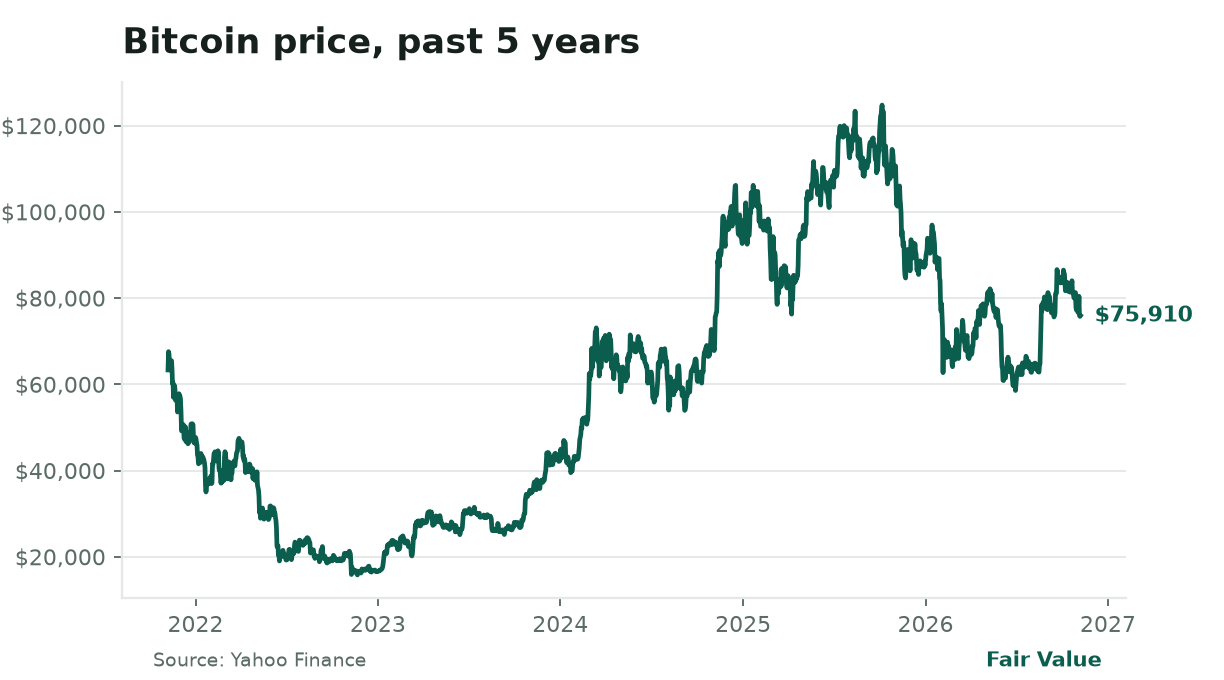
Bitcoin traded at $75,900, down 7% on the month and 25% from its October 2025 peak; Ether at $2,242, down 9% monthly. Fear & Greed reads 25, "Extreme Fear," lowest since August. Stablecoin supply contracted to $292 billion, down 4.9% in 30 days and 3.3% year-over-year, $9.9 billion evaporated in a year. Binance suffered a $6.36 billion hack on October 29 (largest in crypto history), prompting $4.7 billion in net customer withdrawals since reopening November 1. US spot Bitcoin ETFs bled $1.28 billion in five sessions, turning 2026 net flows negative for the first time.
Bitcoin near $76k, still far below its $101k Oct‑2025 peak. The last time Bitcoin hovered around $76k was in early 2022; after that rally it fell to a low of $38k before climbing back above $60k, illustrating how similar levels have preceded steep declines and later recoveries.
In FX, the dollar holds firm: DXY at 102.3, broad trade-weighted at 121.7 (below the 122 stress threshold but climbing). USD/JPY at 158.4 reflects the 375-basis-point Fed-BOJ differential (Fed 3.75-4.00%, BOJ ~0.25%). The Bank of Japan signaled a December hike after holding October 31; Japan's 2-year yield nears 2%. The Nikkei plunged 5.96% Friday, down 18.7% on the month (z-score -3.9), caught between a strengthening yen and the global tech selloff.
Oil gave back its war premium: Brent at $98.32, WTI at $90.83, both down roughly 17% from the October 30 high of $117.64. The dual chokepoint crisis, Iran's Hormuz exclusion zone and Houthi Red Sea attacks, persists, but Saudi Arabia's East-West Pipeline (Petroline) moves 5.8 million bpd around Hormuz, and OPEC+ kept December quotas unchanged for the third consecutive month. QatarEnergy bought 33 US LNG cargoes to offset Hormuz disruption, a 20-year commitment signaling the crisis isn't ending soon.
Gold at $4,075, up 4.5% on the week but down 23% from its January peak. 10-year Treasury yield at 4.84%, 30-year mortgage at 7.18% (highest since 2001). VIX fell 9% Friday to 25.64 but remains up 71% on the month, volatility elevated, not resolved.
The big picture
The bond market prices a December Fed hike with 78-80% probability (CME FedWatch), down from 81% midweek but still the base case. 2-year yield at 4.46%, 10-year at 4.84%, 10-year-minus-3-month spread at 0.67pp, the curve steepening at the front end, a classic "higher for longer" signal. High-yield spreads (OAS 3.48pp) stay wide, reflecting credit caution. Mortgage rates at 7.18% freeze housing: new-home sales at 676,000 versus a 720,000 average, keeping shelter inflation sticky and the Fed hawkish.
The dollar's strength is the transmission mechanism. At 121.7 broad trade-weighted, it compresses multinational earnings and raises debt-service costs for dollar borrowers. Eurozone retail sales fell 0.7% in September, led by a German slump, while the ECB holds deposit at 2.5% and main refi at 2.65%. Lagarde's pending exit adds political uncertainty to a central bank navigating fragmentation, French fiscal stress, German industrial weakness, periphery resilience (Fitch upgraded Greece to BBB and Cyprus to A this week).
Equities are in a violent rotation. S&P 500 at 7,377 (-5.5% monthly), Nasdaq-100 at 26,990 (-13.4% monthly), Dow nearly flat (+0.2% monthly). Small caps (Russell 2000) down just 1.4% monthly.
The divergence is sectoral: tech (XLK -18.2%) and semis (SOXX -29.7%) crushing; utilities (XLU -0.7%), staples (XLP +10.3%), healthcare (XLV +9.5%) holding. Financials (XLF +6.3%) benefit from steeper curves. The market sorts duration risk, long-duration AI exposures pressured by rising real yields; short-duration cash-flow stories persist.
That same duration sorting explains the Nikkei's 18.7% monthly plunge, worst major index globally. The yen at 158.4 should boost exporters, but the index's heavy semiconductor weighting (Tokyo Electron, Advantest) transmitted the global AI-capex digestion, SOXX down 29.7% same month, Nvidia-supply-chain names INTC (-50%), MRVL (-50%), MU (-37%), into violent multiple compression.
Rising global yields (US 10-year 4.84%, 2-year 4.46%) and implied BOJ tightening raised the discount rate on long-duration growth stocks. Positioning amplified: VIX at 25.6, high-yield OAS at 348 bp, systematic volatility-control funds likely deleveraged. For the decline to extend, US yields must keep rising or semiconductor earnings must guide below already-lowered expectations; a Fed pause, BOJ dovish shift, or AI-capex re-acceleration would stabilize the index.
Around the world
Middle East dual chokepoint crisis, day 220+. Iran's Hormuz exclusion zone exempts India, China, Iraq, and Qatar, roughly 55% of Gulf crude flows, while barring Saudi Arabia. US strikes on Qeshm Island (November 3) targeted an underground missile site and naval base; Iran claims downed US drones. Tanker attacks and mining continue: two vessels hit November 3, one striking a mine.
Shanghai Containerized Freight Index doubled since February; bunker fuel costs up 70%. Petroline flows recovered to 5.8 million bpd; Aramco engineering a 43% capacity expansion to 10 million bpd. Houthi Red Sea campaign persists: Ras Tanura claims (October 27), six simultaneous attacks claimed October 29, Saudi intercepts ongoing. Houthi demands: $51 billion and sovereignty recognition.
Japan. BOJ Governor Ueda's October 30 press conference confirmed inflation conditions for a December hike; ex-BOJ chief Kuroda backs more hikes. 2-year JGB yield nears 2%. Nikkei's 18.7% monthly drop reflects the yen's climb from 156.9 three weeks ago and the index's tech exposure.
China. Beijing proposed adding 40 technologies (AI, biomedicine, photovoltaics) to export control list November 3, with interim pre-export registration effective immediately. US-China trade chiefs (Bessent/He Lifeng) held a call November 6 ahead of a potential Trump-Xi summit in Shenzhen; Bessent and Greer raised concerns on China's trade deal actions. Taiwan activated market-stabilization measures alongside South Korea to stem AI-sector bleeding. Coast Guard patrols and shipping harassment confirm gray-zone pressure continues.
Europe. Eurozone retail sales slumped 0.7% in September, Germany leading the decline. ECB holds rates; Lagarde's exit looms. Fitch affirmed Greece BBB/stable and raised Cyprus to A, periphery resilience amid French fiscal stress.
UK house prices fell 1.2% year-over-year, biggest annual drop in three years (Lloyds). Paraguay's president resigned after a banking crisis tied to a lender with close ties, emerging-market stress spreading.
Companies making news
Semiconductors: the bounce recovered roughly one day of a six-week slide. AMD climbed 11% to $449, Intel 7.7% to $56.28, TSMC 6.3% to $375, Marvell 5.7% to $141, Qualcomm 5.5% to $165, Micron 5.1% to $690, ASML 5% to $1,425, all in Friday's session. Yet SOXX down 29.7% monthly (z-score -3.6), Intel -50% monthly, Marvell -50%, Micron -37%, ARM -41%. Hyperscaler capex digestion, not earnings, drives the reckoning.
Binance hack fallout deepens. $6.36 billion stolen October 29 across ten blockchains (largest crypto theft ever), attributed to North Korea's TraderTraitor unit. Stablecoin issuers froze $2.67 billion (Tether $1.57B USDT, Circle $800M+ USDC), but $2.4 billion in unfreezable BTC/ETH remains with the attacker.
Net withdrawals: $4.7 billion since November 1 reopening (2.1% of assets). Binance pledges SAFU fund coverage, says 95% replenished. US spot Bitcoin ETFs: -$1.28B net in five sessions (IBIT -$1.21B alone). 2026 net flows turned negative (-$502M).
Pacific Power seeks 57% California rate hike. Berkshire Hathaway Energy's utility filed for a historic increase raising the typical residential bill $120/month. Driver: wildfire mitigation, grid hardening, and surging data-center demand, AI infrastructure loads rewriting utility economics. California regulators will decide; the request signals a national trend as hyperscalers lock in dedicated power (Google-Constellation 20-year nuclear PPA, Venture Global gas plants for data centers, DOE $1.9B Duane Arnold nuclear restart loan).
ARM misses, Uber collapses. ARM plunged 31.8% on smartphone royalty miss (EPS $0.15 vs $0.22 est) despite higher quarterly sales, market punished the AI-narrative stock for a legacy-business shortfall. Uber collapsed 73.4% (EPS $0.25 vs $0.94 est) on mobility weakness and delivery margin pressure. Both reveal consumer discretionary fragility beneath the AI hype.
McDonald's, Novo Nordisk, Sony beat. MCD rose 6.2% (EPS $3.57 vs $3.36), NVO climbed 9.9% (EPS $0.89 vs $0.81), SONY surged 26.3% (EPS $0.48 vs $0.38). Staples, healthcare, entertainment resilience, short-duration cash flows winning in a high-yield world.
OPEC+ holds December quotas unchanged. Third consecutive month (Oct-Dec) of steady output from seven core members. Saudi 10.48M bpd, Russia 9.95M bpd. The cartel isn't chasing price; it's managing a market where Iranian/Russian barrels are constrained and Petroline bypass hasn't fully capped the risk premium. Brent fell 16.4% weekly, 1.9% monthly.
ConocoPhillips, McKesson beat. COP rose 6.9% (EPS $3.27 vs $3.06), MCK climbed 9.3% (EPS $11.68 vs $10.69). Energy and healthcare distribution, real assets, real cash flow.
From Washington
The midterm Democratic sweep (House flip, Senate hold) rewrites the regulatory landscape. Democrats push to reverse Trump's 50% tariffs on Canada, Carney welcomed the push, lawsuits challenging the tariffs active in federal court. Small business impact reporting confirms the active tariff regime is biting.
Elon Musk's Texas empire (Tesla, SpaceX) faces a "blue wall" of Democratic opposition after staking his expansion on the state. AI data-center moratoriums debated in key states (Texas, Georgia, Ohio), winning candidates promised permitting slowdowns, forcing builders to weigh overseas or desert options. Fed holds 3.75-4.00%; next FOMC December 8-9. No high-impact calendar events this week.
Worth learning today: Discounting, tomorrow's dollar today
Yesterday's prediction check: Canadian employment change for November forecast at +14.6K (prior -68.3K). Release coincided with US jobs report Friday; our data feed hasn't captured the final print. Mechanism: hot Canadian number → Bank of Canada holds rates higher → CAD strengthens → USD/CAD falls → Canadian mortgage rates stay elevated → housing affordability pressure persists. We'll update when the number hits.
The lesson. You see "discount rate" and "present value" thrown around weekly. What are they? Imagine you're promised $100 in one year.
What's it worth today? Less than $100, because if you had it now, you could invest it.
The "discount rate" is the return you'd earn. At 5%, $100 next year is worth $95.24 today ($100 ÷ 1.05). At 10%, it's $90.91. Higher rate, less future money worth today.
This is the engine under every asset price we covered. A stock is a claim on future earnings; a bond, future coupons and principal; a house, future rent savings. When the 10-year Treasury yield jumps from 4% to 4.84%, the discount rate for all long-duration assets rises. That's why Nasdaq-100 (long-duration growth) fell 13% monthly while Dow (shorter-duration value) barely moved.
That's why mortgage rates at 7.18% freeze housing, the monthly payment is the present value of 30 years of cash flows discounted at today's rate. That's why AI stocks, whose profits live in the 2030s, got crushed: a 1-percentage-point higher discount rate cuts the present value of 2030 earnings by roughly 30%.
The sharper edge. Discounting isn't just math, it's a convention about risk. The "risk-free" rate (Treasury yield) anchors everything. But the equity risk premium (extra return stocks demand) shifts with sentiment.
In March 2020, ERP spiked to 7%; in 2021 it compressed to 3.5%. Today ~4.5%, not extreme, but rising. If ERP normalizes to 5.5% while 10-year holds 4.84%, cost of equity jumps to 10.34%.
That alone compresses S&P 500 multiples from 25x to roughly 18x, a 28% drop without earnings changing. The market prices discount rates first, earnings second.
Watch the 10-year real yield (TIPS breakeven 2.24% → real yield ~2.6%). That is the true discount rate for long-duration assets. When it rises, the future gets cheaper.
What to watch this week
▸
Monday, Nov 9 (pre-market): — KKR ($88B) EPS est $1.41; Constellation Energy ($85B) EPS est $3.90; Lucid ($66B) EPS est -$2.27; Ferguson ($46B) EPS est $3.28
▸
Monday, Nov 9 (after-hours): — Occidental Petroleum ($56B) EPS est $1.43; Take-Two ($40B) EPS est $0.49
▸
Tuesday, Nov 10: — US CPI (September), core PCE at 3.12% y/y, core CPI 2.57%; the 55bp gap keeps Fed focused on PCE
▸
Wednesday, Nov 11: — Cisco ($181B) EPS est $1.32; US PPI, pipeline pressure for CPI
▸
Thursday, Nov 12: — US retail sales, consumer resilience test at 7.18% mortgages
▸
Ongoing: — BOJ December hike signals; Iran nuclear proposal via Qatar; China export controls on 40 technologies (comments due Nov 15); FOMC December 8-9 (78-80% hike priced)
Not financial advice. This brief is for informational and educational purposes only and does not constitute investment advice or a recommendation to buy or sell any security.
Data: macro indicators per FRED® (Federal Reserve Bank of St. Louis); not endorsed or certified by the Federal Reserve Bank of St. Louis. Energy data per the U.S. Energy Information Administration (EIA). Auction data per U.S. Treasury Fiscal Data. Filings per SEC EDGAR. Market prices per Yahoo Finance. Earnings calendar per Financial Modeling Prep. Crypto data per Binance and CoinGecko. Geopolitical and corporate developments per WSJ, GDELT, and discovery sweeps.