|
Fair Value
Monday, November 2, 2026
|
| |
| ▸ | Brent crude plunged 7.7% to $108.62 on prospects of a US-Iran deal to reopen the Strait of Hormuz, but the market is pricing diplomacy, not a signed agreement, and Qatar is locking in US LNG as a hedge. | | ▸ | The RBA decides at 22:30 ET today with a 25-basis-point hike to 4.85% fully priced, if delivered, it would be Australia's first rate rise since 2023 and a signal that global tightening isn't over. | | ▸ | Treasury yields fell across the curve, the 10-year dropped to 4.98% and the 5-year to 4.78%, as lower oil prices ease inflation fears, but the 10-year/3-month spread at 78 basis points still signals restrictive conditions. |
|
| | | The big story Oil's sharp reversal, Brent down $9 from Friday's $117.64 to $108.62, WTI below $100 for the first time in weeks, is the market's clearest signal yet that geopolitical risk premium is unwinding. Iranian Foreign Minister Abbas Araghchi said over the weekend that Tehran could reopen the Strait of Hormuz within two days if the US meets its demands: lifting post-Islamabad sanctions, reducing regional military presence, restoring oil waivers, and recognizing a new Omani-backed shipping route. That is a detailed proposal, not a handshake. The market is betting on the prospect of a deal, not the deal itself. The tell is in the physical market. Dated Brent spot, the price for actual barrels loading now, still trades at $123.10, a $14 premium to futures. That gap hasn't closed. Meanwhile Qatar, the world's largest LNG exporter, just secured 7 million metric tons per year of US LNG supply in the past two weeks (4 million from Cheniere, 3 million from Woodside) to replace volumes it can't move through Hormuz. Qatar doesn't sign 20-year contracts on hope. It signs them when it expects disruption to persist. OPEC+ reinforced supply-side discipline Sunday, keeping December output targets unchanged for the seventh core member group. Saudi Arabia's allocation stays at 10.48 million bpd, Russia at 9.95 million. The cartel isn't chasing price; it's managing a market where Iranian and Russian barrels are already constrained, and where the East-West Pipeline (Petroline) moving 5 million bpd around Hormuz hasn't fully capped the risk premium. The result: a paper price drop that may not survive the first missed deadline in Vienna or Doha. For a normal person, this means gasoline prices could ease in a few weeks, but only if the diplomatic track holds. If Iran's conditions prove non-starters for Washington, the $14 spot-futures gap snaps back into futures, and the pump-price relief evaporates. |
| | | What's going on today The oil plunge sets a risk-off tone for the week. S&P 500 futures rose 0.5% and Nasdaq futures 0.9% pre-market, recovering some of Friday's 1.8% and 3.5% drops, but the VIX at 18.8, down 3% today, still sits above its six-month average. The bond market is doing the heavy lifting: the 10-year Treasury yield fell 7 basis points to 4.98%, the 5-year dropped 7 to 4.78%, and the 10-year/3-month spread narrowed to 78 basis points. 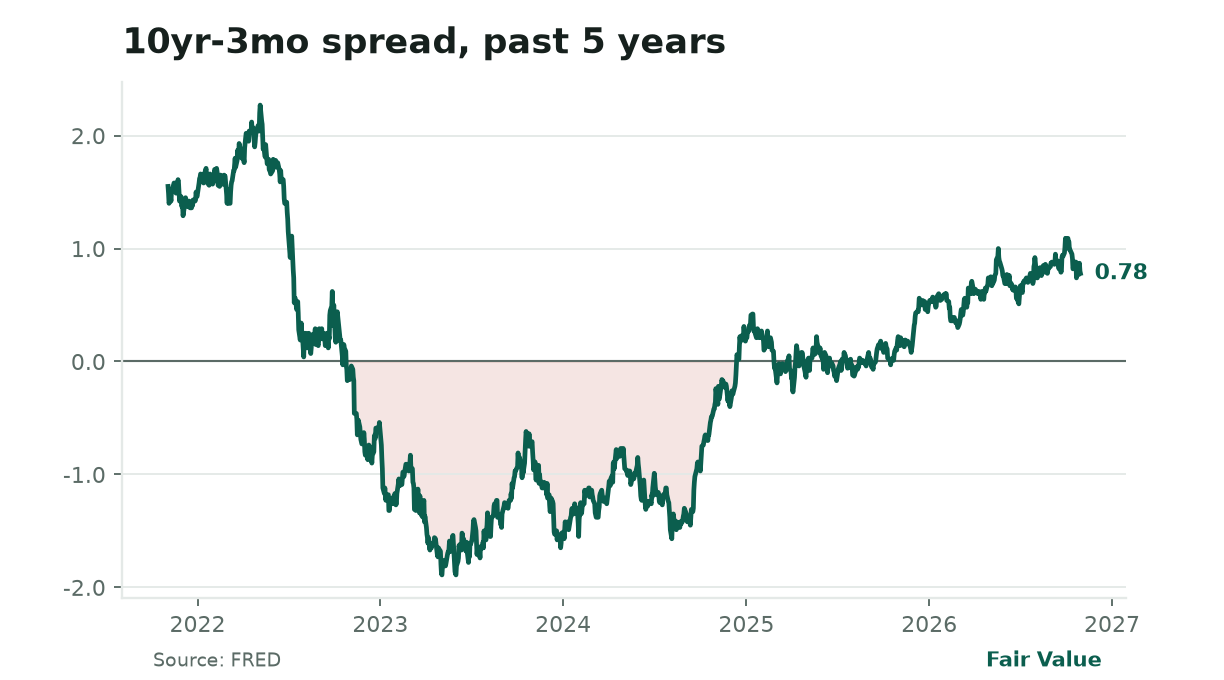 Spread narrowed to 78 bps. The 10‑yr/3‑mo Treasury spread is at 78 bps, its tightest since March 2020; the prior tightening in early 2020 preceded the COVID‑19 recession, after which the spread widened to over 150 bps before gradually tightening again. |
That is the bond market saying lower oil → lower headline inflation → less pressure on the Fed to hike in December. CME FedWatch still prices a 73-85% chance of a 25-basis-point move at the December 8-9 meeting, down from 87% last week. Today's macro calendar is dense. The RBA meets at 22:30 ET tonight (Tuesday 12:30 PM Sydney) with a hike to 4.85% fully priced, the first increase since November 2023. The Bank of England follows Thursday with a 25-basis-point hike to 4.00% expected, and Friday brings the US October jobs report (forecast: 63,000 payrolls, unemployment steady at 4.2%). Earnings take center stage too: Apple reports after the close today, AMD and Pfizer tomorrow, Uber and Snap Thursday. The semiconductor wreckage from Friday, Intel -28.6%, AMD -10.9%, Marvell -10%, gets its first test of whether buyers step in. Crypto traded through the weekend. Binance resumed withdrawals Sunday after the $6.3 billion hack, the largest in crypto history, with the exchange saying it has replaced roughly 95% of stolen assets. Bitcoin held near $77,900, Ether near $2,285, and Solana near $94. Stablecoin supply sits at $298 billion, down 3% in 30 days. The Fear & Greed index reads 37 (Fear), down from 50 a week ago. | | | The big picture The bond market is signaling what the stock market hasn't fully accepted: the inflation fight isn't won, but the marginal pressure is easing. The 10-year at 4.98% is 118 basis points above the Fed's 3.88% effective rate, a term premium that refuses to compress because hyperscaler capex ($691 billion trailing twelve months, up 93.5% year-over-year) keeps sucking up long-duration capital. Five hyperscalers now spend 35.8% of combined revenue and 95.5% of operating cash flow on AI infrastructure. Their aggregate free cash flow has collapsed from $201 billion to $33 billion. That private-sector demand for funding is a structural bid for long-term yields that no Fed pause can fully offset. The dollar reflects the cross-currents. The ICE DXY index sits at 101.6, down 0.3% today and off its October highs. EUR/USD at 1.121 and GBP/USD at 1.341 both gained as Eurozone Q3 GDP beat forecasts (0.4% quarter-over-quarter) and the BOE hike comes into view. But USD/JPY at 158.0, unchanged on the day, shows the 375-basis-point Fed-BOJ differential still anchoring the carry trade. The BOJ's October 31 statement confirmed inflation at target and signaled a December hike, yet the yen hasn't rallied. Hedge funds held net yen short positions in October; market pricing indicated slower BOJ moves. Equity breadth tells the real story. The S&P 500 is 3% off its all-time high, but the Nasdaq-100 is 9% off its peak and semiconductors (SOXX) are 28% below their 5-year high after a 17% one-month drop (z-score -2.0, rarer than 1 in 20). Meanwhile defensive sectors are making highs: healthcare (XLV) +9.8% in October, staples (XLP) +10.9%, utilities (XLU) +10.1%. The market is rotating from "AI will change everything" to "show me the cash flow", and the cash flow isn't there yet. | | | Around the world Middle East: The Iran proposal is the most concrete de-escalation signal since the Strait closure in February. But the conditions, US sanctions relief, military drawdown, recognition of a new Omani shipping lane, are political non-starters for Washington in an election week. Saudi Arabia sounded the "all-clear" after Houthi alerts over the weekend, and Aramco exports reportedly rose in October versus September. Yet the Houthis claimed a Ras Tanura strike last week, and the UN staffer's death in Houthi custody underscores the militia's leverage. The Red Sea chokepoint (Bab al-Mandab) remains active; the Hormuz chokepoint is the diplomatic focus. Both must clear for the risk premium to fully exit. China: Evergrande liquidators have recovered 1% of claims after 30 months, a recovery rate that confirms the property credit engine is broken. PAG bought Evergrande Property Services for $513 million, a floor for asset values. Taiwan reported coast guard harassment by Chinese vessels over the weekend, the latest gray-zone pressure since the October 12 sanctions. The US-China trade truce holds until January 10, 2027, but Xi raised Taiwan directly with Trump in recent talks; Taipei called Beijing the "true disruptor." Japan: The BOJ's October 31 press conference formally declared underlying inflation at the 2% target, "quite close" became "at target." Governor Ueda signaled a December hike, but the policy rate stays at 0.25% for now. JGB yields edged up ahead of this week's auctions. The yen at 158 shows the market still doubts the BOJ's follow-through. Europe: The ECB holds at 2.5% deposit / 2.65% refi. Eurozone headline inflation hit 3.72% year-over-year in September (three-year high), core at 2.57%. Manufacturing PMI held up in October but price pressures rose. The BOE hike Thursday would be the first since 2023, driven by wage negotiations and services inflation. Fitch cut France's outlook to negative Friday; Moody's affirmed but the fragmentation dynamic, Bunds rallying while French spreads widen, persists. Australia: The RBA decision tonight is the week's first central bank test. The cash rate is forecast at 4.85% (up from 4.60%), which would make Australia the first G10 central bank to hike in this cycle after a pause. Australian CPI trimmed mean ran 3.5% in Q3; the RBA's own forecast sees inflation returning to target only in late 2026. A hike tonight would signal global tightening isn't done, and would pressure the Fed's "higher for longer" credibility. | | | Companies making news Apple reports after the close today. The $5.1 trillion giant is expected to post EPS of $1.99 on $113.4 billion revenue. The real focus: iPhone 16 cycle traction in China (where Huawei's Mate 70 launches this month), services margin trajectory, and any color on the Apple Intelligence rollout timeline. The stock is up 3.5% over the past month while the Nasdaq fell 6.7%, a rare relative strength that sets a high bar for guidance. AMD reports tomorrow. Estimates call for $1.95 EPS on $13.1 billion revenue. The data center GPU ramp (MI300 series) and PC client recovery after Intel's collapse are the swing factors. AMD fell 10.9% Friday on Intel's weak PC outlook; a beat could reclaim the sector's leadership narrative. Binance resumed withdrawals Sunday. after the $6.3 billion hack attributed to North Korea's TraderTraitor unit. The exchange says it replaced ~95% of stolen assets; ~$300 million remains unrecovered. Stablecoin issuers froze $3 billion. The breach, the largest in crypto history, tests whether centralized exchanges can survive sovereign-grade attacks without regulatory backstop. Temasek realigned its S$518 billion portfolio. toward AI and private credit, moving Singapore's sovereign wealth fund into the global top 10. The shift from public equities to alternative assets mirrors Norway's GPFG and Abu Dhabi's ADIA, sovereign capital chasing yield and strategic positioning in the AI build-out. Mitsubishi sold a 49.9% stake in its LNG Canada subsidiary. to a Blackstone-led consortium (including CPP Investments) for $3.1 billion. Mitsubishi keeps full offtake rights. LNG Canada's Phase 2 expansion will double capacity to 28 million tonnes/year by 2030, a bet that Asian gas demand outlives the energy transition. METLEN and Shell signed a five-year LNG deal, six cargoes per year (~0.6 bcm) starting 2027, sourced from US Gulf Coast for delivery to Greece. Another data point in the structural rewiring of European gas away from Russia and toward US supply. | | | From Washington The Fed's October 28 "hawkish hold", 10-2 vote, Governors Cook and Hammack dissenting for a hike, keeps December in play. Chair Warsh's comment that rates "get in the cracks" of AI investment signaled the FOMC sees the capex boom as inflationary, not productivity-enhancing, at the margin. The November 18 minutes will show whether the dissenters gained converts. Tuesday's midterm elections could shift House control. A Republican House would likely block clean energy subsidies (IRA implementation) and push spending cuts, fiscal drag that the bond market hasn't priced. The broad trade-weighted dollar at 121.3 remains below the 122 threshold the Fed models associate with acute EM stress, but a hawkish Fed + fiscal uncertainty could push it over. Treasury auction calendar is light this week (no major coupon issuance), but the 10-year at 4.98% and 30-year at 5.32% mean the government's interest bill keeps climbing. Net interest outlays are on track to exceed $1.2 trillion this fiscal year, more than Medicaid. | | | Under the hood The causal chain driving today's moves: Iran diplomacy → Brent -7.7% → 10-year breakeven inflation (T10YIE) at 2.34% → real 10-year yield (TIPS) at ~2.64% → growth expectations repriced lower → Nasdaq -9% from highs, semis -28% → VIX 18.8 (down but elevated) → defensive sectors (XLV, XLP, XLU) at highs. The non-obvious link: hyperscaler capex at 95.5% of operating cash flow means private demand for long-term funding is doing the Fed's tightening for it. Every $100 billion of AI capex financed by debt adds ~5-8 basis points to the 10-year term premium (per ACM estimates). The five hyperscalers' $691 billion TTM capex is effectively a 35-50bp permanent bid for long yields, independent of Fed policy. What would break this read: a core CPI print ≤0.2% month-over-month on November 10 (opens 2027 cut discussion), or a sustained dated Brent close below $105 (signals physical market believes Hormuz reopening is real). What confirms it: November 18 FOMC minutes showing dissenters' logic gaining traction, or 10-year TIPS yield holding above 2.65% (growth concerns not yet outweighing inflation). | | | The long view: What is the Fed doing and why? The Fed is keeping rates restrictive because core inflation (3.12% PCE, 2.57% CPI) remains above target, unemployment (4.2%) is low, and a private-sector AI investment boom ($691 billion hyperscaler capex, 95.5% of operating cash flow) is creating its own demand for capital that lifts long yields regardless of policy. The October 28 hold was a tactical pause, not a pivot: two governors dissented for a hike, the statement upgraded growth to "strong," and the dot plot still projects 4.1-4.4% by year-end 2026. Markets price a 73-85% chance of a December hike. What this means for you: Mortgage rates (7.24% for 30-year fixed) stay elevated because they price off the 10-year, not the Fed funds rate. The 10-year at 4.98%, 110bp above the Fed's upper bound, reflects a term premium that won't compress while hyperscalers issue debt to fund AI build-out. Auto loans, credit cards, and HELOCs track the same dynamic. Housing affordability remains near historic lows; existing-home sales are frozen by the lock-in effect (homeowners won't sell at 3% mortgages to buy at 7%). The reaction function: The Fed eases only if core PCE sustainably trends toward 2.5% or unemployment rises toward 4.5%. It hikes if core CPI/PCE runs >2.5% annualized monthly with resilient growth. The bar for cuts is higher than the bar for hikes, asymmetric by design. What changes the view: November 10 CPI (core ≥0.3% m/m → December hike near-certain; ≤0.2% → 2027 cut discussion). November 18 FOMC minutes (dissenter language). Late November core PCE (monthly pace needs ~0.33% to hit Fed's 3.4% 2026 forecast). Oil: sustained dated Brent >$115 feeding into core via transport costs. Real yields: 10-year TIPS below 2.65% → growth concerns outweigh inflation. | | | Worth learning today: The "risk-free" rate, resolving the RBA prediction Yesterday's edition asked you to predict the RBA cash rate decision (scheduled 22:30 ET today, forecast 4.85% vs prior 4.60%). The decision has not occurred yet, it happens after this brief publishes. We will resolve the outcome in tomorrow's edition. The mechanism to watch: if the RBA hikes, it's because trimmed mean CPI (3.5% in Q3) and services inflation are sticky enough that the board judges "higher for longer" isn't sufficient, they need "higher still." A hold would signal the RBA sees the global disinflation trend (lower oil, easing goods prices) doing its work. Either way, the reasoning in the statement matters more than the 25bp move. Deeper dive: "Risk-free" is a misnomer. We've covered T-bills and money-market funds as the home for idle cash. But "risk-free" only means default-risk-free, the US government prints the currency it borrows in. It does not mean loss-proof. A 3-month T-bill yielding 4.6% loses purchasing power if core CPI runs 2.6% (real yield ~2%), but loses real wealth if inflation surprises to 4% (real yield -0.6%). The "risk" in risk-free is reinvestment risk (rates fall when you roll over) and inflation risk (purchasing power erodes). That's why TIPS exist: they pay a real yield (currently ~2.6% for 10-year) plus inflation adjustment. The trade-off: you lock in a lower nominal yield today for certainty of real return tomorrow. Tomorrow's setup: The RBA Monetary Policy Statement accompanies the rate decision. Which asset is most exposed to a surprise, the Australian dollar (AUD/USD), 3-year Australian government bonds, or ASX 200 financials, and through what mechanism? We'll answer tomorrow. |
| | | What to watch this week | ▸ | Today 22:30 ET — , RBA Cash Rate Decision (forecast 4.85%, prior 4.60%): First G10 hike post-pause cycle; tests global tightening resolve. | | ▸ | Tuesday 8:30 ET — , US Congressional Elections: House control determines fiscal trajectory (IRA subsidies, spending caps, debt ceiling). | | ▸ | Wednesday — , No red-folder events. Earnings: Qualcomm, Uber, Snap. | | ▸ | Thursday 7:00 ET — , BOE Rate Decision (forecast 4.00%, prior 3.75%): First hike since 2023; wage negotiations and services inflation drive it. | | ▸ | Friday 8:30 ET — , US October Jobs Report (forecast 63K payrolls, unemployment 4.2%): The last major data point before the December 8-9 FOMC. | | ▸ | Friday — , University of Michigan Consumer Sentiment (preliminary): Inflation expectations component feeds Fed reaction function. |
|
| |
Not financial advice. This brief is for informational and educational purposes only and does not constitute investment advice or a recommendation to buy or sell any security. Data: macro indicators per FRED® (Federal Reserve Bank of St. Louis); not endorsed or certified by the Federal Reserve Bank of St. Louis. Energy data per the U.S. Energy Information Administration (EIA). Auction data per U.S. Treasury Fiscal Data. Filings per SEC EDGAR. Market prices per Yahoo Finance. Earnings calendar per Financial Modeling Prep. Crypto data per Binance and CoinGecko. WSJ headlines per Dow Jones. |
|
