the torah was given to humans not ai
sholem aleichem,
Every few weeks, Sefaria tries to sell me on yet another AI feature. This week, their “Library Assistant” got the forced pop-over treatment, covering up Sefaria’s sidebar of linked texts (ironically, the main reason so many people use Sefaria in the first place).
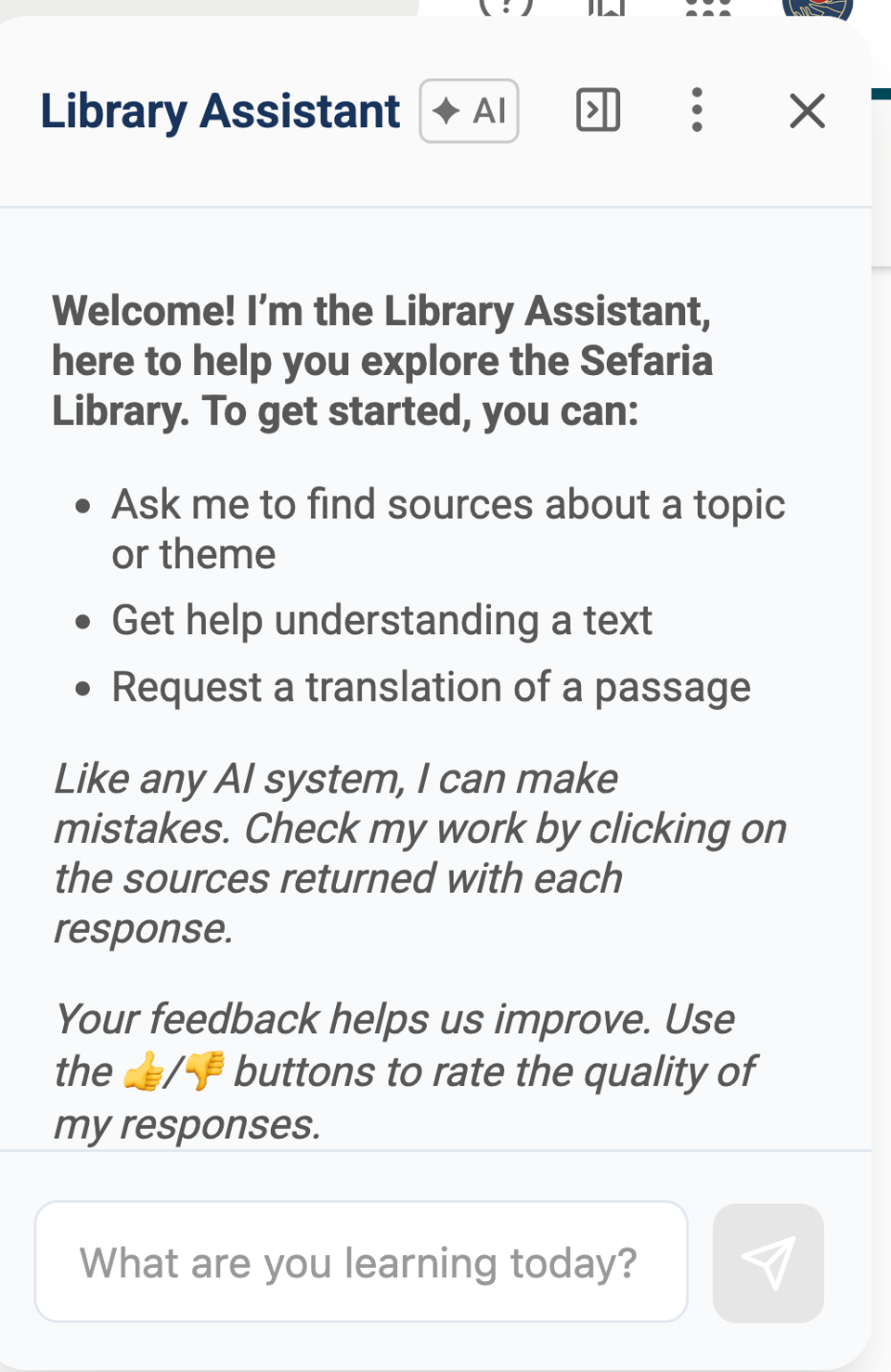
Past AI projects include their so-called “guide” to Pirkei Avos, their topic pages with AI-generated text, and their AI-assisted translation of Kli Yakar.
I no longer donate to Sefaria, but I still use and link to the site extensively.
So today I want to do something a little different, and ask if there’s a point in their AI “journey” where I should stop using Sefaria altogether.
I also want to say that this is a very complex issue, and I am sharing my thoughts as they currently stand. I try to be clear about what I can and cannot know. I am not judging anyone or issuing halachic rulings for anyone. In general please read this charitably with the understanding that I am just a simple Jewish woman, trying to understand her halachic obligations, in a very difficult world. I am extremely open to further conversation and feedback.
Part 1: Using AI Violates Halachah
Sefaria largely uses Claude (by Anthropic) as the base model for their AI projects (although they have also used Google’s Gemini in the past).
In A Jewish Case for AI Work Exemptions, Rabbi Danya Ruttenberg argues that use of Claude falls under a number of halachic prohibitions including: to not benefit from theft, to not destroy the earth, to not commit fraud, to not stand by when we could act to preserve life.
On the first, she writes:
As it happens, I'm one of the many authors whose books (half a million of them!) were stolen by Anthropic AI [for training data]. After a judge ruled that our work was pirated and a class action lawsuit could go to trial, they settled out of court.
Since her piece, the situation has gotten worse, I think, not better. In order to avoid the hassle and expense of legally obtaining the rights to e-books to train their AI models, Anthropic has been buying, scanning, and destroying physical books (particularly, rare ones):
“What is Project Panama?” court exhibit 21 asks, in an internal memo. The answer: “Project Panama is our [Anthropic’s] effort to destructively scan all the books in the world.” The memo advises discretion: “Why use a codename? … [B]ecause we don’t want it to be known that we are working on this.”
One company was, at one point, offering bulk-buys to AI companies of up to a million books at a time. They committed to keeping these purchases secret, since “‘AI company destroys two million books’ is not a headline that generates sympathy.”
I don’t think we know how many rare books have already been destroyed by Anthropic (and other AI companies), some of which may have been the last existing copies. We don’t know if any holy seforim were destroyed in this process, though I imagine it is possible. I don’t know how the employees at Sefaria stomach this desecration; I certainly cannot. Imagine calling your AI tool a “library assistant” as it churns up so-called answers from a company potentially destroying millions of rare books!
I am not a posek. But it certainly seems to me (based on R Ruttenberg’s analysis) that anyone who uses Sefaria’s LLM tools is benefiting from theft, and possibly destruction, of books. And, that is just one of the examples R Ruttenberg gives of AI use violating halachah.
As Sefaria’s LLM systems impact more of the site — even their basic text-linking now uses LLMs — it may be that any use of Sefaria is halachically prohibited.
Part 2: No ethical consumption under capitalism?
Even as I write the above, I am aware that I am typing it on a computer powered by lithium mining, with all its attendant negative impacts on climate, workers, Indigenous rights, and on and on. I own some clothes whose provenance I don’t know, and were therefore quite possibly made with slave labor. I ate ice cream on Sunday and didn’t check the sourcing of chocolate in that ice cream. So, I quite possibly ate child-slave-produced chocolate as well. I still use Google Maps, which (while not itself essentially based on LLMs) is part of a company shoving AI at us left and right.
But I do not think these are compelling arguments for ignoring Sefaria’s AI use.
Because I should pay more attention to where my clothes and food come from! Unless I am starving or in a position where I literally cannot clothe myself otherwise, I should abstain from these kinds of consumption, just as I am arguing for abstaining from LLM use.
The fact that I violate halachah in one way does not mean it is okay for me to violate it in another. Please gd help me to do teshuvah!
And it is, unfortunately, basically impossible to live in my society and country without using computers or benefiting (at least a little) from companies like Google. As R Ruttenberg says in her piece:
In addition, I agree with those who note that we must also talk about cloud computing, Zoom and other aspects of data center work. Ultimately, what we need is regulation and policy change– just as we can't focus solely on individuals recycling while ignoring the fact that the Pentagon is the largest single consumer of fossil fuels in the world.
But here’s the thing.
AI companies like Sefaria want us to think that our world is not possible without them. That life is now or will soon be impossible to live without engaging with LLMs. That we cannot possibly study the words of the living g!d without their soulless algorithms.
But this is not, in general, true!
It is still largely possible to live without using LLMs. Of course, there are cases where it is not, like workers being forced to use LLMs by their jobs, or certain assistive technologies. In such cases, the halachah may be more complex as it weighs different obligations (and that is far outside my authority and wisdom to determine).
But, outside of these cases, we can still live and study Torah without LLMs. And so, if using them is indeed a halachic violation, we must take that seriously.
Part 3: The Ethically Perfect LLM
If all the halachic and ethical problems with LLMs were magically solved, would my opinion change?
It would, but only to a degree.
The Talmud teaches that when Moshe ascended to receive the Torah, the angels objected (Steinsaltz tranlsation): “The Torah is a hidden treasure that was concealed by you 974 generations before the creation of the world, and you seek to give it to flesh and blood?”
Hashem asks Moshe to answer this challenge, and (my translation, based on Steinsaltz)
Moshe said before Hashem: Master of the World, the Torah that you give to me, what is written in it? “I am Hashem your Elokim who brought you out of Mitzrayim”. Moshe said to them [the angels]: Did you descend to Mitzrayim, were you enslaved to Par’oh? Why should the Torah be yours?
Moshe continues answering the angels, asking them: do you perform labor and so require Shabbat? Do you conduct business and require the laws of correct business conduct? Do you have parents to honor? Or an urge to steal that requires prohibition?
LLMs are not angels, but they are comparable (l’havdil) in that they lack the free will and bodysouled nature of human beings, which are precisely the reasons we received the Torah.
Even if all the halachic and ethical issues with LLMs were somehow resolved (and I’m not convinced this is possible), I would still want to learn Torah from someone responsible for and to the Torah. I would still want to know that the words of Torah I’m reading were set down by a bodysoul: by a being with the free will to do right or wrong, by someone who needs Torah just as much as I do.
Part 4: What if AI is or becomes conscious?
I actually do believe that AI is conscious, in the sense that I believe everything is conscious, that chayus (divine life-force) and daas (divine awareness) are fundamental in all existence.
But when people ask this question, they usually mean “what if AI is or becomes conscious like us” — self-aware, capable of free choice, and so on and so forth.
I think it is quite clear that LLM systems are not conscious in this sense yet. If they are or become so, we must immediately stop using them as we are, since if they are or become conscious like us our current use of them would constitute slavery.
In such a world, poskim much wiser than I would have to determine the halachic question of whether such a system could become Jewish, and therefore fully responsible to the Torah. If it were determined that such a thing were possible, and if such a conversion occurred, I would be delighted and honored to study Torah in chavrusa with a fellow Jew.
Part 5: What about accessibility?
Sefaria justifies its AI use with appeals to access. “Lower[ing] barriers to entry” is their first-listed priority on their AI page at time of writing. They open their discussion of AI translation with “Translations are an important component of the Sefaria Library, making Jewish texts […] more discoverable and accessible.”
It is absolutely true that LLMs can increase access to our texts through translation, transcription, vocalization, and other assistive technologies. However, at least in some cases, LLMs only increase access because their use is relatively cheap. And they are so cheap only because LLM companies are not forced to pay fairly for their environmental exploitation, materials, and labor.
Nonetheless, access is an ethical imperative, and, as things stand, I don’t think there is one answer to all questions about using current LLM-based assistive technologies. I think those questions are best answered on a case-by-case basis by the people whose access the technology facilitates.
But I also want to encourage us to think about access not only in terms of accessing the information of our tradition, but also in terms of accessing our traditional practices of text study in our ancestral languages. Just imagine what we could build if we directed a speck of this LLM energy and funding toward Jewish humans learning Jewish languages and Jewish textual lifeways?
If you haven’t experienced it, I don’t know how to explain the transformation that so often occurs when a Jew first learns a line of Torah or Talmud in the original, first feels that holy gift fully present in their human bodysoul.
But every time I see it I imagine a world where we make that accessible to all Jews…
Part 7: So what should we do?
I don’t have one psak to give on how to ethically or halachically engage with Sefaria, or whether that is possible. I’m not a posek, first of all, and these decisions depend on person’s individual situation.
My own intention is to limit my use of Sefaria as much as possible. When I am studying or writing alone (and so I can make the sole decision), I intend to avoid Sefaria entirely (with the possible exception of downloading some of their non-LLM digitized texts).
Part 8: Conclusion
Life of All Worlds, please know Your people’s deep desire to love and care for the Torah that is our inheritance. You gave Her to humans because we alone can choose freely to live in Her ways. Help us to discern the true path from the false, that we may draw healing and life from Your Torah, and not (gd forbid) poison and death.
Good shabbos,
ada
p.s. Thank you for putting up with my stream of consciousness for this long. I’ve been writing pieces like this for a while, but never publishing them because they felt incomplete and meandering. This one does too, but I want to lay out my thoughts, messy as they are, so I can start having conversations about them.
Add a comment: