
Medicare for America + Medicare for 50
Two plans, neither good, for you!
What’s up darlings,
Two newsletters in a week? Don’t get used to it.
In the past week we’ve had two “center-left alternatives” to Medicare for All come out. I’m sympathetic, in a vacuum, to folks who genuinely want to fix healthcare but are wary of doing anything too aggressive to the insurance industry. Unfortunately, a private insurance industry just isn’t compatible with fixing any of the bullshit that kills a bunch of people every year and immiserates millions more. So here are some brief analyses of Rosa DeLauro’s Medicare for America and the Medicare at 50 proposal from my own senator, Tammy Baldwin. In short: they sound nice, and some parts of them are genuinely very good, but ultimately they create self-destructive cycles public plans in the service of making private insurance more profitable.
Thing is, a lot more folks know what Medicare for All is (at least directionally) than they did a decade ago. The term, even if not perfectly accurate, is catchy and people generally understand it to mean “health insurance with no out-of-pocket costs.” The name is here to stay, which means we are going to have to deal with a bunch of bullshit that crowds the field and tries to gleam the cube of the M4A brand — “Medicare for America” is a new example; perhaps you remember Buttigieg’s “Medicare For All Who Want It” from 2020. I am a little fearful that this nomenclature bullshit might at some point divide the base, but more than anything I’m annoyed that these proposals are going to be pains in our giant collective ass for the next two years. So I’ll address them, and I’ll keep it brief (for both of our sakes) so you have something to reference. This is my gift to you: that’s the T-Bone guarantee.
NB: some of the language in both bills is unclear. I’ve made what I think are good-faith assumptions about what DeLauro and Baldwin intend.
I. Medicare for America
DeLauro’s press release trumpets Medicare for America as a “Medicare For All plan that preserves private health insurance.” Sorry, ma’am! Can’t have both!
Med-Am, as I’m calling it, has a bunch of legitimate reforms (like all-payer rate setting) that are totally undermined in service of not only keeping private insurance around but making it more profitable. I don’t care for it!
DeLauro’s plan has some big components. Some of them are quite nice; some of them are mired in the same old bullshit:
A large public option with no application that individuals and employers can buy into, ACA-style. It preserves the employer-employee relationship and is intended to let employees or employers opt in to redirecting ESI subsidies into a public plan.
Reforms to Medicare’s cost sharing — covering long-term care; dental and vision; eliminating the deductible, caps on out-of-pocket costs and means-tested premium subsidies (God forbid we build a universal program).
Some reasonable cost controls via all-payer rate setting, site-neutral billing, and drug negotiation. It’s important to note that these benefit private insurers as well.
A small number of good reforms that a decade of Overton window-shifting have made the norm: loan forgiveness, lifting the residency cap, increasing reimbursements for primary care.
Unfortunately, the way premiums are designed, and the insistence that private insurance needs to be taken care of, completely undermines the public plan. Here’s a helpful (?) table laying out the subsidy and payment scheme:
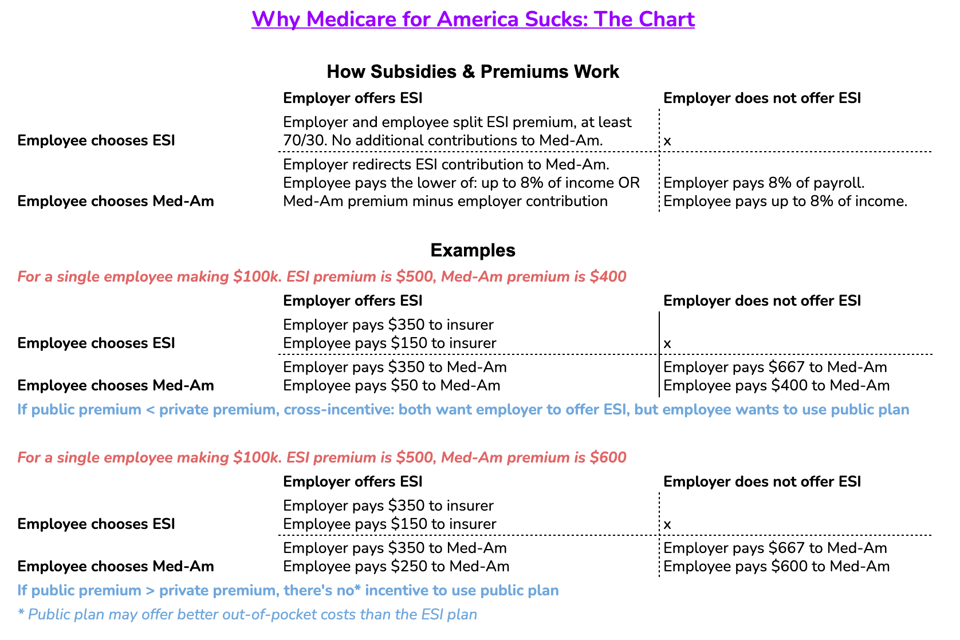
The gist: high-wage employees will always want their employers to offer ESI. If Med-Am is cheaper than ESI premiums, employees and employers alike want to pay based on ESI subsidies instead of the natural Med-Am premium. If Med-Am is more expensive than ESI, employees will stick with ESI unless they need the extra benefits Med-Am covers.
In effect, this means that high-wage workers, who contribute the most money to the public plan and use the least care; the backbone of the risk pool; are incentivized to stay out of the public plan, while the sickest folks are drawn to it. This is antithetical to how a risk pool works — since 50% of healthcare costs come from 5% of the overall population (a dynamic 5%; some years you get cancer or birth a kid or get plowed over by some dipshit looking at TikTok while they drive and some years you don’t), you need as many of the folks who don’t need care in a given year to contribute premiums to balance out the costs for everyone else: the fundamental concept of insurance.
This inevitably turns a two-tier healthcare system — which, as we’ve seen in other countries, is K-shaped (a helpful term we’ve all learned in the past five years).
The whole fucking point of universal coverage is that we all pitch in, then get the care we need when we need it. Anything short of a consolidated risk pool damns the public plan to higher per-capita costs and higher premiums and thus incentivizes private coverage further — a death spiral for public healthcare.
To add insult to injury: since the private insurer's costs are regulated by the private insurer, it gets to pay lower healthcare prices, but doesn’t “earn” those lower prices through negotiating power. Combine that with a consumer base of high-income, healthy people, and the money machine turns on for Aetna/Elevance and UnitedHealthcare. Medicare for America turns private insurers into free riders who benefit from the public shouldering the costs of the people who really need health insurance. As if they couldn’t get any more parasitic!
II. Medicare at 50
Here’s Tammy Baldwin’s press release.
Don’t get it twisted: I think there are viable paths to incrementally expand public healthcare on the road toward Medicare for All. Bernie Sanders calls for dropping the eligibility age to 55 (and covering everyone under age 18). Unfortunately, Tammy Baldwin’s plan doesn’t meet the moment — and there’s a reason Bernie’s not on this bill.
In general, I support increments toward M4A if they do most or all of the following:
bilaterally expand the risk pool
strengthen Medicare purchasing power
expand covered care (vision/dental)
lessen privatization
most importantly, divorce income from healthcare coverage and protect patients from healthcare costs.
Under these criteria, I am left undazzled by Baldwin’s plan. It’s a Medicare buy-in plan available to folks age 50–64, modeled as if it were a plan on the ACA exchange, and thus subsidized in the manner of, and bound in the same ways as, a plan you might buy on healthcare.gov.
It’s got similar issues as Medicare for America: High-income people are excluded from the buy-in, people with shitty ESI have to keep it, low-income people are stranded in the netherzone, and states reap none of the benefit of federalizing care.
Some issues:
Premiums and subsidies. A refresher: Medicare Part A covers hospital care. Part B covers all other physician care (and other stuff). Part D is drug coverage. Medicare Part C is Medicare Advantage, the private plan that combines A, B, and D and receives generous federal subsidies to do so (boo!).
For 65+ people, Medicare premiums cover ~25% the cost of Part B. Baldwin's buy-in population is charged 100% the cost of the program, with some ACA-derived subsidy options. That's a much larger sum of out-of-pocket costs that ultimately weakens the buy-in model. While it’s likely that the 50–64 population is less expensive than the 65+ population, making them pay 100% of costs means a Part B premium alone might be in the neighborhood of $800/month (4x the premium amount for Part B right now). I’m not totally certain how this bill would interact with Part A premiums, which aren’t subsidized the same way as Part B, but a full-freight Part A premium is $565/month, so assuming 50-64s are an arbitrary 2/3 as expensive as 65+s, you’re looking at upward of $1100/month for Parts A & B alone.
Similar to Medicare for America, there is an active disincentive for folks to move from employer-sponsored insurance to the Medicare option. ACA credits only apply to people who aren't offered insurance at their job, and there's no indication that this precedent changes for people 50+ with ESI — if you work at Don’s TV Dinner Factory, and you’re offered a bronze-tier-equivalent plan with a minuscule monthly subsidy, you’re stuck with it. Since the buy-in excludes people with ESI, who tend to be healthier and wealthier, once again you might also just have a public plan with a sabotaged risk pool and a bunch of expensive folks on it, increasing premiums.
It is unclear to me the relationship between ACA premiums and Baldwin’s buy-in premiums. Buy-in subsidies will be calculated the same way that ACA premiums are — based on the second-cheapest qualifying silver plan — and it's possible that the Medicare buy-in premium is large enough relative to ACA marketplace premiums that a subsidy based on the ACA model is insufficient to make the buy-in affordable. And this doesn’t account for the total kneecapping of ACA subsidies under Trump.
Medicaid interactions. States pay Medicare premiums for their Medicaid beneficiaries, and Medicare becomes the primary payer — meaning Medicaid is off the hook for (most of) their care. That’s really important for state budgets, which are put under hard times by Medicaid costs, a problem that is going to get much, much worse with Trump’s Medicaid cuts. Under Baldwin’s plan, people eligible for both Medicare and Medicaid are explicitly excluded from the buy-in — Wisconsin can’t pay for its Medicaid recipients 50–64 to get on Medicare. This means low-income 50-year-olds are stuck at the whims of their state program — very bad for Texans, for example — and constrained state budgets are given no relief by expanded Medicare.
Medicare Advantage is left alone, which I don't like, but it's not made worse. The Medicare product isn't improved, and coverage isn't expanded to include dental or vision care. Medicare's exposure to cost sharing, plus the weight of the premiums, may make Medicare Advantage plans more appealing for 50–64s, which is bad for Medicare, very good for private insurers (a market that is currently under bipartisan investigation for massive fraud and waste), and bad for patients if they ever develop a major or chronic condition after age 50.
OK! That’s it! Now you have an email you can look at whenever these come up. Keep on trucking out there.

Thanks to the kids and adults at the SNaHP conference I spoke at on Friday. It’s really really really nice to talk to med students joining the fight. As always, feel free to bring me out to come speak to your group. Or cross your fingers, wait, and hope: I’m working on getting on the road again.

Add a comment: