Photography as historical analogy
Dear readers,
After the invention of photography, something happened to art. Here I don’t mean art itself but rather how it was understood: as a category that had had something done to it. It was changed — had changed — in response to the introduction of a novel technology. A machine now reproduced nature; human artistry was waning.
Then as now, these stories were mobilized to make a fable out of fear: people are fearful when confronted with new technologies. But those who overcome these initial doubts and learn to work with new mediums and forms of expression will be rewarded. Again and again, these stories are recounted to shape public perception of technical novelty.
These modes of storytelling couldn’t feel more contemporary. Recently, an article posted on the MIT Press Reader by a professor of psychology named Danny Oppenheimer opens with what has, by now, become a meme: “From today, painting is dead!” declared the painter Paul Delaroche upon seeing a photograph for the first time.
Or did he.
In 2001, the art historian Stephen Bann contextualized this quote in his book Parallel Lines: Printmakers, Photographers, and Photographers in Nineteenth-Century France, suggesting that rather than a sincere response to the introduction of photography in 1839, the quote had become a quasi-mythological expression of the assumed anxiety provoked by the introduction of photography.
For Oppenheimer, photography’s disruption — creative acceptance and experimentation quelling anxiety — is a perfect metaphor for the more recent introduction of LLMs. He goes so far as to argue that far from being a negative force for human creativity, the artist of the future will be a “prompt engineer.”
Oppenheimer himself admits to being a prompt engineer, acknowledging that the very article we are reading has been “written with a healthy amount of AI assistance.” Though he notes that he used AI to help him “track down and verify quotes,” whatever model he used does not appear to have referenced Bann’s scholarship on the subject. And while the author admits that his “art history knowledge isn’t deep enough” to have written the article without the help of AI, Oppenheimer persisted in the quest.
The claim, in short, is that “AI” is good actually because artists didn’t stop making art after photography was introduced in the first half of the nineteenth century.
This historical analogy is a favourite one for those opining on AI criticism — if a past technology was met with apprehension and civilization continues, all future technologies must be fine, obviously. Actually, art got better after photography, now that artists didn’t have to be tied to “reality.”
This is a bad analogy. And yet, if you were to take this analogy seriously, I’d come away with a few different takeaways:
In France, the daguerreotype was a craft process purchased by the state so that the method could be used and adapted freely and widely by citizens.
When photographic materials were commercially manufactured, they were often produced by companies using materials sourced from around the world — often mined and extracted far from where the products were then used.
Photographic technologies (both cameras and photographic materials) came under increasingly monopolistic corporate control towards the end of the nineteenth century — a process sometimes described as the democratization or popularization of photography.
Finally, as many have argued, photography did not disrupt or displace other systems of representation, it co-evolved with them. Artists didn’t become photographers, nor did photographers become artists — artists used the tools and techniques available to them.
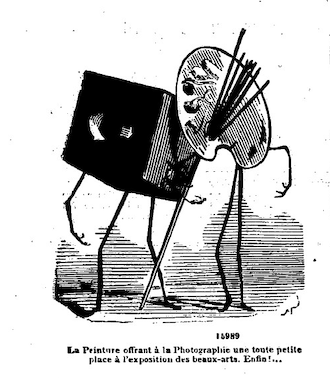
Nadar, “La peinture offrant à la photographie une toute petite place à l'exposition des Beaux-arts. Enfin!“, Journal Amusant, no. 172, 1859.
For those wishing to underscore the power of a novel technology, fear or distrust is indicative of the awesome potential of the new. The more fear, the more extraordinary the disruption to come. The analogy breaks down quickly but like all stories, stories about new media have a larger ideological point to make. The only reason for critique is fear, they say, never understanding. Artists fear AI because they have failed to adapt, not because they critique a system in which human learning, education, and creativity are profoundly devalued; where astounding resources are used to create an image of robots taking daguerreotypes. No, “artists” — that famously singular group — have it wrong. AI is good actually because now they don’t even have to make anything (a real détournement of the “I could make that” guy at the museum meme).
Taking Oppenheimer’s historical argument seriously risks annoying the reader — it is so obviously in bad faith — but I still think there is something instructive about the regular return of the invention of photography as an analogy. What happens if we naturalize the idea that anything other than fawning acceptance of a new technology is just a lack of acculturation? These stories of “acceptance” — or what the art historian Sonja Drimmer has called “slogans masquerading as history” — narrativize hype cycles. Analogies are rarely complex (leave that to the historians) but to tell the story of invention as a two-step dance between introduction and acceptance leaves a whole lot out.
Sincerely,
Emily