on gunpei yokoi and the virtual boy

The Virtual Boy was conceived as a high end toy, it’s important to remember that. Less a gaming system and more a digital successor to perspective boxes, kaleidoscopes and the long legacy of visual trickery through self-contained objects. Well at least that’s what I tried to tell myself again and again this week in working my way through its clumsy and awkward library of games. Having already incurred my wife’s mockery with the purchase of a ridiculous cardboard box headset to play a newly released re-creation of the 1995 system and now finding myself looking directly at a bewildering alternative vision of three dimensional gaming.
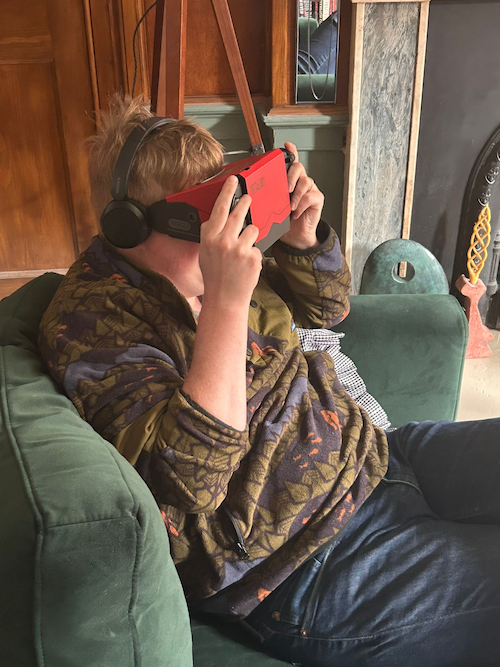
The decision to release it as a new videogame system to compete with the new Sony Playstation was ultimately a marketing one, made against the wishes of its creator Gunpei Yokoi. It would last less than a year on the shelves before being abandoned, still the worst selling Nintendo console by an order of magnitude. In Japan it was done in five months, it never even got round to appearing officially in Europe. Yokoi would begrudgingly point out that its 770,000 sales would be considered quite good for an executive toy in that era. Nintendo however desperately wanted to move the conversation on, away from disappointment and onto the vivid colours and joyful freedom in the acrobatic adventures of Mario 64.
Gunpei Yokoi is best known today for his most ubiquitous creation, the Gameboy, but his career acts as a useful bridge connecting Nintendo’s origins as an illustrated playing card company to the entertainment behemoth it is today. Hired in the mid-60s as an electrical engineering graduate to maintain the ancient printing presses on which the company produced their traditional card sets, he arrived at a struggling company trying everything to appeal to new and younger markets. Even by the diverse range of operations of a Japanese conglomerate, a culture where Yamaha is somehow simultaneously both a famous musical instrument and motorbike company, attempts at shifting to selling Instant Rice and operating as a Taxi business felt desperate.
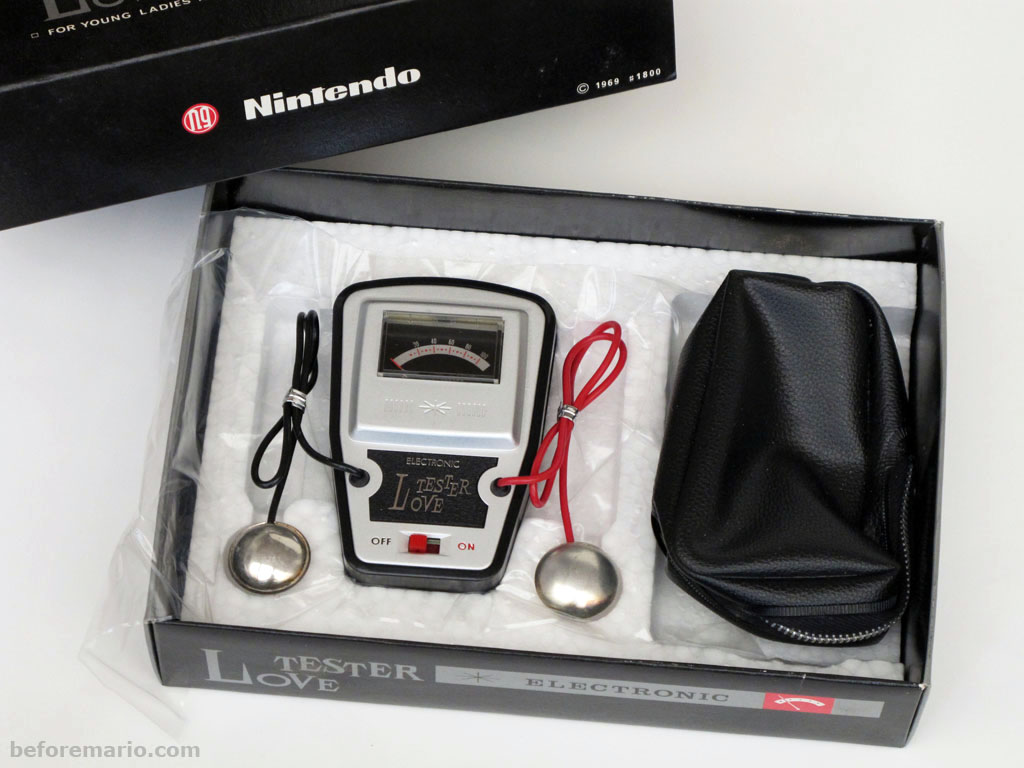
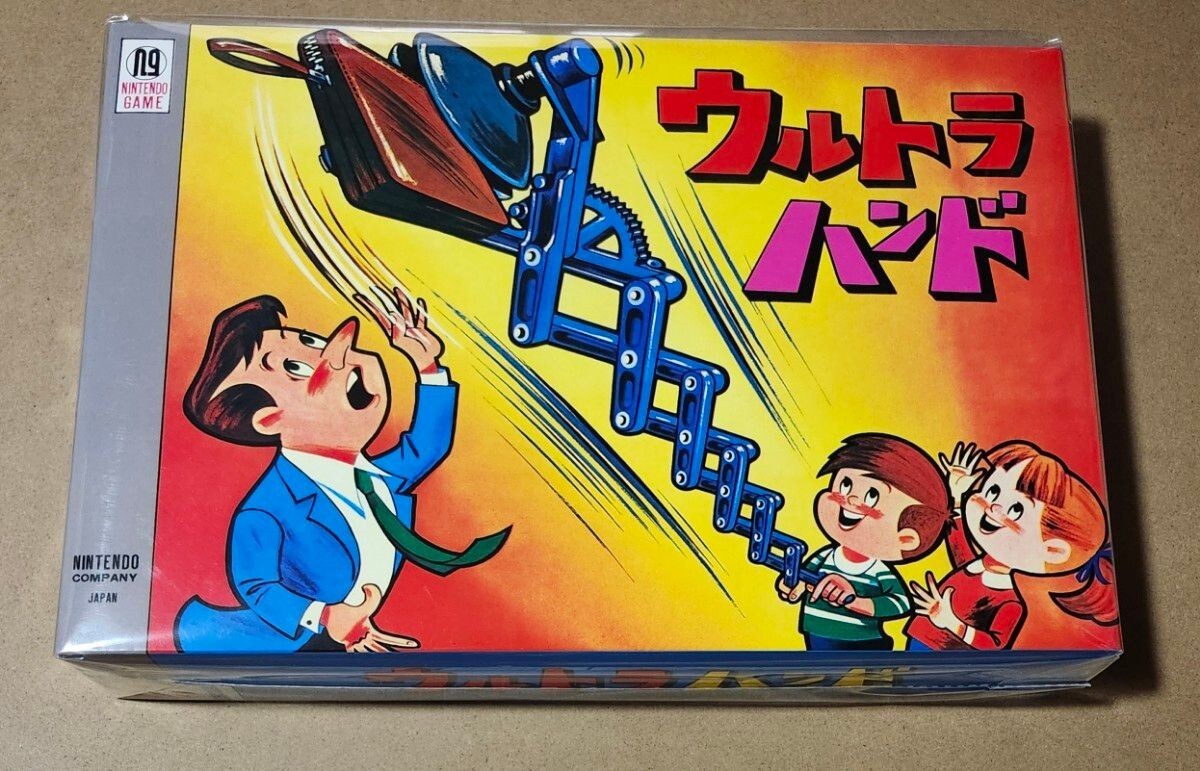
Yokoi was in the exact right place however and management caught on to his tendency to take advantage of the company's machine shop to prototype toys for his own amusement instead of working, seizing upon it as an opportunity to re-position the company. A particularly striking invention of his, given how comically at odds it is with the company's family friendly brand today, is the Love Tester. An analogue meter with two dangling cables, it promised couples who each held an end a precise compatibility rating out of a hundred. More typical of his designs however is the Ultra Hand, an oversized and unwieldy long plastic scissor device which players have to learn to manipulate to pick up and stack a series of coloured objects. It was his first commercial success and as a consequence Yokoi was allowed to lead the production of more toys, mostly akin to the sort of thing you might buy in Flying Tiger at the last minute for a work Secret Santa you don’t know very well.
It’s tempting now to trace their legacy as a toy company through to the present day. An inescapable remnant of the past, like those satellite images of Germany where the old border between east and west is visible in the colour of their lightbulbs. You can see it still in what distinguishes them from their biggest rivals: the focus on appealing to children, the primary colours of their virtual worlds, how Nintendo games often have an emphasis on simple playfulness in contrast to the Hollywood ambitions of their rivals. Yet in truth these differences are marginal compared to how dramatically video games would come to evolve organically beyond the philosophies of their early pioneers. The progression of the average modern Nintendo game is much closer to the emotionally stirring horror of The Last of Us than it is to a toy.
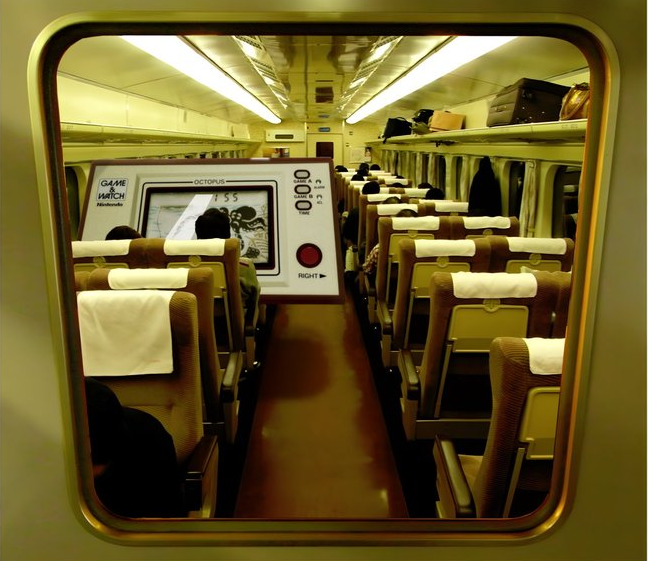
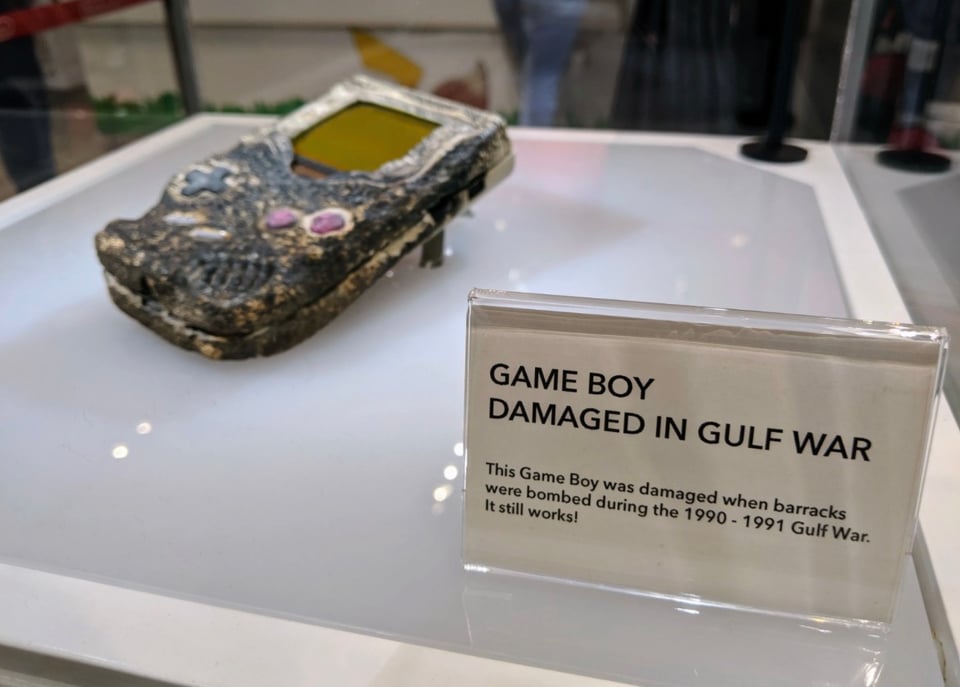
Yokoi would be killed in a motorway accident in the late nineties, but his name would return to prominence in the mid 2000s as Nintendo took advantage of two of his guiding design theories in creating the DS and Wii systems. Yokoi believed in what he called "the lateral thinking of withered technology". The Game and Watch, his early handheld gaming device, came from observing Japanese commuters in the eighties tapping mindlessly on their calculators to pass the time and wondering how that primitive LCD display technology could be turned into something a little more fun. The Gameboy would dispense with years of technological advances to focus on durability and battery life. A display in the Nintendo store in New York holds one which survived being bombed during the first Gulf War, which is mild punishment compared to what I subjected mine to as a child.
After a period of decline in the early 2000s, the introduction of the DS and Wii would see Nintendo choosing to avoid competing graphically with Playstation entirely, instead repurposing older technology to work with a touch screen and motion controller to massive global success. While there’s a bit of corporate self-mythologising at play here, there’s something charming about Yokoi’s mindset too. Finding creative solutions within technical constraints is fundamental to a lot of what makes games interesting, a form of forced problem solving which would generate entire gameplay genres, visual landscapes and storytelling approaches. Why should this not be as true for developing hardware as it is for software? His conscious focus on the hidden power of older technology is a pop culture echo of one of my favourite history books, The Shock of the Old by David Edgerton, which uses examples like the Wehrmacht’s reliance on old fashioned horse transportation for logistics as they Blitzkrieged across Europe in WW2 as a way of illuminating how much of the story we miss by focusing exclusively on the cutting edge.
The Virtual Boy also ran away from the most advanced technology available to its creators at the time. Eschewing the unrealisable ambitions of a broader early-nineties VR drive by relying on mechanically rotating mirrors reflecting a single vertical line of red LED lights to create a low cost illusion in just two colours. A youtube video using high frame rate cameras to pinpoint how exactly this works to trick the eyes into seeing a full image with depth is a little bit of magic in of itself. Yokoi believed that the TV based videogame was a limited market which had now been maximised, and greater rewards came from trying to expand his ideas of play to customers outside of it. Unlike the Virtual Boy, mid 2000s Nintendo games like Dr Kawashima’s Brain Training, Wii Sports and Wii Fitwould find astonishing success in embracing this theory, now dubbed a "Blue Ocean strategy". Though Yokoi would insist that the commercial fortunes of his own device could have been turned around if just presented as a toy and the product’s brand not allowed to be poisoned by the expectations of passionate gamers. In hindsight this is obviously self-delusion but regardless he didn’t get a say and soon departed the company, while the Virtual Boy evolved into a punchline over its commercial failure, technological weirdness and tendency to produce rapid headaches. Very few people could actually claim to have ever played it, especially in this part of the world.
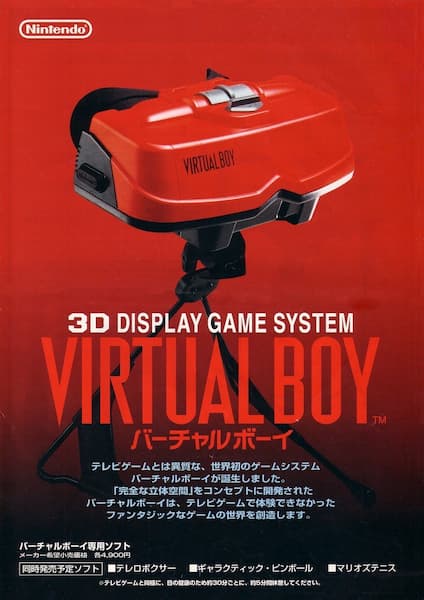
The first thing that’s striking about personally trying it for the first time now three decades later is that it is still a very cool effect. Time has been kind to its two colour palette and the illusion it seeks to build of immersive three dimensional reality via layers of 2D sprites. It is no longer part of the long march towards greater graphical realism and can instead be appreciated for its distinctiveness. Nothing really looks like this anymore, which on one hand is fair enough given how many headaches its distinctive red colour palette created. Yet it also distances it from the rapid cliche forming that’s a side effect of the gaming industry’s endless mining of its own visual heritage. It’s a look that could only have come out of a particular moment, before polygonal worlds were available on the technology but when the knowledge of how to use 2D effects was at its most advanced. A little bit more processing power and there was no reason for it at all.
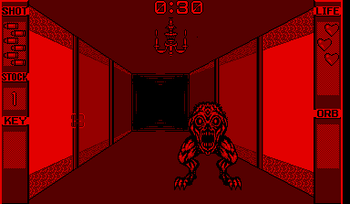
On their much later 3DS handheld Nintendo released a series of 3D versions of classics like Super Mario Bros where their backgrounds and foregrounds were represented on different layers. As impressive as that system's ability to display depth without glasses or a headset was, they didn’t have much impact, and felt more like an excuse to resell you the same games again. The Virtual Boy doesn’t feel like that at all, the depth effect is totally different, the illusion is transportative despite itself. Always pulling you in while it simultaneously alienates you. Even at its most unpleasant and claustrophobic, as in the bombardment of shades of reds in its horror FPS The Mansion of Innsmouth, it is surprising that it can have the hold on you it does. I can see why Gunpei Yokoi thought he had something here all those years ago. At least to show off, a brief but thrilling novelty to appreciate with someone before you move onto something different.
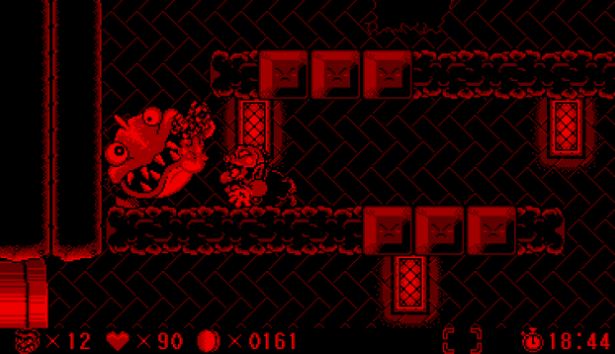
It’s ironic then that the most compelling game on it, Wario Land VB, is so far from that specific vision. Designed from the same mould of Nintendo’s best side-scrollers, with an expert balance between action and exploration, creative boss battles, lively music and the Wario Land series’ characteristic playful animations. The game uses the system's depth effects shrewdly, adding to the atmosphere of each stage by building up the environment through different background details and shades of red in what Seeing Red, Jose Zagal and Benji Edwards’s book about the system, dubs "layered dioramas". In the game, enemies routinely move between the layers of each stage to create novel challenges while exploration is handled by allowing Wario to move back and forth across them to expand the space of each level. While clever touches, ultimately the game would be almost as good if released for the Gameboy like the previous Wario Lands. The gameplay could be replicated in two dimensions with careful use of shadows and angles. As an experience it is best played in the sort of lengthy sittings the technology repels, taking your time to enjoy the imaginative world and find the hidden areas.
More appropriate for the system then is a game like Teleroboxer. A first person sci-fi boxing game which puts you face to face with a large robot enemy throwing punches you need to find a way to block or dodge. There’s nothing more to it than the sequence of enemy robots and their different timing challenges, but the illusion is fantastic, both seductive and transparently artificial. Each robot feels like an elaborate cardboard halloween costume, built up of 2D layers moving together. You can see exactly how it works, but that’s much of the pleasure. I have no idea how to beat the second opponent, but I enjoy it even when my on screen visor cracks with their final punch to signal my latest defeat.
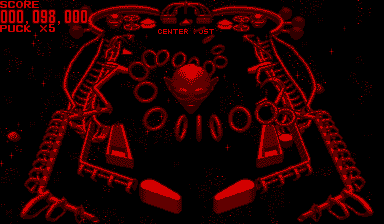
My favorite game on it is called Galactic Pinball. It is an otherwise straightforward digital pinball game, perhaps held back slightly by the colour range when distinguishing the different targets on the board. Yet the overall effect is as if the science fiction themed boards exist suspended in the infinite darkness of space. The black background truly seems to go on forever. As you become absorbed in keeping the little ball moving around this sensation becomes progressively more strange and entrancing, unlike anything else I have played. A popular installation piece in modern art galleries are Yayoi Kusama’s infinity rooms, where visitors enter a small dark space covered with mirrors and the door is closed behind them. Before you are quickly shifted out by a stressed staff member managing a lengthy queue armed with self-sticks, small arrangements of lights will seem to recur into the eternal distance. It’s nowhere near as striking as the effect in Galactic Pinball.
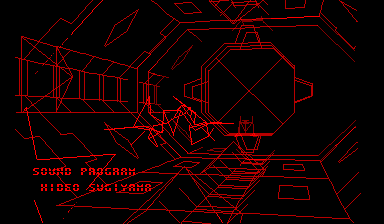
The infinite darkness reappears often, perhaps most oddly in Red Alarm, an early three dimensional space shooter which uses red wireframes to create its entire gameplay. In screenshots this looks like a much less impressive version of similar games at the time, such as SNES Star Fox, and surely impossibly visually confusing. In the depth of the Virtual Boy however this assemblage of see through objects has the same wondrous push and pull which defines the system. Both tricking your brain into understanding them clearly as spaceships flying through indoor tunnels while being transparently false in a way you can’t ever avoid, every object letting the darkness through. It’s not actually a very good space shooter though, but you only really care if you try and play it too much.
It’s testament then to Yokoi’s instincts as a toy maker that I discovered from an interview with his Japanese biographer that the infinite black background was exactly what first drew him to the technology when he was first shown it. He knew what he had all along.
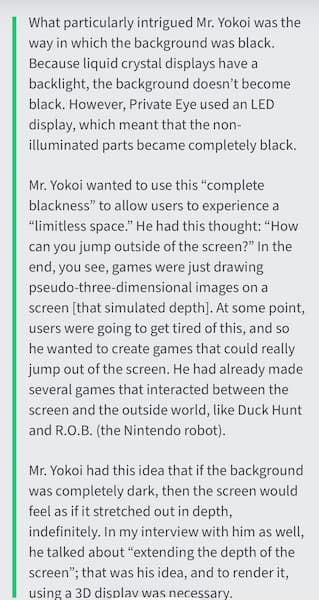
from Ars Technica Interview with Takefumi Makino
read more blogs at microfixations.co.uk