
Why I Worry
Not an AI safety topic in this post. For a while now (at least a year, probably longer) I've been worrying about the financial aspect of the "AI boom." I thought I would write about this topic as Anthropic looks like it is seriously prepping to IPO and the rumors of a massive $2T (trillion) valuation keep getting circulated. Am I qualified to write on this topic? Maybe not, but when dinosaurs ruled the earth 🤣, I got a degree in accounting and economics and got a CPA license. Really bad career move, but I recovered quickly enough.
"PitchBook" from Morningstar provides some very interesting insights from a leaked draft IPO disclosure document. Anthropic’s Leaked Financials Reflect Fast Growth, but Not a $2 Trillion Valuation. Although I agree with the conclusion in the title, I think that the article is actually fairly bullish on this IPO (or at least more bullish than me).
The revenue ramp is astounding. Anthropic generated $4.73B in revenue in Q1 2026 and more than $11.5B in Q2. In July alone, revenue was running at an annualized rate of more than $65B, or roughly $5.42B for the month. If August and September merely matched July, Q3 revenue would be about $16.25B — another ~41% sequential increase over Q2.
Free Cash Flow (FCF)
A $2T valuation divided by $65B in annualized revenue run rate gives us 30.8x revenue for the valuation. A simple but very effective way that financial analysts determine if a valuation is "worth it" is by performing calculations on the "free cash flow" (FCF). How much cash does the business generate. Microsoft in 2025 had a FCF margin of about 25%. In 2026 it is closer to 20% ($67B FCF). Yes, you guessed it, spending on capital infrastructure ate cash during 2026.
Look at what happens at a $2T valuation for Anthropic assuming an excellent 30% FCF rate.
| Eventual FCF | P/FCF at $2T | Revenue needed at 30% FCF margin |
|---|---|---|
| $50B | 40× | $167B |
| $60B | 33× | $200B |
| $80B | 25× | $267B |
To achieve a "less ludicrous" 25x Price / FCF ratio, Anthropic has to generate $267B in revenue and $80B in FCF. The takeaway from this is that Anthropic has to out-perform Microsoft on some key metrics in order to "deserve" that valuation. At 30% FCF rate, Anthropic must become more cash-generative than Microsoft is today while living inside a cash-burning compute-capex cycle.
Let's dissect it even further. Besides achieving an astounding 30% FCF rate, Anthropic would have to make the following transitions:
- $65B run-rate → $200B+ durable revenue
- ~44% estimated gross margin → roughly 70%
- cash-consuming compute expansion → enormous positive FCF
- usage-sensitive customers → durable retained customers
- rapid model commoditization → sustained pricing/economic power
Infrastructure Commitments
The Morningstar report reveals that Anthropic has made approximately $518B of infrastructure commitments over a decade with 80% non-cancellable even in the face of under-utilization. On a simplistic linear scale that is $41.4B / year against the current $65B revenue run rate (revenue, not cash flow).
On the customer-demand side, Morningstar notes that many large customers can reduce spending at any time. Compute demand can fall while roughly 80% of Anthropic's infrastructure commitments remain payable. The unknowable thing is will the upward demand curve continue? If it does, their commitments perform exactly the way they intend. But the ugly truth here is the customers have the leverage.
Near-perfection is the necessity of success
The Morningstar report has this summary at the end:
At about $2 trillion, the proposed valuation assumes that growth continues, customers stay, contracted capacity is used, and margins rise enough to generate tens of billions of dollars in free cash flow a year. We would need to see meaningful progress on those points in the public filing before supporting that valuation. Third-quarter revenue well above $16.3 billion, or evidence that compute costs are falling as a share of revenue, would strengthen the case, but would not by itself establish that $2 trillion is justified.
Note what is necessary:
- Growth continues
- Customers stay
- Contracted capacity is utilized
- Margins rise
These are AND conditions, Anthropic needs all of these to hit and maintain that valuation.
And note that these necessary elements are inextricably linked. Weakness in one engenders weakness in the others.
Business Execution
That seemingly simple list of necessary successes is powered by flawless execution in many areas:
- Frontier Model Development (ahead of competitors)
- Durable enterprise sales contracts and customer retention
- Large-scale consumer business that generates revenues, profits and free cash flow
- Dealing with regulators and political elements
- Managing public perception and brand reputation
- Near-perfect prediction of demand versus capex commitments (much of which is already locked in place)
- A good track record of safety to deserve running enterprise workloads
These are the transitions that a $2T valuation demands:
research lab → product company → hyperscale infrastructure operator → enterprise vendor → global large-cap public company.
Anthropic, OpenAI and xAI are young companies whose leaders are largely untested in the “Major League” they seek to enter. Musk at least has SpaceX and Starlink as evidence that he can execute businesses at enormous scale. Anthropic and OpenAI have no comparable history of operating durable, massively profitable global businesses over decades.
At a much saner, but still historic, valuation ($700B - $1T let's say), Anthropic's meteoric business ramp would be a bull case for their IPO. But at $2T, spectacular growth is merely table stakes. Their job at a $2T valuation is to run that table with near-flawless execution. From a company that is entirely untested in that realm.
Circular Contagion
Moving up to analyze the larger "AI economy" (which is much of the engine powering the entire economy right now), consider what we are explicitly saying today:
- Anthropic and OpenAI succeed → huge compute expenditures are justified
- xAI succeeds → its giant GPU/data center infrastructure investment make sense
- The labs succeed → hyperscaler AI capex has customers
- Hyperscaler capex succeeds → Nvidia/Broadcom/AMD growth assumptions hold
- Chip demand holds → data center buildouts, power contracts and financing makes sense
Yet ... these entities are simultaneously suppliers, investors, creditors and ... competitors.
The Bank for International Settlements creates an annual economic report. BIS Annual Economic Report 2026. They provide a good summary of the dangerous circularity we see today (page 25):
The opacity of AI-sector financing compounds these vulnerabilities. Hyperscalers, chip makers and AI labs are linked through a complex web of private arrangements. The most prominent is circular financing: chip makers and hyperscalers take equity stakes in AI labs or neocloud providers, who in turn commit to multi-year purchases of chips or computing power. Data centre construction is increasingly outsourced to third parties that lease facilities back to hyperscalers on long-dated contracts with embedded exit clauses. The terms of such deals are typically poorly disclosed, with risks of the same asset being pledged multiple times. Together, such arrangements account for a sizeable share of sector-wide financing and forward revenue.
How much? Circular relationships among AI firms: 55.2% of incoming investments in AI firms came from other AI firms. And: ... 46.4% (by deal value) also involved commercial supply chain relationships between the investor and target firms.
The reality is that the valuation of one node is inextricably linked to the valuation of another node or nodes. The Anthropic / Broadcom deal is a great example: Broadcom may lend Anthropic up to $42B to help Anthropic pay for infrastructure involving Broadcom technology. Simultaneously, Anthropic is projected to become Broadcom's largest chip-design customer. Reuters.
Many people (including the BIS) have compared the current AI boom to the railroad buildout in the 19th century. There are some similarities in terms of over-investment and circularity. But when the bust cycle happened, some railroads went bankrupt, but the physical infrastructure remained. Railroad overinvestment is therefore an incomplete historical analogy, not an irrelevant one. Railroad busts were painful and had economy-wide consequences. But today's AI buildout adds a different feature: a highly concentrated network in which the same firms are simultaneously financing, supplying, buying from and competing with one another. That risk is much scarier:
Correlated overinvestment financed through reciprocal relationships is a powder keg under the global economy.
Closing words
Getting back to Anthropic and their IPO, my personal opinion is they are reaching for the stars or following Icarus into the sun when a more modest (but still stupendous) valuation would reduce expectations somewhat and allow them to "grow into" their valuation. There are three companies that achieved $2T valuations that are worth briefly discussing: Microsoft, Google/Alphabet and Apple.
(I had GPT research the data and generate this table for me):
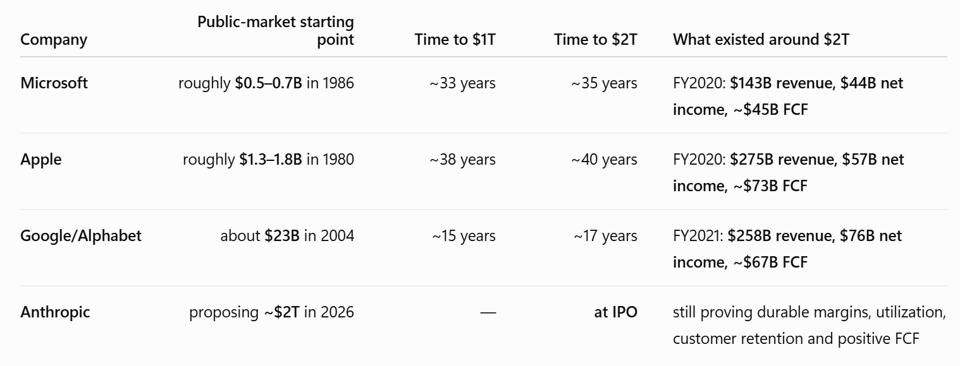
Microsoft went public at $21 a share in March 1986. Microsoft records FY1985 sales of $140M and FY1986 sales of $197.5M; contemporary valuation estimates put the company at only several hundred million dollars around its IPO. Apple's story is similar with an even longer ramp.
Google is perhaps an even more interesting comparison because it was the "go-go new darling" of the early 2000's. Even Google had to cut its initial IPO share price range from $108-135/share to $85-95/share. The market dictated that some of the future valuation should be both earned and left to future investors.
If Anthropic targets (or the market demands) a more modest valuation, Anthropic will have room to be imperfect. At $2T, there is very little room for error. A misstep and a lower post-IPO market share price will make all future financing more expensive and the retention of talent that was promised that incredible valuation much more difficult.
Anthropic is asking investors to teleport it to the destination before it has traveled the road. Microsoft, Google, and Apple grew into their trillion-dollar valuations. Anthropic seems determined to grow out of theirs.