Book news
We're almost a month away from publication in the US and I wrote
a little post about it on my blog. (It's funny; the publication date almost marks the ten-year anniversary of my career as a science writer.)
The Week,
WBUR's On the Point, and
Booklist all picked I Contain Multitudes as one to watch, and
Kottke gave it a nice shout-out. A few more event announcements, too:
- I'll be chatting with Robert Krulwich at New York's Strand Bookstore on August 10th, and tickets are now up for sale.
- I'll be discussing uncertainties and unknowns in science writing with the wonderful Maria Konnikova at the Festival of the Unknown, again in New York on August 13th. Booking info to come.
- I'll be talking to computer scientist and microbiome researcher Eran Segal at an Intelligence Squared event in London on November 5th.
- Details about these and other events will be posted here. And as always, you can pre-order the book here
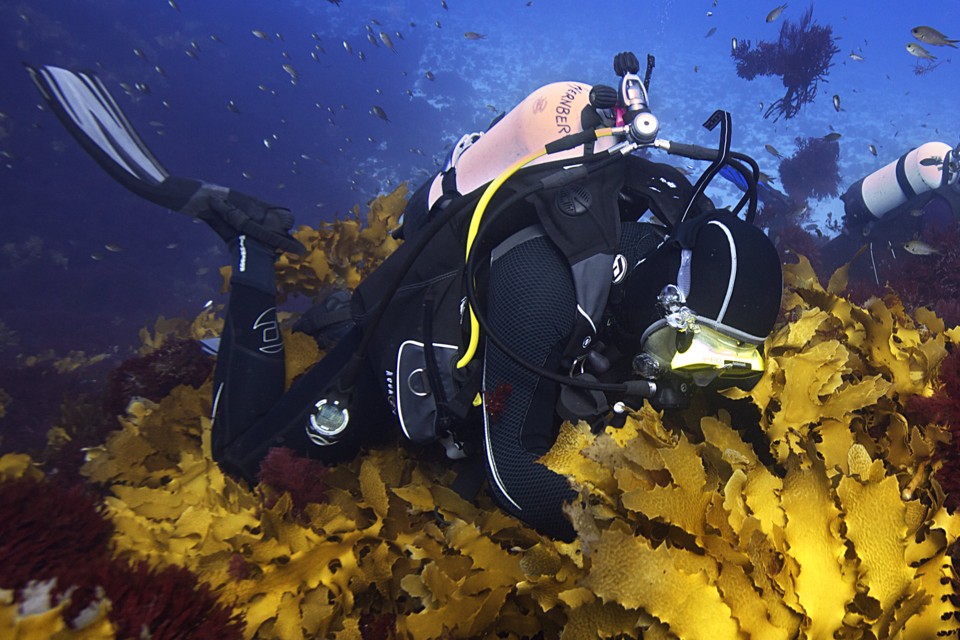
"They last dived the area in 2010. Then, as in the previous decade, they had swum among vast forests of kelp—a tagliatelle-like seaweed whose meter-tall fronds shelter lush communities of marine life. But just three years later, the kelps had disappeared. The duo searched for days and found no traces of them. They only saw other kinds of seaweed, growing in thin, patchy, and low-lying lawns. “We thought we were in the wrong spot,” says Bennett. “It was like someone had bulldozed the reef. It was like a moonscape underwater—scungy, brown, and empty.” (Image: Joan Costa)

"Frustrated by these limitations, Martin Wiselski at the Max Planck Institute for Ornithology devised the ICARUS Initiative (International Cooperation for Animal Research Using Space). His team has developed extremely light radio tags that can be fitted to even tiny animals, and they’re sending a dedicated receiver to the International Space Station next summer. Once it’s up, it will be able to map the whereabouts of hundreds, if not thousands of birds, bats, and other travelers, in real-time. “It will be the best ever possible sensing network of life on the planet,” says Wiselski." (Image: Reuters)
"Every year, in northern Myanmar, thousands of farmers pull tonnes of Cretaceous amber out of the ground, and send the glistening nuggets to local markets. For six years, Bo Wang from the Chinese Academy of Sciences and his colleagues have visited the markets and sifted through 300,000 of the glistening nuggets. It was a lot of work. Then again, it takes a lot of work to find animals that spent their whole lives trying not to be found." (Image: Wang et al.)
"Swordfish steaks frequently appear on menus and dinner plates around the world. But even though many people have hooked, hacked apart, and devoured these majestic fish, few truly understand their bodies. Indeed, until John Videler from Leiden & Groningen University started studying swordfish, no one knew that they had a fist-sized gland in their heads, which slathers lubricating oil over their famous pointed snouts." (Image: Postdlf)
More good reads
You can also
follow me on Twitter or find my writing
at The Atlantic or
on my blog. If someone has forwarded this email to you, you can
sign up yourself.
And that's it! Thanks for reading.
-Ed