
Your AI co-pilot is waiting for you
Four tools, £300 a month, one seriously useful stack →

Well, hello, and welcome to this week’s edition of the eCommercer.
I came across this statistic recently that 56% of CEOs report zero ROI from their AI investments. Not a little return. Zero.
I don't think that's because AI doesn't work. I think it's because most of us are dabbling. We've opened ChatGPT, asked it to write something, closed the tab, and gone back to doing things the way we always have.
Dabbling doesn't generate returns.
So this week I want to share exactly what we're doing with AI across our ecommerce businesses right now. The actual stack, what it costs, and why each tool has earned its place.
Have a great week, wherever you are in the world.
Until next time,
This Week's Episode of the eCommerce Podcast →
How I'm Using AI in My Ecommerce Businesses Right Now
The four tools we use
Across the whole company, we use four AI tools. We've tried more — there was a phase of chasing shiny objects and forgetting about half of them within a fortnight. We stripped it back.
The four that stuck are Claude, Perplexity, Google NotebookLM, and Google Gemini's image generation (which went viral under the name Nano Banana — a much better name). Total cost sits around £300–350 a month for the whole company.
Claude Code and Obsidian
This combination is the one I get genuinely excited about. Claude Code is Claude — the AI assistant — but living inside your computer's terminal rather than a browser. It can see your files, run commands, and make changes directly. Think of the difference between texting a plumber for advice versus having the plumber in your house with their tools.
I pair it with Obsidian, a note-taking app where every note is a plain text file sitting on your computer. Not locked in someone else's cloud. Just simple markdown files that Claude can read, update, and work with directly.
The result is an AI that actually knows your business. All our company information lives in the vault — branding documents, past podcast scripts, playbooks, content plans. When I brainstorm a new episode, Claude doesn't start from scratch. It already knows my voice guide, what we've covered before, the full business context. The difference between that and a new chat window is like the difference between a new employee who knows nothing and a team member who's spent six months reading every document you've ever written.
The thing that showed me what it could really do was a mobile conversion project. One of our ecommerce sites had drifting mobile numbers. After a podcast with mobile optimisation expert Adam Pearce, I fed the transcript into Claude Code, extracted the key points, fact-checked them, and researched the gaps. Built a Mobile Optimisation Playbook in an hour. Then a web app that scores any site against it — two more hours. Redesigned UI modules the next day. One person. Less than a full working day. That would have taken weeks before.
Perplexity
Where Claude Code and Obsidian form my thinking partner, Perplexity is my research department. The key difference is sources — it gives you clickable links so you can verify every claim. Given how good AI is at confidently stating things that aren't true, that matters a lot. Episode 274 on narrative binding came from a full day of Perplexity deep research, following source links and building confidence in the topic. The result was a 30-page document that became the backbone of that episode.
I also use the voice chat feature on my Wednesday morning walk to the office. Sometimes business research. Sometimes 45 minutes on why the Roman Empire fell. Both are excellent.
NotebookLM
This one works differently. Perplexity goes out to the web and comes back with findings. NotebookLM works only with sources you give it — documents, notes, PDFs, YouTube videos, up to 300 sources — and stays strictly within that material.
The feature that still amazes me is the audio generation. You can have NotebookLM create a 20-minute audio overview — two voices, a natural conversation — built from your own sources. I listened to one on negotiation this morning and genuinely couldn't tell it from real humans. Podcasts on demand, on any subject, from your own research.
Nano Banana
The fourth tool is Google Gemini's image generation for product lifestyle shots. Upload a product photo, describe the context, and it generates it. The first thing I tried was asking for our Vegetology Omega-3 bottle by the ocean with dolphins jumping over it in a heart shape. The cheesiest concept I have ever had. It was so well done that I was impressed, even though we'd obviously never use it. For practical website and social media images, it's a fraction of the cost of a studio setup. We still use our photographer Lindy — AI supplements what she does rather than replacing her.
The lesson from our own team
Even in a tech company, adoption was slower than I expected. AI hasn't always lived up to the hype, and most of us have spent more time fixing AI output than the original task would have taken. I've been there too.
But the lesson I'd offer is this. Start with one use case. Pick the one that resonates most with where you are right now, and give it a proper go for two weeks. Not a quick play — a real commitment to learning what it means for your business. When you get stuck, just ask the AI what to do next. It's getting remarkably good at answering that question.
Visit Episode Page →This Month’s Cohorter →
https://www.madebyforest.de
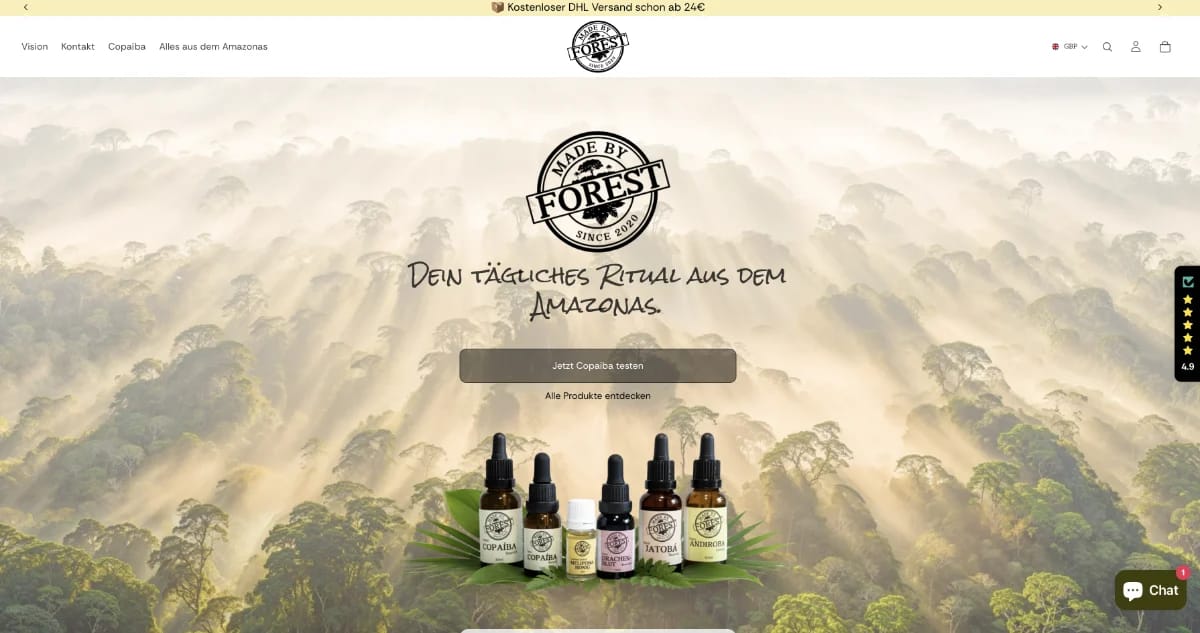
Cohort it our free monthly mentorship programme, and this month the Cohorters got to work on Made By Forest with Chris Totz.
I grew up in the Amazon region of Brazil, deep in the forest, so MadeByForest was never just a normal business idea for me. It started from a bigger question that had been in the back of my mind for years: how do I connect where I come from with something meaningful today, in a way that creates real value, keeps the forest standing, and brings genuinely good products to people?
That is really where MadeByForest comes from. Not from a random idea, but from a personal background, a lot of trial and error, and the wish to build something that is commercially strong but also actually means something, also, not just a side-project, but intended to be a legacy.
One thing I had been missing for a long time was connection with people in eCommerce. In my own environment, there were very few people I could really talk to about building a ecom brand, growing a business, making good decisions, or just dealing with all the pressure and uncertainty that comes with building something from scratch. So when I found Matt Edmundson through the Ecommerce Podcast, that already stood out to me. He has a way of talking about eCommerce that feels grounded, really honest and actually useful. Then later I joined the Cohort, and that felt like a real match.
What the Cohort gave me straight away was perspective. You realise very quickly that you are not the only one carrying certain problems, second-guessing decisions, or trying to work out what the real priority is. That alone already helps. But what made it especially valuable to me is that it is not just motivational talk. It is real feedback from people who are in the middle of it themselves.
When the group reviewed MadeByForest, that helped me a lot, because it made the main issue much clearer. Our site still did not feel like what the brand actually is. It looked too generic, too clean, too much like a normal store. But MadeByForest should feel organic, real, premium, rare, and rooted in the Amazon. It should feel like there is a deeper story behind it, because there is.
That was probably the biggest takeaway for me. We do not just need a better-looking website. We need a site that feels more like an experience and less like a standard shop. Stronger storytelling, stronger branding, more trust, more of the real origin, more of the human side behind the products, because as we all know, people trust people... The feedback helped me see that much more clearly, and it gave me a better sense of what actually matters now instead of trying to improve everything at once.
What I also appreciate is that the Cohort is free, which honestly still surprises me a bit, because the value is hard to put a price on. You get honest criticism, practical ideas, accountability, and something that is probably even rarer: real connection with people who understand what you are trying to build.
For me personally, that matters a lot. I have often felt a bit between worlds, and even more in business that can be a lonely place. So finding a group like this, through Matt and the podcast, has genuinely helped me. I would absolutely recommend it to anyone who wants real feedback and real conversations with people who get it. Also looking forward to all the good friendships that will grow from it :)
Chris Totz, MadeByForestIf you’re not in one of our Cohort groups and would like to know more about how to get involved - check out https://www.ecommerce-podcast.com/cohort for more info.
Freebie of the Month →
The AI Co-Pilot Starter Kit
To go alongside this episode, I've put together a practical guide covering the four tools, getting-started guides, and some of the prompts I use day to day. There's also a priority matrix to help you work out where to start, because the overwhelm often stops people from starting at all.
Be A Guest →
Got an eCommerce business with stories worth sharing?
Come be my guest on the eCommerce Podcast, where I chat with founders about the wins, the disasters, and everything in between. Your story could be the one that helps another founder grow smarter (or avoid your mistakes).