
When Doing Less Builds More Value
Two founders with two different challenges found the same solution which was to simplify to scale.

Well, hello, and welcome to this week’s edition of the eCommercer.
This week, we’re talking about something every founder eventually faces — that moment when growth starts to feel heavier instead of faster (it’s a good problem to have that’s for sure!).
I’ve had two great podcast conversations that hit this from different angles.
Steven Pemberton reminded me that real growth doesn’t come from adding more — it comes from knowing who you’re really serving.
And Ben Sharf showed how even the most successful brands can slow themselves down with overcomplication, and why sometimes the best move is to strip it all back.
Both conversations circle around the same point … the more you simplify, the more value you find.
Have a great week, wherever you are in the world.
Until next time,

Thought For The Week →
When Steven Pemberton’s Amazon business got shut down, he and his wife found themselves a hundred grand in debt and wondering what on earth to do next.
Two months later, they’d rebuilt from scratch on Shopify and were back doing a hundred thousand a month. Same people. Same skills. Entirely different outcome.
When I asked Steven what changed, he said the problem was that founders often focus on making more products instead of "taking more time to actually understand who your actual ideal customer is."
And he’s right. When growth stalls, our instinct is to add — new products, new ads, new agencies, new something. But often, what we really need to do is slow down and take a closer look at who’s already buying from us.
Steven told me about a client who sold a single $35 shoe. Instead of trying to launch hoodies and hats and “build a lifestyle brand,” they decided to double down on what worked. They offered a second pair at 50% off.
That simple move doubled their average order value, almost tripled conversions, and increased profits — all without touching their ad spend. Same traffic, same audience, just better understanding.
It’s a good reminder that growth isn’t always about more reach; sometimes it’s about better resonance.
The real challenge in eCommerce isn’t competition — it’s assumption. We assume we know our customers. We assume we need the next big thing. But if you don’t know exactly why your best customers buy from you, it’s hard to build anything sustainable on top of it.
The brands that last are the ones that keep learning — about their customers, their patterns, and their pain points. That’s what turns a fragile business into a resilient one.
So before you chase the next shiny thing, take a look at your last hundred orders.
Who keeps coming back?
What connects them?
That’s where the next stage of your growth probably starts.
This was the kind of conversation that quietly changes how you think about scaling — and it’s well worth a listen.
This Week’s Episode of the eCommerce Podcast →
Why Your Website Is Too Complicated (And How To Fix It)
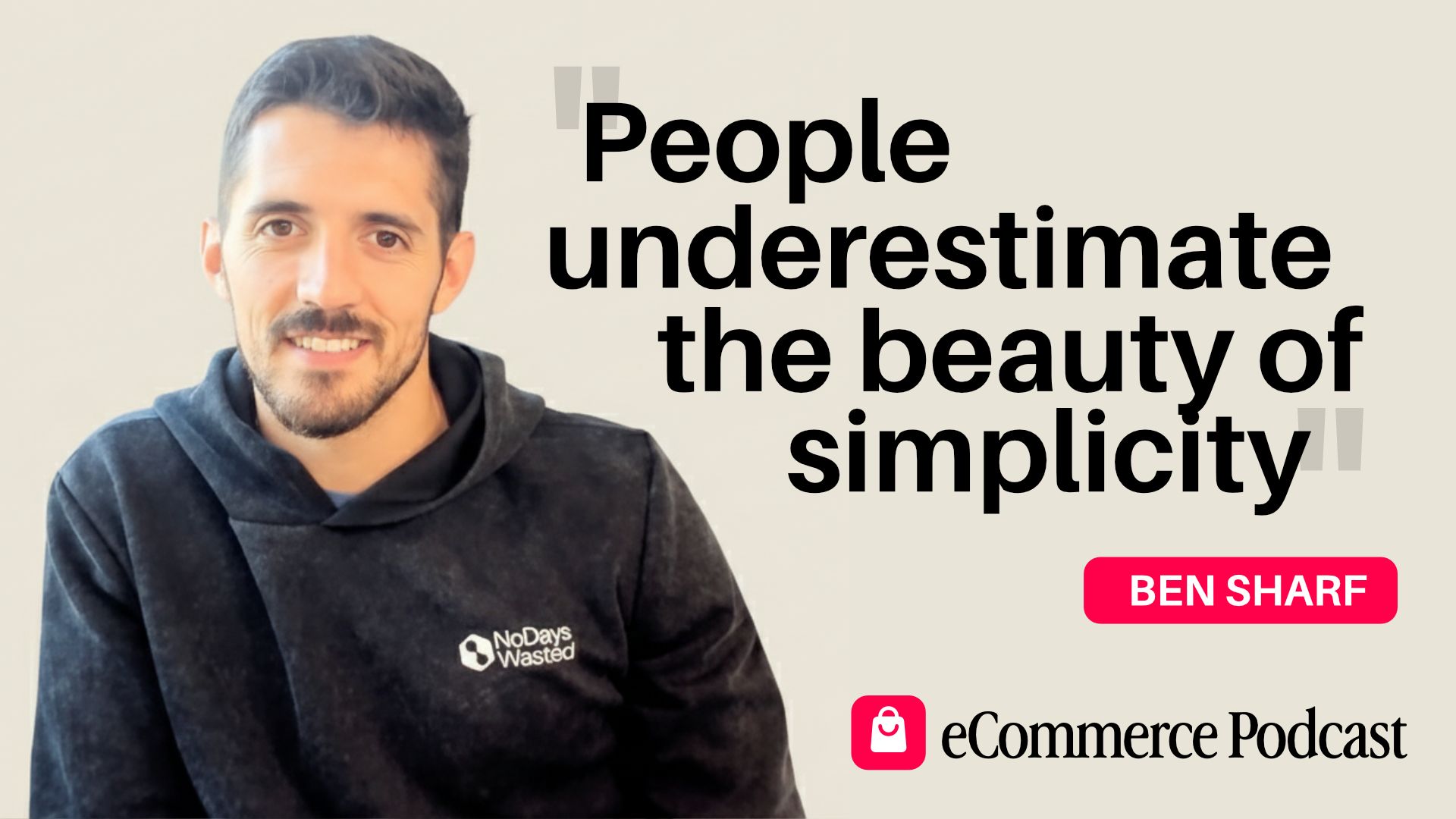
Ben Sharf has helped build over 200 Shopify stores, and noticed a familiar pattern. From the scrappy startups to the eight-figure giants, nearly everyone says the same thing … their website feels harder to manage than it should.
Why? Because what we often call “sophisticated” is really just complicated.
Ben calls it the hidden-code problem. When you delete a Shopify app, the code it adds doesn’t actually go away. It stays there and slows things down and adds invisible layers of technical debt.
He told me about a brand doing $20 million a year. Over seven years they’d had five agencies, seven freelancers, and around 150 apps installed and deleted — all on the same storefront.
“What do you think happens when the next person tries to touch that?” Ben said. “It’s just a spider web.”
The app ecosystem is brilliant when you’re getting started, but it also tempts you to solve every problem by installing something new. Need reviews? There’s an app. Want a countdown timer? Another app. Before long, you’re juggling dozens — each adding code, each another subscription, each another thing that can break.
As Ben put it:
“A lot of these apps are features, not products. But when you stack enough of them together, you end up with a lot of single points of failure.”
So how do you fix it?
It’s not about doing more — it’s about simplifying to scale.
Here’s what Ben focuses on:
1. Consolidate instead of accumulate.
Be ruthless about what stays. If two apps overlap, one goes.
2. Create clarity.
“Give your website to a seven-year-old and a ninety-year-old and see what happens.”
Count how many clicks it takes to buy something. You’ll be amazed how much friction you’ve added without realising it.
3. Let data guide the decisions.
Track revenue per visitor, not just conversion rate or AOV. It’s the one metric that shows whether everything is working together.
He shared a story that sums it up. A brand selling accessories at two price points — $25 and $75 — had a free-shipping threshold set at $60.
“If people are spending either $25 or $75, that incentive should sit closer to $74 or $75,” he said.
It’s simple maths, but it’s the kind of clarity most of us miss when we’re caught up in tweaking everything else.
Ben laughed and said,
“It’s not rocket science. You’re just trying to get someone to come to your website and buy a product.”
And that’s the point. The brands that win aren’t the most complicated. They’re the ones that make it easiest for customers to say yes.
Sometimes the smartest move isn’t to add more.
It’s to do less — just better.
Ben’s Links:
Company: Platter → https://platter.com/
Freebie of the Month →
A comprehensive audit tool that maps 8 areas of digital marketing across 4 growth stages. This 30-minute exercise uses gap analysis scoring to show you exactly where your biggest opportunities lie and which priorities will move the needle. Includes 109 checklist items, scoring framework, coaching questions, and a complete glossary of terms.
Be A Guest →
Got an eCommerce business with stories worth sharing?
Come be my guest on the eCommerce Podcast, where I chat with founders about the wins, the disasters, and everything in between. Your story could be the one that helps another founder grow smarter (or avoid your mistakes).